



A Cash flow management is a combination of banking services, software and processes that helps a business collect, pay, track, forecast and invest its cash. It gives finance teams a real-time view of liquidity across every account, so they can cover obligations, reduce borrowing and put idle cash to work.
For US mid-market and enterprise companies, cash management is now a board-level issue. A PYMNTS Intelligence study found that 77.9% of CFOs rate improving the cash flow cycle as very or extremely important. The same research shows most firms already use at least one AI tool to manage cash flow.
This guide explains the five types of cash flow management, the features that matter, what they cost in the US, and how to choose between software, bank services and an outsourced team.
| Metric | Why it matters |
|---|---|
| 77.9% of CFOs prioritize the cash flow cycle [source] | Cash is a strategic, board-level concern |
| $19M average working-capital opportunity for middle-market firms (Visa/PYMNTS Working Capital Index) | Better cash processes release real money |
| Average global DSO near 59 days [source] | Slow collections tie up working capital |
What are cash management solutions?
Cash management solutions cover everything a company uses to manage money moving in and out of its accounts. That includes the bank services that move the money, the software that tracks and forecasts it, and the people and processes that run it.
For years, cash management meant reconciling bank statements at month-end. Today, a good setup updates daily or in real time across every account, entity and currency. It flags shortfalls weeks ahead instead of reporting them after the fact.
A complete cash management solution handles six jobs:
- Collections: getting paid faster through invoicing, lockbox, ACH and card acceptance, and automated follow-up. This is where the order-to-cash process turns revenue into cash.
- Disbursements: paying vendors and payroll on time, at the right moment, with approval controls.
- Cash positioning: knowing exactly how much cash sits in each account today.
- Forecasting: predicting cash needs for the next 13 weeks and beyond.
- Liquidity and investment: moving surplus cash into yield-bearing accounts and covering gaps with credit lines.
- Controls and reporting: reconciliation, fraud prevention, audit trails and management reports.
5 types of cash management solutions
Most US companies use a mix of these five. The right combination depends on your size, number of entities and how much in-house finance capacity you have.
1. Bank treasury management services
Your commercial bank provides the rails that move money. Common US treasury services include:
- Lockbox: the bank receives and deposits customer checks for you.
- Remote deposit capture: scan checks and deposit them without visiting a branch.
- ACH origination and wires: send and receive electronic payments.
- Positive pay: the bank matches every check and ACH debit against your issued list to block fraud.
- Controlled disbursement: see each day’s clearing amount early so you fund only what you need.
- Sweeps and zero-balance accounts: move balances automatically between operating and investment accounts.
Bank services are essential, but each bank’s portal only shows its own accounts. Companies with several banks need a layer on top.
2. Treasury management systems (TMS) and ERP cash modules
A TMS or ERP module (such as SAP Treasury or Oracle Cash Management) pulls data from all your banks into one view. It supports cash positioning, forecasting, bank reconciliation and debt and investment tracking. These tools are powerful but need implementation budget and skilled users.
3. AP and AR automation software
These tools focus on payables and receivables: invoice capture, approvals, payment runs, collections reminders and cash application. They shorten days sales outstanding (DSO) and give you better control over when cash leaves.
4. Business banking and spend platforms
Fintech platforms combine accounts, corporate cards, bill pay and simple treasury yield in one login. They suit smaller or fast-growing companies that want simplicity over deep treasury features.
5. Outsourced or managed cash management services
Software only works when someone runs it every day. A managed service provides the team that reconciles accounts, updates the 13-week forecast, chases overdue invoices, schedules payments and reports to the CFO. It sits on top of your existing bank and ERP.
This option suits mid-sized companies that have outgrown spreadsheets but don’t want to hire a full treasury team. Corient’s Finance and Accounting services work this way, running cash processes inside your own systems.
| Type | Best for | Main strength | Main limitation |
|---|---|---|---|
| Bank treasury services | Every business | Moves money securely | One bank’s view only |
| TMS / ERP module | Large, multi-entity firms | Deep treasury features | Cost and complexity |
| AP/AR automation | High invoice volumes | Faster collections, lower DSO | Covers part of the cycle |
| Business banking platform | Small and growing firms | Simple, all in one | Limited forecasting and controls |
| Outsourced / managed service | Mid-market without a treasury team | Expert people plus process | Depends on provider quality |
Key features to look for
Whatever mix you choose, check that it covers these capabilities natively rather than through fragile add-ons.
- Bank connectivity: API, BAI2 and SWIFT MT940 feeds from every US and international bank you use.
- Real-time cash positioning: one dashboard showing balances across accounts, entities and currencies.
- Cash forecasting: 13-week rolling forecasts plus longer views, with base, upside and downside scenarios. Strong financial reporting tools feed the data forecasts depend on.
- Automated reconciliation: bank transactions matched to the general ledger daily, with exceptions flagged.
- AP and AR automation: invoice capture, approvals, payment scheduling, collections reminders and cash application.
- Payment execution: ACH, domestic wires, RTP/FedNow and international SWIFT payments from one place.
- Liquidity tools: automated sweeps, cash pooling and access to money market funds or Treasury bills for surplus cash.
- Controls and security: role-based access, dual approval on payments, positive pay and fraud alerts.
- Audit readiness: complete audit trails and SOX-friendly controls for public and pre-IPO companies.
- ERP integration: two-way sync with SAP, Oracle, NetSuite, Microsoft Dynamics or QuickBooks.
Cash management vs. liquidity management vs. treasury management
The three terms overlap but differ in scope. Cash management is the daily core; treasury management is the widest umbrella.
| Cash management | Liquidity management | Treasury management | |
|---|---|---|---|
| Focus | Daily inflows, outflows and balances | Having enough accessible funds for planned and unexpected needs | Overall financial risk, funding and investment strategy |
| Time horizon | Days to weeks | Weeks to months | Months to years |
| Typical activities | Collections, payments, reconciliation, cash positioning | Forecasting, credit lines, sweeps, cash pooling, reserves | Debt, FX and interest-rate risk, investments, bank relationships |
| Usually owned by | Controller, AR/AP teams | Treasurer or finance manager | CFO and treasurer |
For a deeper look at how these connect to your core finance cycles, see P2P, O2C and R2R: the three cycles that run your finance function.
Cash Flow Management KPIs and liquidity ratios to track
A cash management solution should report these metrics automatically, at least monthly.
| KPI | Formula | What it tells you |
|---|---|---|
| Days sales outstanding (DSO) | (Accounts receivable ÷ Revenue) × Days in period | How fast customers pay you |
| Days payable outstanding (DPO) | (Accounts payable ÷ Cost of goods sold) × Days in period | How long you take to pay suppliers |
| Days inventory outstanding (DIO) | (Inventory ÷ Cost of goods sold) × Days in period | How long cash sits in stock |
| Cash conversion cycle (CCC) | DSO + DIO − DPO | Days between paying for inputs and collecting cash |
| Current ratio | Current assets ÷ Current liabilities | Broad short-term solvency |
| Quick ratio | (Current assets − Inventory) ÷ Current liabilities | Solvency without relying on stock |
| Cash ratio | Cash and equivalents ÷ Current liabilities | Strictest liquidity test |
| Forecast accuracy | 1 − (Absolute difference between actual and forecast ÷ Actual) | How reliable your cash forecast is |
Quick rule of thumb: if your DSO is more than 1.5 times your standard payment terms (for example, DSO above 45 days on Net 30), collections need attention.
6 Cash Flow Management Strategies That Free up Working Capital
Technology only pays off when it supports clear habits. These six strategies deliver the biggest gains for mid-sized US companies.
1. Shorten your cash conversion cycle
Automate invoicing and collections follow-up so invoices go out the day work is done and reminders go out before the due date. Apply incoming payments to invoices daily, not weekly.
2. Negotiate payment terms on both sides
Ask suppliers for longer terms and customers for shorter ones. Before taking an early-payment discount such as 2/10 net 30 (2% off if you pay in 10 days instead of 30), check the annualized return. That 2% for paying 20 days early equals roughly 37% a year, so it is usually worth taking if you have the cash.
3. Run a 13-week rolling cash forecast
Update the forecast every week and compare it with actuals. A weekly forecast exposes shortfalls six to twelve weeks ahead, while there is still time to act. Accurate books make this possible, which is why Record-to-Report services matter.
4. Put idle cash to work
Consolidate balances across entities daily with sweeps or cash pooling. Keep an operating buffer, then move surplus cash into money market funds or short-term Treasury bills.
5. Set credit policies before you onboard customers
Define credit limits, payment terms and escalation steps up front. Late-payer patterns usually show up in the first few invoices.
6. Tighten payment controls
Use positive pay, dual approval and vendor bank-detail verification. Payment fraud losses usually cost far more than the controls.
Worked example: what a lower DSO is worth
A distributor has $120 million in annual revenue and Net 30 terms, but its DSO is 63 days.
- Revenue per day = $120,000,000 ÷ 365 = about $329,000.
- Bringing DSO from 63 to 45 days frees 18 days of revenue.
- Cash released = 18 × $329,000 = about $5.9 million.
- At a 7% borrowing rate, that saves about $414,000 a year in interest on a credit line.
The figures are illustrative. Run the same calculation with your own revenue and DSO to size your opportunity.
How Much Do Cash Management Solutions Cost in The US?
Costs depend on company size, number of entities and banks, and whether you buy software, services or both. The ranges below are Corient estimates based on vendor pricing seen in client projects; always request a quote.
| Business size | Software subscription (per month) | Typical scope |
|---|---|---|
| Small (under $10M revenue) | $200–$800 | Basic AP/AR automation, one entity, limited bank feeds |
| Mid-market ($10M–$500M revenue) | $1,500–$8,000 | Multiple entities, forecasting, ERP integration, AR automation |
| Enterprise ($500M+ revenue) | $8,000–$25,000+ | Full treasury suite, multi-currency, SWIFT connectivity, SOX controls |
Three other costs are easy to miss:
- Implementation: often $5,000–$50,000, depending on integrations.
- Bank treasury fees: lockbox, positive pay, ACH and wire fees charged per item or per month. Review your bank’s account analysis statement.
- People: someone has to run the system daily. That is an in-house hire or an outsourced team.
Compare total cost of ownership (subscription, implementation, bank fees and staffing) against the cash released and interest saved. The DSO example above shows how quickly that return can add up.
When Does Your Business Need a Cash Management Solution?
You have likely outgrown spreadsheets and bank portals if any of these apply:
- You manage several bank accounts, legal entities or currencies.
- Your DSO is more than 1.5 times your payment terms.
- Bank reconciliation takes more than two or three days a month.
- You can’t say today’s total cash position without calling someone.
- You are preparing for a SOX audit, a fundraise or an IPO.
- You have acquired a company that runs on a different ERP or bank.
How to Implement a Cash Management Solution
- Map your current process. List every bank account, payment method, approval step and report. Note where time is lost.
- Set goals. Pick two or three measurable targets, such as cutting DSO by 10 days or closing reconciliation within five business days.
- Choose the mix. Decide which jobs your bank, software and team (in-house or outsourced) will each handle.
- Connect data. Set up bank feeds and ERP integration, then clean up vendor and customer master data.
- Run in parallel. Operate the new process alongside the old one for one close cycle and fix gaps.
- Train and assign ownership. Name a cash owner and train the team. Plan for four to six weeks of onboarding.
- Review monthly. Track the KPIs above and adjust as the business grows.
Common Cash Management challenges
- Poor data: forecasts built on late or incomplete books will be wrong. Fix the close first.
- Too many disconnected tools: each bank portal and spreadsheet adds manual work and error.
- Low adoption: a platform nobody updates daily delivers little value.
- Integration with legacy systems: older ERPs may need custom connectors or file-based feeds.
- No dedicated owner: in many mid-sized companies, cash management falls between the controller and the CFO.
How to Choose a Cash Management Solution: 10-Question Checklist
Use these questions when you compare vendors or write an RFP.
- Does it connect natively to your ERP (SAP, Oracle, NetSuite, Dynamics, QuickBooks)?
- Which bank connection standards does it support: API, BAI2, SWIFT MT940?
- Does forecasting use machine learning, fixed rules, or both, and can you model scenarios?
- Can it consolidate multiple entities and currencies in one dashboard?
- Which payment types can it send: ACH, wires, RTP/FedNow, international?
- What fraud controls and SOX-ready audit features are included?
- What is the total cost of ownership, including implementation and bank fees?
- How long does implementation take, and what internal time does it need?
- Who runs the process day to day after go-live?
- What uptime and support response times are written into the contract?
Software, Outsourcing, or Both?
For most mid-sized companies, the answer is both. Software gives you visibility and automation; experienced people make sure the forecast is updated, exceptions are cleared and collections actually happen.
Corient Business Solutions provides that team. Our finance and accounting specialists work inside your existing bank and ERP setup to:
- Reconcile bank accounts daily and report your cash position
- Build and maintain your 13-week cash forecast
- Run collections and cash application through Order-to-Cash services
- Schedule and control vendor payments through Procure-to-Pay
- Deliver monthly reporting and CFO-level advice through outsourced CFO and business advisory services
Struggling with cash flow management?
Corient’s finance specialists will review your cash process for free and show you where to cut DSO and release working capital within 90 days.
People Also Ask:
What is a cash management solution?
A cash management solution combines banking services, software and processes to collect, pay, track, forecast and invest a company’s cash. It gives finance teams real-time visibility of liquidity across all accounts.
What are examples of cash management services?
Common examples include lockbox, remote deposit capture, ACH and wire payments, positive pay, controlled disbursement, sweep accounts and cash pooling. Banks provide most of these, while software and outsourced teams manage the data and processes around them.
What is the difference between cash management and treasury management?
Cash management covers daily collections, payments and balances. Treasury management is broader and includes funding, investments, debt and financial risk such as FX and interest rates.
Do small and mid-sized businesses need cash management solutions?
Yes, once they have several accounts or entities, slow collections, or reconciliation that takes days each month. Smaller firms often start with bank services and AP/AR tools, then add forecasting or an outsourced team as they grow.
How much does cash management software cost?
Subscriptions typically range from about $200 a month for small businesses to $25,000 or more for enterprise treasury suites. Implementation, bank fees and staff time are extra.
Can I outsource cash management?
Yes. An outsourced finance team can handle daily reconciliation, forecasting, collections and payment scheduling inside your own systems, while you keep approval and control.
How does a cash management solution reduce DSO?
It sends invoices faster, automates payment reminders, makes paying easier for customers and applies payments quickly. Together these shorten the time between invoicing and receiving cash.
Conclusion:
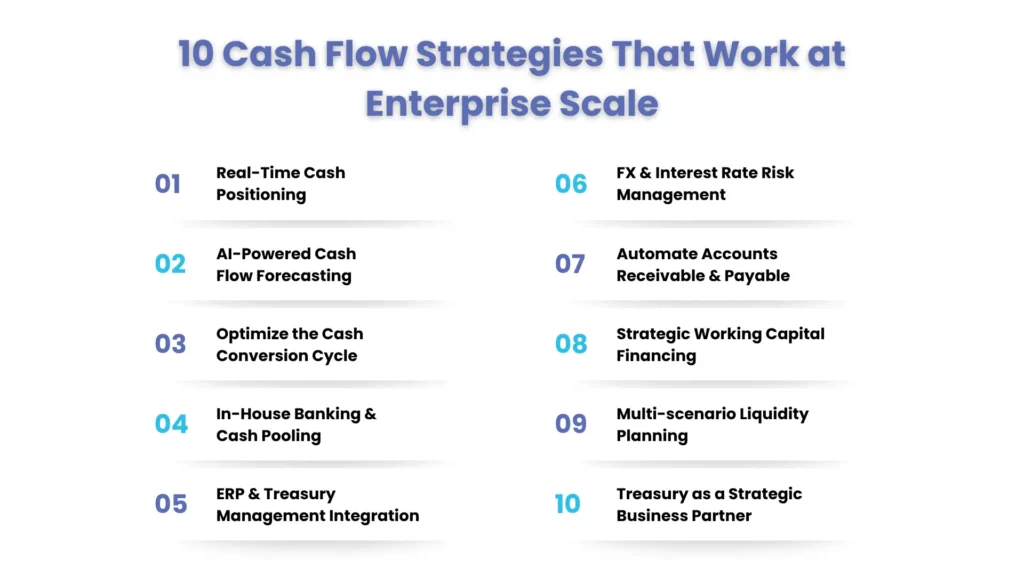
Cash flow management done well is not about being conservative, it’s about having the visibility and the tools to make smart, fast decisions with confidence. The enterprises that handle it best are the ones where treasury isn’t reacting to problems; they’re anticipating them, modeling options, and keeping the business in a position to move when opportunities arise.
That takes the right data, the right processes, and usually the right partners. Corient works with US enterprise finance teams to build cash management functions that actually perform, connecting AR automation, AP discipline, ERP integration, and strategic forecasting into something that works together, not in silos.
Take Control of Your Cash Flow Today
You don’t need a full treasury team to manage cash flow well. Corient’s finance specialists work inside your existing systems to reconcile accounts daily, keep your forecast current, and speed up collections. Book a free consultation and we’ll show you where your cash is stuck.