


Quick answer: P2P (Procure-to-Pay) is how a company buys and pays suppliers. O2C (Order-to-Cash) is how it fulfils customer orders and collects payment. Q2C (Quote-to-Cash) is the wider sales cycle that starts at the quote and contains O2C. R2R (Record-to-Report) records all of it and turns it into financial statements.
Every dollar that leaves or enters a business passes through one of four finance cycles. Procurement and accounts payable run P2P. Sales and revenue operations run Q2C and O2C. Accounting runs R2R. All four write to the same general ledger.
That shared ledger is why the handoffs matter. A clean handoff means a short month-end close and numbers leadership can trust. A messy one means finance spends the first two weeks of every month fixing data created somewhere else.
This guide covers what each cycle does, its steps, who owns it, the KPIs to track, and where U.S. companies most often lose time between them.
P2P vs R2R vs O2C vs Q2C: Key Differences
| Cycle | Money direction | Starts when | Ends when | Main owner | Key document | Headline KPI | Main U.S. compliance touchpoint |
|---|---|---|---|---|---|---|---|
| P2P (Procure-to-Pay) | Out | An employee raises a purchase request | The supplier is paid and the payment is posted | Procurement + AP | Purchase order | Cost per invoice | SOX approvals, W-9 / 1099, use tax |
| Q2C (Quote-to-Cash) | In | Sales issues a quote | Cash is collected and revenue recognized | Sales + RevOps + AR | Quote / contract | Quote-to-close time | ASC 606 contract terms |
| O2C (Order-to-Cash) | In | A customer places a confirmed order | Payment is applied to the invoice | Order management + AR | Sales order / invoice | DSO | ASC 606 timing, sales tax |
| R2R (Record-to-Report) | Records both | A transaction is posted to a sub-ledger | Financial statements are issued | Accounting + FP&A | Journal entry | Days to close | SOX 404, US GAAP, SEC filings |
P2P controls cash going out, Q2C and O2C bring cash in, and R2R proves both sides reconcile in the books.
What Is Procure-to-Pay (P2P)?
Procure-to-Pay (P2P) is the process a company uses to buy goods and services and pay suppliers. It runs from the first purchase request through approval, purchase order, receipt, invoice matching and payment. It is the main control point for company spend.
The 7 steps of the P2P process
- Purchase requisition: an employee requests a good or service against a budget line.
- Approval: the request is routed by amount, cost center and category.
- Vendor onboarding: new suppliers submit a W-9, banking details and a certificate of insurance before any PO is issued.
- Purchase order: the approved request becomes a PO with agreed price, quantity and terms.
- Goods or service receipt: the receiving team confirms what actually arrived.
- Three-way match: AP matches the invoice against the PO and the receipt, and flags any variance.
- Payment: the invoice is paid by ACH, wire, check or virtual card on terms, capturing early-payment discounts where they apply.
Why P2P matters for U.S. companies
P2P is the one cycle where finance can stop a cost before it happens instead of explaining it afterwards. It also carries tax obligations that are easy to miss. W-9 collection at onboarding sounds basic, but missing W-9s are a common reason 1099-NEC and 1099-MISC filings go wrong in January. Use tax on out-of-state purchases can go unnoticed for years until a state audit finds it.
For public companies and any business on an IPO track, P2P is also where many SOX controls sit. Auditors test segregation of duties between requester, approver and payer, documented approval limits, and a trail linking each payment to a PO and a receipt.
When P2P breaks down, invoices arrive with no PO, discounts expire while AP chases approvals, and coding decisions pile up for month-end. When it works, the data reaching R2R is already structured, and AP becomes a strategic function instead of a reactive one.
For a deeper walk-through, our P2P outsourcing services.
What Is Order-to-Cash (O2C)?
Order-to-Cash (O2C) is the process that turns a confirmed customer order into cash in the bank. It covers credit checks, order management, fulfilment, invoicing, collections and cash application. For U.S. companies it also sets revenue recognition timing under ASC 606.
The 7 steps of the O2C process
- Order capture: the customer’s order is entered and validated against pricing and contract terms.
- Credit check: the customer’s credit limit and payment history are reviewed before the order is released.
- Fulfilment: goods are picked, packed and shipped, or the service is scheduled and delivered.
- Proof of delivery: delivery or completion is confirmed and stored with the order.
- Invoicing: a compliant invoice is issued, including the correct state sales tax.
- Collections: AR follows up on overdue balances and handles disputes and deductions.
- Cash application: incoming payments are matched to open invoices and posted.
ASC 606 compliance
Subscription and SaaS businesses depend on getting performance obligations, transaction-price allocation and recognition timing right. If the contract terms feeding O2C don’t match what gets recognized in R2R, your revenue numbers won’t survive an audit.
DSO and cash conversion
Net 30 is the assumption, but in many B2B segments customers pay later than that. A well-run O2C cycle, supported by O2C automation, keeps orders, delivery confirmations and invoices aligned, so customers can’t hold payment over missing paperwork.
When O2C data flows cleanly into R2R, finance gets a reliable view of expected cash, can model working capital with confidence, and can give the board a forecast without caveats.
What Is Quote-to-Cash (Q2C)?
Quote-to-Cash (Q2C) is the full sales-to-cash cycle. It starts when sales prepares a quote and ends when the customer’s payment is collected and revenue is recognized. Q2C includes O2C, plus the pricing, quoting and contracting work that happens before an order exists.
The 6 steps of the Q2C process
- Configure and price: sales defines the product or service mix and applies list prices, discounts and approvals, often in a CPQ tool.
- Quote: a formal quote goes to the customer, and may be revised during negotiation.
- Contract: accepted terms become a signed contract. Finance should review billing terms, renewal clauses and performance obligations here.
- Order: the contract converts to a sales order. From this point the O2C steps apply.
- Billing and collection: invoices follow the contract’s schedule, which may be one-time, milestone, usage or subscription.
- Revenue recognition and renewal: revenue is recognized under ASC 606, and the contract is tracked for renewals and upsells.
O2C vs Q2C: what’s the difference?
| # | O2C | Q2C |
|---|---|---|
| Starts at | Confirmed order | Quote |
| Includes pricing and contracts | No | Yes |
| Main owner | Operations + AR | Sales, RevOps + AR |
| Most relevant for | Product and distribution businesses | SaaS, subscription and services businesses |
In short, O2C is a subset of Q2C. If your revenue depends on negotiated contracts or subscriptions, manage the whole Q2C cycle. Errors made at the quote stage show up later as billing disputes and ASC 606 adjustments.
What Is Record-to-Report (R2R)?
Record-to-Report (R2R) is the accounting process that turns every transaction from P2P, O2C and Q2C into financial statements. It covers journal entries, reconciliations, accruals, the period-end close and reporting to leadership, auditors and regulators.
The 6 steps of the R2R process
- Record: transactions post from sub-ledgers (AP, AR, payroll, fixed assets) to the general ledger, with manual journal entries where needed.
- Accrue and adjust: accruals, prepaids, depreciation and revenue deferrals are booked so the period is complete.
- Reconcile: bank, sub-ledger and balance sheet accounts are reconciled, and differences are investigated.
- Consolidate: intercompany transactions are eliminated and entities are combined.
- Close: the period is locked after review and sign-off.
- Report: financial statements, management reports and, for public companies, 10-Q and 10-K filings are prepared.
Where weak P2P and O2C show up
R2R is where problems from the other cycles become visible. A miscoded purchase shows up as a wrong expense line. A missing receipt creates a goods-received-not-invoiced (GRNI) balance that auditors flag. A customer payment that doesn’t match an invoice sits in a suspense account until someone reconciles it.
When R2R runs cleanly, the close is measured in days rather than weeks, variances are explained early, and finance can spend the second half of the month on analysis instead of reconciliation. For public companies under SOX 404, this is also where control effectiveness is proven, and where deficiencies become disclosable.
Related: our Record-to-Report process guide and R2R services.
How P2P, O2C, Q2C and R2R Connect
P2P and O2C feed the ledger, R2R turns it into reports, and those reports set next period’s budgets and credit decisions.
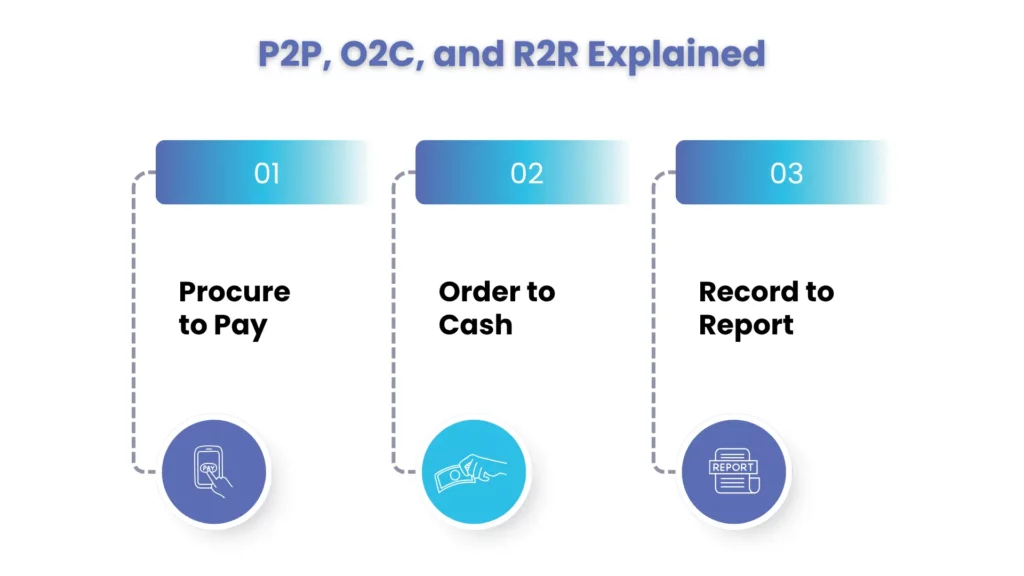
The cycles meet at three handoff points, and each one is a place where errors enter the ledger:
- Coding at purchase (P2P to R2R): the GL account, cost center and project chosen on the PO decide where the expense lands. Getting it wrong at the PO means a reclass at close.
- Timing at delivery (O2C to R2R): under ASC 606, revenue generally follows when control transfers, not the invoice date. Goods shipped on December 30 but invoiced on January 2 is a classic cut-off error.
- Master data at onboarding (P2P and Q2C to R2R): vendor tax status and customer contract terms set up once, wrong, create errors every month. A misclassified vendor surfaces as a 1099 problem eleven months later.
Fix these three points at the source and most month-end reconciliation work goes away. That is why Corient reviews them first when we take over a client’s finance operations.
KPIs to Track for Each Cycle
Each cycle has a small set of metrics that show whether it is working. Track them monthly and watch the trend.
| Cycle | KPI | What it tells you |
|---|---|---|
| P2P | Cost per invoice processed | How efficient AP is |
| P2P | First-pass three-way match rate | How clean POs and receipts are |
| P2P | Days payable outstanding (DPO) | How well you use supplier terms |
| P2P | Early-payment discounts captured | Whether approvals are fast enough |
| O2C | Days sales outstanding (DSO) | How fast invoices turn into cash |
| O2C | Collection effectiveness index (CEI) | How much collectible AR was collected |
| O2C | Invoice dispute rate | Whether orders, delivery and invoices match |
| Q2C | Quote-to-close cycle time | How fast sales converts quotes |
| Q2C | Billing accuracy vs contract | Whether contract terms reach billing correctly |
| R2R | Days to close | Overall health of all four cycles |
| R2R | Post-close adjustments | How many errors slipped through |
| R2R | Unreconciled balance items | Where data quality is failing |
Where the Cycles Break Down
Most close problems trace back to a specific upstream cause. Use this table to fix the source instead of the symptom.
| Symptom at close (R2R) | Root cause | Cycle to fix |
|---|---|---|
| Expense reclasses every month | Wrong GL or cost center on the PO | P2P |
| Large GRNI balance | Goods received but invoice not matched, or receipts not logged | P2P |
| Unapplied cash in suspense | Remittance details missing or payments not matched | O2C |
| Revenue in the wrong period | Invoice date used instead of delivery date | O2C |
| ASC 606 adjustments at audit | Contract terms not reflected in billing schedule | Q2C |
| 1099 errors in January | Missing or wrong W-9 at vendor onboarding | P2P |
| Use-tax exposure found in audit | Tax not accrued on out-of-state purchases | P2P |
Example: The Four Cycles at a Fortune 500 Company
Take a U.S. consumer goods company with 25 plants, 6,000 vendors, and customers in all 50 states and 40 other countries.
P2P: it issues purchase orders for $800 million of raw materials, packaging and logistics. It runs three-way matching at every plant, collects W-9s and insurance certificates from new vendors, and accrues use tax on out-of-state purchases. It pays 6,000 suppliers by ACH and virtual card and captures early-payment discounts.
Q2C and O2C: it negotiates annual contracts with national retailers and sells to thousands of smaller stores. It issues millions of invoices a month across transactional, milestone and subscription billing. It manages credit limits, recognizes revenue under ASC 606, and collects $3 billion in receivables each month.
R2R: at quarter-end, corporate finance consolidates 25 plant ledgers and eliminates intercompany balances. It posts accruals, completes SOX 404 testing, closes in 6 working days and files the 10-Q with the SEC.
These are the same cycles a corner coffee shop runs: buy, sell, report. The difference is scale: hundreds of millions of dollars, thousands of employees, a cloud ERP, a global business services center and SEC deadlines.
A 20-person agency sits in between. It pays freelancers and software bills (P2P), sends proposals and invoices clients (Q2C and O2C), and closes its books each month in QuickBooks or Xero (R2R).
Automate, Outsource or Keep In-House?
There are three ways to run these cycles, and most mid-market companies end up combining them.
| Option | Best when | Watch out for |
|---|---|---|
| Keep in-house | You have a strong controller and stable volume | Key-person risk; the close slips when someone leaves |
| Automate | Volumes are high and rules are repeatable (invoice capture, matching, cash application) | Software needs clean master data and someone to manage exceptions |
| Outsource | You need capacity, SOX-ready processes or a faster close without hiring | Needs clear SLAs, access controls and a defined handoff to your team |
A common setup is to keep decisions in-house, automate high-volume steps inside your ERP (NetSuite, Sage Intacct or Microsoft Dynamics), and outsource the transactional work and reconciliations.
Corient runs P2P, O2C and R2R for U.S. companies as an extension of their finance team, with SOX-ready controls and a defined close calendar. Talk to our team about which cycle to fix first.
People Also Ask:
Is O2C the same as Q2C?
No. Q2C starts at the quote and includes pricing and contracts. O2C starts once a customer places a confirmed order. O2C is a subset of Q2C.
What is the difference between P2P and O2C?
They are mirror images. P2P is your company buying and paying, which creates payables. O2C is your company selling and collecting, which creates receivables.
How does Record-to-Report (R2R) differ from P2P?
P2P controls how your company spends and pays vendors. R2R takes those transactions and turns them into accurate financial statements, reconciliations and compliance reports. Simply put, P2P executes the spend and R2R records and reports it.
What is the difference between P2P and S2P?
Source-to-Pay (S2P) adds the sourcing stage: finding suppliers, running RFPs and negotiating contracts. P2P starts once a supplier is approved and covers purchasing through payment.
Do we need a separate system for each cycle?
Not necessarily. Many mid-market companies run all four from a connected ERP like NetSuite, Sage Intacct or Microsoft Dynamics, with specialized tools added for procurement, CPQ, order management or AP automation. What matters is that data flows cleanly between cycles, not how many tools are in the stack.
How does SOX fit into this?
SOX controls touch every cycle. P2P controls cover purchase approvals and payments. Q2C controls cover contract review and pricing approvals. O2C controls cover revenue recognition under ASC 606. R2R controls cover the close and reporting process. For public and pre-IPO companies, these are tested every year.
Which cycle has the biggest impact on the month-end close?
R2R is where the close happens, but most close delays start in P2P or O2C. Fixing coding and timing at the source usually shortens the close more than changing R2R itself.
Where should we start if all four feel broken?
Start with Procure-to-Pay. It produces the fastest wins through vendor onboarding, approval workflows and spend visibility, and the improvements show up in Record-to-Report within one or two close cycles.
What are other end-to-end finance processes?
Besides P2P, O2C, Q2C and R2R, common ones are Hire-to-Retire (H2R) for payroll and HR, Source-to-Pay (S2P), and Acquire-to-Retire (A2R) for fixed assets.
Conclusion
P2P, O2C, Q2C and R2R are not four separate processes. They are four views of the same money moving through the same ledger. Run them as one connected system, with shared data, clean handoffs and consistent coding at the source. Your finance team then spends less time fixing last month and more time planning the next one.
Whether you’re a growing startup or an established enterprise, getting these four cycles to work as one is what separates a reactive finance team from a strategic one. At Corient, we help U.S. businesses build that connected system: SOX-compliant, US GAAP-ready, and built to close faster, report with confidence, and give your CFO the numbers that drive decisions.