


Financial close automation has changed the way enterprises perform their month-end, quarter-end, and year-end financial closes, not through manual procedures but through automation, intelligent workflows, and real-time financial insights. Reconciliation and preparing reports take weeks, but financial close automation has enabled finance teams to close faster, improve accuracy, and focus on strategic decision-making.
Consider this scenario: On the last day of the month, your finance team is racing against the clock. Spreadsheets are being sent between departments, reconciliations are incomplete, delays in approvals, and your executives are waiting for financial reports based on which critical business decisions have to be made. Everything is delayed, and when the figures arrive, you cannot guarantee their accuracy.
This is the reality faced by many large enterprises.
The fact of the matter is, as your business grows, it will be increasingly difficult to manage the close processes manually. When multiple entities, different ERP systems, high transaction volumes, and strict compliance are involved traditional financial close processes becomes difficult, slow and expensive.
That’s why enterprises across the United States are investing in financial close automation.
According to the U.S. Census Bureau’s BTOS data (December 2025 to May 2026) show that overall AI usage among businesses hovered between 17% and 20%.
In this guide, we’ll explain what financial close automation really involves, why manual processes hold businesses back, how modern automation works, and how Corient helps enterprises modernize and optimize their financial close operations.
What Financial Close Automation Actually Involves
Under financial close automation, technology like AI tools or accounting software with AI features is used to simplify, standardize, and automate activities related to closing financial periods.
Rather than relying on spreadsheets, email, and manual tracking, enterprises can use integrated workflows that will automate repetitive tasks and ensure transparency across the entire close process.
Key Takeaways
- Reduces manual accounting work
- Accelerates month-end and year-end close
- Improves financial accuracy
- Standardizes close processes
- Supports regulatory compliance
- Enhances collaboration across finance teams
- Provides better visibility into close status
Understanding Financial Close
The financial close process typically includes:
- Account reconciliations
- Journal entries
- Intercompany eliminations
- Balance sheet reviews
- Financial statement preparation
- Variance analysis
- Executive reporting
- Compliance reviews
With accounting close process automation, many of these repetitive activities are completed automatically, allowing finance professionals to spend more time reviewing results rather than preparing them.
Why Business Hit a Wall With Manual Close Processes
If your enterprise were small, a manual financial month-end close process would have been sufficient. But as your enterprise grows, complexity and volume will rise, making manual processes irrelevant.
Some of the common challenges you will face are:
Multiple Data Sources
Your finance teams will have to gather data from multiple sources like payroll systems, ERP systems, subsidiaries, and operational platforms. Manually doing such a task will lead to a lot of time and resource consumption, which is unnecessary.
Spreadsheet Dependency
While spreadsheets have their value, relying on them completely for close activities leads to multiple issues such as version control issues, formula errors, and inconsistent reporting. Plus, manually handling multiple spreadsheets is confusing and time-consuming.
Delayed Decision-Making
US business environment is fast-paced, and to make quick decisions, your executive will need timely/ instant financial information. A manual close process will be unable to fulfill that requirement, delaying crucial and time-sensitive financial decisions.
Compliance Risks
Manual close processes are prone to inconsistent documentation and delays in manual approvals. This increases the chances of audits and compliance risks.
High Operating Costs
More manual work means more resources required for completing every close cycle. Even for a large enterprise, such high operating costs are unsustainable and reduce overall finance productivity.
How Modern Financial Close Automation Works — The Process Flow
Modern financial close software creates a structured workflow that connects people, systems, and financial data.
A typical automated close process includes:
- Automated data collection
- Transaction validation
- Account reconciliations
- Journal entry automation
- Workflow approvals
- Exception management
- Financial consolidation
- Automated financial reporting
- Executive dashboards
- Audit-ready documentation
Instead of chasing information across departments, finance teams monitor progress through centralized dashboards.
A Simplified Before/After Close Timeline
| Manual Financial Close | Financial Close Automation |
| Manual data collection | Automated data integration |
| Spreadsheet reconciliations | Automated reconciliations |
| Email-based approvals | Workflow-based approvals |
| Manual journal entries | Automated journal processing |
| Delayed reporting | Real-time financial reporting tools |
| Limited visibility | Centralized dashboards |
| Higher error rates | Improved accuracy |
| Lengthy close cycles | Faster financial close |
The result is a faster, more transparent, and more reliable financial close process.
How AI Helps in Financial Close Automation
Artificial intelligence has helped in automating financial close by making the close process faster, more accurate, and less dependent on manual effort. For large enterprises, AI helps streamline every aspect of financial close while enabling your professionals to focus on strategic analysis.
Here are some of the key ways AI is improving financial close automation:
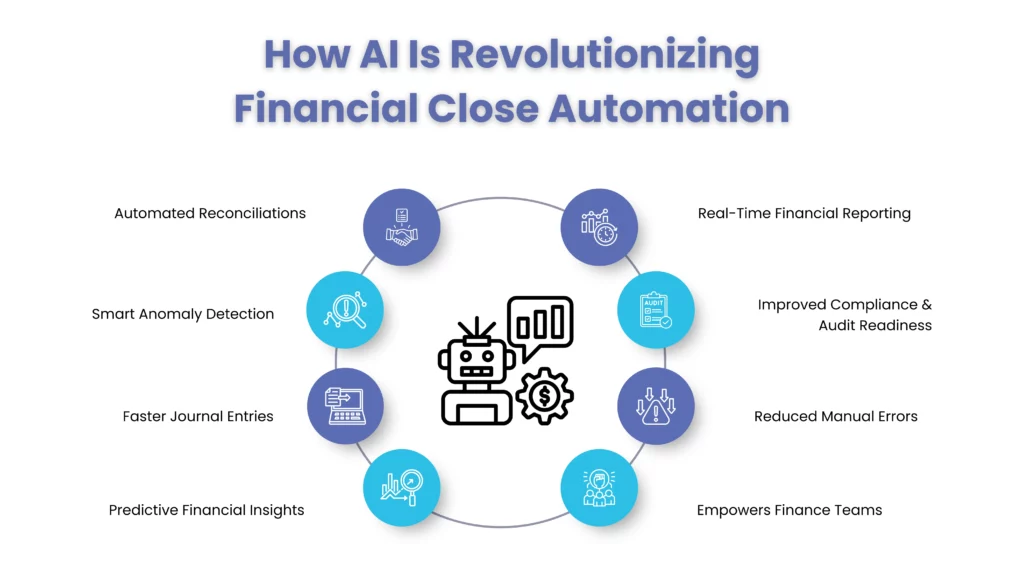
Automates Transaction Matching and Reconciliations
Reconciliation is a time-consuming aspect of financial close and AI will automate transaction matching across bank accounts, ERP systems, and ledgers, significantly reducing manual reconciliation work.
Detects Anomalies Before They Become Problems
AI will 24/7 analyze financial data to identify unusual data transactions, duplications, missing documentation, or any other discrepancies.
Speeds Up Journal Entry Processing
AI will automatically generate recurring journal entries based on historical data and predefined accounting rules. Your finance teams will only have review and approve the entries rather than creating them manually.
Improves Financial Forecasting
AI helps in analyzing historical data and identify trends and provide predictable insights. This enables you to make better-informed decisions about cash flow, budgeting, and future performance.
Enables Real-Time Financial Reporting
Instead of waiting for month-end close for reports, real-time AI tools continuously process and validate financial information, giving leadership near real-time visibility into financial performance.
Enhances Compliance and Audit Readiness
AI helps maintain consistent financial processes by monitoring transactions against company policies and regulatory requirements. It also creates detailed audit trails, making it easier for finance teams and auditors to trace approvals, reconciliations, and journal entries.
Reduces Manual Errors
Manual spreadsheets and repetitive data entry increase the likelihood of human error. AI minimizes these risks by automating calculations, validating data, and identifying inconsistencies before reports are finalized.
Frees Finance Teams for Higher-Value Work
Perhaps the biggest advantage of AI is that it allows your finance professionals to spend less time on repetitive administrative tasks and more time on activities that add strategic value, such as financial analysis, performance reporting, business partnering, and executive planning.
Ready to Accelerate Your Financial Close Process? Reduce manual accounting efforts, improve reporting accuracy, and streamline your month-end close with expert finance support and automation solutions.
What to Evaluate When Comparing Accounting Close Software
A good financial close automation platform is not made of one but multiple features. Here are some of the core ones:
Automated Account Reconciliation
As your enterprise expands, so will the volume of transactions, which will have to be matched against bank statements, subledgers, and supporting documents. Good software will have an automated account reconciliation feature to handle huge volumes and speed up the process, leaving only exceptions for human review.
Journal Entry Automation
You will need to select a software that will handle recurring entries in templates, validate them, and route them through approval workflows before they go to the general ledger.
Flux Analysis
Find software that explains period-over-period balance movements automatically against materiality thresholds you define, replacing spreadsheet-based variance work.
Close Task Management
Give preference to software that offers a single dashboard that will be visible with owners, dependencies, statuses, and reviewers, instead of relying on a cumbersome email thread.
Financial Reporting
Identify which software provides you with balance sheet and profit and loss statements regularly from updated data instead of relying on a manual end-of-month report.
ERP Integration
Get software that is bi-directionally synced with the system of record, so reconciled balances and journal entries stay current in both places.
Centralized Audit Trail
Get software that offers to automatically log every reconciliation, adjustment, approval, and comment with timestamps and user attribution.
Building the Internal Business Case for Finance Leadership
Your executive might be highly comfortable or trusting your finance team when it comes to financial close, but now incorporating financial close automation is a necessity for the benefits and problems it tackles. Therefore, it is important to make your executive aware of it.
You need to convince them and build the case around the business outcomes financial close automation offers rather than focusing on technology alone.
The ROI Framework Finance Leaders Actually Use
When evaluating financial close automation investments, you convince your team to consider these benefits it offers:
- Reduced close cycle time
- Lower operational costs
- Increased finance productivity
- Fewer manual errors
- Improved compliance
- Faster executive reporting
- Better audit readiness
- Enhanced employee satisfaction
Rather than focusing solely on software costs, calculate the value of time saved across every monthly, quarterly, and annual close.
How to Present This to Your CFO
To convince your CFO about financial close automation, you will need to answer only three questions.
Question 1: What problem are we solving?
Explain current inefficiencies:
- Manual reconciliations
- Delayed reporting
- Spreadsheet dependence
- Growing close timelines
Question 2: What improvements will financial close automation deliver?
Demonstrate measurable outcomes such as:
- Faster close
- Improved visibility
- Lower risk
- Better reporting quality
Question 3: How will the investment pay for itself?
The high investment in the automation of financial close and training of staff will pay off in the medium and long term through:
- Reduction in overtime
- Higher productivity
- Better decision-making
- Reduced compliance risk
- Greater scalability
Executives respond best when technology investments are presented as business transformation initiatives rather than simple IT projects.
How Corient Supports Business Financial Close Automation
Technology is only one part of successful financial close transformation.
Getting the technology is just part of a successful close transformation; you will need trained staff and processes to manage the technology and get the maximum out of it, and that’s where most large enterprises lack.
That’s where Corient comes to the rescue.
Corient has worked alongside large enterprise finance teams to optimize their financial close operations by combining experienced finance professionals with modern automation technologies.
Our support through our record to report services includes:
- Financial close process optimization
- Account reconciliations
- Journal entry preparation
- Financial reporting support
- ERP and accounting system expertise
- Workflow standardization
- Process documentation
- Finance operations support
Corient will not replace your internal finance team, but our experts will become an extension of it. Our professionals’ expertise will help you implement efficient workflows, improve reporting quality, and maximise the value of your financial close software investment.
Whether you’re looking to Automate Finance Processes, improve reporting speed, or strengthen financial controls, Corient provides scalable finance expertise that grows with your business.
Modernize Your Enterprise Financial Close Operations
Corient helps enterprises optimize financial close workflows, strengthen financial controls, and maximize the value of automation with experienced finance professionals.
What is financial close automation?
Financial close automation uses technology to automate and streamline month-end, quarter-end, and year-end accounting activities such as reconciliations, journal entries, approvals, consolidations, and reporting. It helps finance teams close faster, reduce manual work, and improve reporting accuracy.
What are the benefits of financial close software?
Financial close software helps enterprises reduce close times, improve data accuracy, strengthen compliance, automate repetitive accounting tasks, and provide greater visibility into the financial close process.
How does accounting close process automation improve efficiency?
Accounting close process automation eliminates repetitive manual tasks, standardizes workflows, automates reconciliations and approvals, and enables finance teams to focus on analysis rather than administrative work.
Can financial close automation support real-time financial reporting?
Yes. Modern real-time financial reporting tools integrate with ERP systems and automate data collection, allowing finance teams to access up-to-date financial information throughout the reporting period instead of waiting until month-end.
Is financial close automation suitable for large enterprises?
Absolutely. Large enterprises benefit the most because automation helps manage high transaction volumes, multiple business entities, complex reporting requirements, and compliance obligations more efficiently than manual processes.
How can Corient help with financial close automation?
Corient supports enterprises by optimizing financial close processes, providing experienced finance professionals, standardizing workflows, assisting with reconciliations and reporting, and helping organizations maximize the value of their financial close automation initiatives.
Conclusion : Future Trends in Financial Close Automation
Financial close automation cannot be considered a simple technology upgrade; it’s a technology that will give a strategic advantage to your enterprise with regard to accuracy, fast reporting, and enabling quick decision-making.
As organizations continue to grow, manual close processes become increasingly difficult to sustain. Automating repetitive accounting activities while empowering finance professionals with better tools creates a more efficient, resilient, and scalable finance function.
However, successful automation is not limited to only implementing the software. It requires the right processes, experienced professionals, and a partner who understands enterprise finance operations.
That’s where Corient can help.
Our finance and accounting experts work alongside your internal teams to streamline close processes, improve reporting quality, optimize workflows, and help you unlock the full value of your automation investment.
Ready to modernize your financial close?
Contact us today to discover how our finance and accounting outsourcing solutions can accelerate your financial close and support smarter business growth.