



Accounts receivable management is the end-to-end process businesses use to evaluate customer credit, issue invoices, collect payments, resolve disputes, and apply cash to the correct ledger accounts. Its primary goal is to accelerate working capital velocity, minimize Days Sales Outstanding (DSO), and prevent bad debt write-offs while maintaining positive customer relationships.
For finance leaders, AR isn’t back-office paperwork. It’s one of the largest liquid assets on the balance sheet, and how well it’s managed directly affects working capital, borrowing costs, and forecasting accuracy. Slow or manual cash application and reconciliation are widely cited by finance teams as leading causes of avoidable DSO inflation, though the exact number of days lost varies by industry and ERP complexity, so treat any single benchmark with caution.
According to financial industry benchmarks, enterprise payment processing delays and manual cash application can extend DSO by 7 to 10 days unnecessarily, locking up millions in operational liquidity. Run well, the function shifts from a reactive cost center to an active engine for balance sheet optimization.
This guide covers the full AR process, common challenges, modern automation tools, and how to evaluate outsourcing partners, for companies of any size managing credit sales in the US.
Key Objectives of AR Management
- Accelerating cash velocity: shortening the time between invoice and settlement
- Managing counterparty risk: credit checks and ongoing monitoring before and during the relationship
- Optimizing cash application: matching incoming ACH, wire, check, or virtual card payments to open invoices, a core piece of what modern cash management solutions are built to automate
- Reducing dispute cycle times: resolving deductions and pricing issues before accounts age further
- Protecting customer relationships: professional, data-backed communication at every collections touchpoint
What Is Accounts Receivable Management?
At enterprise scale, the discipline goes well beyond sending invoices and chasing late payments.
Accounts receivable management is the end-to-end operational, administrative, and strategic governance of all incoming funds owed to a corporation by clients who purchase goods or services on credit. It encompasses every customer touchpoint across the order-to-cash (O2C) lifecycle—from initial counterparty credit risk evaluation and contract billing execution to proactive portfolio collections, deduction management, cash reconciliation, and ledger posting.
For large US corporations, that means high-volume portfolios spanning thousands of customer accounts, customized buyer payment terms, multiple ERP systems, and complex buyer-vendor portals.
Benefits of Effective AR Management
Once an organization gets the function right, the impact is felt across business units, operationally and on the balance sheet.
- Substantial DSO Reduction: Streamlined account receivable management reduces administrative delays in the billing process, speeding up the cash you collect and releasing “trapped” cash.
- Predictable Working Capital & Forecasting: Proactive management gives the treasury team visibility into cash flowing in real time, enhancing their financial forecasting and minimizing reliance on debt financing.
- Minimized Bad Debt Exposure: Adopted credit scoring and collection schedules standardise credit risk, minimising the amount of receivables that flow through into the uncollectible Bad Debt Write-Offs.
- Lower operational cost: Automation frees in-house finance talent for high-value analysis and strategic work.
- Strengthened Customer Relationships: Professional invoice delivery, speedy short-payment resolution, and transparent terms instill trust among corporate buyers, transforming credit management into a positive interaction with customers.
Struggling with delayed payments, rising DSO, or inefficient cash application? Get expert support to streamline your AR process.
Why AR Management Matters on the Balance Sheet
The top line on an income statement is a theoretical number until the money lands in the bank.
Receivables are often the single largest liquid asset an enterprise holds. Managing that asset at scale introduces real complexity: thousands of customers, each with their own commercial terms, procurement portals, billing guidelines, and dispute protocols. Left unmanaged, it creates operational drag.
Without a consolidated approach, companies face avoidable friction, interest costs on revolving credit used to cover shortfalls, and a loss of balance sheet agility. Accurate AR data also underpins financial reporting, helping finance leaders read cash flow patterns, customer payment behavior, and overall business performance.
How the Accounts Receivable Process Works
To understand how to manage accounts receivable efficiently across complex corporate structures, enterprise finance teams must treat the process as a connected, closed-loop lifecycle.
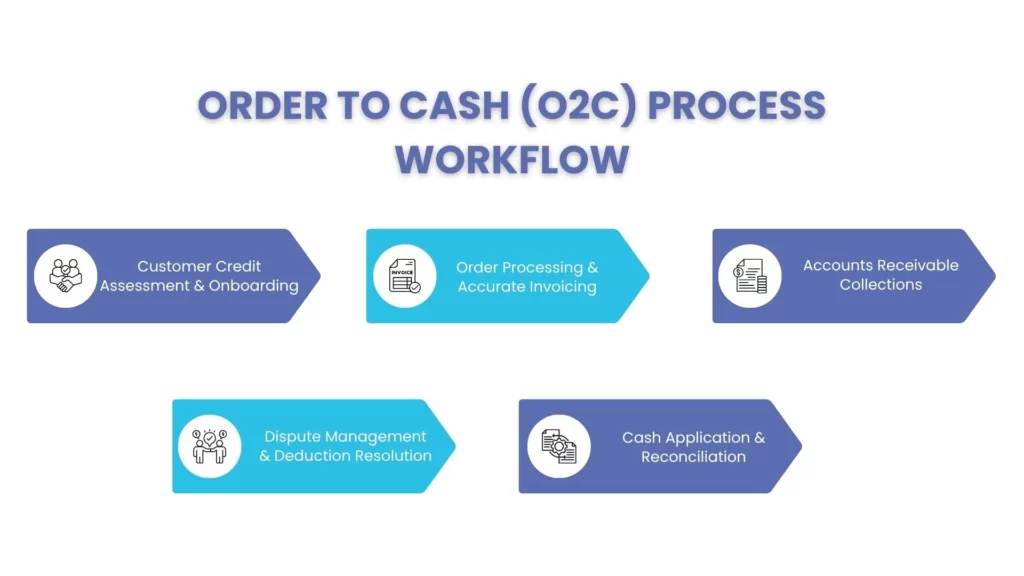
Step 1: Credit Risk Evaluation & Customer Onboarding
The process starts before the order ships. Finance teams assess credit using financial disclosures, agency scores, and trade references. Tiered credit limits and standardized payment terms protect the business against outsized counterparty risk.
Step 2: Accurate Billing & Invoicing Delivery
A significant share of late payments trace back to wrong purchase order numbers, incorrect tax totals, or mispriced line items. A well-run billing step ensures invoices go out correctly the first time, delivered immediately via automated EDI or uploaded to the buyer’s vendor portal.
Step 3: Proactive Collections & Portfolio Segmentation
Rather than waiting until an account is badly past due, strong collections rely on intelligent portfolio segmentation. Automated worklists and personalized collection schedules are used to prioritize high-value enterprise accounts, high-risk balances, and historical late payers.
We break this down further in What Is Order to Cash (O2C)? The B2B Process Explained.
Step 4: Dispute Management & Deduction Resolution
Short payments and billing issues stall cash and pile pressure on the accounting team. Structured workflows log, categorize, investigate, and resolve disputes alongside sales, customer support, and logistics.
Step 5: Cash Application & Ledger Reconciliation
Once payment is received, cash application matching rules reconcile funds against open receivables line items. Fast, accurate cash application prevents phantom late notices from reaching buyers and keeps credit lines refreshed in real time.
Reconciliation gaps here are also a top driver of the risks we cover in The Hidden Risks of a Delayed Month-End Close Process.
Common Accounts Receivable Challenges Faced by US Businesses
Even high-performing finance divisions struggle when determining how to manage accounts receivable effectively across decentralized business units:
- Manual and Fragmented Workflows: Manual and static spreadsheets and email threads slow collections performance and lead to higher operational error rates.
- Complex Deduction Backlogs: Unauthorized discounts, freight disputes and pricing discrepancies frequently sit in queues for many months with no dedicated resources dedicated to solving them.
- Decentralized ERP Systems: post-merger legacy systems make consolidated reporting difficult, which is often where record to report step in to unify reporting
- Decaying Aged Balances: The risk of cash collection for unpaid Invoices decreases as they go beyond 60 and 90 days.
- High Operational Overhead: Expensive internal accounting resources being spent on payment chasing – which is a mundane and repetitive process – is an unnecessary expense, and not a strategic asset.
Accounts Receivable Management Software: What It Solves
As business operations scale, manual workflows fail to keep pace with volume. Implementing enterprise-grade accounts receivable management software transforms collections functions into automated cash-generation units.
According to leading industry studies by technology leaders like HighRadius, AI-powered accounts receivable automation can accelerate cash application speeds by up to 80% while dramatically lowering dispute resolution cycle times.
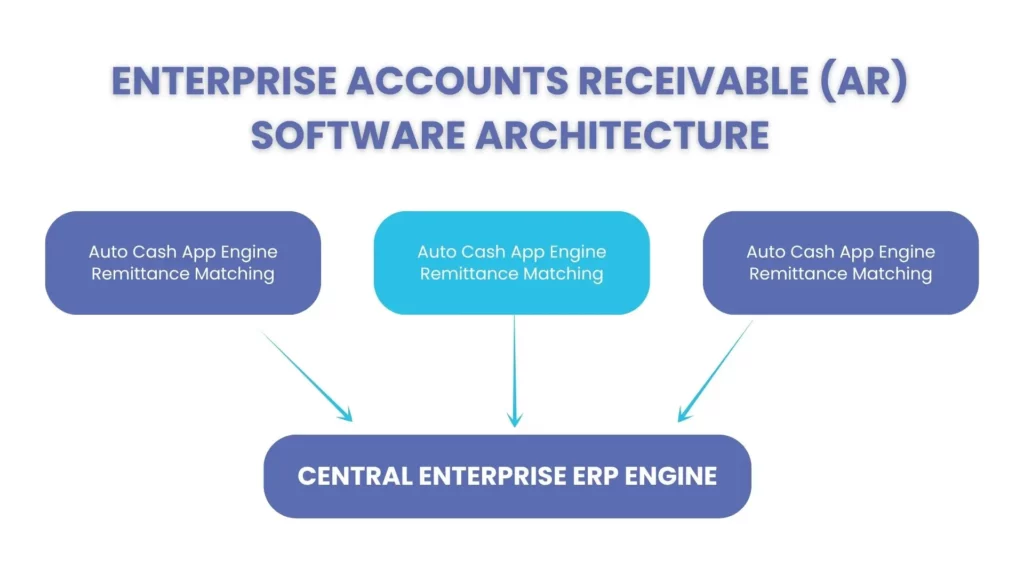
Key Capabilities of Enterprise AR Software
- Automated Cash Application: Leverages machine learning and OCR to connect payments from a variety of channels to open invoices in ERPs.
- Predictive Collections Analytics: Automatically see the likelihood of payment default based on customer payment history.
- Self-Service Buyer Portals: Offers buyers a digital platform to check account balances, download invoices, dispute them and make electronic payments.
- Automated Collection Cadences: Sets up reminders before and after payment due dates, tailored to each customer segment by their rules.
While accounts receivable software offers powerful tools, technology alone cannot fix underlying strategy or staffing deficits. Optimizing management of accounts receivable requires combining advanced software platforms with experienced operational talent.
Outsourcing Accounts Receivable Management: Does It Make Sense, and How to Choose?
To address labor shortages, reduce fixed operating costs, and accelerate cash recovery, finance executives are increasingly evaluating outsourced delivery models.
The Enterprise Rationale for Outsourcing
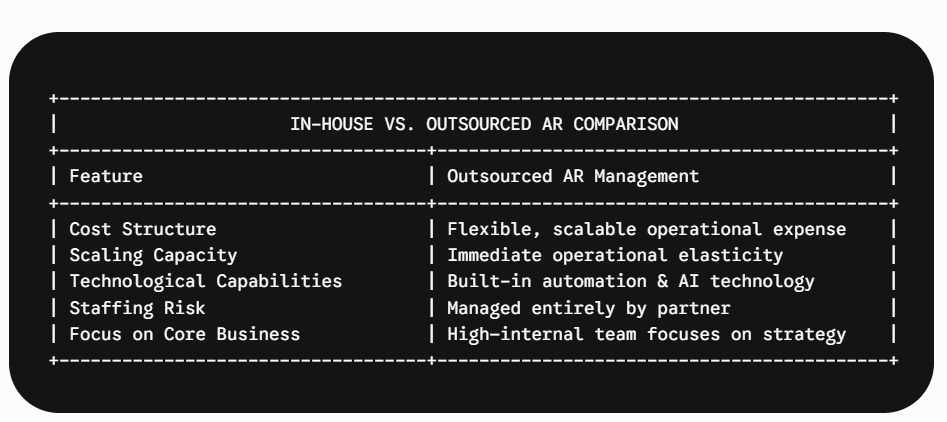
Outsourcing accounts receivable management lets companies scale operational capacity quickly, adopt proven practices, and improve collections without carrying heavy internal overhead.
Executive teams typically see four balance sheet advantages:
- Operational Overhead Reduction: Converts fixed internal labor and infrastructure costs into a flexible, scalable cost structure.
- Access to Specialized Global Talent: Brings your company into contact with credit and collections professionals knowledgeable in US accounting rules, advanced ERP systems, and dispute resolution processes.
- Elastic Operational Scalability: Easily scale accounts receivable processing capacity up or down to meet business growth, seasonal volume spikes and corporate acquisition needs.
- Strategic Focus on Core Drivers: Liberates internal financial leadership to concentrate on long-term capital allocation, strategy and corporate growth.
How to Select an Accounts Receivable Management Company
Choosing the right provider directly affects working capital performance and customer relationships. Use these criteria during vendor selection:
- US Market & Domain Expertise: Make sure the provider has experience in dealing with US accounting standards, industry billing rules and large enterprise ERPs (SAP, Oracle, NetSuite, Microsoft Dynamics).
- Security & Regulatory Compliance: Ensure compliance with SOC 1 / SOC 2, ISO data security certifications and strong privacy frameworks.
- Technology Integration Capabilities: Check whether the provider integrates cleanly with your stack or brings proven workflow automation platforms.
- Transparent SLA & KPI Reporting: Ensure 100% visibility of key metrics such as DSO trend, Collection Effectiveness Index (CEI), percentage of cash unapplied, dispute resolution speed etc.
- Brand & Customer Experience Alignment: Ensure the external team acts in a professional way of your corporate brand and maintain the trust of buyers on all communications.
Looking to reduce collection costs, improve cash flow, and scale AR operations without adding internal headcount? Partner with Corient for tailored receivables support.
Getting Your AR Process Right, Where to Start
Re-engineering the function works best as a clear, phased roadmap:
- Audit Baseline Metrics: Set baseline metrics for DSO, Collection Effectiveness Index (CEI), aging bucket distribution and average dispute cycle times.
- Standardize Credit Governance: Set standardized credit scoring criteria, credit limits, payment terms etc and inter-department dispute resolution SLA.
- Automate Core Billing Workflows: Say eliminating manual billing hassles with standardized e-invoice formats, PO validation and automated portal submissions. (the same PO-matching discipline used on the payables side in procure to pay services)
- Leverage Strategic Services Partners: Evaluate outsourcing to clear aging backlog, absorb routine collections, and lower cost-to-collect.
How Corient Helps US Enterprises Strengthen AR Management
As a trusted global accounting and financial operations partner, Corient empowers US middle-market and enterprise businesses to transform their end-to-end order-to-cash workflows.
Deep industry knowledge, flexible global delivery models, and proven process frameworks let us take on high-impact receivables work. Process excellence and human skills converge in Corient’s solution to reduce DSO, deal with complicated dispute backlogs and optimize working capital efficiency for CFOs.
Whether you need dedicated support to clear a cash application backlog or a fully managed service, Corient builds the engagement around your ERP systems, operating model, and governance requirements.
Beyond credit and collections, Corient provides end-to-end accounts payables receivables management outsourcing support, providing executive leaders with unified visibility and complete control over their entire working capital lifecycle.
Take control of your receivables, reduce DSO, and unlock trapped working capital. Schedule a consultation with Corient’s finance experts today.
People Also Ask:
What is accounts receivable management?
Accounts receivable management is a systematic process for credit evaluation, invoicing, tracking payment, dispute resolution and cash application that businesses utilize to manage and negotiate their sales under credit arrangement.
What happens when receivables are managed poorly?
Weak processes drive up Days Sales Outstanding, tighten cash flow, increase reliance on expensive credit lines, raise administrative costs, and push more balances into bad debt write-offs, all of which hit profitability.
How does outsourcing AR improve cash flow?
A dedicated external collections team streamlines follow-up, works outstanding balances consistently, resolves invoice disputes promptly, and applies cash correctly. The result is faster recovery, lower DSO, and steadier working capital.
How do automated tools integrate with enterprise AR?
Modern platforms connect to ERPs such as SAP, NetSuite, and Oracle through secure APIs to automate cash application, prioritize collector worklists, send overdue reminders, and feed real-time reporting dashboards.
What’s the difference between accounts payable and accounts receivable outsourcing?
The account payables outsourcing involves the management of the cash disbursements, vendor invoices and supplier payments going out. Accounts receivable outsourcing management is all about the revenue cycles that are being handled when it comes to the incoming side, such as credit risk, customer billing, collections, and cash application. When the accounts payables receivables management outsourcing is combined, enterprises have the full control of their working capital ecosystem.
Why is credit evaluation so important?
Upfront credit evaluation sets clear credit limits and payment terms based on buyer risk profiles. Establishing robust credit governance during customer onboarding prevents non-payment exposure and reduces default rates down the line.
Conclusion:
As the economy becomes more liquid and cash flows become more velocity, it’s imperative to modernize your enterprise accounts receivable management strategy.
Through standardized credit governance, advanced accounts receivable management software and specialized assistance from an experienced accounts receivable management company, executive leaders can eradicate bad debt, reduce DSO, and free up valuable working capital to invest in future business expansion.
Immediate, high-impact balance sheet results are realized with control of your order-to-cash lifecycle, either through process optimization or swing into full accounts payables receivables management outsourcing.