


Procurement outsourcing companies help large US enterprises hand off sourcing, purchasing, and vendor management to a specialized partner instead of running the entire function in-house. The best procurement outsourcing companies combine deep category expertise with AI-driven technology, letting finance and supply chain leaders cut costs, reduce risk, and free internal teams for strategic work.
According to industry reports from Industry Research Biz, over 60% of enterprise firms cite cost optimization and operational efficiency as their primary reason for delegating purchasing operations. Furthermore, large enterprises account for nearly 70% of total market demand as organizations move away from fragmented in-house execution.
For large enterprises across the United States, selecting from the top procurement outsourcing companies is one of the most effective ways to modernize purchasing, gain instant category expertise, and scale operations without adding massive internal headcount. In this blog post, we review the premier procurement outsourcing service providers operating in the U.S. market today, highlighting their capabilities, technology platforms, and key industry strengths.
What Is Procurement Outsourcing?
Procurement outsourcing is the practice of delegating sourcing, purchasing, and vendor management functions to a specialized outsourcing partner rather than staffing them entirely in-house. Most procurement outsourcing companies manage tasks like supplier identification, contract negotiation, purchase order processing, invoice matching, and spend analytics. Strategic decisions, final supplier selection, budget approval, and core vendor relationships, typically stay with the client’s internal team. This split lets enterprises access specialized skills and technology without losing control over the decisions that matter most.
Why Do US Companies Outsource Procurement?
Enterprise spend is divided into hundreds of categories, spread across multiple geographic locations and thousands of vendor relationships – all of which demand ongoing investment in technology and in specific domain expertise. Having all of these capabilities within an organization is costly, slows down the purchasing process, and prevents savings in many organizations.
Industry data shows that over 35% of procurement service contracts now include AI and machine learning for predictive sourcing. The smart CFO or CPO treats outsourcing partners as more than cost-cutters, they become delivery partners who accelerate digital transformation, strengthen supplier relationships, and bring real-time analytics into everyday decisions.
Key Benefits at a Glance
- Immediate cost savings: Specialized procurement outsourcing companies typically deliver 10–20% cost reductions against market benchmarks, with the largest gains in fragmented indirect and tail spend.
- Deep category knowledge: In-house teams rarely have the bandwidth to track new suppliers and product releases across every category — from IT infrastructure to MRO and logistics.
- Faster digital transformation: Leading providers bring pre-configured technology stacks, including AI-powered workflows and automated invoice and contract handling, without a long software rollout.
- Scalability on demand: Mergers, acquisitions, and rapid growth are easier to absorb when a partner can flex sourcing capacity up or down.
- Proactive risk oversight: Real-time risk engines monitor supplier financial health, ESG performance, and supply chain bottlenecks before they disrupt operations.
When Should a US Company Outsource Procurement?
Deciding when to outsource procurement comes down to internal maturity, spend visibility, and team bandwidth. When growth outpaces internal purchasing capacity, most enterprises reach a tipping point where staying lean means bringing in outside support.
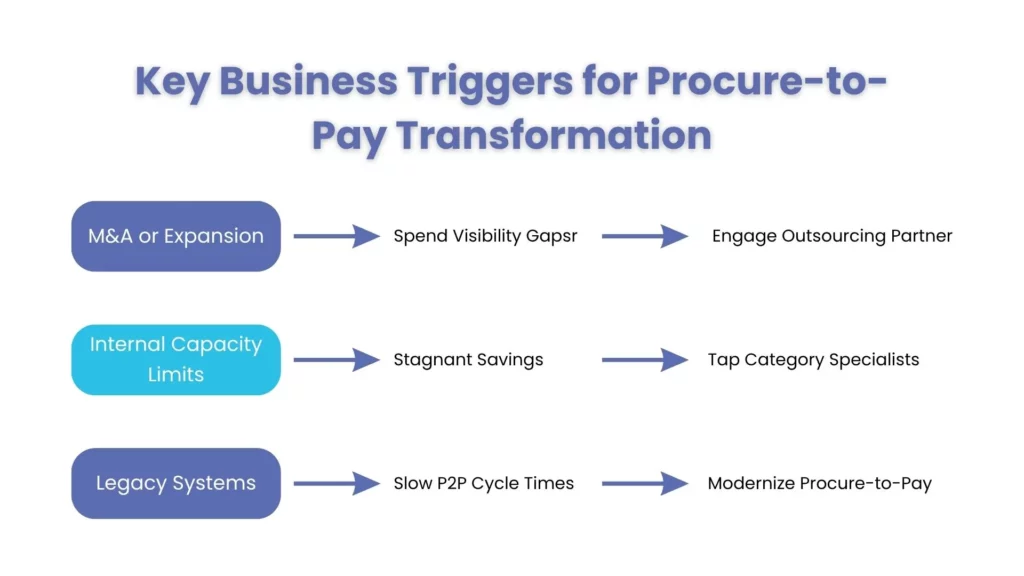
Key indicators that signal it is time to engage procurement outsourcing companies:
- Unmanaged Tail Spend: Where internal category managers are only concerned with high-dollar direct materials.
- Post-Merger Operational Integration: Consent of vendors, contracts and policies must be quickly consolidated, harmonised and aligned with M&A activities. Mature procurement outsourcing businesses have the added muscle that can help gain synergies rapidly.
- Category Talent Shortages: It can be difficult to recruit and keep qualified sourcers in competitive U.S. markets. The best procurement outsourcing service providers cover those gaps in a snap.
- Outdated Procurement Infrastructure: If you are still managing to use manual purchase orders, email authorizations or scattered spreadsheets, you can speed the path of technology modernization by working with a procure-to-pay outsourcing service provider.
- Strategic Core Focus: When management determines that the staff focus should be on core competencies, like creating new products or expanding the customer base, outsourcing mundane tasks to procurement outsourcing service providers may seem like a no-brainer for the business.
How Much Does Procurement Outsourcing Cost?
Pricing among these providers generally falls into three structures:
- Fixed management fee: a set monthly or quarterly fee scaled to service scope, offering predictable budgeting.
- Gainshare / shared savings: the provider earns an agreed percentage of documented hard-cost savings, aligning incentives with results.
- Hybrid model: a lower fixed fee paired with performance bonuses tied to cost-reduction or accuracy targets.
Fixed-fee and hybrid models are most common for enterprise-wide Source-to-Pay engagements, while gainshare structures are popular for tail-spend consolidation projects where savings are easy to measure. Corient structures engagements around the client’s goals, blending fixed and outcome-based pricing rather than forcing a one-size model, worth raising directly with a Managed Procurement Automation Services advisor when scoping a project.
How We Evaluated These Providers
To identify the leading procurement outsourcing companies serving U.S. enterprises, our evaluation framework focused on four core operational pillars:
- Category Depth & Market Intelligence: Range of managed categories, proprietary rate databases and global market coverage.
- Technology & AI Enablement: Modern Source-to-Pay (S2P) platform integration, automated workflows, and predictive spend analytics.
- U.S. Enterprise Delivery Track Record: Experience providing measurable value, risk management, and compliance solutions to Fortune 1000 and middle-market organizations.
- Governance & Operating Frameworks: Flexibility of SLAs, performance-based pricing models and account management alignment.
The same criteria we apply when benchmarking outsourced finance and accounting service providers more broadly.
10 Best Procurement Outsourcing Companies in the USA
According to industry analysis from The Business Research Company, North America dominates over 40% of the global procurement outsourcing market, with leading providers helping U.S. enterprises capture 12%–18% average cost reductions, automate Procure-to-Pay (P2P) cycles, and integrate AI-driven spend analytics.
1. Corient Business Solutions
Corient Business Solutions ranks among the premier procurement outsourcing companies, delivering custom operational models tailored specifically for U.S. enterprise needs. Corient combines dedicated U.S.-based account governance with scalable global delivery teams, helping businesses expand operational capacity while keeping tight strategic control over supplier relationships.
Corient’s Managed Procurement Services cover all of Source-to-Pay (S2P). With intelligent workflows and real-time spend analytics, combined with proactive category management, Corient enables finance and supply chain leaders to turn a mess of spend into measurable savings.
Core Strengths:
- Dedicated U.S. account management backed by scalable global execution hubs.
- Embedded analytics and automated tools across contract tracking, expense management, and invoice verification.
- Proven track record in rapid tail-spend consolidation, contract optimization, and Procure-to-Pay acceleration.
- Dynamic engagement structures ranging from targeted capability support to fully managed procurement operations.
2. Genpact
Genpact is a well-known business process optimization and digital operations provider known worldwide. Genpact is one of the most experienced and well-known procurement outsourcing firms that are more adept at connecting end-to-end processes across the supply chain with predictive analytics and automation.
Key Focus Areas:
- Data-driven procurement operations transformation.
- AI-enabled supplier risk tracking and ecosystem management.
3. GEP
GEP is a recognized market leader focused exclusively on procurement and supply chain software and services. Pairing strategic advisory with its proprietary AI platform (GEP SMART™), GEP is a primary choice for global businesses looking for unified procurement outsourcing service providers.
Key Focus Areas:
- Integrated global managed procurement services.
- AI-native software orchestration across Source-to-Contract and Procure-to-Pay.
4. Accenture
Accenture Procurement Services is a business process-executing arm that brings strategic consulting expertise to a large-scale program. Accenture is one of the world’s largest procurement outsourcing firms, and it relies on its vast software partner network (including SAP, Coupa and Oracle) to provide automated, data-driven procurement operations.
Key Focus Areas:
- High-volume global category management and strategic sourcing.
- Sustainable sourcing frameworks and ESG metric integration.
5. Corcentric
Corcentric provides a range of procurement, accounts payable and order-to-cash solutions that are optimized to maximize working capital. Corcentric’s position in the niche sector of procurement outsourcing services merges spend management technology and group purchasing initiatives, enabling enterprise CFOs to squeeze every ounce of cash flow from them.
Key Focus Areas:
- Group Purchasing Organization (GPO) leverage across indirect categories.
- Working capital advisory and procure-to-pay process integration.
6. LogicSource
LogicSource focuses strictly on indirect spend management for retail, consumer goods, healthcare, and financial services organizations. As a focused specialist among procurement outsourcing service providers, LogicSource pairs experienced category teams with a proprietary database built on tens of billions of dollars in historical market spend data.
Key Focus Areas:
- Exclusive focus on non-payroll indirect spend categories.
- Pre-negotiated market rates and pricing intelligence.
7. Capgemini
With a wide variety of technology and engineering resources, Capgemini is able to support global procurement operations. Capgemini is one of the leading digital-first procurement outsourcing firms, using cognitive analytics and intelligent process automation to create frictionless operational models.
Key Focus Areas:
- Automated, frictionless procurement operational frameworks.
- Continuous spend visibility and supplier risk monitoring.
8. Deloitte
Deloitte’s expertise in the industry and its on-the-ground execution power ensures that clients receive procurement advice and managed operational services. Deloitte is a leading enterprise procurement outsourcing service provider and is particularly strong in strategic risk management, value creation and long-term organizational transformation.
Key Focus Areas:
- Enterprise supplier risk management and regulatory compliance.
- Large-scale digital procurement architecture integration.
9. IBM
IBM Procurement Services’ enterprise consulting heritage with IBM Watson AI software tools. IBM is a technology leader in the procurement outsourcing business that assists large organizations in automating high-volume transaction processing and predicting market developments before they are realized.
Key Focus Areas:
- Automated procurement workflows and cognitive analytics.
- Global enterprise sourcing operations.
10. The Hackett Group
The Hackett Group offers benchmarks-driven procurement guidance and execution. Using quantitative performance metrics in guiding strategic sourcing programs, Hackett is one of the few procurement outsourcing service providers to base its strategy on extensive empirical data.
Key Focus Areas:
- Empirical, benchmark-guided strategic sourcing initiatives.
- Procurement Center of Excellence (CoE) design and execution.
Comparison Table At Glance
To help executive teams quickly evaluate the marketplace, the table below breaks down how the leading procurement outsourcing providers compare across key delivery dimensions:
| Company | Core Differentiator | Target Client Scope | Key Capabilities |
| Corient Business Solutions | High-touch U.S. account governance + Global AI delivery | U.S. Large & Mid-Market Enterprises | Tail spend management, end-to-end P2P execution, custom AI workflows |
| GEP | Unified AI-native platform | Global 2000 & Fortune 500 | Software + managed services integration, global category scale |
| Accenture | Massive operational scale & enterprise AI models | Multi-National Fortune 100 | Digital S2P transformation, global supply chain network integration |
| Genpact | Process optimization & data-led BPO execution | Fortune 500 Enterprises | Intelligent automation, predictive risk management, supplier operations |
| Corcentric | Combined spend management tech & working capital tools | Middle Market to Large U.S. Businesses | Indirect category benchmarking, GPO programs, Fleet/MRO management |
| LogicSource | High-touch execution backed by $60B+ spend data | Retail, Healthcare, Finance & CPG | Non-payroll indirect spend focus, pre-negotiated market rates |
| Capgemini | Frictionless operational frameworks & automation | Multi-National Corporations | Cognitive analytics, continuous process improvement, global hubs |
| Deloitte | Strategic consulting paired with operational execution | Global 1000 Enterprises | Enterprise risk mitigation, regulatory compliance, strategic sourcing |
| IBM | AI-driven workflow transformation via Watson | High-Tech, Industrial & Enterprise | Autonomous contract management, predictive market modeling |
| The Hackett Group | Benchmark-driven operations and empirical data | C-Suite & Enterprise Procurement Leads | Intellectual property access, Performance CoE development |
Ready to see how a dedicated delivery partner fits your procurement strategy? See Managed Procurement Services.
Procure-to-Pay Outsourcing: A Focused Operational Model
Many enterprise leaders have a vision of comprehensive Source-to-Pay transformation, but many U.S. organizations elect to begin by partnering with a specialized Source-to-Pay outsourcing service provider.
In enterprise finance, the largest number of day-to-day transactions are managed by the Procure-to-Pay cycle, which involves requisition approvals, creation of purchase orders, receiving verification, matching invoices, and executing payments.
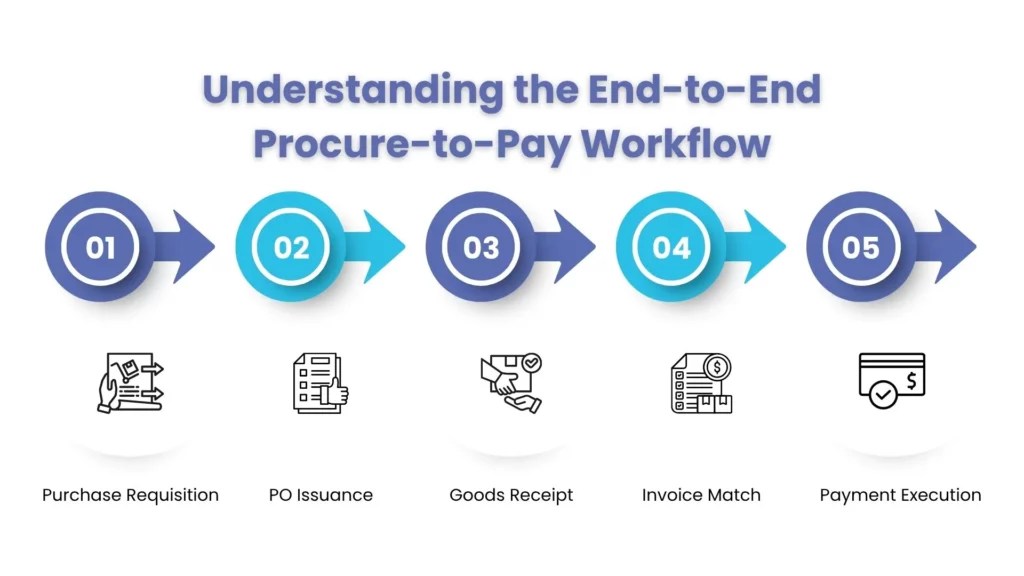
Procurement outsourcing companies that specialize in P2P typically deliver three advantages:
- Faster Transaction Speeds & Higher Accuracy: Manual invoice processing often leads to duplicate payments, missed payment deadlines and early payment discounts. A specialized procure to pay outsourcing service provider employs special software called ‘matching software’ to enhance the rate of processing.
- Improved Cash Flow Management: Enterprise finance teams can now see when they have to pay an account, how to schedule payments to benefit from dynamic discounting, and how to use this information to enhance working capital.
- Strategic Staff Reallocation: Internal teams shift away from manual accounts payable processing toward budgeting and financial planning.
What Do Procurement Outsourcing Case Studies Show?
Looking at real-life examples, the clear, practical benefits that U.S. companies benefit from when working with an expert procurement outsourcing firm are evident:
Case Study Focus 1: Industrial Manufacturing Enterprise (Indirect Spend Consolidation)
- Challenge: Uncontrolled tail spend, inconsistent vendor pricing and disparate contracts throughout the 40 U.S. locations.
- Solution: Partnered with a single procurement outsourcing solution provider that would consolidate the management of vendors, consolidate indirect buying volume, and use universal contract terms.
- Results: Captured 18% savings on indirect categories within 12 months, 35% reduction in number of non-critical vendors and fully achieved contract compliance across all plants.
Case Study Focus 2: Healthcare Network (P2P Process Automation)
- Challenge: Manual processing caused an overwhelming number of supplier invoices (more than 500,000 per annum) to be created, causing processing backlogs, late penalties, and high operating costs.
- Solution: By collaborating with a specialist procure to pay outsourcing service provider, they put in place automated optical character recognition (OCR) and 3-way invoice matching.
- Results: So, an average invoice could be processed in 22 days, but was reduced to 3 days; and the cost of invoice processing was cut by 62%, and the capture of early payment discounts was significantly increased. A similar operational cleanup is detailed in Corient’s vendor invoice management case study.
How to Choose the Right Procurement Outsourcing Provider
Selecting the right partner from the best procurement outsourcing service providers requires a clear, structured evaluation process:
- Define Your Scope: Decide if your business needs a full Source-to-Pay (S2P) outsourcing solution, category-specific sourcing support (tail spend), or a specific transactional process solution that comes from a procure to pay (P2P) outsourcing service provider.
- Verify Technology Integration: Ensure that the provider’s technical platforms are easily linked to the company’s current Enterprise Resource Planning (ERP) platforms (e.g., SAP, Oracle, NetSuite or Workday).
- Structure Commercial Agreements Around Outcomes: Look for flexible commercial terms—such as fixed management fees, shared-savings models, or hybrid SLAs tied directly to verified cost reduction and processing accuracy KPIs.
- Evaluate Data Security & Regulatory Compliance: Businesses that have to undertake enterprise procurement need to consider data security and regulatory compliance issues. Confirm SOC 1, SOC 2 Type II, and relevant ISO certifications.
- Review Industry References: Ask for case studies and client references with comparable spend size and complexity.
Looking to streamline your enterprise procure to pay processes? To find out how our customized Finance & Accounting Services, advanced Enterprise Automation and strong P2P execution skills can optimize your procurement strategy, contact Corient today!
Common Objections (and How to Address Them)
We’ll lose control of our vendor relationships : Reputable procurement outsourcing companies operate under rules the client sets. Day-to-day market research and transaction execution move to the provider, but supplier approval and key strategic relationships stay internal.
Our team is worried this means job cuts : In most engagements, outsourcing removes transactional busywork so internal staff can shift toward planning, analysis, and vendor strategy, roles that are harder to fill and more valuable to the business.
Is our data secure with an outside partner?: Established providers carry SOC 1 and SOC 2 Type II certifications and structure data-handling agreements specifically for enterprise compliance requirements, this is worth confirming in writing during vendor selection.
People Also Ask:
How do private companies handle IT outsourcing procurement?
Private companies typically define vendor oversight rules, calculate total cost of ownership, and work with specialized providers who benchmark hardware, software licensing, and cloud infrastructure pricing to secure better terms.
What is the key difference between direct and indirect procurement outsourcing?
Direct procurement covers raw materials and components used in finished goods. Indirect procurement covers non-production needs like IT, facilities, marketing services, and professional consulting.
Will outsourcing procurement cause our business to lose control over supplier relationships?
No. Reputable procurement outsourcing companies operate under client-defined governance. Day-to-day research and execution move to the provider, while supplier approval and strategic relationships stay internal.
How long does it take to implement a managed procurement service model?
Implementation dates vary by project size. Usually, a focused Procure-to-Pay (P2P) process outsourcing or indirect tail-spend management program can be put in place in 8 to 12 weeks. Typically, enterprise-wide Source-to-Pay (S2P) transformations will take 4 to 6 months to be completely onboarded and integrated into the platform.
How are procurement outsourcing services usually priced?
Most providers use a fixed management fee, gainshare/shared savings tied to documented results, or a hybrid of both.
Why do US companies outsource procurement instead of building internal teams?
By outsourcing procurement, U.S. companies can quickly leverage existing, deep category expertise, pre-built technology platforms and supplier buying power without the added overhead, lengthy hiring process, and software investment that’s needed to develop these capabilities on their own.
Is procurement outsourcing the same as purchasing outsourcing?
They’re closely related. “Purchasing” often refers narrowly to transactional buying, while “procurement outsourcing” typically covers the broader cycle , sourcing, contracting, purchasing, and payment.
What’s the ROI of procurement outsourcing?
Most enterprises see returns through 10–20% cost reductions on managed spend, faster invoice cycles, and reduced internal headcount needs, with payback often realized within the first 12 months of a well-governed engagement
Top strategic sourcing firms in the USA?
Accenture, GEP, Corcentric, and Efficio lead large-scale sourcing. Corient supports mid-to large market procurement through its procure-to-pay and vendor management services.
What does vendor vetting involve?
Checking a supplier’s financials, compliance, pricing, and reliability before onboarding. Corient builds this into its procure-to-pay process as an ongoing check, not a one-time step.
Conclusion
Procurement is no longer a back-office function, it’s a lever for protecting margin, managing risk, and keeping supply chains agile. The right procurement outsourcing companies bring category expertise, proven technology, and a track record of measurable savings, without the cost and delay of building that capability from scratch. Whether the goal is tail-spend consolidation, P2P acceleration, or a full Source-to-Pay transformation, the partner you choose matters more than the framework.
Ready to optimize your procurement operations and reduce unnecessary costs? Corient’s Procure to Pay Services help US enterprises streamline purchasing, automate invoice processing, improve spend visibility, and build a more efficient procurement workflow. Talk to our procurement experts today and discover how we can support your growth.