


Quick answer: If you already outsource to a CPA firm, the question isn’t whether to use an external partner. It’s which kind fits your business now. Traditional accounting firms are built for defined, periodic work such as tax preparation, audit, and year-end financial statements. Outsourced finance-operations providers like Corient run the daily processes, Record to Report, Procure to Pay and Order to Cash, with a standing team that scales with transaction volume. Many mid-market companies end up using both: the CPA firm for tax and attestation, and an outsourced team for day-to-day finance operations.
When the CPA firm stops keeping up
It was mid-February, and Daniel still didn’t have January’s close.
Daniel is the CFO of a growing US e-commerce company. His CPA firm had been reliable for six years. It kept the books clean, prepared the tax returns on time, and had never given him a reason to worry. But tax season had started, and his monthly bookkeeping file was now sitting behind a long queue of client returns.
Then the company acquired a second entity. The firm responded the way firms usually do: with a new engagement letter, a revised scope, and a higher fee. When Daniel asked who would handle intercompany reconciliations, the answer was that it depended on staff availability.
Nothing had gone wrong, exactly. The firm was doing what it was built to do. The problem was that Daniel’s business no longer needed accounting that recorded what had already happened a few weeks later. It needed finance operations that ran every day, closed on schedule, and absorbed more volume without a new engagement letter each time the business changed.
So the question became: should a growing US business stay with a traditional accounting firm, or move its finance operations to a provider built for that work, such as Corient?
How Corient’s model differs from a traditional accounting firm
For businesses that need conventional bookkeeping, tax preparation, or periodic accounting support, a traditional accounting firm is still a sensible choice. But mid-market and enterprise businesses dealing with high transaction volumes, multiple entities, reporting pressure, and growth-related workload spikes often need a different operating model.
Corient combines dedicated finance professionals, standardized processes, and technology-enabled delivery across Record to Report, Procure to Pay, Order to Cash, financial reporting, and broader finance operations. It works inside existing platforms, including SAP, Oracle, NetSuite, Microsoft Dynamics, Sage Intacct, and QuickBooks Enterprise.
The difference isn’t traditional versus digital. It’s a periodic professional-services engagement versus a finance operating model designed to run continuously and scale.
Understanding traditional accounting firms in the USA
Traditional firms aren’t the problem. Their model was built for a particular kind of workload, and it serves that workload well.
Traditional accounting firms in the US have built their reputations on dependable professional services: maintaining financial records, preparing statements, handling tax compliance, supporting audits, and giving professional advice. The typical rhythm is familiar. The business sends over bank statements, invoices, and receipts. The firm processes them. At month-end or quarter-end, the business receives financial statements. At tax time, the firm prepares the returns.
For businesses with straightforward financial operations, that familiarity has real value.
Services offered by traditional accounting firms
Depending on its size and specialization, a firm may provide:
- Bookkeeping and general ledger maintenance
- Bank and credit-card reconciliations
- Accounts payable and accounts receivable support
- Payroll support
- Tax preparation, planning, and compliance
- Financial statement preparation
- Audit, review, and compilation engagements
- Business and tax advisory
- Controller or CFO services
Where traditional firms are the right fit
A traditional firm is often the better choice when your transaction volume is modest and predictable, when you mainly need periodic statements and tax compliance, when you value a long-term relationship with a named partner, or when you need services only a licensed CPA firm can provide, such as audit opinions and attestation work.
Where the traditional firm model starts to strain
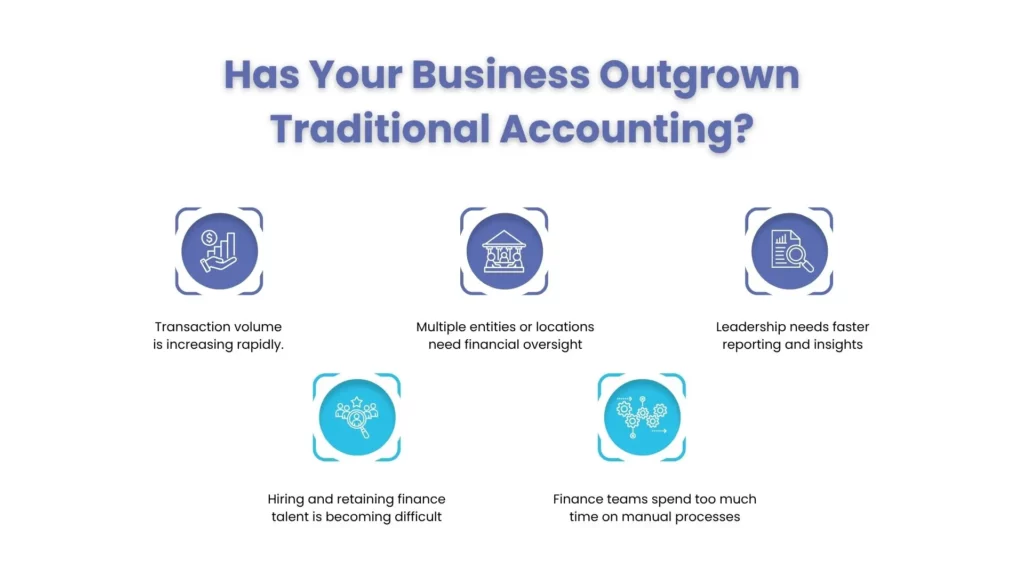
Think of your firm’s engagement as a small bridge. It worked perfectly when ten cars crossed it every hour. Then the business doubled, transaction volume tripled, and the company opened another entity. The bridge didn’t get worse. The traffic changed.
These are the pressure points finance leaders most often run into.
Tax-season bottlenecks
Most CPA firms earn a large share of their revenue between January and April. During that stretch, recurring bookkeeping and close work competes with tax deadlines, and it doesn’t always win. If your month-end close slips every spring, the cause is usually capacity, not competence.
Periodic rather than continuous close
Firm engagements are typically scoped around monthly, quarterly, or annual deliverables. That works when leadership only needs historical statements. It becomes a problem when the CEO wants margin analysis this week, the board wants a reliable monthly pack, and lenders want covenant reporting on a fixed date.
Scope changes billed as extras
A new entity, a new sales channel, an ERP migration, or a surge in invoice volume usually means a rescoped engagement and a new fee. Each change adds an administrative step before any extra work actually gets done.
Work that depends on whoever is available
Firms rotate staff across clients and across seasons. Your file may be handled by a different staff accountant each quarter, which means re-explaining unusual transactions, approval rules, and vendor quirks. Knowledge ends up in the firm’s people rather than in documented processes.
Multi-entity and ERP complexity
Many firms are strongest with small-business ledgers. Intercompany eliminations, consolidations, and work inside SAP, Oracle, or Microsoft Dynamics call for a different depth of process and system experience, which varies widely from firm to firm.
What modern finance operations look like
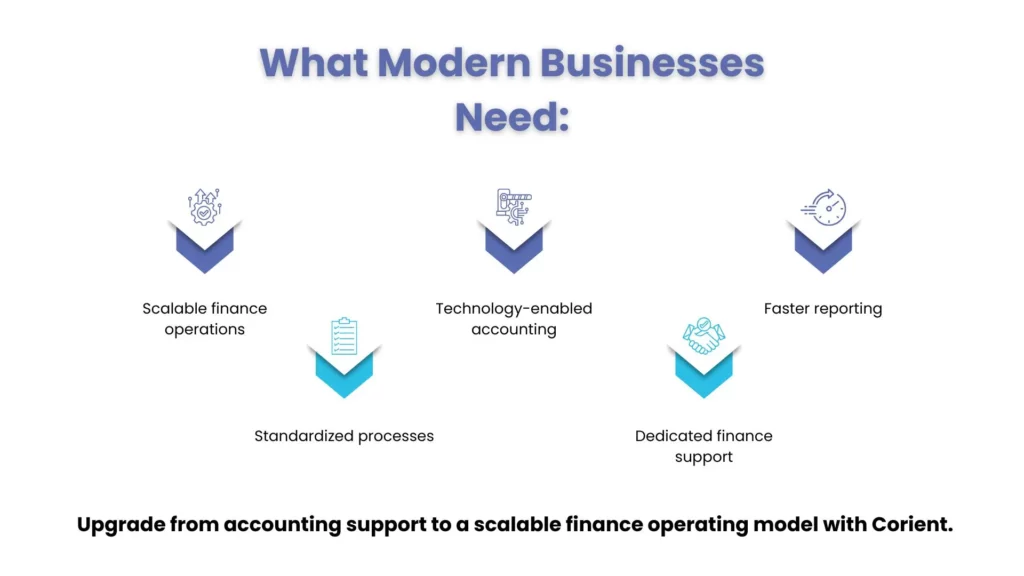
By the time you walk into your next leadership meeting, the conversation has moved well beyond bookkeeping:
- The CEO wants to know why gross margins changed.
- Operations wants a clearer view of vendor spending.
- Sales wants faster visibility into receivables.
- The board wants reliable, on-time reporting.
Finance is no longer a back-office function that sits quietly at the end of the month. It has become part of how decisions get made.
Modern finance and accounting services are designed for that. Instead of treating finance as a set of isolated tasks, they connect processes, people, systems, reporting, and controls into one operating framework.
Take a single invoice. In a heavily manual environment, someone downloads it, checks it, keys it into a system, routes it for approval, updates a spreadsheet, and eventually reconciles the payment. In a technology-enabled environment, the same invoice moves through standardized workflows, system integrations, automated checks, and clearly defined ownership.
The accountant doesn’t disappear. Their time moves away from shifting data between systems and toward investigating discrepancies, reviewing results, supporting the close, and helping management understand performance. Corient’s US finance and accounting model is built on that principle.
Outsourced accounting vs traditional accounting firms: feature-by-feature comparison
Once you set the logos aside, the decision comes down to a few questions. Who handles the daily work? Who delivers better reporting, and when? Who absorbs growth without a new contract? Who works inside the systems you already have? And who can do the things only a licensed firm can do?
| Factor | Traditional accounting firm | Corient outsourced accounting |
|---|---|---|
| Core model | Periodic professional accounting services | Continuous, technology-enabled finance operations |
| Billing model | Hourly, fixed retainer, or per-engagement fee | Scoped to transaction volume, entities, and processes |
| Bookkeeping and accounting | Yes | Yes |
| Daily finance operations (AP, AR, reconciliations) | Depends on engagement scope | End-to-end P2P, O2C, and R2R |
| Month-end close | Often periodic; timing can slip in tax season | Run to an agreed close calendar and SLAs |
| Busy-season availability | Capacity shared with tax deadlines | Dedicated team not tied to the tax calendar |
| Reporting | Periodic financial statements | Management reporting and controllership support |
| Scalability | Usually requires a rescoped engagement | Designed to scale across processes and business units |
| ERP compatibility | Varies by firm | SAP, Oracle, NetSuite, Microsoft Dynamics, Sage Intacct, QuickBooks Enterprise |
| Multi-entity support | Varies by firm | Built for multi-entity and shared-services environments |
| Process model | Often relationship- or person-dependent | Standardized, documented workflows |
| Tax filing and audit opinions | Yes (licensed CPA firms can sign returns and issue opinions) | Support only: prepares workpapers and schedules for your CPA or auditor |
| Best fit | Businesses needing periodic accounting, tax, and attestation | Mid-market and enterprise businesses needing scalable daily finance operations |
The tax and audit row matters. An outsourced finance-operations provider doesn’t replace the attest function of a licensed CPA firm, and it shouldn’t claim to. That’s exactly why many companies run both models side by side, as covered below.
How does each process compare? A closer look
Bookkeeping and general ledger
A traditional firm can keep your books accurate and up to date. Corient does too, but treats bookkeeping as the first step of a broader Record to Report process: general ledger management, journal entries, reconciliations, fixed assets, and financial reporting all run as one workflow. If you only need bookkeeping, a conventional provider may be enough. If bookkeeping feeds directly into your close, reporting, and management decisions, the broader model is worth a look.
Accounts payable and Procure to Pay
When the AP team is buried under invoices, many enterprises start comparing accounts payable outsourcing companies rather than asking their CPA firm for more hours. Corient’s procure to pay process covers vendor onboarding, invoice processing, approvals, and payment runs. Added capacity is built in for pressure points such as month-end close, audit season, M&A activity, and system transitions. You’re not buying more accounting hours. You’re buying operational capacity.
Accounts receivable and Order to Cash
Traditional firms often touch receivables only at period-end, when balances need reconciling. Order to Cash runs continuously: invoicing, cash application, collections follow-up, and aging analysis. For a growing business, the difference shows up directly in days sales outstanding and cash visibility.
Financial reporting
This is where the difference is most visible. A traditional firm can tell you what your financial statements say. A finance-operations model should make those numbers usable while there’s still time to act on them. Corient’s service includes financial reporting, balance-sheet reviews, reconciliations, and close support, with the aim of improving reporting accuracy and financial control.
Technology and systems
Moving away from a traditional firm doesn’t mean replacing your technology stack. Corient’s team works within existing ERP and finance environments, including SAP, Oracle, NetSuite, Microsoft Dynamics, Sage Intacct, and QuickBooks Enterprise, so the transition is less disruptive for businesses already invested in their systems.
How CPA firm billing compares with outsourced pricing
Cost works differently under each model, and the billing structure often matters more than the headline number.
Traditional firms typically bill in one of three ways:
- Hourly: you pay for time spent, so costs rise with complexity, questions, and clean-up work.
- Fixed retainer: a monthly fee for a defined service list, with out-of-scope work billed separately.
- Per engagement: separate fees for the tax return, the review, the audit, or a one-off project.
Outsourced finance-operations providers such as Corient generally price around the size of the finance function being supported: transaction volume, number of entities, and which processes are in scope. That tends to make costs more predictable during growth, because added volume adjusts an existing scope rather than triggering a new engagement.
Here’s how that plays out. When Daniel’s company added a second entity, the firm issued a new engagement letter. Under a volume-based model, the same change would be handled as a scope adjustment within the existing agreement.
Published rate cards are rare in this market, so ask any provider directly how it prices, what counts as out of scope, and how a change in volume is billed.
Can you keep your CPA firm and outsource accounting operations?
Yes, and for many mid-market companies this is the best of both. The hybrid model lets each provider do what it’s built for.
| Your CPA firm keeps | Your outsourced finance team runs |
|---|---|
| Federal and state tax returns | Daily bookkeeping and general ledger |
| Tax planning and advisory | Accounts payable and vendor payments |
| Audit, review, or compilation engagements | Invoicing, cash application, and collections |
| Year-end sign-off and attestation | Bank and balance-sheet reconciliations |
| Complex technical accounting opinions | Month-end close and management reporting |
The practical benefit runs both ways. Your CPA firm receives clean, reconciled books and ready-made schedules at year-end, which often reduces its hours. Your finance operations no longer compete with the firm’s tax calendar.
To make it work, agree in writing who owns which reconciliations, who prepares year-end schedules, and how the two teams hand off at close.
Is outsourced accounting secure?
Whichever external provider you use, a firm or an outsourcer, your financial data leaves your network, so the provider’s controls become part of your control environment. Ask where data is processed and stored, who can access it, and which certifications the provider holds, such as SOC 2 Type II or ISO 27001. We cover the full list of questions in our outsourced accounting vs in-house team guide.
How to switch from a traditional accounting firm
Moving daily finance operations away from a firm is easier when you collect the right material up front. Before the transition starts, request:
- The current chart of accounts and any mapping notes
- Prior-period reconciliations and supporting workpapers
- Open items lists for AP, AR, and unreconciled balances
- Fixed-asset and depreciation schedules
- Admin or user access to your accounting system, bank feeds, and payment tools
- Any documented procedures, approval rules, and close checklists
- The notice and exit terms in your current engagement letter
If you’re keeping the firm for tax and audit, tell it early. Most firms welcome the change once they see they’ll receive cleaner books at year-end.
A typical transition runs 60 to 90 days, with a parallel-run period in which the new team processes alongside the existing arrangement before anything is handed over. Timing depends on the number of entities, the state of your existing reconciliations, and system access.
Why choose Corient over a traditional firm?
At this stage you’re no longer comparing logos. You’re comparing operating models.
Complete finance operations support
Corient’s offering covers Record to Report, Procure to Pay, Order to Cash, financial reporting, compliance support, and broader finance operations under one scope. Finance leaders can address several connected processes through one partner instead of coordinating a firm, a payables vendor, and a reporting consultant separately.
Industry-focused accounting expertise
A finance model should reflect how your business actually makes money. A retailer worries about inventory, margins, and multiple sales channels. A manufacturer deals with cost structures and supply-chain complexity. A SaaS company tracks recurring revenue and growth metrics. A real estate business has a completely different reporting environment.
Corient provides industry-focused support for retail and e-commerce, manufacturing and logistics, healthcare, real estate and property management, technology and SaaS, and professional services, a range reflected in its case studies.
Capacity that scales without re-contracting
Imagine your company enters a new market, transaction volume rises, month-end gets heavier, and an acquisition adds another entity. With a traditional firm, each of those changes can mean a new engagement letter and a wait for staff to be allocated. With Corient, added capacity is built into the engagement, so support extends across processes and business units as requirements change.
More transactions, new entities, tighter deadlines? Contact Corient to scope where outsourced finance operations would fit alongside, or instead of, your current firm.
People Also Ask:
Is an outsourced accounting provider the same as a CPA firm?
No. A CPA firm is a licensed practice that can sign tax returns and issue audit or review opinions. An outsourced finance-operations provider runs day-to-day accounting processes such as AP, AR, reconciliations, close, and reporting. Many businesses use both.
Can I outsource my accounting and still use my CPA for taxes?
Yes. This is one of the most common setups. The outsourced team maintains the books and prepares year-end schedules, and your CPA firm handles tax returns, planning, and any attestation work.
Can an outsourced accounting provider sign my audit?
No. Audit opinions must come from an independent licensed CPA firm. An outsourced provider can prepare the reconciliations, schedules, and supporting documentation your auditor asks for, which usually makes the audit faster.
Is outsourced accounting cheaper than a traditional accounting firm?
It depends on your volume and scope. Firms bill by the hour, by retainer, or by engagement. Outsourced providers usually price by transaction volume, entities, and processes. For growing, high-volume businesses, volume-based pricing is often more predictable. Compare total annual cost, including out-of-scope fees.
When should a business move away from a traditional accounting firm?
Common signals include a month-end close that regularly slips during tax season, frequent rescoping as the business grows, new entities or an ERP the firm isn’t set up for, and leadership needing management reporting faster than the firm can deliver it.
How long does it take to move from a CPA firm to an outsourced provider?
Typically 60 to 90 days, including a parallel-run period before full handover.
Conclusion: Which Accounting Solution Fits Your Business?
Traditional accounting firms aren’t obsolete. If your company needs straightforward bookkeeping, tax preparation, periodic statements, audit work, or a close relationship with a named accountant, a traditional firm may still be the right fit.
If your company needs daily finance operations, a reliable close calendar, structured processes, work inside a complex ERP, and capacity that grows without a new engagement letter, Corient deserves a place on your shortlist. For many businesses, the answer is both: the firm for tax and attestation, and an outsourced team for everything that runs between year-ends.
When you compare the top accounting firms in the US against outsourced providers, don’t judge them only by the services listed on their websites. Ask:
- How will the work be handled during tax season?
- What happens to the fee if transaction volume doubles?
- Who owns each process, and is it documented?
- How quickly will we have management reporting after month-end?
- Can the provider work inside our existing ERP?
Most importantly, ask whether the arrangement gives your finance leaders more time to make decisions rather than chase transactions.
Still deciding whether to outsource at all? Read our comparison of outsourced accounting vs an in-house team. If you’re already outsourcing and feeling the limits of a traditional firm, contact Corient for a scoped review of your finance operations and where outsourced support would help most.