




The accounting industry is currently facing a “perfect storm.” Firms across the United States are grappling with a dwindling pipeline of new CPAs, rising domestic labor costs, and an ever-increasing demand for complex advisory services. For many, the traditional model of local-only hiring is no longer sustainable for growth. This is where the strategy to build your offshore accountants team becomes a game-changer.
At Corient, we understand that building an offshore accounting team is no longer just a cost-saving measure for the “Big Four”; it is a scalable, strategic necessity for mid-sized and boutique firms looking to reclaim their time and increase their margins. In this comprehensive guide, we will explore everything you need to know about how to successfully integrate an offshore accounting team into your practice.
So, what exactly does this look like in practice? An offshore accounting team is a group of international professionals, usually based in countries like the Philippines or India, hired by U.S. firms to handle routine financial tasks. This strategy cuts labor costs by 30 to 70 percent while freeing up local CPAs to focus on high-level growth and advisory work.
In short, offshore accounting turns a staffing shortage into a growth lever.
Due to widespread local talent shortages, many businesses, including those in the Portland area, are turning to offshore staffing as a practical solution to build and scale their remote accounting teams by collaborating with global staffing firms like Corient business solution.
Why CPA Firms Are Turning to Offshore Accounting Teams
The shift toward global talent is driven by more than just the bottom line. When you look at how to outsource accounting to offshore team members, you are looking at a fundamental shift in how work gets done.
Access to a Global Talent Reservoir
The U.S. Bureau of Labor Statistics has long been aware of the lack of accountants. As firms look to offshore staff for accountants, they can access high growth markets such as India, the Philippines and South Africa where accounting is a high-earning and popular career choice. Thousands of CA and CPA-equivalent professionals are produced each year in these regions, with a good grasp of International Financial Reporting Standards (IFRS) and U.S. GAAP.
Efficiency and “Follow-the-Sun” Productivity
The biggest benefit of working with an offshore accounting team is the ability to have a 24-hour production cycle. Your team can be asleep while your offshore team is working on your workpapers, reconciling your bank statements, or filing your tax returns. This ensures that when your U.S. team starts their day, the “heavy lifting” is already completed.
Cost-Effective Scalability
Local employment costs a lot – office space, benefits, 401(k) contributions and high base salaries. Offshore staffing typically costs 30–50% less than a comparable U.S. hire, and firms can redirect the savings toward advisory services or firm technology.
What to Look for Before You Start Hiring
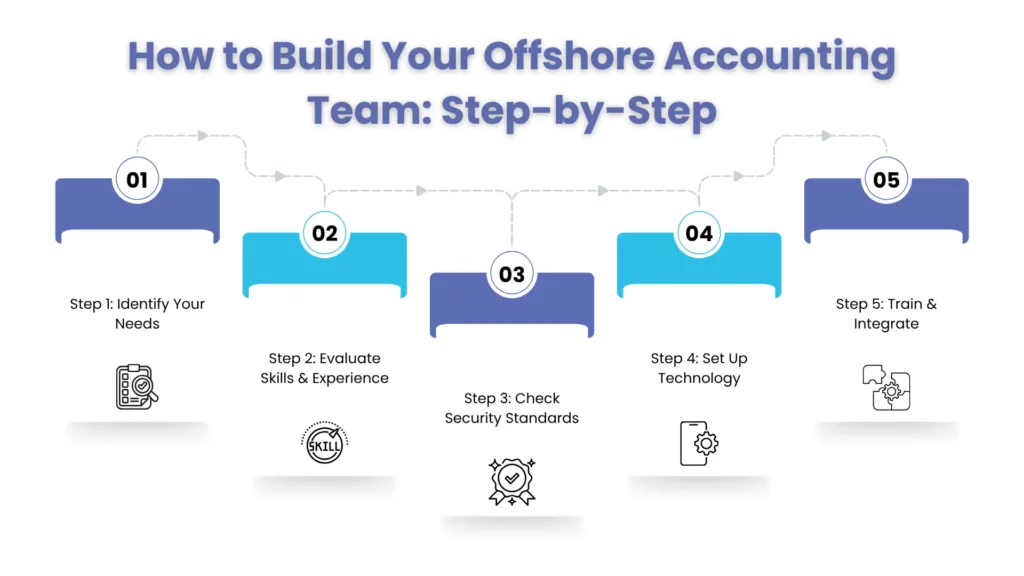
Before you jump into building an offshore accounting team, you must lay the groundwork. Hiring without a plan is the fastest way to encounter friction.
Define Your “Why” and “What”
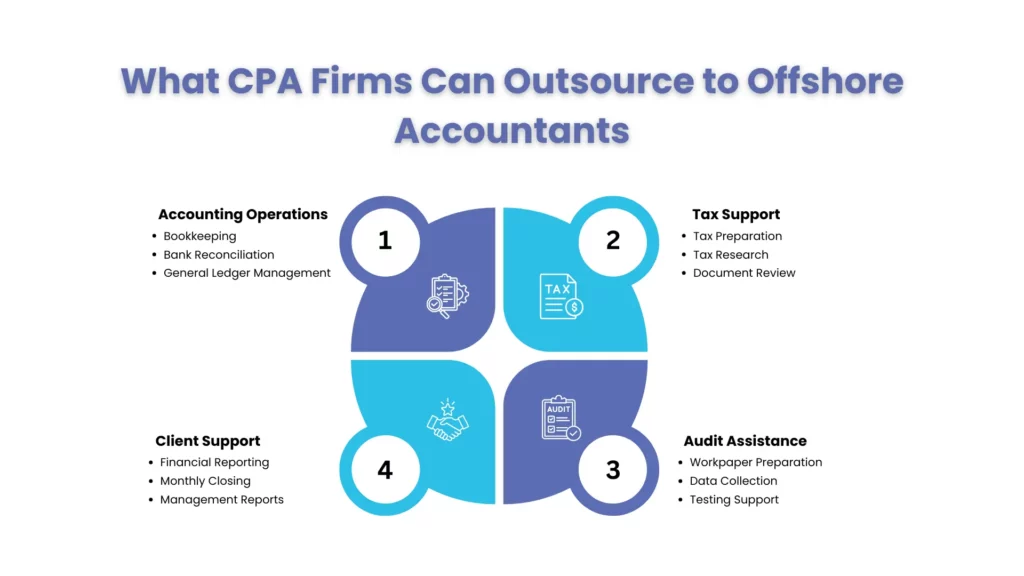
What specific tasks are bogging down your senior staff? Common areas to delegate to an offshore team for accountants include:
- Standard bookkeeping and data entry.
- Accounts payable and receivable.
- Tax preparation for individuals and small businesses.
- Audit support and workpaper preparation.
- Monthly management reporting.
Evaluate Your Technology Stack
To successfully build your offshore accountants team, your firm must be “cloud-ready”. If you are still using local servers and paper files, it will be extremely difficult to offshore. Make sure you have cloud-based accounting software (such as QuickBooks Online or Xero), safe document portals and solid practice management tools.
Security and Compliance
Data security is the number one concern for CPA firms. When hiring an offshore accounting team, ensure the provider or the individuals follow strict security protocols. Look for:
- SOC 2 Type II compliance.
- Compliance with the FTC Safeguards Rule under the Gramm-Leach-Bliley Act (GLBA) and IRS Publication 4557 data-security requirements — not GDPR, which applies to EU data subjects rather than U.S. taxpayer and client data
- Secure VPNs and multi-factor authentication (MFA).
- No-phone and “clean desk” policies in offshore offices.
How to Onboard Your Offshore Accounting Team the Right Way
The success of your global strategy hinges on offshore accounting team onboarding. You cannot simply “toss work over the fence” and expect perfect results.
The First 30 Days: Integration, Not Just Instruction
Remember to treat the new team members as part of the team – not a “vendor.
- Cultural Orientation: Share your company’s Vision and Values with them. Discuss why you choose to do things a given way for your clients.
- Standard Operating Procedures (SOPs): When building an offshore accounting team, you must have processes for building an offshore accounting team. Record videos with screen recording software (such as Loom) for a library of tutorials for all tasks they are expected to complete.. For a template starting point, see how CPA firms structure this in our post on outsourced bookkeeping for CPA firms.
- Communication Channels: Set up communication channels in Slack, Microsoft Teams, or Zoom. Building trust is crucial during the offshore accounting team onboarding process, and regular “face-to-face” video calls play a key part in this.
Provide Feedback Loops
In the early stages, provide daily feedback. Correcting a small mistake on day three prevents a massive headache on day thirty. Treat the offshore accounting team as you would a junior associate in your local office.
Managing Time Zones Without Losing Your Mind
One of the most common questions is how to handle the “time gap”. Finding the best time zones for offshore accounting teams depends on your firm’s workflow.
Common Regional Time Zones
- The Philippines: Typically 12–13 hours ahead of EST. This is excellent for a “flip” schedule where work is sent at 5:00 PM and returned by 8:00 AM the next morning.
- India: 9.5–10.5 hours ahead of EST. Similar to the Philippines, it offers a strong “follow-the-sun” model.
- South Africa/Eastern Europe: 6–7 hours ahead of EST. These regions offer a significant overlap with the U.S. morning, which is ideal for firms that require real-time collaboration during offshore accounting team onboarding.
Creating a “Golden Hour” of Overlap
Regardless of the region, make it a goal to set up 1-2 hours of overlapping work time. Take advantage of this “Golden Hour” for every day huddles to discuss difficult tax matters or training. When you grow your offshore team of accountants, it’s important for them to share overlap and not feel excluded.
Common Mistakes CPA Firms Make (and How to Avoid Them)
Even with the best intentions, many firms stumble when they first learn how to outsource accounting to offshore team members.
The “Set It and Forget It” Mentality
An offshore accounting team are not plug-and-play software; they are people. Firms that fail often treat the offshore team as a “black box” where work goes in and comes out. Success requires active management and leadership.
Under-Communicating
In a remote, offshore environment, you cannot over-communicate. If an instruction is ambiguous, an offshore accounting team may attempt to interpret it in the way they think it is supposed to be interpreted – resulting in rework. Set clear deadlines and anticipated outcomes.
Neglecting Security Training
Security is not just a one-off installation; it’s a way of life. Provide regular training to your offshore accounting staff regarding data privacy, password safety and phishing.
Focusing Only on Price
Having a good deal of money saved is a good thing, but the use of the lowest-cost workforce is likely to provide poor quality and high turnover. Hire a trusted partner that has good employees and a professional work setting. This is essential in establishing an offshore accounting team that can remain with you in the long term.
Is Your CPA Firm Ready to Scale With an Offshore Team?
Scaling is about readiness. To determine if you are ready to build your offshore accountants team, ask yourself these three questions:
- Are our processes documented? If your processes only exist in the heads of your senior managers, your offshore team will struggle.
- Is our leadership bought in? If your partners view offshoring as a “necessary evil” rather than a strategic opportunity, the culture will suffer.
- Do we have the right tools? Ensure your tech stack supports remote collaboration.
If you can answer “yes” to these, you are ready to reap the benefits of an offshore team for accountants.
Related Blog:
How CPA Firms Can Prepare for Tax Season: The Complete Readiness Checklist
10 Best CPA Outsourcing Services for CPA Firms in 2026
Need More Capacity During Busy Season?
Partner with Corient to access experienced offshore accountants who help CPA firms handle bookkeeping, tax preparation, audit support, and reporting without increasing local hiring costs.
People Also Ask:
How much does it cost to hire an offshore accounting team?
Costs vary by role, experience, and provider model, but most firms save 30–50% compared to an equivalent US hire once salary, benefits, and overhead are factored in. Dedicated offshore hires (working exclusively for your firm) typically cost more than shared-pool outsourcing but offer better consistency and client-specific familiarity over time.
Will my clients be upset if I use an offshore accounting team?
Most customers want accuracy, security and speedy delivery. Transparency is key. For many companies, engagement letters are revised to include information about the use of third-party or offshore support. Once clients see the faster turnaround and consistent quality an offshore team delivers, concerns about “where” the work happens tend to fade quickly.
How do I ensure the quality of work from an offshore team for accounting?
Quality is maintained through rigorous offshore accounting team onboarding, clear SOPs, and regular feedback. Implementing a “First Review” process where a senior offshore member checks the work of a junior member before it reaches your U.S. team is also a best practice.
What are the best time zones for offshore accounting teams to support U.S. firms?
The “best” time zone depends on your needs. For overnight processing, the Philippines and India (10–13 hours ahead) are excellent. For real-time collaboration and morning overlap, South Africa or Eastern Europe (6–7 hours ahead) are often preferred.
How long does offshore accounting team onboarding usually take?
While basic tasks can be transitioned in a few weeks, it typically takes 3 to 6 months for an offshore accounting team to become fully integrated and reach peak efficiency.
Can an offshore team for accountants handle complex tax returns?
Yes, provided they are trained on U.S. tax law and your firm’s specific software and workflows. Many offshore professionals hold advanced degrees and are highly experienced in U.S. tax preparation.
Conclusion
The decision to build your offshore accountants team is one of the most significant steps a modern CPA firm can take toward sustainable growth. From picking the best time zones for your offshore teams to going through offshore accounting team onboarding, you can have a strong team of productivity which helps your local workers focus on the most important thing – client relations.
Relying on an offshore accounting team is not just a matter of where the work gets done; it’s a matter of how a firm is going to succeed in today’s global economy. At Corient Business Solution, we believe that embracing an offshore team for accounting isn’t just about changing where the work happens; it’s about changing how your firm thrives in a global economy.
Scale Your CPA Firm Without Increasing Overhead
From bookkeeping and tax preparation to audit support and financial reporting, Corient helps CPA firms build secure offshore accounting teams tailored to their workflow. Get in touch with Today.