



A business tax extension is a smart financial decision when your business needs more time to prepare an accurate tax return using an IRS Form 7004. It offers businesses legitimate extra time to file, not additional time to pay taxes owed. Such an extension, when used appropriately, helps reduce errors and panicked filings and gives a vital breathing space during a busy tax season.
You can understand the importance of a business tax extension through this example: A CFO of a growing enterprise was observing that its team was juggling year-end close, audits, payroll, and tax preparation. Multiple business units were still finalizing financial statements, while its tax advisors were waiting for supporting documents. In such a situation, filing accurately and on time became difficult.
But instead of making a hasty filing and risking making costly mistakes, it chose the option of filing a business tax extension using Form 7004. This eased the pressure on their accounting team and gave them a breathing space to validate the financial data and then file the tax return with full confidence.
This scenario is becoming common every year across the United States. According to Acuity, about 5.5 million businesses file tax extensions each year. For large enterprises managing multiple entities, subsidiaries, or complex financial operations, a tax extension for business filers can be part of a well-planned tax strategy, not a sign of poor planning.
In this guide, we’ll explain how a Business Tax Extension works, who qualifies, key deadlines for 2026 (covering 2025 tax returns),the difference between an IRS extension filed on Form 7004 versus Form 4868, common mistakes to avoid, and how partnering with an experienced accounting support provider like Corient Business Solution can help simplify the entire process.
What Is a Business Tax Extension – and Do You Actually Need One?
A business tax extension is an IRS business tax extension, an IRS-approved request that is a lifeline for businesses that need more time to file their federal income tax return. It gives a 6-month reprieve from filing tax forms such as 1065, 1120, and 1120-S. Businesses can request this IRS extension by filing Form 7004, which is the official business tax extension form.
However, many misread it as a tool for getting more time to pay; it must be made clear that this Extension = More Time to File, Not More Time to pay.
Many businesses use extensions because they want to:
- Finalize year-end financial statements
- Complete audits
- Gather missing tax documentation
- Review complex deductions and credits
- Improve filing accuracy
- Coordinate reporting across multiple entities
Which Forms Do You Need to File a Business Tax Extension?
Corient’s tax team confirms the form depends entirely on your entity type: sole proprietors and single-member LLCs file Form 4868, while partnerships, S-corporations, and C-corporations file Form 7004. Filing the wrong form is one of the most common reasons an extension gets rejected, so Corient verifies entity classification before submission. Both forms grant a 6-month extension to file, not to pay, so any estimated tax owed is still due on the original deadline.
Quick-reference table
| Business Type | Form Required | Extension Length |
| Sole proprietor / single-member LLC | Form 4868 | 6 months |
| Partnership | Form 7004 | 6 months |
| S-corporation | Form 7004 | 6 months |
| C-corporation | Form 7004 | 6 months |
IRS Form 7004 vs. Form 4868: Which IRS Tax Extension Form Do You Need?
Not every business files the same IRS tax extension form. The correct form depends entirely on how your business is structured and taxed. Here’s how the two most common forms compare:
| Feature | IRS Form 7004 | Form 4868 |
|---|---|---|
| Who files it | C corps, S corps, partnerships, multi-member LLCs, trusts, and estates | Sole proprietors, single-member LLCs, and individual taxpayers |
| What it extends | Business income tax returns (Forms 1120, 1120-S, 1065, and others) | Individual income tax returns (Form 1040), including Schedule C business income |
| Extension length | 6 months | 6 months |
| 2026 deadline | March 16, 2026 (partnerships/S corps) or April 15, 2026 (C corps) | April 15, 2026 |
| Extends time to pay? | No | No |
If your business is taxed as a corporation or partnership, Form 7004 is the correct IRS extension request. If you run a sole proprietorship or a single-member LLC that reports business income on your personal return, you’ll instead need Form 4868, the same form individual taxpayers use for a personal IRS tax extension. Filing the wrong form is one of the most common reasons an extension request gets rejected or delayed, so confirming your entity type before you file is a critical first step.
Business Tax Extension Deadlines – By Entity Type
It’s important to know the business tax extension deadlines so that you don’t miss them. For 2025 tax returns filed in 2026, the general federal deadlines are expected to follow the IRS 2026 filing season.
2026 Extension Deadline Dates at a Glance
| Business Type | Original Filing Deadline | Extended Filing Deadline* |
| Partnerships (Form 1065) | March 16, 2026* | September 15, 2026 |
| S Corporations (Form 1120-S) | March 16, 2026* | September 15, 2026 |
| C Corporations (Calendar Year) | April 15, 2026 | October 15, 2026 |
| Multi-member LLCs | Depends on tax classification | Depends on entity type |
| Sole Proprietorships / Single-Member LLCs | April 15, 2026 | October 15, 2026 (via Form 4868) |
Dates reflect the typical IRS calendar for tax year 2025 returns filed in 2026. Businesses should always verify the official IRS filing calendar for any updates or disaster-related relief.
Along with a federal extension, you will also need a state filing extension, which differs from state to state.
Many states offer:
- Automatic approval if you have IRS Form 7004.
- Some states do not give automatic approvals, and you will need to file a separate state-specific extension form.
- Payment mandates differ from state to state.
Businesses operating in multiple states should carefully review each state’s tax authority requirements along with local and city-level taxes.
Working with experienced tax professionals or experienced outsourcing partners like Corient can help enterprises stay compliant across multiple jurisdictions.
How to File a Business Tax Extension Using Form 7004
The IRS allows businesses to request an extension by submitting Form 7004.
The Internal Revenue Service allows businesses to make a request for an IRS extension by submitting Form 7004. Wondering how to file it, it’s a simple process.
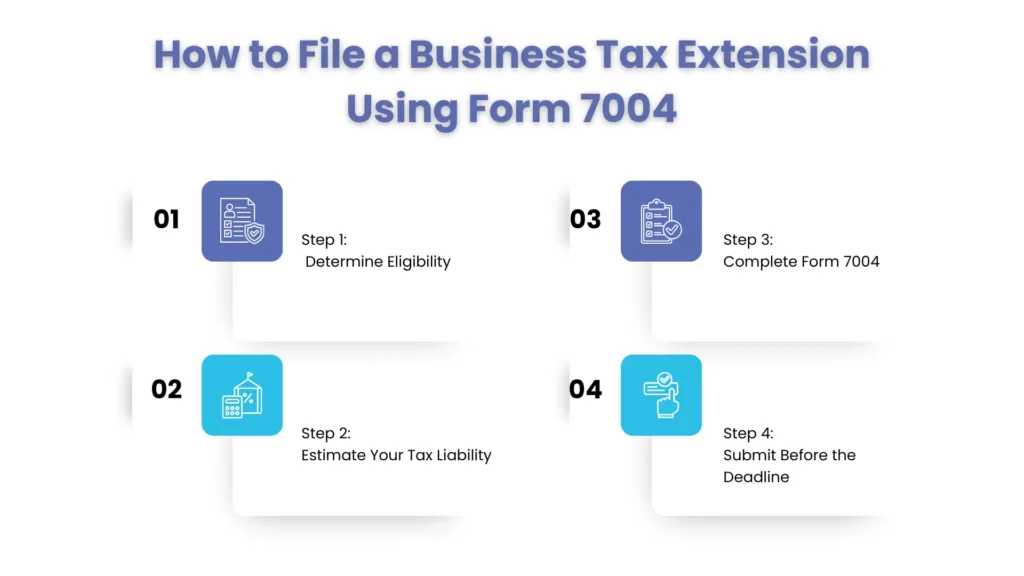
Step 1: Determine Eligibility
Confirm your business entity qualifies to use Form 7004.
Before you start filling out a Form 7004, make sure that your business is eligible for it. For instance, Form 7004 is applicable for business entities like corporations (C-corps and S-corps), partnerships, estates, trusts, and multi-member LLCs taxed as partnerships.
Sole proprietorships and single-member LLCs are not eligible for it and must use Form 4868 for their IRS tax extension instead.
Step 2: Estimate Your Tax Liability
Before you seek additional time for filing, remember that taxes must be paid at the original due date. Remember this extension is for more time to file, not more time to pay.
Step 3: Complete Form 7004
You’ll need information such as:
- Business name
- Employer Identification Number (EIN)
- Entity type
- Estimated tax due
Step 4: Submit Before the Deadline
Once you are done entering all the details in the form, you will need to either:
- Mail the completed form
- E-file Form 7004 online
- Use IRS-approved tax software
- Work with an authorized tax professional
Many outsourcing providers also allow businesses to file an IRS tax extension for business taxes online free or at minimal cost, depending on the platform and filing requirements. For larger enterprises with multiple legal entities, outsourcing this process to an experienced accounting partner reduces administrative complexity and minimizes filing errors.
Here’s where Corient Business Solution comes into the picture: our accounting support teams help organizations manage tax preparation, documentation, and compliance activities so internal finance departments can focus on strategic priorities.
What Happens If You Miss the Business Tax Extension Deadline?
You might be concerned about what happens if you miss the tax extension deadline.
Missing the filing deadline may result in:
- Failure-to-file penalties, 5% of the tax due (less any tax paid on time and available credits) for each month or partial month the return is late. The penalty accrues up to a maximum of 25%. (on businesses)
- Interest charges on unpaid taxes
- Increased IRS scrutiny
- Additional compliance challenges
Furthermore, if the taxes are not paid on their original due date, then penalties and interest are applied and continue to accumulate until the balance is settled. Such costs can be significant for even a large enterprise like yours.
The best approach is to plan well in advance, estimate tax liabilities accurately, and submit extension requests before the deadline.
Common Business Tax Extension Mistakes to Avoid
Although filing for a business tax exemption is simple, we have noticed multiple businesses committing some mistakes frequently. You should know about these mistakes so that they can be avoided.
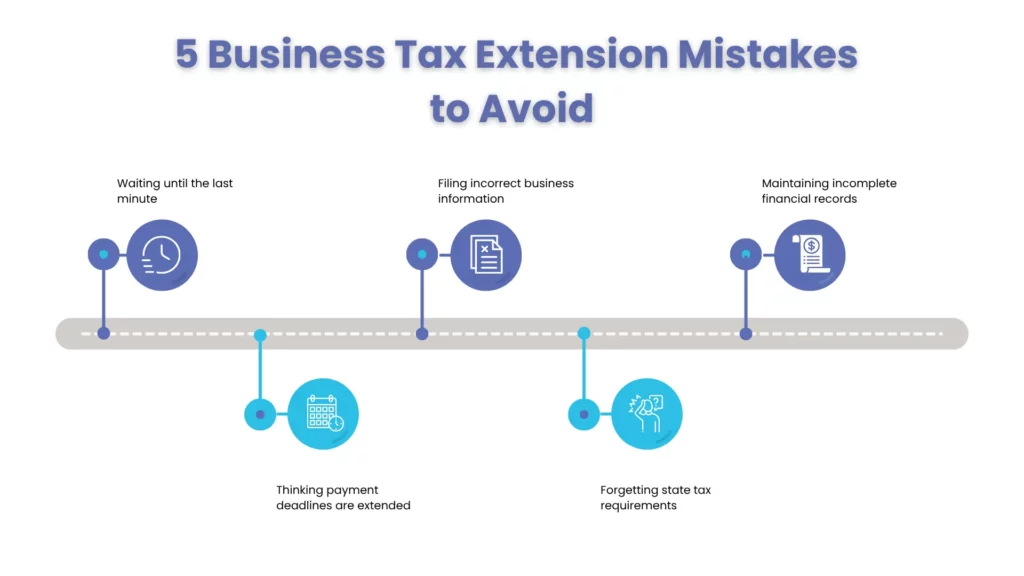
Assuming an Extension Delays Tax Payments
This is one of the common mistakes that has been committed by many businesses across the USA. Therefore, always remember that extensions delay filing, not payment, which has to be paid on its deadline.
Missing the Original Deadline
Waiting until the final day increases the risk of technical issues or incomplete information.
Using Incorrect Business Information
Errors in your EIN, entity classification, or filing details may delay processing, bring bad repute to your business, and grab the attention of regulators.
Filing the Wrong IRS Tax Extension Form
Businesses sometimes file Form 4868 when they should have filed Form 7004, or vice versa. Since eligibility depends on entity type, confirming which IRS extension form applies to your business before submission prevents an automatic rejection.
Forgetting State Requirements
Just getting a federal approval for extension is not enough; many businesses neglect satisfying state tax obligations where their business is based, leading to delays.
Poor Financial Recordkeeping
Incomplete bookkeeping often creates unnecessary delays during tax preparation.
Many enterprises reduce these risks by partnering with outsourced accounting providers that maintain accurate financial reports throughout the year.
Avoiding these common mistakes will require a lot of investment and workforce, which many businesses find difficult to commit to. That’s why they have started partnering with outsourced accounting providers who will maintain accurate financial records throughout the year.
Among outsourcing providers, Corient Business Solution ranks high when it comes to supporting finance teams of businesses with bookkeeping, reconciliations, financial reporting, and accounting operations that help simplify tax season from start to finish.
Should You File a Business Tax Extension
A business tax extension will not be needed all the time, but it is highly beneficial when it’s required. You will find a tax extension for business filing highly appropriate if:
- Financial statements are still being finalized
- Audits are ongoing
- Tax documentation is incomplete
- Multiple subsidiaries require consolidation
- Additional time improves filing accuracy
On the other hand, if you already possess complete financial records, then choose to file by the original deadline. The goal is not simply filing early but filing accurately.
People Also Ask:
What happens if you don’t file a business tax extension?
Not filing your business tax return or asking for a business tax extension before the due date will lead to IRS charging failure to file penalties, along with interest on any unpaid taxes. The penalties will rise overtime and continued non-compliance will lead to IRS notice or enforcement actions. All this can be avoided by filing a business tax extension on time.
Can you do an extension on business taxes?
While most business entities can request for extension by filing Form 7004 before the original filing deadline. That extension is only for submitting your tax return, taxes need to be paid by the original due date or else you will face penalties and interest.
What is a business tax extension and how does it work?
The business tax extension is an IRS approved way of giving businesses more time to file their federal income tax returns. For that they will have to file a form 7004 before the original filing deadline. This extra time (usually 6 months) give time to the business to complete their financial reporting accurately, gather important documents, and reduce the risk of filing errors.
How do I file a business tax extension using Form 7004?
To file a Business Tax Extension, complete Form 7004 with your business details, Employer Identification Number (EIN), entity type, and estimated tax liability. Submit the form electronically through an IRS-authorized e-file provider or by mail before the original filing deadline. If you expect to owe taxes, make the estimated payment by the original due date, as an extension only provides additional time to file—not to pay.
What is the business tax extension deadline for 2026?
For most calendar-year businesses filing 2025 tax returns, partnerships and S corporations generally have an extended filing deadline of September 15, 2026, while C corporations typically have until October 15, 2026. These dates are based on the standard IRS filing calendar. Businesses should always verify the official IRS deadlines each year, as filing dates may change due to weekends, holidays, or disaster-related tax relief.
Does a federal business tax extension apply to state taxes too?
Not necessarily. A federal IRS business tax extension does not automatically extend your state tax filing requirements. Many states have separate extension forms, payment deadlines, or filing procedures. If your business operates in multiple states, you should review each state’s tax authority requirements carefully to ensure full compliance and avoid state-level penalties or interest charges.
Can I e-file Form 7004 online?
You can do that using an IRS-authorized software or approved e-file services. Electronic filing is quick secure and provides a confirmation of the request received. That’s why it is preferred by the majority of businesses.
What happens if I miss the business tax extension deadline?
Missing out on business tax extension will lead to late filing penalties, interest on unpaid taxes, and other charges. More the delay more the penalties. So, ideally you must not miss the deadline if you thing you are not able to meet it then consult a professional tax professional or an outsourcing provider like Corient for assistance.
What’s the difference between Form 4868 and IRS Form 7004?
Form 4868 is the IRS tax extension form for individual taxpayers and businesses that report income on a personal return, such as sole proprietorships and single-member LLCs. IRS Form 7004 is the extension form for corporations, partnerships, multi-member LLCs, trusts, and estates. Both grant a 6-month extension to file, and neither extends the deadline to pay taxes owed.
What form do I need to file a business tax extension?
Corient’s tax advisors point businesses to Form 7004 for partnerships, S-corps, and C-corps, and Form 4868 for sole proprietors and single-member LLCs, filing the wrong one is the most common cause of a rejected extension.
Conclusion
Tax season should be a race against the clock, and a business tax extension has ensured that by providing businesses valuable time for preparing accurate returns, reducing compliance risks, and making informed tax decisions. When used wisely, it can help you provide the breathing space for making records accurate and avoid unnecessary pressure.
However, filing an extension is only one part of effective tax management. Strong bookkeeping, timely reconciliations, organized financial records, and proactive planning throughout the year are what truly make tax season easier.
That’s where Corient Business Solution can help.
Our outsourced accounting professionals support businesses with bookkeeping, financial reporting, reconciliations, and tax-ready accounting processes that keep your finance team prepared long before filing deadlines arrive.
Whether you’re managing one company or multiple entities, Corient is here to help you streamline accounting operations so your internal team can focus on growth, not paperwork.
Planning to file a Business Tax Extension for 2026? Contact us today to learn how our outsourced accounting solutions can help your business stay compliant, improve efficiency, and navigate tax season with confidence.