




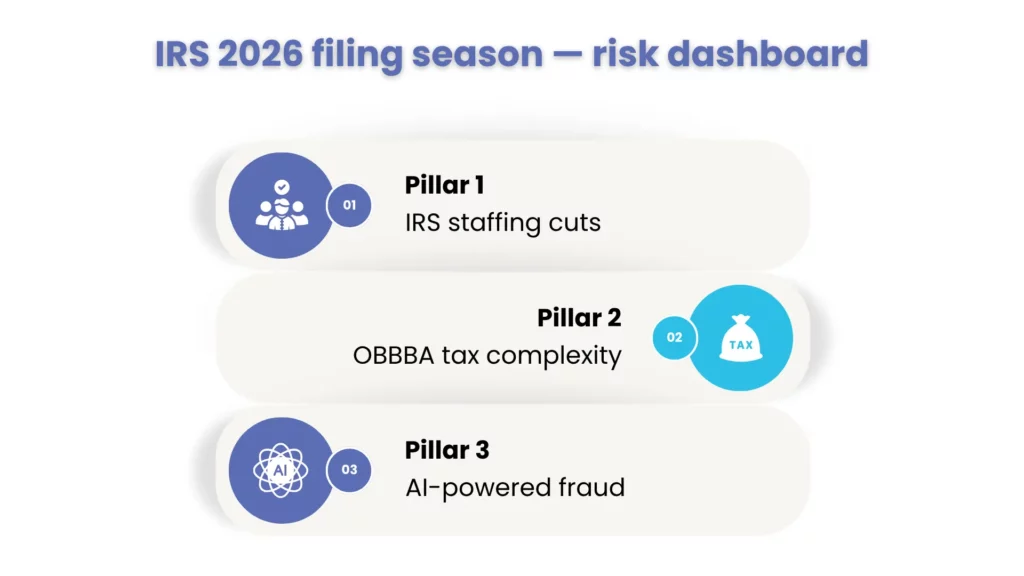
Each IRS filing season, the National Taxpayer Advocate and the Treasury Inspector General for Tax Administration (TIGTA) flag the risks businesses should watch for. For 2026, Erin M. Collins and TIGTA cautioned that this tax season carries elevated risk for US businesses. Three compounding factors drive the warning: a 27% overall IRS workforce reduction (from ~102,000 to ~74,000 employees), more than 100 tax code changes under the One Big Beautiful Bill Act (OBBBA), many retroactive to the 2025 tax year, and a sharp rise in AI-powered tax fraud. Taxpayers filing electronically with direct deposit are largely unaffected; those requiring IRS human review face the greatest delays and risks.
For most taxpayers filing electronically with direct deposit, the IRS expects processing to proceed normally. The risks are concentrated in situations requiring human IRS involvement paper returns, amended filings, disputes, and instalment agreements. With unprocessed paper returns rising from 52,293 in December 2024 to 294,052 in December 2025,(per the TIGTA January 2026 Readiness Report), businesses that rely on manual processes face the greatest exposure this season.
This guide covers what finance teams need to know: which new OBBBA deductions carry audit risk, how IRS tax extensions work, how to spot AI-driven scams targeting your payroll team, and the exact steps to take before your next filing deadline. See Corient’s Finance and Accounting Services for support with any of the above.
OBBBA Tax Law Changes That Affect Your 2025 Return
Many of the OBBBA provisions are retroactive to the 2025 tax year, making this filing season more complex than the last, stemming from the One Big Beautiful Bill Act (OBBBA), signed into law on July 4, 2025 as Public Law 119-21. The Taxpayer Advocate cautioned that the new rules have “complex eligibility rules, income thresholds, and phaseouts that will be hard for many taxpayers to understand and be reasonably sure the IRS filing season warning is implemented correctly.
Note: The IRS created a new Schedule 1-A to consolidate all four new OBBB deductions in one place. Ensure your accounting software has been updated to include this form.
The new deductions that could be the source of confusion this tax season are highlighted here:
Key OBBB Deductions — Eligibility, Risk & Income Thresholds
| New Deduction | Who It Applies To | Key Risk | Income Phase-out |
| Tips income deduction | Qualifying tipped workers (IRS-listed occupations only) | Eligibility widely misunderstood; occupations list is specific | Phases out over $160,000 MAGI |
| Overtime income deduction | Hourly workers within income thresholds | Max $12,500 ($25,000 joint); many overclaiming | Phases out over $150,000 ($300,000 joint) |
| Auto loan interest deduction | US-assembled vehicles only (verify via NHTSA VIN decoder) | Non-qualifying vehicles frequently claimed | Phases out over $100,000 ($200,000 joint) |
| $6,000 senior deduction | Taxpayers aged 65+ | Income phase-outs commonly missed | Phases out over $75,000 ($150,000 joint) |
| Enhanced Child Tax Credit | Eligible families | Old software reflects outdated limits | Verify current limits at IRS.gov |
| Raised SALT cap | High-tax state taxpayers | Cap rules misapplied for joint filers | Effective 2025–2029 |
The IRS waived third-party information reporting on several provisions, removing the W-2 and 1099 cross-checks that normally catch errors. Overclaiming is a heightened audit risk in 2026. Verify every deduction at IRS.gov before filing.
New: IRS Schedule 1-A — Required for All OBBB Deductions
The IRS introduced Schedule 1-A, Additional Deductions, to calculate and claim all four new OBBB deductions for 2025 returns. If you are claiming the tips deduction, overtime deduction, auto loan interest deduction, or the senior deduction, you must complete this schedule. Confirm your tax software has been updated to include it before filing. visit Corient’s Record to Report Services
How IRS Tax Extensions Work (Form 4868 and Form 7004)
Filing extensions are a practical risk-management tool this year, not a fallback. With OBBBA guidance still evolving and IRS capacity reduced, an accurate October return beats an incomplete April one. An accurate October return beats an incomplete April filing every time.
Who Should Consider Filing an IRS Tax Extension in 2026 and why?
Filing an extension makes sense if your business faces:
- Late-arriving K-1s from partnerships, S-corporations, or trusts
- Multi-state operations with complex apportionment documentation
- OBBBA deduction uncertainty while IRS guidance on new provisions is pending
- Recent finance team turnover affecting workflow continuity
- Significant late-2025 transactions not yet fully closed for tax purposes
How a Form 4868 Extension Works (and What it Does NOT Cover)
The critical distinction every finance team must know an extension extends your filing deadline not your payment deadline.
- Form 4868: Enacts new provisions for the extension of filing for individuals and sole proprietorships, to Oct. 15, 2026 – file at IRS.gov
- Form 7004: Partnerships, S corporations, and C corporations – Deadline depends on entity type
Even if this deadline is extended, taxes remaining due for 2025 are still due by April 15, 2026. The non-payment penalty is 0.5% per month, up to 25% and the IRS interest charge will be the short-term federal rate + 3%. The taxpayer can submit an IRS.gov application for an installment agreement that can be set up to pay the remaining balance over a period of up to 72 months if they are unable to pay the balance due on April 15.
Critical Deadlines: April 15 Original Deadline, October 15 Extended Deadline
| Deadline | Date | What It Covers |
| S-corp / Partnership extension | March 16, 2026 [CHANGED: was March 17] | Form 7004 for pass-through entities |
| Original filing / Extension request | April 15, 2026 | Individual and C-corp returns; Form 4868 or 7004 due |
| Tax payment due | April 15, 2026 | All taxes owed even with an extension filed |
| Partnership extension (extended) | September 15, 2026 | Final deadline for extended partnership returns |
| Extended filing deadline | October 15, 2026 | Final deadline for extended individual returns |
The IRS grants no further extensions beyond October 15, regardless of circumstances, plan filings accordingly.
Note: The IRS grants no further extensions beyond these dates.
Where Things Stand as of Mid-Year
Where things stand as of mid-2026: The April 15 original deadline has passed, but the extended deadlines have not. Partnerships and S-corps that filed Form 7004 have until September 15, 2026, and individuals and C-corps that filed Form 4868 have until October 15, 2026. If your business filed an extension, treat this mid-year window as the time to close out late-arriving K-1s, resolve OBBBA deduction questions, and avoid a repeat scramble in October.
Dirty Dozen / Fraud section
This year’s warning includes an urgent fraud alert. IRS Commissioner Frank J. Bisignano addressed the issue on National Slam the Scam Day (March 5, 2026), noting that scammers constantly adjust their tactics to target honest taxpayers. For finance teams managing payroll data and tax records, one breach can expose your entire organisation. Corient’s Back Office Processing includes secure payroll data protocols designed to reduce this exposure.
The IRS “Dirty Dozen” Top Threats This Season
The 7 categories of fraud in the IRS filing season warning Dirty Dozen are: Widely considered to be the riskiest for businesses this filing tax season:
- IRS impersonation phishing: Fake emails, texts and social media messages containing a QR code to trick people into visiting fake IRS sites to enter information.
- AI voice scams: Calls made with artificial voice that sound like human voice, have prerecorded messages and spoof caller ID numbers or make them look like real ones
- Preparers who file returns without a valid PTIN or without signing the returns: Ghost tax preparers; your business might be held liable for inaccuracies
- W-2 spear phishing: Malicious email messages that prey on CPAs and payroll staff to trick them into disclosing employee and client tax information
- Bogus self-employment tax credit promotions: Promoters deceiving businesses to claim tax credits that they are not eligible for.
- Abusive Form 2439 schemes: Fraudulent refund credits based on non-existent or misrepresented investment funds
- Misleading Offer in Compromise marketing: Companies overpromising IRS warning debt settlement at high fees to ineligible taxpayers
AI-Powered Phone Fraud and Fake IRS Websites on the Rise
AI is the defining escalation in this year’s IRS 2026 filing season warning. Voice-cloning technology now produces calls indistinguishable from a live IRS agent. Fake IRS websites appear as paid search ads during filing season; a routine search for “IRS” carries genuine click risk.
Payroll departments are prime targets of the IRS filing season warning, employees who expect tax communications during filing season are far more likely to trust a message appearing to come from internal HR than from a distant government office. Coordinated attacks across email, voice, and collaboration platforms are replacing the single suspicious email, making detection harder.
How to Verify IRS Contact (Mail First Always)
The IRS contacts taxpayers by official mail first never by unsolicited phone, email, or text.
The IRS will never:
- Demand payment via gift cards, wire transfer, or cryptocurrency
- Request credit card details over the phone
- Threaten immediate arrest or legal action without prior written notice
- Deny your right to question or appeal a tax bill
If contact seems suspicious, hang up. Report phishing to phishing@irs.gov and submit tips at IRS.gov/SubmitATip. These are the only legitimate IRS reporting channels.
IRS 2026 Filing Season Checklist for CFOs and Finance Teams
The IRS is clear that electronic returns are processed normally this filing season. Every elevated risk sits in situations requiring human IRS involvement. Build your compliance strategy around minimizing that exposure.
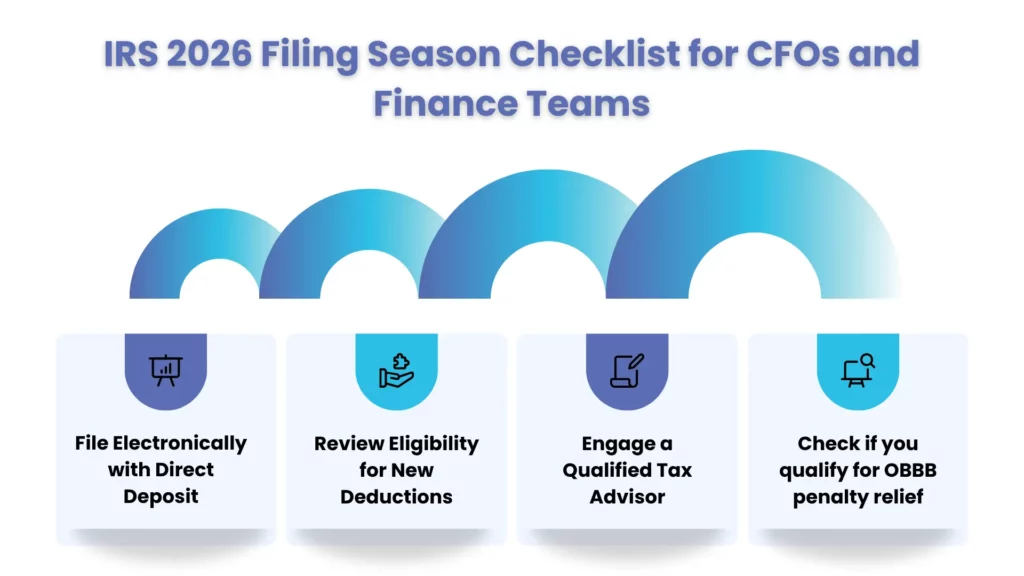
File Electronically with Direct Deposit the IRS’s Own Guidance
Electronic filing with direct deposit is the only method the IRS filing season warning unprocessed paper backlogs grew from 52,000 in December 2024 to nearly 294,000 by December 2025, per TIGTA. Paper refund checks were eliminated per executive order. Paper refund checks were phased out in September 2025. File electronically, choose direct deposit, and track your return via IRS Online Account at IRS.gov without needing to call the agency.
Review Eligibility for New Deductions Before Filing Don’t Rely on Previous-Year Playbooks
Last year’s approach does not apply to the IRS 2026 filing season warning, every OBBBA deduction carries specific income thresholds and documentation requirements and not all accounting software has been updated. Overclaiming in a year with waived third-party reporting is a real and heightened audit risk. Verify each deduction at IRS.gov before including it on your return.
Engage a Qualified Tax Advisor, Especially for Cross-Border US Filings
With IRS capacity at a multi-year low, errors in 2026 take longer to resolve than in any recent year. Businesses with international operations face added complexity. Engage a credentialed CPA, enrolled agent, or tax attorney with a valid PTIN and start those conversations well before April 15.
Check if you qualify for OBBB penalty relief
The IRS has announced penalty relief for tax year 2025 for taxpayers who under-withheld due to the tip and overtime income deductions. If your employees received tips or overtime in 2025 but withholding was not adjusted mid-year, you may qualify. Review IRS Notice 2025-110 and consult IRS.gov for eligibility details.
Still unsure how the IRS 2026 changes affect your specific business? Corient helps US companies to stay compliant through every filing season, from deduction reviews to full-service accounting support. No jargon, no surprises.
People Also Ask:
What is the IRS 2026 filing season warning about?
The IRS 2026 filing season warning comes from National Taxpayer Advocate Erin M. Collins, and will cover the following: IRAs are slashing their staff by 27%, they are making more than 100 tax law changes retroactively, and scams are becoming more common with AI. “Simple” electronic returns are being processed normally; those that need the IRS’s human help may experience lengthy wait times this filing season.
How does the staffing reduction affect my business?
The overall 27% workforce reduction (from approximately 102,000 to approximately 74,000 employees, per TIGTA) dramatically increases resolution times. Unprocessed paper returns rose from 52,000 in December 2024 to nearly 294,000 in December 2025. Amended returns, disputes, and installment agreements can now take several months.
What new deductions apply for the 2025 tax year?
For the 2026 tax year, key updates include higher standard deductions ($16,100 single, $32,200 married filing jointly), a new $6,000 “bonus” deduction for seniors over 65, increased retirement contribution limits, and higher income thresholds for tax brackets to account for inflation.
Does an extension give my business more time to pay taxes?
No, both Forms 4868 (individuals) and Form 7004 (businesses) only delay the filing deadline. All taxes owed for 2025 are due April 15, 2026. Any unpaid balances start being penalized at 0.5% per month, plus IRS interest, from the date of the filing of the extension, if one is filed.
How do I verify whether IRS contact is legitimate?
The IRS only contacts people through official mail; it never contacts them by phone, email or text. It will never ask for the payment of gift cards or cryptocurrency or threaten instant arrest. If the contact appears suspicious, don’t engage in any communications and confirm with the IRS.gov contact information.
Should my business file electronically in 2026?
Yes, definitely it is possible, there are several months’ long backlogs in paper returns, and paper refund checks are no longer issued. The only reliable way to get timely and accurate filing and refunds in 2026 is by electronic filing with direct deposit.
What is Schedule 1-A and do I need it?
Schedule 1-A is a new IRS form introduced for the 2025 tax year that consolidates all four OBBB deductions — tips, overtime, auto loan interest, and the senior deduction — in one place. If you are claiming any of these deductions, you must file Schedule 1-A with your return.
Conclusion
This year’s IRS filing season warning centers on three compounding risks: a 27% cut in workforce, more than 100 retroactive tax law changes, and a sharp rise in AI-driven scams. Together, they mean real exposure — penalties, audits, and lengthy delays can turn a simple filing into a major headache. This year, finance teams need to double down on preparation: verify all deductions electronically, treat April 15 as your firm payment deadline regardless of any extensions, and stay alert for signs of fraud.
Getting through this tax season smoothly comes down to focus and teamwork. Make sure your staff know what to watch for, encourage them to report anything suspicious, and put structured processes in place to reduce risk. For businesses wanting practical guidance, Corient Business Solutions offers tools and insights to help finance teams stay organized, secure, and confident, even in a filing season as challenging as this one. Get in touch today.