



Why is cash flow forecasting necessary?
Cash flow forecasting is the process of estimating a business’s future cash inflows and outflows over a defined period, typically 13 weeks for operational planning or 12–36 months for strategic planning. For CPA firms, offering cash flow forecasting shifts their service model from reactive historical reporting to high-margin Client Advisory Services (CAS). It provides corporate clients with early visibility into liquidity gaps, working capital needs, and strategic growth opportunities while unlocking predictable monthly retainers for the practice.
In today’s dynamic financial environment, client expectations for accounting practices are shifting rapidly. Historical reporting, annual tax filings, and compliance accounting remain fundamental, but corporate leaders now demand proactive advisory services that guide their future growth. Among advisory offerings, robust cash flow forecasting stands out as the single most critical deliverable for accounting practices seeking to scale their Client Advisory Services (CAS).
A widely cited 2015 U.S. Bank study (conducted by researcher Jessie Hagen) found that 82% of small businesses that fail cite poor cash flow management as a contributing cause — a figure that has since been referenced across SBA-affiliated resources, the U.S. Chamber of Commerce, and SCORE. Separately, SBA and Bureau of Labor Statistics data show that roughly 20% of new businesses fail within their first year and about half fail by year five — underscoring how much runs on cash timing, not just profitability. When CPA firms deliver structured cash flow forecasting, they move from historians to strategic financial partners, helping clients navigate volatility, plan capital expenditures, and avoid liquidity crises before they happen.
This comprehensive guide examines how accounting firms can implement, scale, and optimize cash flow forecasting services—exploring key benefits, core processes, sample client scenarios, and modern delivery models.
What Is Cash Flow Forecasting?
In essence, cash flow forecasting is about predicting the flow of cash in and out of your business for a given period of time, usually a week, month, quarter or year. Unlike profitability modeling, which relies on accrual accounting, a cash flow forecast tracks real liquidity movement through the bank account: cash flowing in from receivables and cash flowing out to payroll vendors, debt payments, taxes, etc.
Short-Term vs. Long-Term Cash Flow Forecasting
Modern advisory practices generally categorize cash flow forecasting into two primary operational models:
- Short-Term Cash Flow Forecasting (13-Week Forecast): Focuses on immediate liquidity, working capital management and short-term cash requirements. It monitors the daily and weekly cash flow of the business in order to ensure that firms can pay their payroll, pay their key suppliers, and have some cash flow buffer in between.
- Long-Term Cash Flow Forecasting (12 to 36 Months): Focuses on strategic financial planning, capital expenditure (CapEx), growth hiring, debt refinancing, and key business growth.
It becomes easy for CPA firms to offer end-to-end strategic and operational clarity by combining the direct cash method with indirect method projections for short-term projections and multi-year strategy, respectively.
Why Cash Flow Forecasting Matters for CPA Firms and Their Clients
Managing paper profitability alone is insufficient for corporate survival. Many profitable businesses face financial distress due to cash timing mismatches—such as delayed invoice collections paired with immediate payroll or vendor obligations. Proactive cash flow forecasting directly addresses this operational vulnerability.
The Value for Corporate Clients
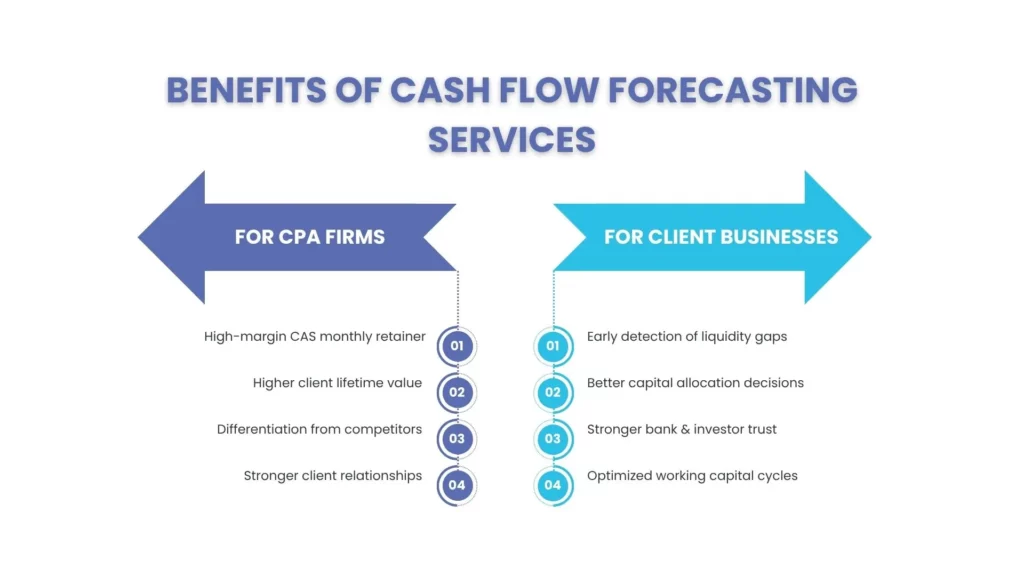
- Eliminates Cash Surprises: A well-designed cash flow forecasting system can detect cash shortages many weeks or months in advance, enabling the executive team to make necessary adjustments to the burn rate or borrow from a line of credit.
- Optimizes Working Capital: Systematic cash flow forecasting uncovers non-productivity in collections (Days Sales Outstanding – DSO) and accounts payable timing (Days Payable Outstanding – DPO).
- Accelerates Strategic Growth: A trustworthy cash flow forecast can be used by corporate management to consider the feasibility of new hiring, equipment investments, or market expansion, without compromising the core stability of the operations.
The Strategic Value for CPA Firms
- Drives Predictable Retainer Revenue: Cash flow forecasting moves periodic tax engagements into recurring advisory-based retainers with predictable cash flow and high margins.
- Deepens Client Retention: By highlighting financial risks to your clients’ attention, you become a trusted, indispensable partner because you’re preparing them for the future through structured cash flow forecasting.
- Elevates CAS Practices: Cash flow forecasting enhances a firm’s CAS practices and helps to differentiate your firm from compliance-focused competitors.
Key Benefits of Offering Cash Flow Forecasting Services
Adding formal cash flow forecasting to your firm’s service portfolio generates strategic advantages for both your internal team and your business clients.
High-Margin Revenue Expansion
While tax preparation and audit engagements carry strict fee caps and seasonal volume compression, advisory services based on cash flow forecasting command premium monthly retainers. Corporate clients readily pay for forward-looking clarity that directly protects their operational solvency.
Data-Backed Financial Decision-Making
Clients often ask their accountants such questions as, “Can we afford to open a second facility this quarter?” or “Should we buy this equipment now or wait 6 months?” The scenario approach to cash flow forecasting allows you to take a more scientific approach to answering these questions, instead of depending on a hunch.
Proactive Risk Mitigation
External events like disruptions in the supply chain, major macroeconomic changes, or the loss of a large account may quickly have a negative effect on business cash flow. A regular cash flow forecasting model includes scenario sensitivity and enables executive teams to stress-test the cash flow of their operations for different economic conditions.
Stronger Credit & Investment Approvals
Lenders and equity investors look at past financial statements, and lenders extend capital based on future cash flow performance. Verified cash flow forecasting reports really enhance your clients’ creditworthiness and debt approval rates in bank negotiations (read more about cash projection modeling on J.P. Morgan Treasury Insights).
How CPAs Can Help Businesses Improve Cash Flow Visibility
Many business leaders struggle to maintain clear financial visibility because operational data remains siloed across disparate accounting and billing systems. Accounting practices bridge this gap by bringing analytical rigor, financial discipline, and integrated reporting technology to the organization.
Unifying Disparate Financial Data
CPAs clean up chart-of-accounts structures and integrate core general ledgers (e.g., QuickBooks Online, Xero, NetSuite) directly with commercial bank feeds and enterprise billing platforms. This integration ensures that the cash flow forecasting engine relies on accurate, real-time data inputs.
Setting Up Operational Cash Metrics
To maintain actionable cash flow forecasting, CPAs establish and monitor primary working capital Key Performance Indicators (KPIs):
- Cash Conversion Cycle (CCC): The number of days it takes from the purchase of raw materials and operational inputs until cash is received from these resources.
- Days Sales Outstanding (DSO): Accelerating client collection speeds through structured billing intervals and automated follow-ups.
- Days Payable Outstanding (DPO): Strategically managing vendor payment terms without harming supplier relationships or incurring late fees.
Stress-Testing Cash Scenarios
CPAs immediately provide value by creating best case, expected case and downside risk models in their cash flow forecasting process. Through tweaking important parameters such as payment velocity, revenue volatility, or margin adjustments, business leaders can get a comprehensive view of what their lowest liquidity levels are.
Cash Flow Forecasting Process: Steps and Best Practices
Executing accurate, scalable cash flow forecasting across multiple corporate client accounts requires a standardized, repeatable methodology. Below is the multi-step framework leading CPA practices use to deliver reliable results.
1.Establish the Baseline & Historical Cash Profile:
Look at the bank statements, operational cash flow and general ledger activity for the past 12 to 24 months before making any forward-looking projections. Look for common seasonal patterns, significant one-time costs, when and how taxes are collected, and the average time lag between sales and collection to make realistic basis forecasts for your cash flow forecasting model.
2.Determine the Right Forecasting Horizon and Method:
Select the appropriate model based on client needs:
- Direct Cash Flow Method: Appropriate for cash flow forecasting for 13 weeks, where individual accounts receivable, payables and/or recurring banking line items are directly mapped.
- Indirect Cash Flow Method: Suitable for 12 to 36-month cash flow projections; best used for translating Net Income into cash positions by making adjustments for non-cash expenses, working capital changes and changes in the balance sheet.
3.Aggregate Cash Inflow Projections:
Forecast incoming cash sources by breaking them into distinct operational streams:
- Existing Accounts Receivable (factoring in historical DSO delays)
- Recurring contract retainers and subscription billing
- Projected sales volume pipeline multiplied by historical conversion rates
- Non-operational cash sources (credit lines, tax refunds, capital injections)
4.Map Out Cash Outflow Requirements:
Document every mandatory cash drain accurately within the cash flow forecasting framework:
- Fixed operational expenses (rent, utilities, software subscriptions, insurance)
- Variable operating expenses (COGS, raw materials, shipping, hourly labor)
- Payroll, employer payroll taxes, and benefit schedules
- Scheduled debt service, tax liabilities, and owner distributions
5.Run Scenario Sensitivity & Variance Analysis:
Quality control and iterative accuracy alignment. Compare rolling historical projections against actual bank balances bi-weekly or monthly. Quantify variances, adjust baseline velocity assumptions, and continuously refine the underlying predictive rules within your cash flow forecasting engine.
Need Help Building Reliable Cash Flow Forecasts for Your Clients?
Our finance specialists help CPA firms streamline forecasting models, integrate financial data, and deliver client-ready advisory reports that strengthen CAS capabilities.
Operating Standards for CPA Firms Delivering Forecasting Services
To maximize efficiency and accuracy across your firm’s advisory engagements, adhere to these proven industry standards:
- Automate Data Synchronization: Eliminate manual spreadsheet entry by connecting specialized cash flow forecasting tools directly to client general ledgers and commercial banking feeds.
- Account for Seasonality: Avoid relying on straight-line average calculations; factor in historical seasonal demand spikes and slow-payment cycles.
- Establish Liquidity Reserves: Build target cash safety cushions (e.g., 60 to 90 days of operating expenses) directly into executive client dashboards.
- Deliver Clear Executive Insights: Provide concise executive summaries that translate complex financial modeling into actionable business advice.
AI and Automation in Modern Forecasting
Forecasting is shifting from static spreadsheets toward AI-assisted modeling. What’s changing:
- Automated anomaly detection flags unusual transactions before they distort a forecast, rather than surfacing them during a manual monthly review.
- Predictive receivables scoring uses historical payment behavior to estimate which invoices are likely to pay late, refining DSO assumptions automatically instead of using a flat historical average.
- Natural-language executive summaries, some platforms now auto-generate plain-English commentary alongside the numbers, cutting the manual write-up time for advisors.
This doesn’t replace the CPA’s judgment — scenario design, assumption-setting, and client interpretation still require an experienced advisor — but it does reduce the manual data-entry burden that limits how many clients a firm can serve.
Common Client Objections — and How to Respond
| Objection | How to Respond |
| “I already get cash reports from QuickBooks.” | QBO reports show historical cash movement; a forecast shows forward risk — the gap between the two is exactly where liquidity crises get missed. |
| “This seems expensive for something I could build myself.” | A DIY spreadsheet model typically breaks down after 2–3 months without dedicated upkeep; the retainer covers ongoing accuracy, not just initial setup. |
| “We’re profitable — why do we need this?” | Profitability and liquidity fail on different timelines; the ABC Logistics example below shows a profitable, growing company that still hit a real cash shortfall. |
| “How is this different from budgeting?” | A budget is a plan for the year; a forecast is a live, continuously updated view of actual cash trending against that plan. |
Cash Flow Forecasting Example: A Sample Client Scenario
To examine the real-world impact of strategic advisory work, consider this practical scenario featuring a growing mid-market client.
Client Profile
- Company: ABC Logistics LLC (Specialized Freight & Fleet Services)
- Annual Revenue: $12,000,000
- Challenge: Rapid revenue expansion caused severe cash squeezes due to upfront fuel and driver payroll costs combined with 60-day billing terms for enterprise customers.
The CPA Advisory Solution
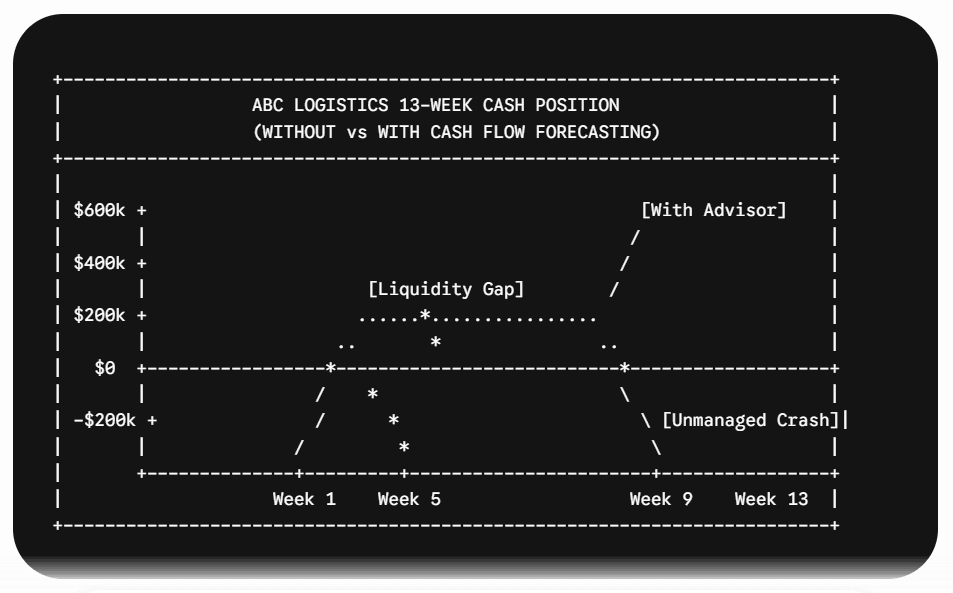
ABC’s CPA firm implemented a weekly 13-week cash flow forecasting model paired with dynamic scenario analysis. The structured framework revealed a major liquidity deficit looming in Week 6 caused by simultaneous fleet maintenance payments, quarterly corporate tax liabilities, and delayed enterprise receivables.
Actions Taken via Cash Flow Forecasting Insights
- Factoring & Credit Line Adjustments: Armed with clear cash flow forecasting data, the CPA helped ABC secure a temporary $300,000 revolving credit line weeks before the shortfall hit.
- Collection Acceleration: Identified high-DSO enterprise accounts and implemented 15-day early payment discounts, accelerating $140,000 in cash receipts, the same discipline applied through structured Order to Cash processes.
- Vendor Payment Structuring: Renegotiated fuel supplier terms from Net 15 to Net 45 days, aligning outflows with incoming client collections.
Result
ABC Logistics successfully navigated its growth phase without missing payroll or delaying fleet servicing, proving the massive ROI delivered by proactive cash flow forecasting.
Common Cash Flow Forecasting Challenges for Businesses
While the value of forward-looking financial management is clear, building and maintaining reliable forecasting models comes with operational hurdles.
| Challenge | Root Cause | Impact on Cash Visibility | CPA Advisory Solution |
| Inaccurate Data Inputs | Unreconciled accounts, delayed ledger entries | Broken assumptions in cash flow forecasting models | Daily automated bank feeds and automated bookkeeping schedules |
| Unpredictable Customer Delays | Poor collection follow-ups, dispute delays | Phantom receivables distorting inflow timing | Historical DSO weighting applied to outstanding invoices |
| Spreadsheet Overhead | Manual Excel/CSV updates | Error-prone models that quickly become outdated | Cloud-based software auto-synced with the ERP |
| Ignoring Unexpected Outflows | Omitting capital expenses, tax obligations, or debt service | Sudden cash burn emergencies | Integrated cash burn models tracking non-operational liabilities |
Recognizing these challenges gives accounting firms a distinct edge. By offering managed advisory packages, CPAs solve these operational pain points directly for busy clients.
Why CPA Firms Outsource Cash Flow Forecasting Support
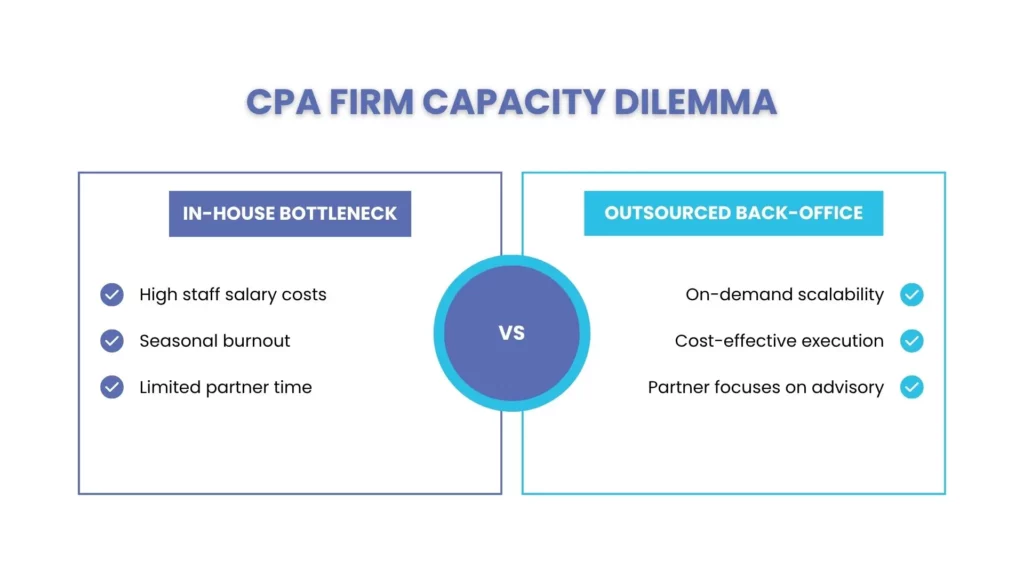
As demand for Client Advisory Services grows, CPA firms often face severe capacity constraints. Designing, populating, and updating custom cash flow forecasting models for dozens of corporate clients requires significant manual effort and specialized analytical bandwidth.
Key Drivers for Outsourcing Back-Office Advisory Support:
- Talent Shortages & Overhead Pressure: Hiring senior staff accountants strictly to execute backend cash flow forecasting data entry strains firm operational budgets and squeezes advisory margins.
- Scalability Constraints: Managing manual data pulls across multiple clients limits the number of advisory accounts a firm partner can effectively serve.
- Software Configuration Friction: Standardizing custom tools across diverse client general ledgers demands technical resources that mid-sized CPA practices often lack internally.
By partnering with specialized back-office support providers, accounting firms offload repetitive financial modeling, data aggregation, and report generation—allowing partners to focus entirely on high-level client strategy.
Scale Your CAS Practice Without Increasing Overhead
From 13-week cash forecasts to long-term financial models, Corient provides the execution support CPA firms need to expand advisory services while focusing on client relationships.
How Corient Supports CPA Firms With Cash Flow Forecasting Services
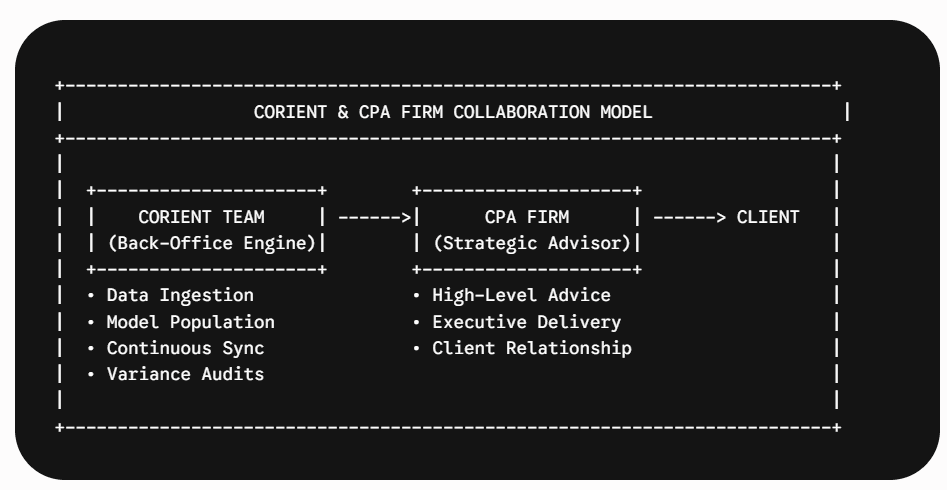
Corient Business Solution serves as a strategic back-office growth partner for accounting practices across the United States, providing specialized resource support that empowers firms to scale their Client Advisory Services efficiently.
End-to-End Cash Flow Forecasting Execution
Corient’s financial analysts build, maintain, and update custom cash flow forecasting models tailored to your clients’ unique operating requirements. From setting up direct 13-week cash projections to multi-year scenario planning, our team handles the heavy lifting behind the scenes.
Seamless Software Integration
Our team works natively within leading cloud accounting platforms—such as QuickBooks Online, Xero, NetSuite, Float, Fathom, and Helm. We configure clean data feeds and automate balance sheet updates so your firm’s cash flow forecasting dashboards remain accurate and up to date.
White-Labeled Advisory Deliverables
All deliverable reports, visual dashboards, and scenario analysis models are white-labeled under your CPA firm’s branding. Your clients experience polished, professional cash flow forecasting reports delivered directly by your advisory team.
Operational Cost Efficiency
By leveraging Corient’s outsourced talent model, CPA firms optimize execution costs compared to expanding internal headcount. This enables your firm to offer competitive advisory pricing while protecting high profit margins.
People Also Ask About Cash Flow Forecasting Services
How often should a cash flow forecast be updated?
There should be short-term 13-week cash flow forecasting models and they should be updated on a weekly basis, for operational visibility, in order to show, in real time, the receivables and payables. There are monthly or quarterly strategic 12-month models that can be reviewed on a regular basis with wider financial performance reviews.
What is the primary difference between profit and cash flow?
Profit (Net Income) is total revenues minus total expenses for an accrual basis, not a cash basis. Cash flow forecasting involves looking at cash inflows and outflows to bank accounts and reflects cash flow changes in the balance sheet, such as inventory purchases, debt service, accounts receivable timing and capital investments.
What software tools are best for cash flow forecasting?
Popular specialized platforms include Float, Fathom, Jirav, and Helm. However, pairing these cloud tools with experienced accounting analysts ensures the underlying cash flow forecasting model accounts for complex business realities that software alone might overlook.
How can CPA firms package and price cash flow forecasting services?
Estimated pricing typically starts around $1,500/month per client and scales to $5,000+ for larger, more complex accounts, these are general industry estimates, not confirmed pricing, and should be set based on your firm’s own costs and positioning.
How accurate should a cash flow forecast be?
A mature 13-week model should typically land within 5–10% variance by the fourth week of the cycle. Wider variance early on is normal while assumptions are still being calibrated.
How is cash flow forecasting different from budgeting?
A budget is a static annual plan. A forecast is continuously updated against actual cash trends, making it a live tool rather than a once-a-year exercise.
Can a small business afford cash flow forecasting services?
Yes — engagement scope can flex significantly. A lean model tracking only the client’s highest-risk cash items (see the small-business example above) can be delivered at a lower price point than a full multi-line 13-week build.
Does AI replace the need for a CPA in forecasting?
No. AI tools can automate anomaly detection and receivables scoring, but assumption-setting, scenario design, and interpreting results for a specific client’s context still require an experienced advisor.
Conclusion: Elevate Your Advisory Practice with Strategic Cash Flow Services
One of the quickest methods to grow recurring income, boost the value of your CPA company, and provide game-changing value to company clients is through the incorporation of sturdy cash flow forecasting into your services provided. Your practice will become a true business advisor who can offer your clients financial clarity in the future.
Partnering with Corient Business Solution allows your firm to scale high-margin cash flow forecasting services seamlessly—without overworking internal staff or increasing overhead costs.
Ready to grow your firm’s advisory practice? Contact Corient today to learn how our specialized back-office support can help you expand your service capabilities.
Expand Your CPA Firm’s Advisory Capabilities With Cash Flow Forecasting Support
Cash flow forecasting enables CPA firms to move beyond compliance and deliver proactive financial guidance to clients. With Corient’s specialized finance support, your firm can offer accurate forecasting, reporting, and advisory services without the challenges of hiring and training additional resources.
Ready to grow your CAS practice?
Partner With Corient for Cash Flow Forecasting Services