




US CPA firms hire dedicated bookkeeping teams in India to add reliable production capacity without adding headcount. A dedicated team works inside your existing software and processes, absorbs recurring reconciliation and close work, and leaves review, client communication, and professional judgment with your US staff.
Picture a firm that has grown to 200 clients. Revenue is up. So is the bookkeeping queue. Your accountants are spending their week on transaction coding, reconciliations, and month-end close instead of talking to clients or selling advisory work.
The obvious answer is to hire. But recruiting takes months, the market is thin, and the demand you are hiring against is not constant across the year, it spikes at month-end, quarter-end, and through tax season.
That gap between when you need capacity and when you can hire it is why the dedicated bookkeeping model has become a standard part of how firms staff production work.
Done properly, it is not simply about sending work offshore. It is about building a repeatable delivery structure that gives your firm more capacity while client relationships, review, and professional judgment stay firmly under your control.
The behaviour is now mainstream. In the AICPA’s 2025 National Management of an Accounting Practice (MAP) Survey, 29% of responding firms reported using offshoring, broadly unchanged from the 2023 cycle, when roughly 30% of more than 1,100 firms reported outsourcing domestically and 25% offshore. Offshore capacity is no longer an experiment the profession is running. It is a settled part of how a quarter to a third of firms operate.
So the question for most firms is no longer “should we hire?” It is “what is the smartest way to build the capacity we need?”
What is a dedicated bookkeeping team?
A dedicated bookkeeping team is a named group of accounting professionals assigned to your firm on an ongoing basis, working inside your workflows, your software, and your quality standards. Unlike task-based outsourcing, the same people stay on your account, so process knowledge compounds instead of resetting with every engagement.
You define the scope. You set review procedures and turnaround expectations. You keep every client-facing decision.
How this differs from other engagement models
Most firms comparing offshore options are really choosing between three structures:
| Model | Best when | Trade-off |
| Dedicated FTE | Volume is steady and process knowledge matters | Fixed monthly commitment |
| Shared pool | Volume is low or unpredictable | Less continuity; more re-explaining |
| Per-transaction / block hours | Work is episodic, cleanups, catch-up, seasonal overflow | Harder to forecast cost at scale |
Why CPA firms are choosing the dedicated model
- Capacity without immediate headcount: You can take on more bookkeeping clients without opening a requisition, running a search, or carrying a salary through your slow months.
- More predictable delivery: Before work transfers, the team is briefed on your processes, documentation standards, and review expectations, then calibrated against them. Output becomes something you can plan around rather than something you chase.
- Less pressure on your US staff: Recurring bookkeeping is time-consuming and low-leverage. Moving it lets your US accountants concentrate on review, client conversations, and advisory work, the services clients actually pay a premium for.
- Seasonal demand you can absorb: Volume climbs at month-end, quarter-end, and around filing deadlines. A flexible model gives you that capacity without staffing to peak all twelve months.
- Scalability: When your client base grows, capacity can expand without a recruitment cycle standing between you and the work.
- A deeper talent pool: India has a large, established finance and accounting services sector, with professionals experienced in US GAAP and the software US firms actually run.
If you are still deciding whether to outsource at all, our overview of outsourced bookkeeping for CPA firms covers that earlier decision.
What bookkeeping work CPA firms delegate
A dedicated team handles recurring production work. In practice, that clusters into four areas:
Transaction processing
- Transaction categorisation
- Bank and credit card reconciliations
- Invoice processing
- Journal entries
Payables and receivables
- Accounts payable
- Accounts receivable
- Payroll-related bookkeeping
Close and reporting
- General ledger maintenance
- Month-end close support
- Financial statement preparation
- Management reporting
Remediation
- Accounts cleanup
- Bookkeeping catch-up
- Client bookkeeping queries
What you delegate depends on your review structure. A common split: the offshore team prepares monthly books and reconciliations; a US accountant reviews before anything reaches the client. That creates a clean separation between production and professional oversight.
Quality control is not optional here. The IRS requires complete and accurate records to prepare financial statements and returns and to substantiate what is reported on them. Whoever keys the transaction, your firm is the one standing behind the file.
How a dedicated bookkeeping team in India works
Engagement starts with an assessment of your current workload, client count, transaction volume, industry mix, software, existing workflows, month-end requirements, review procedures, and turnaround expectations. That assessment determines team size and structure before anyone touches a client file.
Once the engagement starts, responsibility splits cleanly:
| Your firm owns | The dedicated team handles |
| Client relationship and communication | Transaction processing and reconciliations |
| Instructions and standards | Documentation and workpapers |
| Review and correction | Month-end close preparation |
| Final approval and sign-off | Financial statement preparation |
| Professional judgment and liability | Recurring production work |
The model works best when the team is trained around your firm’s specific standards rather than treated as generic offshore labour. At Corient, our bookkeeping teams operate as a white label bookkeeping of your practice, inside your software, under your brand, invisible to your clients.
What compliance requires before you send work offshore
This is the part most offshore bookkeeping articles skip, and it is the part your professional liability carrier will ask about first.
- Client consent under IRC §7216: If an engagement involves disclosing tax return information to a preparer located outside the United States, US regulations require the client’s advance written consent (Treas. Reg. §301.7216-3). Revenue Procedure 2013-14 sets the format, including 12-point type and masking of the taxpayer’s Social Security number. Pure bookkeeping does not automatically fall under §7216, but the moment the same relationship extends into return preparation, it does. Build the consent into your engagement process before that line gets crossed, not after.
- Data safeguards: IRS Publication 4557, Safeguarding Taxpayer Data, sets out the security expectations for anyone handling taxpayer information. Your provider’s controls should map to it explicitly, not approximately.
- Engagement letter disclosure: Even where consent is not legally required, disclosing the use of third-party service providers in your engagement letter is standard risk-management practice and avoids an uncomfortable conversation later.
Corient’s engagement model is built for US CPA compliance requirements: SOC 2 Type II controls, ISO 27001 certification, least-privilege access provisioning, and alignment with IRS Publication 4557. Access is granted per engagement and revoked when a team member rolls off.
How to build and manage a dedicated team
Treat this like building an internal function, not like placing an order.
- Define the scope: Decide which bookkeeping activities move and which stay. Write it down.
- Document your processes: Set explicit instructions for transaction coding, reconciliation, month-end close, documentation, and review. Ambiguity is where quality problems start.
- Confirm the software: The team should work inside the platforms you already run, QuickBooks, Xero, Sage Intacct, NetSuite, rather than forcing a migration.
- Establish review procedures: Decide who reviews, what gets reviewed, and how quickly corrections come back.
- Set measurable expectations: Turnaround times, accuracy thresholds, communication cadence, escalation points.
- Start with a pilot: Begin with a limited client group or a single defined workflow. Expand once it runs consistently for a full close cycle.
- Review performance regularly: Track accuracy, turnaround, pending work, rework rate, and client feedback. Course-correct early, while corrections are small.
A dedicated team gets more valuable as it learns your firm. That only happens if the communication stays open after go-live.
Dedicated team vs in-house hire
| Factor | In-house hire | Dedicated team |
| Recruitment | Your firm runs the search | Provider sources and staffs |
| Capacity | Fixed to employee availability | Structured around workload |
| Training | Firm-led | Shared onboarding |
| Employment costs | Salary, benefits, payroll taxes | Agreed engagement fee |
| Scalability | New hire required to expand | Team expands within the engagement |
| Software | Firm provides infrastructure | Team works in your existing systems |
| Management | Direct employee management | Defined service management structure |
| Seasonal demand | Excess capacity in slow months | Capacity adjusts |
| Client relationship | Your firm | Your firm |
| Professional liability | Your firm | Your firm |
Those last two rows matter more than the cost rows. Nothing about this model transfers professional responsibility. It transfers production.
For most firms the answer is a blend: keep strategic and client-facing roles in-house, run recurring production through a dedicated team.
Add Reliable Bookkeeping Capacity
Expand your firm’s delivery capacity with a dedicated bookkeeping team that works within your processes while your US team stays focused on review, client relationships, and advisory services.
Choosing Partner For US CPA Practices
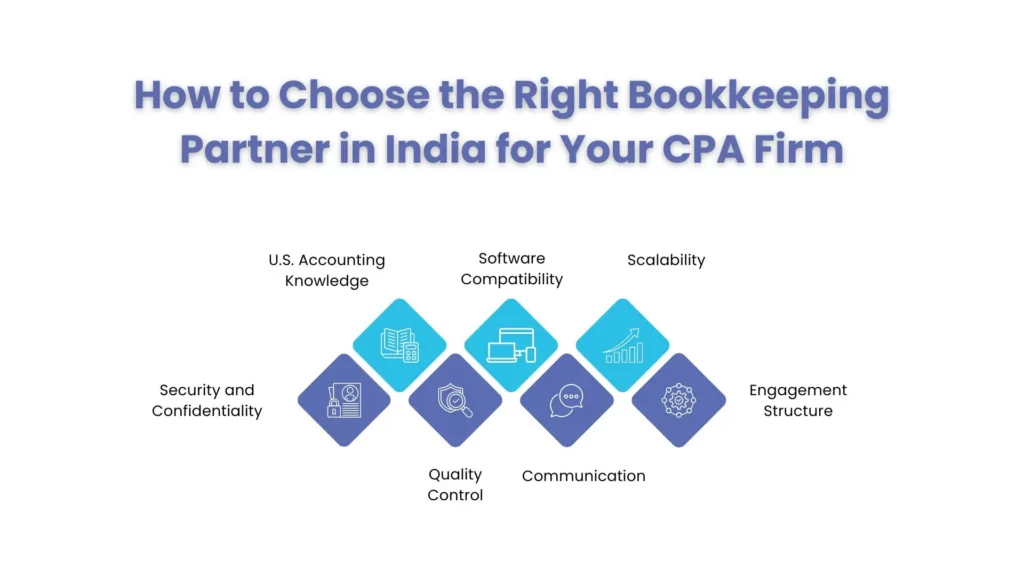
Cost is one input among several. Before you commit, get clear answers on security controls and access management, US accounting knowledge, who performs quality review before work reaches your team, software compatibility, communication and escalation structure, scalability, and exit terms.
We cover the full evaluation framework, including the questions worth asking every vendor, in our guide to choosing the right CPA outsourcing partner. If you want to see how providers compare on those criteria, our review of bookkeeping outsourcing companies for CPA firms is the place to start.
Common challenges, and how to solve them
- Communication gaps: Fix with a named point of contact, a regular meeting cadence, and a documented escalation path. Most “quality problems” are unresolved questions.
- Inconsistent quality: Fix with documented processes, review checklists, and a defined quality-control step before work reaches your team.
- Time-zone differences: Choose a provider willing to overlap US hours, particularly for urgent queries and review cycles.
- Limited client or industry knowledge: A new team does not know your clients. Fix with structured onboarding and client-specific accounting instructions, written once, reused indefinitely.
- Data security concerns: Review the provider’s controls, certifications, and data-handling procedures before any file transfers, not after.
- Loss of control: Keep review, client communication, and final approval inside your firm. The strongest offshore models do not take control away from the CPA firm; they take production away from the CPA firm’s calendar.
Why CPA firms work with Corient
The right offshore arrangement should feel less like handing work to a vendor and more like adding a layer to your delivery team.
We have supported US CPA firms for over a decade through a white-label delivery model: your firm keeps the client relationship and the final sign-off, our dedicated team handles the agreed production work, and your clients see your name on the deliverable.
We offer dedicated FTE arrangements alongside per-transaction, block-hour, and fixed-monthly structures, so the engagement can be shaped around your workload rather than forcing your firm into one model.
The split is straightforward. Your firm owns the relationship. Your team owns the judgment. We handle the production.
What that buys back is time, to review properly, to build out advisory services, and to grow without a hiring cycle standing in the way.
People Also Ask:
What is dedicated bookkeeping?
Dedicated bookkeeping is a model where specific accounting professionals are assigned to a CPA firm or client portfolio on an ongoing basis. The team follows the firm’s processes and handles agreed bookkeeping activities, rather than picking up isolated tasks.
Why are CPA firms hiring dedicated bookkeeping teams in India?
To increase capacity, access accounting talent, control costs, and handle recurring bookkeeping without depending entirely on local recruitment. In the AICPA’s 2025 MAP Survey, 29% of responding firms reported using offshoring.
What is the difference between dedicated bookkeeping and traditional outsourcing?
A dedicated model assigns named resources who learn your processes and stay on your account. Traditional outsourcing may route work through a shared pool or handle it transaction by transaction. Dedicated is built for continuity; task-based is built for flexibility.
Do I need client consent to send bookkeeping work offshore?
For bookkeeping alone, generally no. But disclosing tax return information to a preparer outside the United States requires the client’s advance written consent under Treas. Reg. §301.7216-3, in the format set out in Rev. Proc. 2013-14. If your engagement extends into return preparation, build that consent into your process. Confirm the specifics with your own counsel or professional liability carrier.
How long does it take to onboard a dedicated bookkeeping team?
Most firms start with a pilot covering a limited client group and run it through one full month-end close before expanding. That first cycle is where process gaps surface and get fixed.
Will my clients know the work is done offshore?
Not unless you tell them. Under a white-label model the work is delivered under your firm’s brand. Whether and how you disclose the arrangement in your engagement letter is your firm’s call and standard risk-management practice favours disclosure.
Conclusion
Hiring a dedicated bookkeeping team in India is not simply a cost-cutting move. For a growing number of firms it is a different answer to the question of how accounting work gets delivered.
You do not have to choose between doing everything internally and giving up control. Keep client relationships, professional judgment, and final review with your US team. Move recurring bookkeeping to a dedicated team. Use the recovered capacity for clients, advisory work, and growth.
If your bookkeeping workload is growing faster than your ability to hire, it may be time to look at something other than another job posting.
Talk to us about a dedicated bookkeeping team built around your firm’s workflow, software, and clients.