


The top bookkeeping outsourcing companies in the USA in 2026 are Corient, Personiv, TOA Global, MYCPE ONE (Entigrity), CapActix, inDinero, Pilot, Paro, QX Accounting Services and Fincent. They fall into three distinct models, dedicated offshore staffing, managed full-service bookkeeping, and technology-led platforms, and the right one depends less on price than on how much control and review capacity you want to keep in-house.
Bookkeeping outsourcing companies have become core infrastructure for US CPA firms and growing businesses. Grand View Research projects a 10.7% compound annual growth rate for the United States outsourcing services market from 2026 to 2033, and industry surveys put the share of small businesses outsourcing at least one finance function at roughly one in three.
Partnering with a bookkeeping outsourcing company lets you take on higher client volumes without expanding your in-house team. The provider handles recurring, time-consuming production work while your professionals concentrate on advisory, review and client relationships.
This guide compares 10 bookkeeping outsourcing companies operating in the US market in 2026, what each one costs, where it delivers from, which accounting platforms it supports, who it fits, and where it falls short. It covers both CPA and accounting firms buying capacity, and business owners buying a finished bookkeeping service.
Key Takeaways
- Bookkeeping outsourcing in the USA splits into three models: dedicated offshore/nearshore staffing (Corient, TOA Global, MYCPE ONE, QX, CapActix), managed full-service bookkeeping (Pilot, inDinero, Fincent), and expert-network or flexible staffing (Paro, Personiv).
- Costs range from roughly $200–$1,500 per month for managed services to a dedicated offshore FTE at a fraction of a US bookkeeper’s fully loaded cost.
- Delivery location matters more than headline price. Offshore delivery is cheapest but requires documented review, security and handoff protocols; nearshore buys time-zone overlap; onshore buys the least friction at the highest cost.
- CPA firms should evaluate on review process and data security before price, outsourcing production work does not transfer professional responsibility.
- A pilot engagement on a single month’s books is the single most reliable way to test a provider before committing client volume.
How We Chose These Bookkeeping Outsourcing Companies
To qualify for this list, each provider had to
(1) actively serve US-based clients,
(2) offer bookkeeping as a named service line rather than as an add-on, and
(3) published client counts, independent review profiles, or recognised security certifications.
From there we compared five things: delivery model and location, pricing structure and transparency, accounting-platform compatibility, quality-control and review process, and the type of buyer each provider is genuinely built for.
Disclosure: Corient Business Solutions is one of the providers on this list. We have set out our own limitations in the same format as every other entry, and the list is ordered by delivery model rather than by rank.
Why Are CPA Firms and US Businesses Outsourcing Bookkeeping in 2026?
CPA firms are finding it convenient to outsource bookkeeping services due to staff shortages, cost control, increased capacity, and getting access to experienced professionals for high-value services.
The pressure is structural, not cyclical. The domestic accounting talent pool has been shrinking for a decade, which is why firms that historically hired locally are now buying capacity instead.
For CPA firms, outsourcing can provide:
- Additional bookkeeping capacity without full-time hiring
- Flexible support during tax season
- Bank and credit-card reconciliations
- Accounts payable and receivable support
- General ledger maintenance
- Month-end close assistance
- Draft financial reporting
- Catch-up and cleanup bookkeeping
For business owners rather than firms, the driver is different: the books are behind, reconciliations are being done at 11pm, and the cost of a full-time in-house bookkeeper, salary plus benefits, payroll taxes, software and overhead, no longer makes sense at the current transaction volume.
By partnering with a bookkeeping outsourcing company, you will be in a position to hand over routine bookkeeping work so that your in-house team can concentrate on client relationships, review, and final professional judgment.
What Are the Different Types of Bookkeeping Outsourcing Services?
“Bookkeeping outsourcing” describes at least six different arrangements. Choosing the wrong one causes more problems than it solves, so it is worth being precise about which you are buying.
Full-service bookkeeping
The provider owns the entire function: transaction recording, accounts payable and receivable, reconciliations, month-end close, financial reporting and often payroll. Best for businesses that want a genuinely hands-off arrangement and have no internal finance staff.
Partial or co-sourced bookkeeping
You keep some tasks in-house and hand over others, typically retaining client-facing work and review while outsourcing data entry, reconciliations and reporting. This is the most common model among CPA firms, because it preserves professional judgment internally.
Project-based bookkeeping
One-off engagements: catch-up and cleanup work, a backlog of unreconciled months, a quarterly reporting crunch, or a system migration. Useful for testing a provider before committing recurring volume.
Dedicated staffing (offshore or nearshore)
You are buying a named person or team who works only on your files, managed by the provider. This is the dominant model for CPA firms in the USA because it behaves like an extension of the firm rather than a vendor relationship, and it is the model Corient, TOA Global, MYCPE ONE, QX Accounting Services and CapActix all run.
White-label bookkeeping
The provider works under your firm’s brand and never appears to your clients. Firms offering client accounting services usually need this. See our guide to white-label bookkeeping for CPA firms for how the arrangement works in practice.
Virtual / platform bookkeeping
Delivered entirely through cloud accounting software, QuickBooks Online, Xero, NetSuite, with communication through a portal. Most managed providers on this list operate this way.
Offshore, Nearshore or Onshore Bookkeeping: Which Delivery Model Fits?
Where your bookkeeping is actually performed affects cost, working-hour overlap, regulatory familiarity and the amount of review your team has to build in. The three options are not interchangeable.
| Model | Where work is done | Typical cost position | Main trade-off |
| Offshore | India, the Philippines and similar delivery centres | Lowest | Limited live overlap with the US working day; requires documented handoff, review and security protocols |
| Nearshore | Latin America, Colombia, Mexico, Argentina | Mid | Full or near-full US time-zone overlap at a higher rate than offshore; smaller talent pool for US GAAP specifically |
| Onshore | United States | Highest | No language, time-zone or regulatory-familiarity friction, but the cost advantage over an in-house hire narrows sharply |
Why most US CPA firms choose offshore delivery
Offshore delivery gives the widest access to accountants trained specifically in US GAAP workflows, at a cost structure that makes it viable to outsource high-volume production work rather than only overflow. India in particular has a mature US-facing accounting outsourcing sector, and the shift toward dedicated bookkeeping teams in India reflects that firms are now buying named, permanent capacity rather than ad-hoc overflow support.
The overnight offset is often an advantage rather than a cost. Work handed off at the end of a US business day is returned before the next one begins, which compresses turnaround on reconciliations and close work, provided the workflow is genuinely asynchronous and not dependent on live back-and-forth.
What to check before choosing an overseas bookkeeping provider
- Security certification: Ask for SOC 2 Type II, ISO 27001, or both, and ask to see the report rather than the badge.
- IRC §7216 consent: If US taxpayer information will be handled outside the United States, confirm the provider’s process for the disclosure consents this requires.
- Access controls: Role-based permissions, no shared logins, restricted-download or virtual-desktop environments, and a documented offboarding process.
- Overlap hours: How many hours per day genuinely overlap your working day, and who is reachable during them.
- Review layer: Who checks the work before it reaches you, and what their qualification is.
- Continuity: Attrition rate on the delivery team, and what happens to institutional knowledge of your chart of accounts when a person leaves.
If those six are documented, offshore bookkeeping behaves like any other production process. If they are not, the cost saving is borrowed against future rework.
How Much Does Outsourced Bookkeeping Cost in the USA?
Outsourced bookkeeping in the USA is priced four ways, and comparing headline numbers across models is misleading unless you normalise for scope.
| Pricing model | Typical range | What it usually includes | Best for |
| Flat monthly subscription | Approx. $200–$1,500/month, scaling with expense volume | Transaction categorisation, reconciliations, monthly financial statements | Businesses wanting a finished service |
| Hourly | Approx. $20–$100+/hour depending on seniority and location | Pay only for hours used; scope defined per task | Low or irregular transaction volume |
| Dedicated FTE (offshore/nearshore) | Monthly per-FTE range | A named full- or part-time resource working only on your files, plus supervision | CPA firms buying recurring capacity |
| Project / catch-up | Quoted per engagement, commonly a one-time fee | Cleanup of a defined backlog of months | Firms with a specific backlog |
How that compares with hiring in-house
The comparison most firms get wrong is salary-to-invoice. The Bureau of Labor Statistics puts the median annual wage for bookkeeping, accounting and auditing clerks at $50,670 as of May 2025. But salary is only about 70% of what the role costs: BLS employer cost data for March 2026 shows benefits account for 30.1% of total compensation in private industry. That lands the fully loaded cost at roughly $72,500 a year, before software seats, equipment, recruiting time or training. It also excludes the weeks the seat sits empty, and BLS still projects around 144,100 openings a year in the occupation, almost entirely replacement hires.
Outsourcing converts that fixed cost into a variable one. The question is not whether the monthly invoice beats a salary, but whether the capacity per dollar is higher once your own review time is counted.
What drives your quote up or down
- Monthly transaction volume and number of bank and card accounts to reconcile
- Number of entities or clients, and how consistent their charts of accounts are
- Cash-basis versus accrual-basis accounting
- Whether payroll, AP/AR, sales tax or reporting are in scope
- Close cadence, monthly, weekly, or continuous
- Cleanup required before steady-state work can begin
Ask every provider for a written scope alongside the price. A cheaper monthly figure that excludes reconciliation of half your accounts is not cheaper.
The 10 Best Bookkeeping Outsourcing Companies in the USA (2026)
The providers below are grouped by delivery model rather than ranked, because a firm buying dedicated offshore capacity and an owner buying a finished monthly service are not choosing from the same shortlist.
1. Corient Business Solutions
Corient focuses on supporting U.S. CPA firms with bookkeeping, tax preparation, compliance, financial reporting, and other outsourced accounting functions. Its model is designed to help firms increase capacity without proportionally increasing internal headcount.
- Delivery / headquarters: US/UK/India
- Key bookkeeping services: Accounting and bookkeeping, tax preparation and planning, AR/AP, financial reporting and analysis, account reconciliation, audit and compliance support, outsourced CFO and advisory.
- Software support: QuickBooks Online and Desktop, Xero, Sage Intacct, NetSuite, plus practice-management tools.
- Best suited for: CPA firms of any size that want scalable, CPA-specific outsourcing across more than bookkeeping alone
2. TOA Global
TOA Global specializes in outsourced accounting talent for accounting firms of any size, providing dedicated offshore staff who track financial transactions day to day.
- Delivery / headquarters: Australian-headquartered with delivery from the Philippines and offices in the US and South Africa
- Key bookkeeping services: Recordkeeping, ledger management, trial balance, posting process checks, accounts payable and receivable, payroll, data entry and reporting
- Best suited for: CPA and accounting firms wanting dedicated offshore accounting professionals with structured training behind them.
- Potential limitations: Firms must be comfortable managing a distributed team and coordinating offshore workflows. Philippines-based delivery generally means overnight shift work to overlap US hours.
- Strengths: Strong accounting-industry specialisation, dedicated teams, an established training academy, and scalability; widely regarded as the category leader for white-label and staffing support to accounting practices
- Pricing: Quote-based dedicated-staff pricing.
3. MYCPE ONE (Entigrity)
Entigrity has merged with MYCPE and now operates under the combined brand MYCPE ONE, offering offshore staffing solutions for accounting, bookkeeping, and tax preparation tailored to CPA and accounting firms.
- Delivery / headquarters: US-facing brand with offshore delivery from India.
- Key bookkeeping services: Bookkeeping, accounting support, tax preparation support, payroll and related back-office functions.
- Best suited for: CPA firms looking for dedicated offshore accounting staff and nothing else, this is one of the few providers that works exclusively with firms rather than holding direct business-client relationships.
- Potential limitations: Offshore delivery requires firms to establish clear communication, review, security and workflow protocols. Not a fit for businesses wanting a finished bookkeeping service rather than staff.
- Strengths: CPA-focused staffing model, no channel conflict with your own clients, and experience supporting distributed accounting teams.
4. QX Accounting Services
QX Accounting Services has made its name delivering structured bookkeeping outsourcing services that not only keep your ledgers precise and organized but also reduce your firm’s operational costs.
- Delivery / headquarters: UK-headquartered with delivery from India and nearshore options; dedicated US accounting practice.
- Key bookkeeping services: Bank reconciliation, credit card reconciliation, accounts receivable, accounts payable, payroll and sales gross-up.
- Best suited for: CPA firms seeking dedicated offshore or nearshore accounting capacity with a documented review layer.
- Strengths: Deep accounting-firm specialisation, scalable staffing, structured review processes and broad service coverage.
- Potential limitations: Firms should assess whether its offshore/nearshore delivery model fits their client communication and oversight preferences.
5. CapActix
CapActix provides outsourced bookkeeping for CPAs, small businesses, startups, and enterprises, including setting up bookkeeping processes, tracking expenses, defining income sources, maintaining accurate financial records, and generating reports.
- Delivery / headquarters: Delivery from India, serving US, UK, Canada and Australia
- Key bookkeeping services: Chart of accounts setup, ledger maintenance, bank reconciliation, accounts receivable and payable, cash flow management, financial reporting and analysis
- Best suited for: Firms wanting a broad outsourced accounting partner rather than bookkeeping alone
- Strengths: Wide service range, CPA partnerships, flexible support and demonstrated tax-season capacity
- Potential limitations: Firms wanting a highly specialised U.S.-only delivery model should clarify staffing and delivery arrangements before contracting.
6. Personiv
Personiv provides custom finance and accounting outsourcing built around each client’s specific goals and team size, making it one of the more flexible bookkeeping outsourcing companies on this list.
- Delivery / headquarters: US-headquartered with global delivery centres
- Key bookkeeping services: General accounting, accounts payable, accounts receivable, transactional accounting and wider finance support
- Best suited for: Firms and finance teams looking for flexible accounting staffing rather than a narrow bookkeeping package
- Strengths: Scalable staffing, broad finance capabilities and flexible team sizes
- Potential limitations: Its broader finance-and-accounting orientation may be more than a firm needs for straightforward bookkeeping production work.
7. Pilot
Pilot is a San Francisco-based provider built for startups and growth-stage companies that need proper accrual-basis books rather than basic cash-basis transaction tracking. It pulls automatically from bank accounts, cards, payroll systems and payment platforms, and generates startup-specific outputs such as burn and runway reporting.
- Delivery / headquarters: United States
- Key bookkeeping services: Monthly bookkeeping, financial statements, AP/AR, tax preparation and fractional CFO services as add-ons
- Software support: QuickBooks Online, with native connections to Gusto, Expensify, Stripe and Shopify
- Best suited for: CPA firms serving startups and technology companies, and post-seed businesses that need investor-ready accrual books
- Strengths: Strong technology integrations, structured close process, startup-specific reporting and US-based delivery
- Potential limitations: Pricing scales with monthly expense volume and rises steeply as a business grows. Annual billing is required for the best rates and an onboarding fee applies. Its positioning is business-client focused rather than white-label CPA firm outsourcing.
- Pricing: From $299/month on annual billing, scaling with monthly expense volume
8. inDinero
inDinero combines day-to-day bookkeeping with tax compliance and CFO-level advisory in a single managed relationship, aimed at growing businesses rather than at accounting firms buying capacity.
- Delivery / headquarters: United States
- Key bookkeeping services: Reviewing and updating financial records, reconciliations, real-time transaction categorisation, AR/AP management, financial statement preparation, payroll support, catch-up bookkeeping
- Software support: NetSuite and QuickBooks Online
- Best suited for: Growing businesses and mid-market companies seeking broader finance capability than bookkeeping alone
- Strengths: Integrated accounting, bookkeeping, tax and CFO-oriented services under one provider
- Potential limitations: Higher cost than bookkeeping-only providers, and better suited to firms wanting broad finance support than to those buying bookkeeping execution. Reported inconsistency in customer service response times.
- Pricing: Essential plan from $750/month; Growth plan from $1,250/month
9. Fincent
Fincent combines AI-assisted categorisation with human bookkeeping oversight to keep books continuously current rather than closing them only at month-end.
- Delivery / headquarters: United States
- Key bookkeeping services: Transaction organisation, reconciliations, AP support, reporting
- Best suited for: Smaller firms and small businesses looking for a technology-enabled bookkeeping service with transparent packaging
- Strengths: Simple product experience, human support layer, clear reporting and transparent package options
- Potential limitations: Positioned toward small businesses rather than large-scale CPA firm back-office outsourcing. Less suitable where multi-entity or complex accrual work is involved.
10. Paro
Paro operates as a vetted expert marketplace rather than a bookkeeping firm, matching businesses with independent US-based finance professionals through a multi-stage screening process. Engagements are flexible and on demand rather than subscription-based.
- Delivery / headquarters: United States
- Key bookkeeping services: Accounts receivable, accounts payable, account reconciliation, cleanup and catch-up work, month-end close, cash flow monitoring
- Software support: QuickBooks, Xero, NetSuite
- Best suited for: Firms and businesses needing accounting expertise that extends beyond basic bookkeeping, on a flexible engagement
- Strengths: Access to experienced, vetted US finance professionals and capability well beyond transactional bookkeeping
- Potential limitations: Quality varies across the network, pricing is not published and lacks a flat-rate option, and reviewers report variability in account management. Firms looking specifically for high-volume offshore bookkeeping will find other providers more specialised.
How Do the Top Bookkeeping Outsourcing Companies Compare?
The best choice among bookkeeping outsourcing companies depends on whether your priority is dedicated staffing, broad accounting support, technology, or CPA-firm specialisation.
| Company | Model | Delivers from | Best fit | Primary strength |
| Corient Business Solution | Dedicated staffing | India | CPA firms | CPA-focused scalable support |
| TOA Global | Dedicated staffing | Philippines | Accounting firms | Dedicated accounting talent |
| MYCPE ONE | Dedicated staffing | India | CPA firms only | Works exclusively with firms |
| QX Accounting | Dedicated staffing | India / nearshore | CPA firms | Structured review process |
| CapActix | Dedicated staffing | India | CPA firms, SMBs | Broad accounting support |
| Personiv | Flexible staffing | Global | Finance teams | Scalable finance staffing |
| Pilot | Managed service | United States | Startups, SMBs | Technology + accrual books |
| inDinero | Managed service | United States | Growing businesses | Integrated finance + CFO |
| Fincent | Managed service | United States | Small businesses | AI + human bookkeeping |
| Paro | Expert network | United States | Complex finance needs | Vetted US specialists |
What Should You Look for in a Bookkeeping Outsourcing Company?
Right now, you will find multiple bookkeeping outsourcing companies in the US market, but you need to find the right outsourcing partner for your firm. For that, you need to have criteria in place.
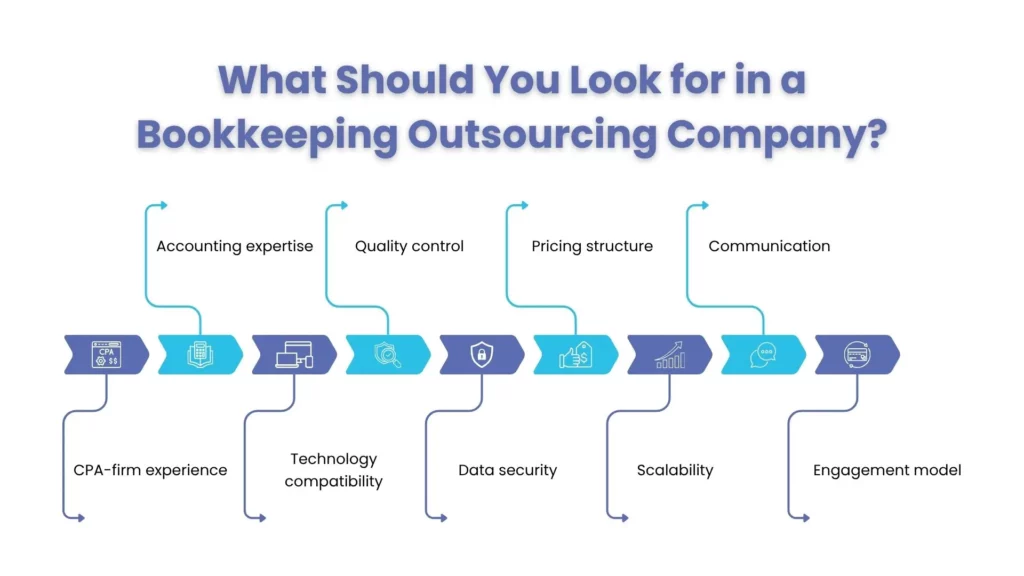
Your evaluation criteria should include:
- CPA-firm experience: Does the provider understand US accounting workflows and professional expectations?
- Accounting expertise: Can its team handle reconciliations, AP/AR, month-end close, and financial reporting?
- Technology compatibility: Can the team work with your existing accounting and practice-management platforms?
- Quality control: Is there a documented review process, and who performs the review?
- Data security: Ask about security certifications, access controls, encryption, and confidentiality procedures.
- Scalability: Can the team increase or decrease capacity as your client workload changes?
- Communication: Will you have dedicated contacts and predictable turnaround times?
- Engagement model: Can you choose dedicated staff, managed teams, project-based support, or another structure?
- Delivery location: Where is the work physically performed, how many hours overlap your day, and what consents does that require?
- Pricing transparency: Is the scope written down alongside the price, and what triggers an out-of-scope charge?
Your goal should never be to find the cheapest outsourced bookkeeping provider, it’s to find one that offers reliable capacity without creating additional burden for your team.
Is In-House or Outsourced Bookkeeping Better for CPA Firms?
Outsourced bookkeeping is more flexible for firms facing variable workloads; in-house bookkeeping gives maximum direct control at a higher fixed cost. The table below sets out the trade-off across the factors that actually change the decision.
| Factor | In-House | Outsourced |
| Hiring | Firm manages recruiting | Provider supplies talent |
| Cost structure | Fixed salary + benefits | Flexible service/staffing cost |
| Scalability | Slower | Faster |
| Tax season staffing | Requires temporary/permanent hiring | Capacity can scale |
| Training | Firm responsibility | Provider responsibility/shared |
| Management | Direct | Requires vendor oversight |
| Expertise | Depends on hiring | Access to broader talent pool |
| Control | Very high | High with proper workflows and review |
| Technology | Firm-funded | Often provider-enabled |
For many firms, the answer does not have to be either/or. A hybrid model can keep client-facing and review functions in-house while outsourcing repetitive production work.
What Are the Benefits of Partnering With a Bookkeeping Outsourcing Company?
- More capacity: Take on additional clients without immediately expanding internal headcount.
- Better workload management: Remove repetitive work from senior accountants so they can concentrate on advisory.
- Tax season staffing: Add support when bookkeeping and tax workloads rise. Providing
- Lower overhead: Reduces spending on recruiting, salaries, benefits, and training.
- Faster turnaround: Dedicated teams work continuously on defined workflows.
- Higher-value work: With repetitive work handled by your partner, your in-house professionals spend more time on advisory.
- Scalability: Increase or decrease resources by season, from peak to lean.
- Broader services: Some providers offer outsourced accounting and bookkeeping alongside tax, payroll, audit or CFO support.
Outsourcing work does not end your accountability. You will need to maintain proper review, supervision, client communication, and professional responsibility.
What Are the Risks of Outsourcing Bookkeeping and How Do You Manage Them?
- Scope creep and unexpected cost: Work that turns out more complex than quoted becomes an out-of-scope charge. Mitigation: a written scope, and a defined process for approving anything outside it.
- Reduced direct control: You cannot walk to a desk for an answer. Mitigation: named contacts, fixed turnaround commitments and a scheduled weekly checkpoint.
- Data security exposure: Client financial data leaves your environment. Mitigation: SOC 2 Type II or ISO 27001, role-based access, no shared credentials, signed NDAs and a documented offboarding process.
- Regulatory unfamiliarity: An offshore team may not track US filing changes. Mitigation: keep interpretation and final review in-house; outsource production, not judgment.
- Staff turnover and lost context: Institutional knowledge of your chart of accounts walks out with a departing team member. Mitigation: ask for attrition figures and require documented process notes per client.
- Communication drag: Overnight delivery only works if the workflow is genuinely asynchronous. Mitigation: batch queries, and agree a daily overlap window.
None of these is an argument against outsourcing. They are the checklist that separates a provider relationship that compounds from one that generates rework.
How Does the Onboarding Process Typically Work?
- Discovery call: the provider reviews your current bookkeeping software, client volume, and workflow gaps.
- Pilot engagement: many providers start with a small batch of clients or a single month’s books before scaling up.
- Access and security setup: the provider is granted controlled access to accounting software, with role-based permissions and confidentiality agreements in place.
- Workflow documentation: turnaround times, escalation paths, and review checkpoints are defined in writing.
- Ramp-up: client volume scales up once quality and turnaround benchmarks are consistently met.
Onboarding typically runs one to three weeks from signed engagement to steady-state work, covering system access, process alignment, chart-of-accounts review and initial data migration.
What Questions Should You Ask Before Choosing a Bookkeeping Partner?
- How much experience do you have working with U.S. CPA firms?
- Which accounting platforms and software do your teams support?
- Will we receive dedicated staff or work with a shared team?
- What quality-control and review procedures do you use?
- How do you protect sensitive client financial information?
- What are your turnaround-time commitments?
- Can staffing increase during tax season?
- How are errors handled and escalated?
- Can you work under our firm’s brand?
- Can we start with a pilot engagement before expanding?
- Where physically is the work performed, and how many hours per day overlap ours?
- Do you hold SOC 2 Type II or ISO 27001, and can we see the report?
- What is your annual attrition rate on client-facing delivery teams?
- What is your process for IRC §7216 consent where US taxpayer data is handled offshore?
These questions reveal whether a provider can become a genuine extension of your firm rather than another vendor to manage. Our full vetting checklist takes each of them further, with the answers that should make you walk away.
Bookkeeping Outsourcing for PE-Backed and Portfolio Companies
Private equity firms and their portfolio companies buy outsourced bookkeeping for a different reason than a CPA firm does. The requirement is consistency across many entities with different charts of accounts, a reporting pack that arrives on the same date every month, and books that can withstand diligence without a cleanup project first.
That points toward providers who can run standardised close processes across multiple entities rather than toward the lowest monthly rate. Ask specifically about multi-entity consolidation, whether the same team covers all entities, and how quickly a newly acquired company can be brought onto the same close calendar.
Why Do CPA Firms Choose Corient Business Solutions?
Corient works exclusively with CPA, bookkeeping and accounting firms, supporting them with bookkeeping, tax preparation, compliance and financial reporting. Its CPA outsourcing services are built so firms can increase capacity without proportionally increasing internal headcount, and because Corient holds no direct business-client relationships, it never competes with the firms it serves.
Corient has been operating since 2011, has offices in the UK, India and the USA, and is ACCA-approved and fully compliant with ISO 27001 for data security.
Corient provides outsourced accounting and bookkeeping services designed specifically to help CPA firms increase operational capacity, manage tax season staffing demands, reduce repetitive workload, improve turnaround times and focus on higher-value client services.
People Also Ask:
What is bookkeeping outsourcing?
Bookkeeping outsourcing means contracting a third-party provider to perform your day-to-day financial recordkeeping — transaction categorisation, bank and credit-card reconciliation, accounts payable and receivable, and monthly financial statements, instead of employing a bookkeeper directly. The provider can be onshore, nearshore or offshore, and can be engaged either as dedicated staff working under your direction or as a managed service delivering a finished monthly output.
Which are the best bookkeeping outsourcing companies in the USA?
The strongest options in 2026 are Corient, TOA Global, MYCPE ONE (Entigrity), QX Accounting Services and CapActix for CPA firms buying dedicated capacity; Pilot, inDinero and Fincent for businesses wanting a managed monthly service; and Paro and Personiv for flexible access to experienced finance professionals. The right choice depends on your delivery-model preference and how much review capacity you keep in-house.
How much does outsourced bookkeeping cost in the USA?
Managed monthly services typically run from roughly $200 to $1,500 per month depending on transaction and expense volume. Hourly arrangements commonly range from $20 to over $100 per hour depending on seniority and location. Dedicated offshore or nearshore staffing is quoted per resource per month. Cost is driven by transaction volume, number of accounts and entities, cash versus accrual basis, close cadence and whether payroll, AP/AR and reporting are in scope.
Is offshore bookkeeping safe?
Yes, when the provider has the right controls in place. Look for SOC 2 Type II or ISO 27001 certification with the report available on request, role-based access with no shared logins, restricted-download or virtual-desktop environments, signed NDAs, and a documented offboarding process. Where US taxpayer information is handled outside the United States, confirm the provider’s process for obtaining the disclosure consents required under IRC §7216.
What is the difference between offshore, nearshore and onshore bookkeeping?
Offshore bookkeeping is delivered from countries such as India or the Philippines at the lowest cost, with limited live overlap with the US working day. Nearshore bookkeeping is delivered from Latin America at a mid-range cost with full or near-full US time-zone overlap. Onshore bookkeeping is delivered from within the United States at the highest cost, with no language, time-zone or regulatory-familiarity friction.
Can CPA firms outsource bookkeeping under their own brand?
Yes. White-label bookkeeping means the provider works under your firm’s brand and never appears to your clients — communications, deliverables and reporting all carry your identity. Most providers built for accounting firms, including Corient, TOA Global, MYCPE ONE and QX Accounting Services, support this. Confirm whether the provider also holds direct relationships with business clients, since that can create channel conflict.
Does outsourcing bookkeeping transfer professional responsibility?
No. Outsourcing shifts production work, not accountability. The engaging firm remains responsible for review, supervision, client communication and final professional judgment. This is why the review layer, who checks the work and what their qualification is, should be a primary evaluation criterion rather than an afterthought.
How long does it take to onboard a bookkeeping outsourcing provider?
Most engagements reach steady state within one to three weeks. That covers a discovery call, system access and security setup with role-based permissions, chart-of-accounts review, workflow documentation covering turnaround times and escalation paths, and a pilot on a small batch of clients or a single month’s books before volume scales up.
What accounting software do outsourced bookkeepers work with?
The most commonly supported platforms are QuickBooks Online and Desktop, Xero, NetSuite and Sage Intacct, alongside payroll systems such as Gusto and payment processors including Stripe and Shopify. Ask specifically whether the provider works inside your existing instance or migrates you onto their own platform, the latter complicates any future move to a different provider.
Should a CPA firm outsource bookkeeping or hire in-house?
Outsourcing suits firms with variable workloads, tax-season peaks or capacity constraints, because it converts a fixed staffing cost into a variable one and scales faster than recruiting. In-house hiring suits firms that need maximum direct control and have stable, predictable volume. Many firms run a hybrid: client-facing and review work stays internal, while repetitive production work goes to a partner.
How do I switch from my current bookkeeping provider to a new one?
Export and secure all historical financial data first, and make sure you retain primary administrative access to your accounting software. Then notify your existing provider and agree a clean cutoff date. Finally, hand the historical files to the incoming provider so they can reconcile the transition period. Confirm before signing that your data is held in a standard platform you own rather than a proprietary system.
What is the difference between bookkeeping and accounting services?
Bookkeeping records financial transactions as they occur, invoicing, reconciliation, categorisation and recordkeeping. Accounting interprets those records to produce financial statements, tax returns and strategic analysis. Bookkeepers maintain the data; accountants determine what it means. The two overlap in smaller businesses, but the distinction matters when you are scoping an outsourcing engagement.
Who are the top bookkeeping outsourcing companies for CPA firms?
Corient, QX Accounting Services, Personiv, TOA Global, Entigrity, CapActix, inDinero, Pilot, Paro, and Fincent are among the top providers for U.S. CPA firms in 2026.
What makes Corient different from other outsourcing providers?
Corient functions as a white-labeled extension of a CPA firm’s existing team rather than a standalone offshore vendor, with a U.S. entity structure supporting direct partner access and US-hours coverage.
Conclusion
The right provider is rarely the one with the largest marketing budget. It is the one whose delivery model, review process and security posture match how your firm actually works.
Start by identifying which bookkeeping tasks you can hand over, usually reconciliations, AP/AR and month-end production, while review and client communication stay with you. Then shortlist on five criteria: CPA-firm experience, delivery location and overlap hours, security certification, platform compatibility and scalability. Finally, run a pilot on a single month’s books before moving client volume across. Every credible provider on this list will agree to one.
If you want a partner that can support more than basic bookkeeping, Corient is worth shortlisting. Our CPA outsourcing model covers bookkeeping, tax, compliance and reporting through a single relationship. Contact us for a workload assessment covering which parts of your bookkeeping workflow can be outsourced and how quickly a team can be deployed.