




White label bookkeeping is a service model in which a third-party accounting provider performs bookkeeping tasks (transaction categorization, reconciliations and financial reporting) under a CPA firm’s own brand. The CPA firm owns the client relationship and reviews all delivered work, while the provider supplies the operational support behind the scenes.
This model has worked well for firms that are aggressively expanding their services, improving their capacity, and scaling up, particularly through structured CPA outsourcing programs built for exactly this kind of growth.
A few years ago, a growing CPA firm could succeed by focusing mainly on tax preparation and compliance work. Today, clients expect more financial updates, bookkeeping support, cash flow visibility, and advice throughout the year.
We have come across a CPA firm that had recently gained multiple new clients, and all of them demanded bookkeeping support. The immediate challenge for the firm was creating additional capacity. However, getting in experienced bookkeepers meant higher payroll costs, more management responsibilities, and additional overhead, not to mention the time it takes to find experienced talent.
White label bookkeeping solves this by pairing the firm with a partner who does the work while the firm keeps the client relationship under its own brand. It is increasingly popular with firms that want to expand without building a large internal department.
The shift is already mainstream. In the AICPA’s 2025 National MAP Survey, 29% of the more than 1,000 responding CPA firms reported using offshoring, while revenue from client accounting advisory services continued to grow.
What Is White Label Bookkeeping?
White label bookkeeping is a method where an external accounting provider does the bookkeeping work on your behalf under your brand name. The client sees only your CPA firm, while the external team works in the background.
A white label bookkeeping arrangement may include:
- Transaction categorization
- Bank and credit card reconciliations
- Accounts payable support
- Accounts receivable tracking
- Monthly financial statements
- General ledger maintenance
- Bookkeeping clean-up projects
You remain responsible for the client relationship while the provider supplies the operational support, giving you access to bookkeeping expertise without hiring additional employees.
What’s the Difference Between White-Label and Outsourced Bookkeeping?
The core difference is visibility. In white label bookkeeping, the client only sees your firm’s name, the provider stays invisible. In outsourced bookkeeping, the client may work with the third party directly. Co-sourcing shares the work openly between your team and the provider. The table below compares all three.
| Model | How It Works | Client Relationship | Best For |
| White label bookkeeping | A provider completes bookkeeping under the CPA firm’s brand | Owned by CPA firm | Firms expanding services without hiring |
| Outsourced bookkeeping | A third party performs bookkeeping directly for the business | May be owned by provider | Businesses needing accounting support |
| Co-sourcing | Internal team and external professionals share responsibilities | Shared relationship | Firms needing additional capacity |
For the broader picture of what to hand off, what it costs and how to transition, see our complete guide to outsourced bookkeeping for CPA firms.
How Does White Label Bookkeeping Work? (Step-by-Step Process)
White label bookkeeping follows a structured, four-step partnership between the CPA firm and the provider:
Step 1: Client Assessment
The provider identifies the client’s bookkeeping needs, monthly bookkeeping, historical clean-up, financial reporting, or industry-specific requirements — then builds a delivery plan.
Step 2: Secure Access Setup
You provide secure, role-based access to the client’s accounting platform (QuickBooks Online, Xero, Sage Intacct, NetSuite, or Bill.com), with encrypted data transfer and signed confidentiality agreements before access is granted, the AICPA’s SOC suite of services is the industry benchmark for evaluating security.
Step 3: Bookkeeping Execution
Your white-label team records transactions, reconciles accounts, reviews financial data, and prepares reports, following your firm’s standards and processes.
Step 4: Review and Delivery
You review completed work before it reaches the client, then deliver final reports under your firm’s name. You retain responsibility for communication, pricing, and client strategy, while the provider operates behind the scenes as an extension of the firm.
What Your Clients See: Branding in a White Label Setup
White label only works if every client touchpoint looks like your firm. Before onboarding the first client, agree on these four things with your provider:
- Deliverables: financial statements, reconciliation reports and management packs go out on your letterhead and your templates.
- Communication: clients hear from your team or from firm-branded email addresses, never from the provider’s domain.
- Software access: the provider works inside your QuickBooks Online Accountant or Xero login, under user names your firm controls.
- Documents: file names, notes and report metadata follow your firm’s conventions.
- A simple test: pull one month of deliverables and read them the way your client would. If anything points to a third party, fix it before the next close.
Who Owns the Client Relationship?
In a white label arrangement, your firm owns the client, the engagement letter, the pricing and the data. Put that in writing:
- Your firm holds master admin access to every client file; the provider gets user-level access you can revoke at any time.
- Working papers, reconciliations and supporting schedules belong to your firm.
- A non-solicitation clause stops the provider from approaching your clients during the engagement and for a defined period after it.
- An exit clause sets out how files are returned, how access is removed and how quickly.
This protects more than one engagement. A book of bookkeeping clients is only an asset to your practice if the relationship can’t walk out the door with a vendor.
What Software and Tech Stack Is Used?
White label bookkeeping providers primarily rely on QuickBooks Online, Xero, Sage Intacct, NetSuite, and Bill.com to manage client accounts.
| Technology | Purpose |
| QuickBooks Online | Small business bookkeeping and reporting |
| Xero | Cloud accounting collaboration |
| Sage Intacct | Advanced financial management |
| NetSuite | Enterprise accounting operations |
| Bill.com | Invoice and payment workflows |
| HubSpot or CRM tools | Client communication tracking |
A strong provider should be comfortable working within the software ecosystem your firm already uses.
What Are the Benefits of White Label Bookkeeping for CPA Firms?
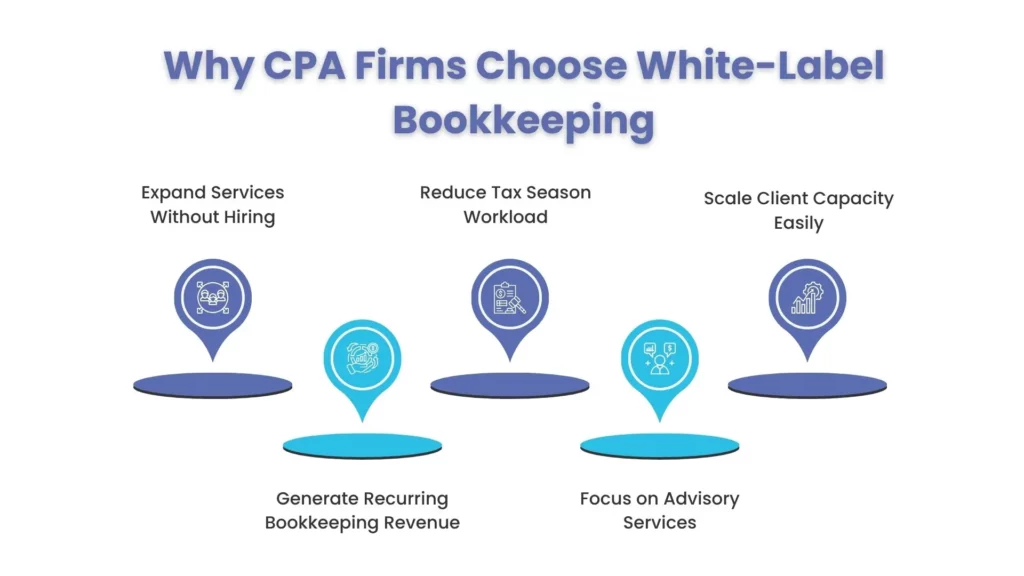
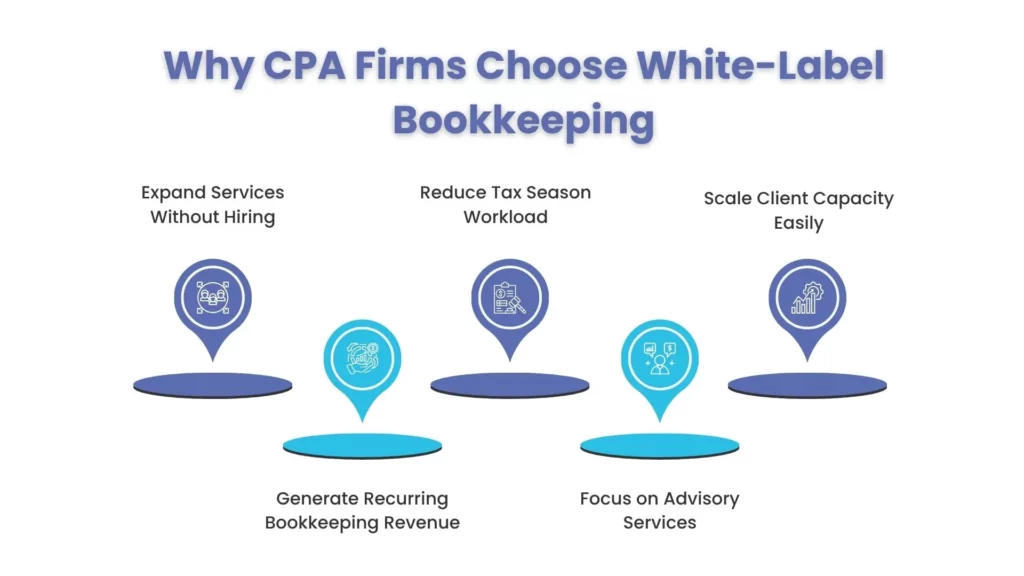
White label bookkeeping benefits CPA firms by adding bookkeeping capacity, revenue, and advisory bandwidth without the cost of hiring in-house.
Expand Services Without Hiring
Finding qualified, experienced accountants is difficult nationwide; white-label services provide that expertise without adding headcount.
See How to Offer Client Accounting Services Without Hiring an In-House Team.
Create New Revenue Opportunities
Bookkeeping creates monthly recurring revenue and year-round client engagement, not just work concentrated around tax season, which strengthens relationships and lifetime client value.
Improve Tax Season Efficiency
Many CPA firms experience significant workload pressure during tax season. White label bookkeeping services take that pressure off by handling it consistently throughout the year, making tax preparation easier and creating clean books.
Clean books mean:
- Fewer corrections
- Faster preparation
- Better client conversations
Focus on Higher-Value Advisory Work
Bookkeeping contains multiple recurring and transactional tasks that are high in volume and consume considerable time. White label bookkeeping allows your team to spend more time on:
- Tax planning
- Business consulting
- Financial strategy and CFO advisory
This improves both profitability and client value.
See what a dedicated bookkeeping team could add to your firm’s capacity, talk to Corient about your CPA outsourcing options.
The Real Economics: Margin & ROI Math for CPA Firms
White-label pricing has two layers: what the provider charges your firm, and what you charge the client, the gap is your margin.
For Example Only: $400/month billed at $650 nets about $3,000 per client yearly, or $30,000 across 10 clients, with no added headcount. Most firms mark up 30–50%. (Illustrative only, confirm real wholesale pricing with your provider.)
What Should CPA Firms Watch Out For? (Risks and Common Mistakes)
The main risks of white label bookkeeping are quality-control gaps, weak communication, and poor data security, all of which trace back to choosing the wrong partner.
- Lack of Quality Control: Errors affect tax prep, reporting, and client trust. Ask about quality checks, review procedures, training, and accounting experience before signing.
- Poor Communication: Unclear project ownership, response timelines, escalation processes, or reporting schedules erode client confidence, your firm should always know the status of client work.
- Weak Data Security: Confirm the provider uses secure cloud systems, access controls, encryption, and confidentiality agreements, at minimum, a current SOC 2 Type II report, encryption in transit and at rest, and multi-factor authentication.
Who Is Liable if There’s an Error in the Books?
The CPA firm remains ultimately liable for the accuracy of the books, even though a provider performs the work, the specific division of responsibility should be spelled out in your service agreement.
A strong partnership should include:
- Clearly defined responsibilities
- Quality expectations
- Review processes
- Service agreements
CPA firms should never assume that outsourcing removes their professional responsibility. The provider supports the work, while the CPA firm has to maintain oversight.
Compliance and Disclosure Requirements for CPA Firms
White label keeps the provider out of sight in day-to-day work, but it does not mean keeping the arrangement secret. Under the AICPA Code of Professional Conduct (ET 1.150.040), a firm should inform clients, preferably in writing, before sharing their confidential information with a third-party service provider. Most firms handle this with a short engagement-letter clause, and the AICPA publishes sample client disclosure language for outsourcing that you can adapt. Your clients still deal only with your firm; the clause simply makes the arrangement transparent from day one.
- AICPA Code of Conduct: ET sections 1.150, 1.300, and 1.700 require confidentiality agreements with providers; firms stay responsible for outsourced work’s accuracy (WSCPA).
- State Board Disclosure: Some state boards add their own disclosure or consent requirements for outsourcing. Check your state board’s current rules before sending client data to any provider.
- IRS Rules for Tax Data: If the engagement involves tax return information, IRC Section 7216 requires the client’s written consent before you disclose it to a provider, in the format set out in Rev. Proc. 2013-14. Stricter rules apply when the provider is located outside the United States.
Corient Business Solution’s compliance-focused engagement model supports these requirements, so firms can outsource without a compliance gap.
How Much Does White Label Bookkeeping Cost?
Cost depends on client count, volume, complexity, and review level. Typical pricing models include:
| Pricing Model | How It Works | Best For |
| Monthly package | Fixed monthly fee based on workload | Firms with predictable client needs |
| Per-client pricing | Fee charged for each bookkeeping client | Growing CPA firms |
| Hourly pricing | Pay based on hours worked (offshore-backed teams; dedicated U.S.-based teams) | Project-based support |
| Custom engagement | Tailored pricing based on requirements | Larger firms with complex needs |
Illustrative market ranges: hourly support typically runs about $25–$90 an hour depending on provider location and staff seniority, and a dedicated offshore bookkeeper commonly costs $1,500–$4,000+ per month. These are general market indicators, not a quote. Request a scoped, written proposal before comparing providers.
When Should a CPA Firm Move Bookkeeping In-House?
Move bookkeeping in-house once client volume can keep a full-time hire busy. The median bookkeeping, accounting and auditing clerk earned $50,670 a year in May 2025, per the U.S. Bureau of Labor Statistics, so the math works once client volume justifies that salary plus benefits, payroll taxes and software. Firms that want to own bookkeeping as a long-term strategic service line are the best candidates.
How to Choose a White Label Bookkeeping Partner
Most vetting advice applies to any outsourcing vendor. For white label work, three things matter most: the provider stays invisible to your clients, your team reviews every deliverable before it goes out, and the same people stay on your accounts season after season. That last point is why many firms choose a dedicated bookkeeping team over a shared pool. Security, software fit and CPA-firm experience still matter, and we cover them in detail in our bookkeeping outsourcing vetting checklist.
White-label warning signs
- The provider wants to email or call your clients directly “to save time.”
- Their name appears where clients can see it: report footers, file names, portal logins or email signatures.
- The contract has no non-solicitation clause covering your clients.
- There is no written plan for returning files and removing access if you part ways.
With Corient’s support, firms can:
- Offer bookkeeping services without building a large internal team
- Increase capacity during busy periods
- Reduce recruitment pressure
- Support more clients
- Focus on higher-value advisory work
Corient will work behind the scenes so that you maintain ownership of your client relationships.
People Also Ask:
What is white label bookkeeping?
A service model where a third-party provider completes bookkeeping under a CPA firm’s brand, while the firm manages the client relationship.
How is white label bookkeeping different from outsourced bookkeeping?
White-label work is delivered under the CPA firm’s brand; outsourced bookkeeping may involve the client interacting with the provider directly.
Does the client know a third party is doing the bookkeeping?
Clients know the arrangement exists but deal only with your firm day to day. The AICPA Code expects firms to inform clients before sharing their confidential information with a third-party provider, usually through a short engagement-letter clause. Tax return data also requires written client consent under IRC Section 7216, and some state boards add their own rules.
Who is responsible if there’s an error in the client’s books?
The CPA firm remains responsible for the relationship and final quality; the agreement should define responsibilities and review processes.
What software do white label bookkeeping providers typically use?
QuickBooks Online, Xero, Sage Intacct, NetSuite, and Bill.com are the most common platforms.
Can white label bookkeeping scale during tax season?
Yes, firms can add support during peak periods without hiring permanent staff.
What should a CPA firm look for in a bookkeeping provider?
A partner that stays invisible to your clients, lets your team review every deliverable before it goes out, and keeps the same people on your accounts. Data security, software fit and CPA-firm experience are the baseline.
Can white label bookkeeping still run through my own QuickBooks or Xero account?
Yes, most providers work inside your firm’s existing account, keeping your data ownership intact.
When should a CPA firm hire an in house bookkeeper instead of outsourcing?
Once client volume can keep a full-time bookkeeper busy and the firm wants to own bookkeeping strategically (see salary math above).
Conclusion
White label bookkeeping is becoming an increasingly valuable growth strategy for CPA firms. These days, clients want more in the form of financial support, accurate reporting, and guidance throughout the year. However, building up these capabilities takes years and is expensive and time-consuming.
White label bookkeeping provides another option. It allows CPA firms to expand services, improve capacity, and create recurring revenue without immediately increasing payroll costs.
The key is choosing the right partner.
Corient helps CPA firms deliver professional bookkeeping and accounting services while keeping their client relationships and brand identity intact.
Ready to expand your bookkeeping services without the challenges of building a larger internal team?
Connect with us to explore how white label bookkeeping support can help your CPA firm grow efficiently, serve more clients, and create new revenue opportunities.