



A cash management solution is an integrated system of software, banking connections, and processes A cash management solution is an integrated platform that combines bank connectivity, accounts receivable, accounts payable, cash forecasting, and financial reporting to give CFOs real-time visibility and control over business liquidity. Modern cloud-based systems use AI to predict shortfalls, automate reconciliation, and compress the order-to-cash cycle.
For mid-size and large enterprises, effective cash management, liquidity management, and working capital optimisation are no longer back-office concerns — they are board-level strategic priorities. A PYMNTS Intelligence study found that 77.9% of CFOs now rate improving the cash flow cycle as “very or extremely important,” and 70% of firms already use at least one AI tool to manage cash flow.
The right cash management solution turns scattered bank data into a single source of truth, shortening collections, reducing idle balances, and freeing working capital for growth.
| Metric | Why It Matters for CFOs |
| 77.9% of CFOs prioritize the cash flow cycle | Cash is now a strategic, board-level concern. |
| $19M average savings (middle-market) | According to the Visa/PYMNTS Working Capital Index 2025–26, automation and optimization can unlock significant savings. |
| 25–30% DSO reduction from AR automation | Faster cash collection and lower borrowing costs improve financial flexibility. |
| 59 days average global DSO | 1 in 5 firms still wait 90+ days to get paid, highlighting the risk of delayed receivables. |
What Are Cash Management Solutions? (And Why Your Old Definition Is Outdated)
For decades, cash management meant reconciling bank statements at month-end and hoping the numbers matched. Today’s cash management solutions combine accounts receivable, accounts payable, treasury, forecasting, bank reconciliation, and payment automation into one cohesive platform.. This integration updates constantly for every account and currency. The change is significant because cash flow management has become a strategic part of business, not just a routine task in the background.
Modern solutions aren’t just about recording transactions; they predict outcomes, warn about liquidity issues weeks in advance, and even suggest money movements. It also compresses the order to cash process so revenue becomes cash faster. The old definition looked backward; the new one steers forward.
Types of Cash Management Solutions: Traditional, Automated & Cloud-Based
Not every cash management solution works the same way. Broadly, they fall into three categories.
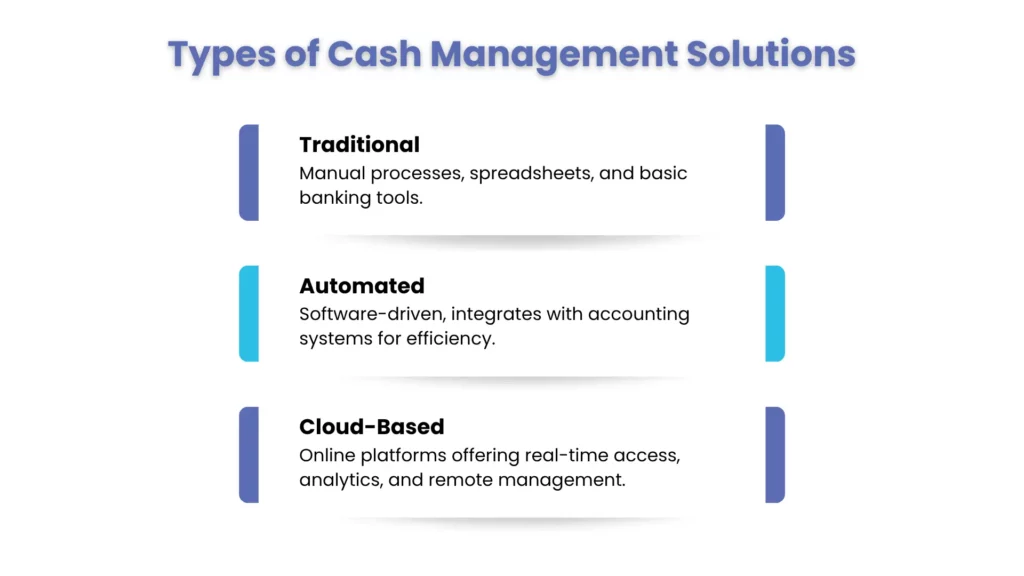
| Model | Overview | Scalability | Key Risk |
| Traditional / manual | Spreadsheets & bank portals. Relies on manual data entry across disconnected tools. Works for very small operations. | Poor | Error-prone; DSO creep; difficult to scale |
| automated on-premise | ERP treasury modules (e.g., SAP Treasury, Oracle Cash Management). Automates AP/AR and reconciliation within an ERP. Powerful but requires dedicated IT resources. | Moderate | Costly maintenance; slow to update |
| Cloud-based platform | API-connected SaaS (integrates with NetSuite, QuickBooks, SAP, Oracle). Provides real-time dashboards and scales without new hardware. Corient’s Finance and Accounting Services operate on this model, delivering real-time visibility with zero on-premise overhead. | High | Vendor dependency |
Many of these platforms double as cash flow management software, layering AI forecasting on top of live transaction data. For most mid-to-large firms, this is where modern platforms now live. Corient Business Solutions operates on a cloud-based model delivering real-time visibility, seamless integrations, and scalable cash management without the overhead of on-premise infrastructure.
The 5 Core Pillars Every CFO Should Evaluate
In assessing any platform, test against five fundamentals:
- Visibility: A single, real-time window across all bank accounts, entities, and currencies. Look for BAI2 and SWIFT MT940 bank feed support for US enterprise connectivity.
- Forecasting: AI-driven 13-week and rolling cash forecasts with scenario modelling (base, upside, downside). See how modern financial reporting tools support this capability.
- Automation: Automated AP/AR, bank reconciliation, and collections Automation that compress the order-to-cash cycle and reduce DSO by 25–30%.
- Control: Workflow approvals, fraud detection, audit trails, and SOX-compliant audit logs for public and pre-IPO companies.
- Integration: Native connectors to your ERP (SAP, Oracle, NetSuite, QuickBooks), banking partners, and your broader finance and accounting ecosystem via standard APIs.
A platform that excels at all five will become the bedrock of informed decision-making, while one falling short in two or more areas creates dangerous vulnerabilities.
Cash Flow Management Strategies That Reduce DSO and Free Working Capital
Technology is worthless without discipline. The best cash flow management techniques CFOs use are as follows:
Reduce your cash conversion cycle:
Automate AR invoicing and follow-up. Companies that automate collections reduce DSO by 25–30%, according to industry benchmarks.
Negotiate favourable payment terms:
Aim for 60–90 day outbound payment terms. Use early-pay discount programmes such as “2/10 net 30” — meaning you receive a 2% discount if you pay within 10 days rather than the full 30-day term. Run the annualised cost of capital before accepting. Corient’s Procure to Pay Services enforce these terms systematically. Read the deep-dive: Procure-to-Pay Process: Key Steps & Best Practices
Forecast in 13-week rolling cycles:
Weekly liquidity forecasts expose shortfalls 60–90 days before they become emergencies. Corient’s Record to Report Services generate the accurate financial data forecasts depend on. Learn more: Record-to-Report Process Guide for 2026
Sweep and invest surplus cash:
Aggregate balances across entities daily. Deploy surplus into ACH sweeps, money market funds, or short-duration Treasuries to generate yield on idle balances.
Set and enforce customer credit policies upfront:
Define credit limits, payment terms, and escalation triggers before onboarding new clients. Late-payer patterns are almost always predictable from the first invoice.
Combining these strategies with cash flow management tools enables you to go from firefighting to forecasting.
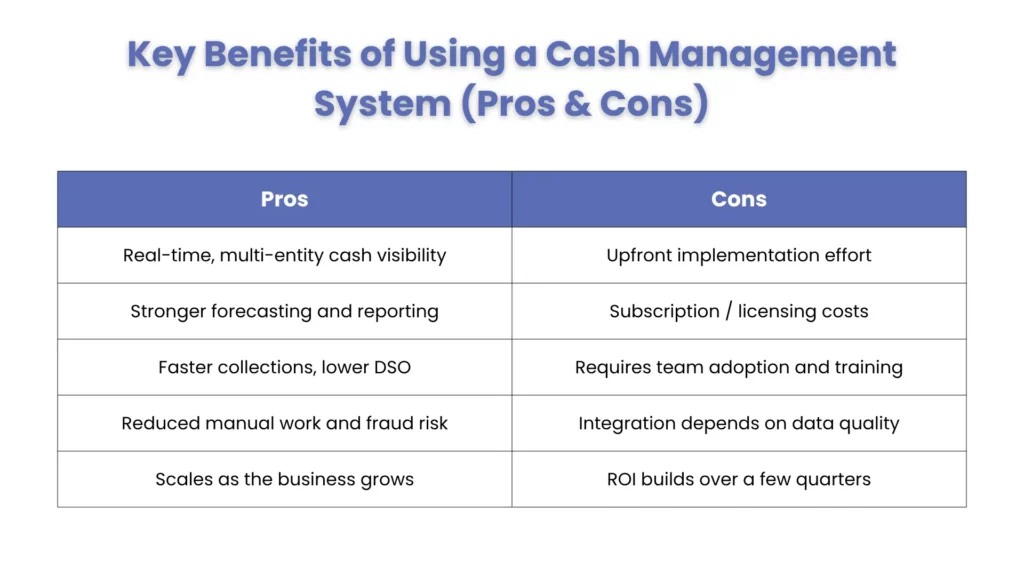
Key Benefits of Using a Cash Management System
The advantages of a modern system compound quickly:
- Real-time liquidity visibility across all accounts, entities and currencies.
- Lower borrowing costs by reducing reliance on short-term credit.
- Faster collections and a measurably lower DSO.
- Audit-ready financial reports generated automatically — including SOX and ASC 606 compliant records
- Reduced fraud and error through automated controls.
How Much Does Cash Management Software Cost? (US Market Benchmarks)
A cash management solution earns its keep when complexity outpaces spreadsheets. Common triggers include multiple bank accounts, entities, or currencies; a DSO drifting above your terms (a DSO-to-terms ratio over 1.5 is a red flag); and manual reconciliation eating days each month.
| Business size | Typical monthly cost | What’s usually included |
| Small business (<$10M revenue) | $200–$800/mo | Basic AR/AP automation, single entity, limited bank feeds |
| Mid-market ($10M–$500M revenue) | $1,500–$8,000/mo | Multi-entity, AI forecasting, ERP integration, AR automation |
| Enterprise ($500M+ revenue) | $8,000–$25,000+/mo | Full treasury suite, multi-currency, SWIFT connectivity, SOX audit logs |
Note: Most vendors charge implementation fees separately ($5,000–$50,000 depending on complexity). Always request a total cost of ownership (TCO) estimate, not just the subscription rate. Contact Corient for a tailored quote based on your entity count and ERP setup.
Top Features of Cash Management Systems to Look For
The strongest platforms share a consistent feature set:
- Bank connections that allow you to import US and international bank feeds through API, BAI2, and SWIFT MT940
- We’ve got a cash forecasting system that uses AI to predict your cash flow out 13 weeks, 6 months and even a whole year
- Automated AP and AR – we cover the whole order-to-cash and procure-to-pay processes from start to finish
- Get a clear picture of your company’s cash situation with multi-entity, multi-currency dashboards that are updated in real time, and give you a consolidated view of your cash position
- Create your own KPI dashboards, and generate audit trails and ASC 606 revenue recognition reports that are SOX-ready
- We’ve also got role-based access controls, fraud alerts, and you can set dual-approval requirements for payments to prevent any funny business
- From one interface, you can initiate ACH, domestic wire, and SWIFT international payments
- We integrate with lots of ERP systems, including SAP, Oracle Fusion, NetSuite, Microsoft Dynamics, and QuickBooks – so you don’t have to worry about setting that up yourself
Look for cash flow management software that delivers these natively rather than through fragile add-ons. The best cash management solution feels like one system, not five stitched together.
When Does Your Business Actually Need a Cash Management Solution?
When Does Your Business Actually Need a Cash Management Solution?
- Managing multiple bank accounts, legal entities, or currencies
- DSO drifting above your payment terms (a DSO-to-terms ratio above 1.5 is a red flag)
- Manual reconciliation consuming more than 2–3 days per month
- Preparing for a SOX audit or IPO readiness review
- Integrating a newly acquired entity with a different ERP or banking setup
Illustrative scenario
A $400M regional distributor operating on Net 30 terms watched its DSO climb to 63 days — trapping roughly $200K in working capital inside unpaid invoices. After deploying a cloud cash management solution with automated AR collections and real-time dashboards, the business pulled DSO back toward terms within two quarters and redeployed freed capital into inventory investment. (Based on a composite of mid-market client outcomes. Contact us for a case study specific to your industry.)
Cash Management Best Practices for CFOs and Finance Teams
To maximise value, adhere to sensible cash management principles:
- Recall: Reconcile regularly, not only at the end of the month.
- Create rolling forecasts and run through downside scenarios.
- Define and apply credit policies up front with customers.
- Weekly review of financial reports with stakeholders with access to action.
- Review cash management solution configuration as the business grows.
- Invest in change management: platform ROI drops significantly without team adoption. Assign a treasury champion internally and plan for a 4–6 week onboarding period.
To speed up adoption, many companies will have the platform set up and configured for them, plus have outsourced finance and accounting services that will oversee the platform.
Vendor Evaluation Checklist: How to Choose a Cash Management Solution
Use this checklist when evaluating vendors or building an RFP:
- Does it connect natively to your existing ERP (SAP, Oracle, NetSuite, QuickBooks)?
- What bank connectivity standards does it support — BAI2, SWIFT MT940, direct API?
- Does the forecasting engine use AI/ML, or rule-based logic?
- Can it handle multi-entity consolidation and multi-currency in a single dashboard?
- What SOX or audit-support features are included out of the box?
- What is the total cost of ownership (subscription + implementation + training)?
- What is the typical implementation timeline, and what internal resources are required?
- Does the vendor offer managed finance and accounting services alongside the software?
- Can the platform initiate ACH, wire, and international SWIFT payments directly?
- What SLA (uptime, support response) is guaranteed in the contract?
How to select the right cash management partner?
Selecting a cash management solution is as much about who your partner is as it is about the solution itself. Look for vendors that grasp the intricacies of the mid-market and enterprise, provide tested integration with banks and ERP, and have the implementation support and finance and accounting skills to back the product.
Transparency in pricing will be the focus, with a defined path to ROI, and ensure the roadmap remains aligned with the capabilities of AI and changing cash flow management software. Most importantly, the most successful system is one that will be used daily by your team; consider usability and support as much as features when choosing a system.
Schedule a free cash management consultation.
Get expert guidance to optimize cash flow, improve liquidity, and strengthen your financial operations.
People Also Ask:
A cash management solution is a way to handle cash that is suitable for your business.
It is a single platform that brings together banking, accounts receivable, accounts payable, forecasting and reporting together to give CFOs real-time visibility and control of cash. With modern cash management solutions, AI forecasting and automation are layered atop real-time banking information.
The difference between cash management and treasury management is…
Cash Management is about the day-to-day collections, payments and order to cash process. Treasury Management is wider, including financial risk, investments, debt and funding. The core that the treasury rests on is having strong cash flow management. Read the deep-dive: P2P, O2C, and R2R — the 3 cycles that run your finance function
What is the benefit of a cash management solution to cash flow management?
Automation of collections and reconciliation reduces DSO (typically by 25-30%), provides a real-time view of all accounts, and generates accurate financial reports that are accurate and reliable, not guesswork based on weekly forecasts.
What is the price of cash flow management software?
It depends on the scale, number of entities and integrations. Most enterprise platforms are subscription-based, and the return is usually a lower cost of borrowing, a shorter DSO, and labor saved on manual reconciliation.
Should there be a necessity for finance and accounting services when there is software?
Software will manage the execution but setup, controls design, interpretation of financial reporting and strategic oversight cannot be replaced by it in the finance and accounting services.
Conclusion:
Under circumstances where agility, liquidity, and good decision making go hand in hand, efficient cash management has become a fundamental aspect of corporate finance. Corporations that have real-time visibility and forecasting capabilities will be able to leverage this for better resilience, enhanced performance in terms of working capital, and more confident response to dynamic market conditions.
However, in order to realize these benefits, businesses may need the right combination of technologies, process and specialized advice. Companies looking to improve their cash management techniques will gain from collaborating with the experts at Corient Business Solutions.