


The strongest procure to pay software vendors in the US for 2026 are Coupa (best for spend control and team adoption), SAP Ariba (best for large global enterprises), Ivalua (best for custom workflows and deep audit trails), ProcureDesk (best mid-market option for US businesses), and Precoro (best for multi-entity or multi-currency operations). The right pick depends on your ERP, your team size, and whether the bigger pain is procurement or AP.
If your finance team is chasing duplicate payments, waiting weeks for approvals, or pulling spend reports off a spreadsheet that’s already stale by Tuesday, the problem usually isn’t the team. It’s the process underneath them.
This guide compares ten procure-to-pay software vendors that US businesses are actively shortlisting in 2026: what each one is good at, what it costs, and who it’s not for.
What is procure to pay software?
Procure to pay software automates the full purchasing cycle: request, approval, PO, goods receipt, invoice match, payment. You’ll see it called purchase-to-pay software, procurement-to-pay software, or a P2P tool. Same category, different labels.
The goal isn’t to add a system. It’s to remove the manual hand-offs that quietly create duplicate payments and missed early-payment discounts.
What a Good P2P Workflow Looks Like
A clean purchase-to-pay process runs through six steps. Good software automates every hand-off:
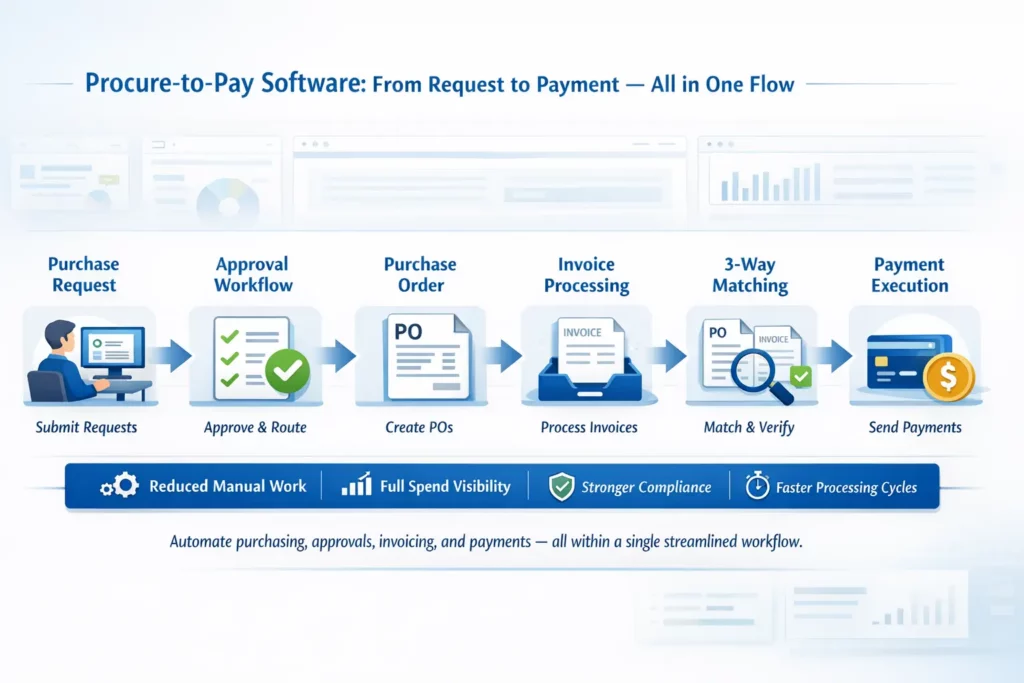
- Request. An employee submits a purchase request.
- Approval. The request routes to the right approver based on category and amount.
- Purchase order. The system generates and sends the PO.
- Receipt. Delivery is logged, enabling 2-way or 3-way matching.
- Invoice. Vendor invoice is captured (usually by AI or OCR), validated against the PO and receipt.
- Payment. Approved invoices pay automatically by ACH, wire, or virtual card with a full audit trail.
The gaps between these steps, the email approvals, the “can you just push this through manually” moments, are where the money quietly leaks out.
Quick Comparison: Top 10 Procure-to-Pay Software Vendors
The table compares the leading procure-to-pay companies side by side. Rankings reflect 2026 market positioning, weighted across features (40%), ease of use (30%), and value (30%):
| Platform | Best For | Enterprise | Mid-Market | AI Automation | SOX Ready | Free Trial | Pricing |
| Coupa | Spend control & adoption | ✓ | ✓ | Strong | ✓ | ✗ | Quote |
| SAP Ariba | Large global enterprises | ✓ | ✗ | Strong | ✓ | ✗ | Quote |
| Oracle Cloud | Oracle ERP users | ✓ | ✗ | Strong | ✓ | ✗ | Quote |
| Ivalua | Custom workflows | ✓ | ✓ | Strong | ✓ | ✗ | Quote |
| GEP SMART | Strategic sourcing + P2P | ✓ | ✓ | Strong | ✓ | ✗ | Quote |
| JAGGAER | Regulated industries | ✓ | ✓ | Moderate | ✓ | ✗ | Quote |
| Basware | AP automation at scale | ✓ | ✓ | Strong | ✓ | ✗ | Quote |
| ProcureDesk | Mid-sized US firms | ✗ | ✓ | Moderate | Moderate | ✗ | ~$399/mo |
| Procurify | SMBs | ✗ | ✓ | Moderate | Moderate | ✓ | Quote |
| Precoro | Multi-entity mid-market | ✗ | ✓ | Moderate | Moderate | ✓ | Quote |
What Actually Matters in a Procure-to-Pay Tool
Every procure to pay management software demo will walk you through a long feature list. Most of it won’t matter for your situation. The features that do:
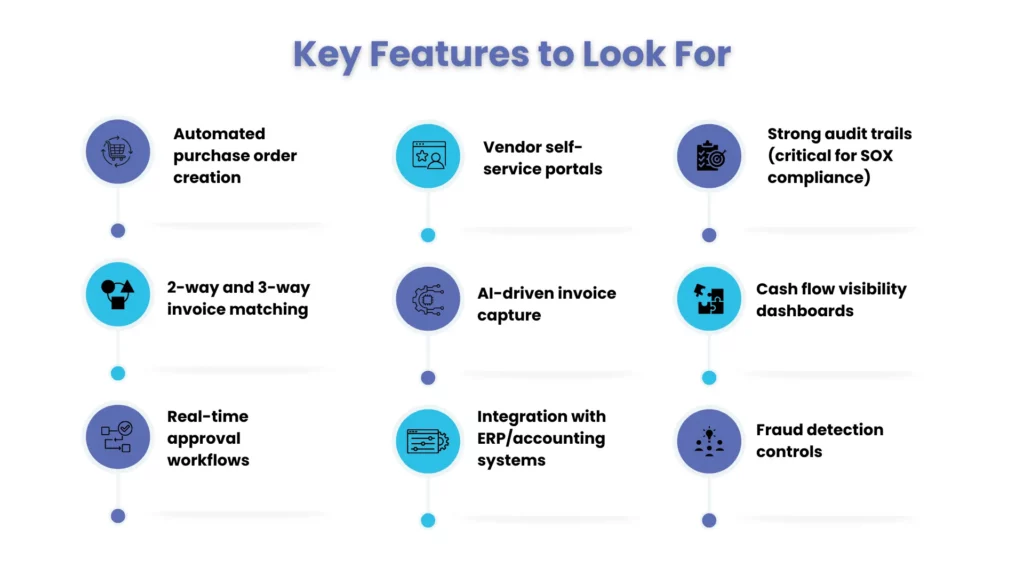
- Multi-level approval routing based on spend category and amount, not just one default approver
- 3-way matching between PO, goods receipt, and invoice before any payment goes out
- AI invoice capture that handles your actual vendor PDF formats, not just clean ones
- Vendor self-service portal so suppliers upload their own invoices
- Native ERP integration for your specific ERP version, not “we support SAP” in general
- Immutable audit trails for SOX and GAAP requirements
- Real-time dashboards showing committed spend versus available budget
Two things you can probably skip in early shortlisting: supplier marketplaces (if you already have contracted vendors) and mobile apps (if your team works at desks).
Top 10 Procure-to-Pay Software Platforms in the USA (2026)
1. Coupa – Best Overall for Spend Control and User Adoption
Coupa holds the top spot in most 2026 independent rankings, and the main reason is simple: non-procurement staff actually use it. Adoption is where P2P projects live or die, and Coupa’s interface gets out of the way. Its AI-powered spend insights benchmark your costs against industry peers, which is genuinely useful at planning time.
Watch for module creep. The base contract often doesn’t cover what your team will want in year two, so get those needs scoped into the original deal before signing.
Best for: Mid-market to large enterprises focused on adoption and spend control
Pricing: Quote-based, usually per-user annual
ERP fit: SAP, Oracle, NetSuite, Workday
2. SAP Ariba – Best for Large Global Enterprises
If you run SAP ERP, SAP Ariba is the default for good reason. The Ariba Network has over six million suppliers already on it, which makes supplier onboarding far less painful than starting cold.
The trade-off is weight. Implementations rarely come in under six months, and smaller procurement teams find it heavy to administer. If you’re not on SAP, the integration cost alone can be hard to justify.
Best for: Large enterprises with global supply chains
Pricing: Quote-based enterprise licensing
ERP fit: Native SAP; connectors for Oracle and others
3. Oracle Procurement Cloud – Best for Oracle ERP Users
If you’re already on Oracle Financials or Fusion, this is the first platform to evaluate. Native integration removes the data mapping problems that plague cross-vendor setups, and the supplier risk monitoring, ESG, cybersecurity, financial health is genuinely strong, not just a checkbox.
Outside the Oracle ecosystem, the switching cost gets steep fast.
Best for: Oracle ERP users, regulated industries
Pricing: Per-user/module, quote-based
ERP fit: Oracle Fusion (native); REST APIs for others
4. Ivalua – Best for Custom Workflows
Ivalua’s pitch is flexibility, and the 2026 rankings back it up, particularly on feature depth and audit-trail strength. Most enterprise P2P platforms make you change your process to fit them. Ivalua’s no-code workflow builder lets procurement and finance configure approval rules without an IT ticket. All P2P modules are included in the core platform, so there are none of the surprise module charges that buyers hit elsewhere.
Best for: Enterprises with non-standard P2P workflows
Pricing: Quote-based, all modules included
ERP fit: SAP, Oracle, Microsoft Dynamics, custom via API
5. GEP SMART – Best Source-to-Pay and P2P in One Platform
GEP SMART is one of the few platforms that handles source-to-pay end-to-end in a single cloud-native environment: sourcing, contracts, purchasing, and payments without stitching tools together. Electronic payments and supplier compliance are strong, which matters when your vendor base is large.
If you need both strategic sourcing and a strong P2P tool in the same product, GEP is usually the shortlist leader.
Best for: Mid-market and enterprise with complex sourcing needs
Pricing: Quote-based
ERP fit: SAP, Oracle, Microsoft Dynamics
6. JAGGAER – Best for Regulated Industries
JAGGAER owns a niche in US regulated sectors: higher education, healthcare, public sector. Its audit logs are built around the way regulated auditors actually work, not the way software vendors think they work. Supplier communication and risk tracking are well above average for this segment.
Best for: Higher ed, healthcare, public sector procurement
Pricing: Quote-based, modular
ERP fit: SAP, Oracle, Banner, Workday
7. Basware – Best for AP Automation at Scale
Basware shows up in 2026 rankings particularly when invoice volumes are high. It’s the specialist pick for AP automation and e-invoicing, with compliance built for 50+ countries, useful for multinationals managing cross-border tax rules.
One thing to flag: Basware is AP-first, not full procurement lifecycle. If your real pain is invoice processing rather than upstream purchasing, that’s a feature. If you need full procure-to-pay management software, look at the broader platforms above.
Best for: High invoice volumes, multinational operations
Pricing: Quote-based
ERP fit: SAP, Oracle, Microsoft Dynamics, others via API
8. ProcureDesk – Best Mid-Market Purchase-to-Pay Software for US Businesses
ProcureDesk sits in a useful spot: more capable than QuickBooks-plus-spreadsheets, less expensive and complicated than enterprise. For US companies in the 50–500 employee range that have outgrown manual purchasing but aren’t ready for SAP Ariba, it’s often the right next step. Multi-level approvals, real-time budget controls, clean QuickBooks integration.
Best for: Mid-sized US businesses building structured procurement for the first time
Pricing: From around $399/month
ERP fit: QuickBooks, NetSuite, Xero, Sage Intacct
9. Procurify – Best for SMBs
Procurify is built for small businesses bringing order to purchasing without scaring off non-finance staff. Mobile approvals are useful for companies with field teams or multiple sites, where the purchasing manager is rarely at a desk. A free trial means you can run it against your actual workflow before committing.
Best for: SMBs building their first formal purchase-to-pay process
Pricing: Quote-based, free trial available
ERP fit: QuickBooks, NetSuite, Xero
10. Precoro – Best Procurement-to-Pay Software for Multi-Entity Mid-Market
Precoro has been climbing 2026 mid-market rankings and now sits alongside the established procure to pay software vendors on most US shortlists. It overlaps with ProcureDesk on size but adds strong multi-currency and multi-entity support that ProcureDesk doesn’t match, useful if you run cross-border or have several legal entities to consolidate. The interface is clean enough that non-procurement staff don’t push back, and there’s a free trial, which is unusual at this tier.
Where to test carefully: the audit trail and SOX features are solid for mid-market but not at enterprise depth. If you’re publicly listed, compare it directly against Ivalua or SAP Ariba before committing.
Best for: Mid-sized US businesses with multi-currency or multi-entity operations
Pricing: Quote-based, free trial available
ERP fit: NetSuite, QuickBooks, Xero, Sage Intacct
Best Procure to Pay Software for Compliance and Audit Trails
For US businesses under SOX, GAAP, or industry-specific regulation, the audit trail isn’t a feature. It’s the whole decision. Four platforms lead this dimension in 2026:
Ivalua has the most configurable audit framework. Field-level changes are timestamped, attributed, and immutable. Its approval matrices map cleanly to segregation of duties, which is what SOX auditors actually test.
SAP Ariba is the safest enterprise pick when your auditors already live in SAP. Audit logs flow into SAP GRC natively, cutting year-end attestation work substantially.
Oracle Procurement Cloud matches Ariba on audit depth and adds stronger supplier risk monitoring, useful when compliance scope extends to vendor ESG and cybersecurity.
JAGGAER is the specialist for higher education, healthcare, and public sector audit patterns. Its log formats line up with what those auditors specifically request.
At the demo, insist on four things regardless of vendor:
- Truly immutable audit trails (no edit, no delete, not even by admin)
- Field-level change history with user and timestamp
- Segregation of duties enforced in configuration so the same person can’t create, approve, and pay
- Auditor-ready export packages
If a vendor can’t show all four in 30 minutes, the platform isn’t audit-ready, whatever the marketing says.
Procure-to-Pay vs Source-to-Pay: Which Do You Need?
This question comes up on almost every shortlist. The short answer:
- Procure-to-pay software handles the transactional side: request, PO, receipt, invoice, payment. It picks up after the supplier is already contracted.
- Source-to-pay procurement software adds the upstream supplier lifecycle: discovery, RFx, contract negotiation, qualification.
Pick a P2P tool if your headache is AP efficiency, slow approvals, or no spend visibility. Pick source-to-pay procurement software if you also need to fix how you find and contract with suppliers. Among the platforms above, Coupa, SAP Ariba, Oracle, Ivalua, and GEP SMART span both stages. Basware, ProcureDesk, Procurify, and Precoro focus on the P2P side.
Where P2P Implementations Go Wrong
Solid software fails for predictable reasons. Four come up again and again:
- Skipping process redesign – Software automates whatever is already there. If your current process has unclear ownership or no approval hierarchy, the software automates the chaos faster. Fix the workflow before configuring anything.
- Going live with dirty vendor data – Duplicate vendor records are the biggest cause of duplicate payments after go-live. Deduplicate the vendor master before migration, not after.
- Treating it as a finance-only project – A platform finance loves and procurement won’t use breaks at the PO stage. Both teams have to own it from day one.
- No named owner – Every P2P system needs one person accountable for exceptions, adoption, and ongoing config. Without that, the platform drifts back to workarounds within a year.
How to Choose
- Start with your biggest pain – Duplicate payments? Slow approvals? No visibility on committed spend? The answer tells you which capabilities to weight and which platforms to drop from the shortlist.
- Match the platform to your ERP first – Native integration matters more than people realise. Middleware-based integrations look fine in the demo and create data quality issues six months later.
- Be honest about your admin capacity – Enterprise platforms need dedicated admins. If your procurement team is two people, you’re not buying SAP Ariba.
- Confirm US compliance upfront – For publicly listed companies, SOX needs immutable audit trails and segregation of duties across the full purchase-to-pay cycle. Add GAAP and state-level tax automation to the verification list.
- Cost out year two, not year one – Ask vendors what the contract looks like once you’ve added the supplier portal, analytics, and extra ERP connector. The headline price is rarely the real number. Budget implementation at 50–80% of Year 1 licensing for any enterprise platform.
Ready to fix your procure-to-pay process? Whether you’re choosing your first P2P platform or replacing one that isn’t working, Corient handles the hard part, process redesign, data cleanup, and implementation support.
People Also ask
What is the best procure to pay software in 2026?
Coupa leads most 2026 independent rankings overall, with SAP Ariba and Ivalua close behind for enterprise depth. For mid-market US businesses, ProcureDesk and Precoro are the practical picks. For high-volume AP, Basware is often the better specialist.
Who are the leading procure to pay software vendors in the USA?
The top procure to pay software vendors in the US for 2026 are Coupa, SAP Ariba, Oracle Procurement Cloud, Ivalua, GEP SMART, JAGGAER, Basware, ProcureDesk, Procurify, and Precoro. Coupa, SAP Ariba, Oracle, Ivalua, and GEP SMART compete in enterprise; JAGGAER leads in regulated industries; Basware specialises in AP automation; ProcureDesk, Procurify, and Precoro serve the mid-market and SMB tiers, with Precoro standing out for multi-entity or multi-currency operations.
What is the difference between purchase-to-pay and procure-to-pay management software?
There’s no functional difference. Purchase-to-pay (P2P), procure-to-pay management software, and procurement-to-pay software are interchangeable terms for the same category — software that automates request, PO, invoice, and payment.
Which procure-to-pay platforms are strongest for compliance and audit trails?
Ivalua has the deepest audit configurability. SAP Ariba is the safest pick when your auditors already work in SAP. Oracle Procurement Cloud adds strong supplier risk monitoring on top of audit depth. JAGGAER is the specialist for higher education, healthcare, and public sector audit patterns.
What results can businesses expect from a P2P tool?
Businesses that implement procure-to-pay software and redesign the process around it typically see invoice processing time drop 60–80%, duplicate payments fall to near zero, and a real improvement in early-payment discount capture. The redesign part matters: software bolted onto a broken process delivers a fraction of that.
Conclusion
The right procure-to-pay software isn’t the one with the longest feature list. It’s the one that fits your team’s size, your ERP, your compliance load, and how willing you are to redesign the process around it.
For 2026, Coupa leads for overall usability and spend management. SAP Ariba and Ivalua sit close behind for enterprise depth and workflow flexibility. For mid-market US businesses, ProcureDesk and Precoro both deserve a shortlist spot, with Precoro pulling ahead for multi-entity or multi-currency operations. For AP-heavy multinationals, Basware is worth running against the enterprise names.
The technology is the easy part. The hard part is cleaning your vendor data, redesigning approvals, and getting procurement and AP to own the outcome together.
If you’re picking your first P2P platform or replacing one that isn’t working, Corient handles the hard part: process redesign, data cleanup, and implementation support.
Talk to the Corient team about where your P2P process stands today.