 United States
 United Kingdom
 India


Outsourced bookkeeping lets an accounting practice hand its recurring transaction work to an external team, so partners and senior staff spend their time on review, advisory and client relationships instead of data entry. For firms facing busy-season backlogs and a thin hiring pool, it is one of the fastest ways to add capacity without adding headcount.
This guide explains how outsourced bookkeeping works, what you can hand off, where the risks sit, and how to choose a provider and start without disrupting client service.
Key takeaways
Hand off the production work (data entry, categorization, reconciliations, cleanup). Keep review, sign-off, tax strategy and client advice in-house.
- For most firms the real issue is capacity, not budget. The US Bureau of Labor Statistics (BLS) projects that employment of bookkeeping, accounting and auditing clerks will fall 6% between 2025 and 2035, so hiring alone is unlikely to fix it.
- Judge providers on total cost, not hourly rate. Add your own review time, management time and rework to the fee, then hold that up against an in-house hire, which runs about $72,400 a year fully loaded at the BLS median wage.
- Pilot it for four weeks with a few clients whose books are clean and documented. Look at accuracy, turnaround and rework before you add more.
- White-label means the provider works in your software under your brand. Your clients still have to be told that a third party may see their data.
What is outsourced bookkeeping?
Outsourced bookkeeping is an arrangement where a third-party provider handles day-to-day bookkeeping tasks on behalf of your firm or your clients. That includes coding transactions, reconciling accounts, managing payables and receivables, and preparing monthly financials. The work is done remotely in the client’s accounting software, typically QuickBooks Online or Xero, and passes through your review.
You will also see it called bookkeeping outsourcing, outsourcing bookkeeping or outsourced bookkeeping services. The terms mean the same thing. An outsourced bookkeeper can be a freelancer, a dedicated team assigned to your firm, or a specialist provider with its own review layer. The principle is the same in each case: the preparation is done by someone else, and the professional judgment stays with you.
How Outsourced Bookkeeping Works For An Accounting Practice
Most engagements follow the same five steps, whether you outsource one client or fifty.
- Scope and access: You define which clients and tasks are in scope, and give the provider restricted access to each client’s accounting file, bank feeds and document portal.
- Setup and standards: The chart of accounts, coding rules, naming conventions and close checklist are documented, so the provider works to your standards rather than its own.
- Monthly processing: The team codes transactions, reconciles bank and credit-card accounts, processes bills and invoices, and keeps the books current.
- Review and handoff: A reviewer at the provider checks the work. It then reaches your team as reconciled books with a short list of open questions.
- Your sign-off: Your staff resolves the judgment calls and turns the books into financials, advisory or tax work for the client.
Because everything runs in cloud accounting software, this model is also called virtual bookkeeping or online bookkeeping services. A remote bookkeeper working inside your clients’ files is no different in practice from one sitting in your office, as long as access, communication and review points are set up properly.
What you can outsource
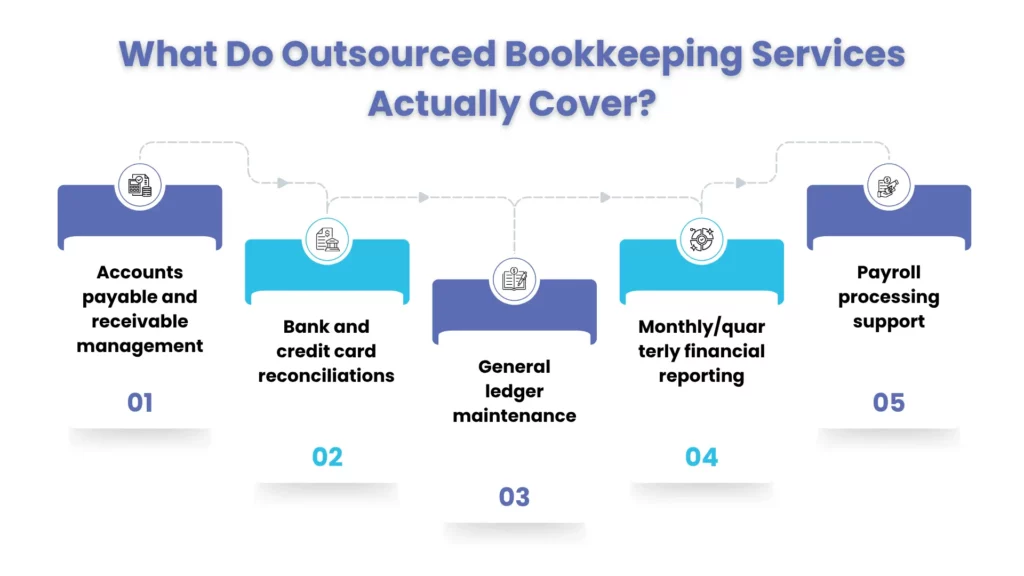
Rule-based, high-volume work is the easiest to hand off. The usual scope looks like this:
- Transaction coding and reconciliations: Bank and credit-card coding, plus routine bank reconciliation services.
- Payables and receivables: Bill entry, payment runs, invoicing and collections follow-up. Accounts payable outsourcing is a common place to start.
- Month-end close: Reconciliations, draft adjusting entries and a reviewed set of monthly financials.
- Cleanup and catch-up: Bookkeeping cleanup services for messy files, and catch up bookkeeping for clients who are months behind.
- Payroll processing: Outsourced payroll runs and the related reconciliations.
- Controller-level review: For larger clients, an outsourced controller can review the close and flag exceptions.
What stays with your firm is the judgment work: tax positions, advisory, client communication and final sign-off.
Outsourced vs in-house vs AI bookkeeping
An in-house bookkeeper gives you proximity and control, but capacity is fixed. You carry the same team through quiet months and peak weeks, and a single resignation can stall several clients at once.
Outsourced bookkeeping gives you flexible capacity and specialists who do this work all day. The trade-off is onboarding effort and the need for clear standards and oversight, because you are managing a team you do not sit next to.
AI bookkeeping and automated bookkeeping tools are strong at bank-feed categorization, receipt capture and flagging duplicates. They do not replace reconciliation review or the handling of exceptions. The strongest setups combine automation with a human reviewer. The question is rarely outsourced or automated. It is who reviews the output before it reaches your client.
Outsourced bookkeeping vs outsourced accounting
Bookkeeping records and organizes transactions. Accounting interprets them: preparing financial statements, analyzing results, supporting tax work and advising on decisions. That is the core of the bookkeeping vs accounting question, and of bookkeeper vs accountant when you are deciding who does what.
Outsourced accounting services sit one step above bookkeeping. They can include financial statement preparation, controller functions and tax-prep support, which need more review and more trust. Most firms start by outsourcing bookkeeping, which is high-volume and rule-based, and extend to outsource accounting tasks once the provider has proven its quality.
Benefits and risks of outsourcing bookkeeping
For accounting firms, the case for outsourcing accounting work rests on capacity and focus. The risks are real but manageable with the controls covered later in this guide.
Benefits
- Extra capacity in busy season without temporary hiring
- Relief when bookkeeper roles are hard to fill or keep filled
- A documented, repeatable process instead of knowledge held by one person
- Senior staff time moved from data entry to review and advisory
- The ability to take on new clients without waiting for a hire
Risks
- Uneven quality if standards and review are not defined up front
- Data security exposure when a third party touches client files
- Weaker client communication if the provider is not briefed on each client
- Dependence on one provider with no backup coverage
- Slower turnaround if handoffs and deadlines are unclear
Signs it’s time to outsource bookkeeping
For CPA firms and other accounting practices, the signal is usually a capacity problem that shows up in the same few ways:
- Your team spends more hours on data entry and reconciliations than on review or advisory.
- Busy season accounting backlogs push month-end close and filing deadlines.
- Bookkeeper roles stay open for months, or turnover keeps resetting the team.
- New clients are waiting because everyone is full.
- Cleanup work for new clients delays onboarding.
- Partners are reviewing bookkeeping that should have been delegated.
If several of these apply, a short scoping call with CorientBS is a low-risk way to see what outsourcing would look like for your firm.
Quality control, security and compliance
Quality and security are what firms worry about most, and both come down to process rather than promises.
Quality control
- Document the chart of accounts, coding rules and close checklist before work starts.
- Require a review layer at the provider, then your own review on top.
- Sample-check the work closely for the first 90 days, then reduce checks as accuracy proves out.
- Track corrections so repeat errors are fixed at the source.
Security and access
- Use role-based, least-privilege access, multi-factor authentication and individual logins. No shared passwords.
- Ask for a SOC 2 report or an equivalent security assessment, and a signed NDA.
- Agree on data retention, return and deletion terms in writing, including what happens when the engagement ends.
- Keep the audit trail in the accounting software switched on.
Compliance
Tax professionals in the US have data-security obligations. The FTC’s Safeguards Rule lists tax preparation firms among the businesses it covers, and it expects you to choose service providers that can maintain safeguards and to spell out your security expectations in the contract. The IRS points tax professionals to Publication 4557, Safeguarding Taxpayer Data as the place to start a written data security plan. Also check how your state board and AICPA guidance treat third-party providers, and whether your engagement letters need to disclose their use. Confirm the details with your own advisor, since requirements differ by firm and state.
How to Choose An Outsourced Bookkeeping Firm
Ask every shortlisted provider the same questions, and weigh the answers about process more heavily than the sales pitch. Our roundup of the top bookkeeping outsourcing companies in the USA is a useful place to build the shortlist.
- Experience: Have they worked with accounting firms, and with your software stack, such as QuickBooks Online or Xero?
- Review process: Who checks the work before it reaches you, and how are corrections tracked?
- Team structure: Is it a dedicated team or a shared pool? Who covers when someone is out?
- Security: Can they show a SOC 2 report, NDA terms and their access controls?
- Communication: Is there a single point of contact, defined response times and a reporting cadence?
- Capacity: Can they absorb your busy-season volume without slipping deadlines?
- Contract terms: Is there a pilot period, a reasonable notice term and a clear process for returning your data?
- References: Can they connect you with other firms using their outsourced bookkeeper team?
Red flags: a provider that will not run a pilot, cannot say who actually does the work, has no documented review step, asks for shared logins, or cannot explain how it protects client data.
How to transition without disrupting clients
Start small and start outside your busiest weeks, so any problems surface before a deadline does.
- Pick a pilot group: Choose three to five clients with stable volume and reasonably clean books.
- Write down your standards: Chart of accounts, coding rules, close checklist and escalation contacts.
- Run a 60 to 90 day pilot: Hold a short weekly check-in and log every correction.
- Measure the pilot: Look at turnaround time, rework, staff hours freed and client feedback.
- Expand in stages: Add clients by type, and handle cleanup and catch-up work as a separate project.
- Update the paperwork: Revise engagement letters and client communications where needed.
A good pilot also tells you how the provider behaves when something goes wrong, which is more useful than any sales presentation.
People Also Ask:
How does outsourced bookkeeping work?
Your provider gets restricted access to each client’s accounting software, processes transactions and reconciliations to your documented standards, and passes reviewed books back to your team for sign-off.
Can I outsource only some clients or tasks?
It can be, if the provider uses role-based access, multi-factor authentication, individual logins and signed NDAs, and can show a SOC 2 report or equivalent. Ask for these before the pilot starts.
Who is responsible for the accuracy of the books?
Your firm remains responsible to its clients. That is why a documented review step on both sides matters, and why the provider’s work should be treated as preparation, not final sign-off.
Will my clients know their books are handled by an outsourced team?
With a white-label provider, clients deal only with your firm and see your brand. That doesn’t remove your duty to disclose that a third party may have access to their data. Most firms handle this through the engagement letter.
How do I start without disrupting my clients?
Run a 60 to 90 day pilot with three to five stable clients, outside busy season, with weekly check-ins and a log of corrections.
Can outsourced bookkeeping scale during tax season?
Usually, if you set it up for that. Hourly and per-client models flex more easily than a fixed dedicated team. Ask each provider how much notice they need to add people, and put it in the contract.
Conclusion
Outsourced bookkeeping works best when it is treated as an extension of your team, with written standards, a review layer and a staged rollout. Done that way, it frees your people for the review and advisory work clients value most, and gives you room to grow without waiting on a hire.
If you are weighing outsourced bookkeeping services for your firm, Corient can scope a pilot around your clients and software, with no commitment to scale up.