


To build a high-performance finance function, your CFO will need to bring people, processes, technology, and data together to create a finance team that delivers accurate reporting, insights, and efficiency. When standardization of workflows, automation, and frequent improvements are done, finance will turn into a function that will drive business growth.
A high-performance finance function is not limited to managing transactions and reporting numbers; it has turned into a strategic partner that has helped drive business growth, improve profitability, manage risk, and support faster decision-making. For your CFO (chief financial officer), creating a finance function is no longer optional but essential for being relevant in a competitive business environment.
Let’s understand the importance of the finance function through a scenario. Imagine your executive team is waiting for financial reports before deciding on a major expansion. But your finance team is still stuck reconciling accounts, chasing missing invoices, and correcting spreadsheet errors. The reports get delayed by five days, delaying critical decisions and frustrating leadership.
Think: if you had financial data updates in real-time through integrated systems, the financial close process is done ahead of time, dashboards providing updated cash flow and profitability information, and your financial professional spends more time advising than preparing reports.
That difference is the result of a well-designed Finance Function.
Now, the finance function is going through a rapid transformation. According to the Deloitte Q4 2025 CFO Signals Survey, about 50% of North American CFOs have made digitization of finance their top priority. 49% believe that automation will free up their employees from high-value work.
This guide explains the framework CFOs can use to build a scalable, modern, and high-performing Finance Function that supports long-term business growth.
Why Finance Performance Matters to Business Growth
Finance is the heartbeat of any large enterprise, and every major business decision can be taken only when you have accurate financial information. When the finance function works well, your leadership gains confidence in making strong decisions on:
- Business expansion
- Capital investment
- Pricing strategies
- Hiring plans
- Cash flow management
- Risk management
- Mergers and acquisitions
On the other hand, a poor finance function creates delays, uncertainty, and unnecessary risk.
You must be expecting your CFO to deliver more than just financial statements. They must offer more insights through financial planning and analysis, scenario modeling, and real-time financial reporting. This helps your executives make quick decisions as per changing market conditions.
A high-performing Finance Function also advances collaboration across departments. In short, stronger finance performance leads to stronger business performance.
10 Warning Signs Your Finance Function Needs Transformation
It doesn’t matter how well-established your business is; if your finance operations are not upgraded periodically, it will cost you dearly. As your business expands, the old manual procedures, workflows, and disconnected systems will cause more hindrance.
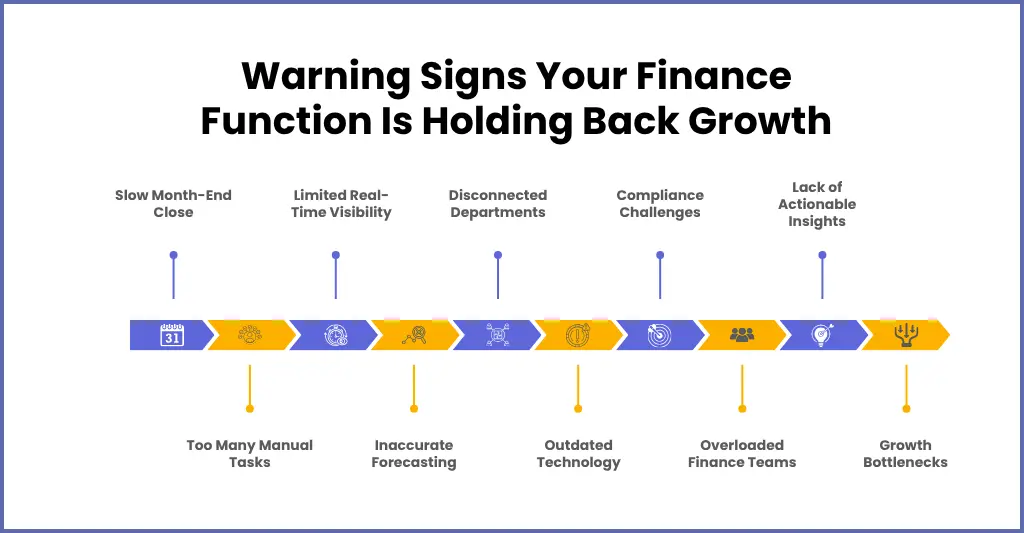
Here are ten signs that your finance function may need transformation.
1. Month-End Close Takes Too Long
Is your month end close process taking too much time consistently, like more than a week? It delays reporting and slows executive decision-making. Such delays indicate manual work, poor integration, and an inefficient review process.
2. Teams Spend Too Much Time on Manual Tasks
If your accountants are spending most of their time correcting errors and doing data entry, leaving them much less time for strategic work, then it’s a warning sign. Emphasis must be placed on automation to handle routine work while your accountants can focus on high-value tasks.
3. Financial Reports Are Not Available in Real Time
Financial reports with outdated information are useless for any business leader. Without real-time financial reports and insights, you will be reacting slowly to market changes, operations issues, and cash flow challenges.
4. Forecasting Is Frequently Inaccurate
Are you seeing constant corrections in budgets and forecasts? It means that your finance team is not doing a good job with regard to providing reliable data or advanced financial planning and analysis. Accurate forecasting needs integrated systems, consistent processes, and timely information.
5. Departments Operate in Silos
Your finance team must work closely with operations, sales, procurement, HR, and executive leadership. Any disconnect between them, or if departments are maintaining separate data sources and reporting methods, then it damages collaboration and decision-making becomes patchy.
6. Technology Is Outdated
Old accounting systems or processes will give you limited productivity. Modern enterprises depend on cloud accounting software, integrated ERP platforms, and automation tools for eliminating manual intervention and increasing transparency into the organization.
7. Compliance Feels Reactive
Is your finance team struggling to prepare for audits or regulatory inspections? In such a case, you will have to invest in structured controls, standardized documentation, and regular monitoring during compliance support.
8. Your Team Is Constantly Overloaded
If your finance professionals are working overtime just to complete routine accounting tasks, then something is very wrong, and it needs to change. Such a finance team can never support long-term business growth. A high workload means inefficient processes rather than insufficient talent.
9. Leadership Lacks Actionable Insights
Providing financial reports is just one role of the finance team. These days, executives are demanding finance teams to explain trends, highlight risks, and recommend actions. Is your team capable enough to do that?
10. Growth Is Creating Operational Bottlenecks
When your business expands, you will find your finance operations are not up to the mark. Higher volumes of transactions, the need for additional departments, and more complex reporting will place more pressure on your existing team.
The CFO’s Framework for Building a High-Performance Finance Function
Creating a modern finance function involves more than just getting new software. It requires a clear CFO framework that aligns people, processes, technology, and strategy.
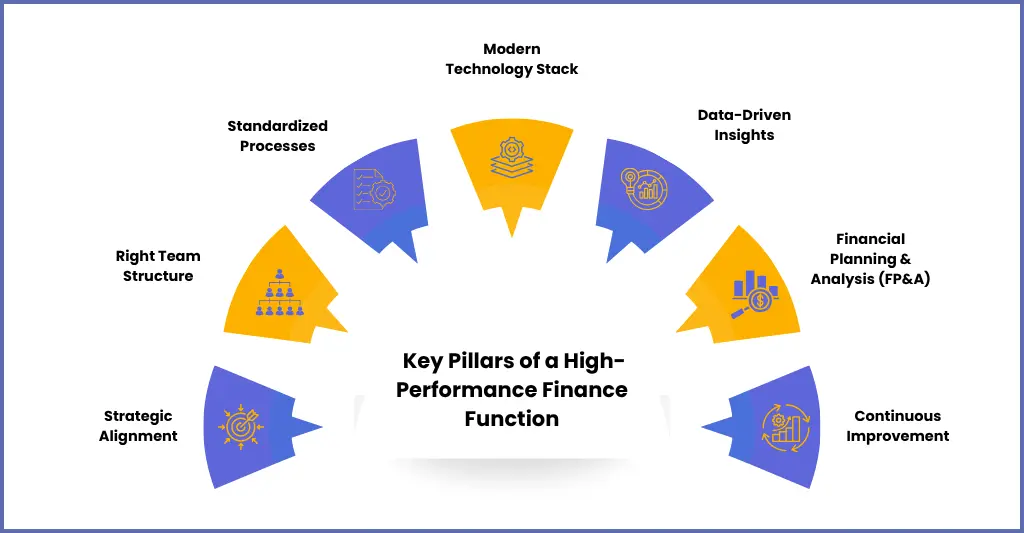
Align Finance with Business Strategy
Your finance department must actively support organizational objectives rather than operating independently.
Start by asking:
- What are the company’s growth goals?
- Which financial insights will help leadership make better decisions?
- How can finance support profitability and operational efficiency?
A strategic finance function connects financial performance directly to business outcomes.
Build the Right Finance Team Structure
A single finance team cannot handle all finance activity. High-performing organizations define clear responsibilities across:
- Financial accounting
- Management accounting
- Treasury
- Tax
- Internal controls
- Financial planning and analysis
- Business partnering
A well-structured finance department will ensure every function contributes towards the organization’s strategic objectives.
Standardize Core Finance Processes
Consistency leads to efficiency; therefore, focus on creating standardized procedures for:
- Accounts payable
- Accounts receivable
- Expense management
- General ledger
- Bank reconciliations
- Financial close
- Budgeting
- Reporting
Standardized workflows reduce errors, improve compliance, and simplify training for new team members.
Invest in the Right Technology Stack
Put the right technology foundation in every finance function. Without integrated systems, your finance teams will be spending most of their time gathering data instead of analyzing it.
Today’s leading finance organizations invest in:
- Cloud accounting software
- Enterprise Resource Planning (ERP) platforms
- Automated accounts payable and receivable solutions
- Financial planning and forecasting tools
- Business intelligence dashboards
- AI-powered analytics
- Workflow automation software
The objective isn’t just digitization but creating a connected finance ecosystem where information flows automatically between systems, reducing manual work and improving decision-making.
Make Financial Planning and Analysis a Strategic Priority
Many finance departments are good at preparing reports but struggle in predicting the future. That’s where financial planning and analysis (FP&A) becomes essential.
An effective FP&A function enables CFOs to:
- Build rolling forecasts
- Model different business scenarios
- Analyze profitability by customer or product
- Improve budgeting accuracy
- Support strategic investment decisions
- Identify financial risks before they become problems
Rather than asking, “What happened last month?” modern finance teams ask:
- What will happen next quarter?
- How will inflation affect margins?
- What happens if revenue grows by 15%?
- Can we support expansion without increasing debt?
This forward-looking mindset will transform your finance team from a reporting function into a strategic business advisor.
Build a Data-Driven Decision Culture
All high-performing finance functions ensure financial decisions are based on facts only. That’s why access to real-time financial reporting has gained importance through dashboards and automated reporting tools.
These dashboards often include:
- Revenue trends
- Cash flow position
- Gross margin
- Departmental spending
- Budget variance
- Working capital
- Customer profitability
Develop Future-Ready Finance Talent
Only technology cannot help you in building a great finance organization. You will need people with skills in running AI tools. Modern finance professionals need skills beyond traditional accounting, including:
- Data analysis
- Business partnering
- Strategic planning
- Communication
- Financial storytelling
- AI and automation management
- Digital systems knowledge
Leading CFOs invest continuously in learning because tomorrow’s finance leaders will spend less time processing transactions and more time influencing business strategy.
Technology and Automation That Drive Finance Excellence
Technology is redefining all aspects of the finance function, as we speak. But instead of replacing finance professionals, it has helped in reducing repetitive work so that they can focus on high-value analysis and advisory roles.
Some of the most impactful technologies include:
- Artificial Intelligence (AI): AI has helped in automating invoice processing, identifying errors, cash flow prediction, and forecasting accuracy.
- Robotic Process Automation (RPA): RPA has helped in handling repetitive work like reconciliations, journal entries, invoice matching, account receivables, and report generation.
- Cloud Accounting Software: Modern cloud accounting software enables secure collaboration across departments, improves accessibility, and provides real-time visibility into financial data.
- Advanced Analytics: Collaborative dashboards provide executives with immediate financial insights instead of waiting for manual reports.
- Automated Financial Close: Technology streamlines the financial close process, reducing close times while improving data accuracy and audit readiness.
KPIs Every High-Performance Finance Team Should Track
Measuring performance helps CFOs identify improvement opportunities and demonstrate the value of the Finance Function.
| KPI | Why It Matters | Target |
| Financial Close Cycle | Measures reporting efficiency | Shorter each month |
| Forecast Accuracy | Indicates planning quality | 90–95%+ |
| Days Sales Outstanding (DSO) | Evaluates cash collection efficiency | Lower is better |
| Days Payable Outstanding (DPO) | Measures payment management | Industry benchmark |
| Invoice Processing Cost | Indicates operational efficiency | Continuous reduction |
| Cash Flow Forecast Accuracy | Supports liquidity management | High accuracy |
| Budget Variance | Tracks financial performance | Minimal variance |
| Finance Team Performance Metrics | Measures productivity and service quality | Continuous improvement |
| Automation Rate | Percentage of finance processes automated | Increasing over time |
| Cost per Finance Transaction | Reflects operational efficiency | Lower year over year |
These finance team performance metrics provide CFOs with meaningful insights into operational performance while supporting continuous improvement.
How Corient Helps Enterprises Build Scalable Finance Functions
To build a modern finance function, you will need to hire additional experienced accountants. But as your enterprise grows, you will be faced with talent shortages, rising workloads, rising operating costs, and tighter reporting deadlines. Maintaining efficiency while scaling is a major challenge.
This is where Corient adds strategic value.
Corient is not a traditional outsourcing provider; it will work as an extension of your finance team and help improve your efficiency while allowing your CFOs to retain visibility and control.
Our experienced professionals support a wide range of finance and accounting services, including:
- Bookkeeping and accounting
- Accounts payable and receivable
- Bank and balance sheet reconciliations
- Procure to pay services
- Financial reporting
- Month-end and year-end support
- Order to cash services
- Tax and compliance assistance
- Management accounts
- Record to report services
Corient works with leading cloud accounting platforms and finance technologies, enabling seamless collaboration with your internal team.
Whether you’re expanding into new markets, integrating acquisitions, or preparing for digital transformation, Corient provides flexible support that scales alongside your business.
Many CFOs also use outsourced accounting for CFOs as a strategic solution to handle transactional accounting while internal finance leaders focus on forecasting, business partnering, and strategic growth initiatives.
This balanced approach enables organizations to improve efficiency without significantly increasing internal headcount.
People Also Ask:
What is a high-performance finance function?
A high-performance Finance Function combines skilled professionals, standardized processes, automation, and strategic planning to deliver accurate financial information, support decision-making, improve compliance, and drive long-term business growth.
What are the key pillars of a strategic finance function?
The main pillars include strong leadership, standardized processes, modern technology, financial planning and analysis, data-driven decision-making, compliance, talent development, and continuous performance improvement.
What technology does a high-performance finance team need?
Most modern finance teams rely on cloud accounting software, ERP systems, AI-powered automation, business intelligence dashboards, financial planning platforms, workflow automation tools, and secure cloud collaboration technologies.
How long does it take to build a high-performance finance function?
The timeline depends on the size and complexity of the organization. Many enterprises begin seeing measurable improvements within six to twelve months after implementing standardized processes, automation, and finance transformation initiatives.
Should a CFO outsource parts of the finance function or hire in-house?
The right approach depends on business objectives. Many CFOs adopt a hybrid model by retaining strategic activities internally while using outsourced accounting for CFOs to manage routine accounting, bookkeeping, reconciliations, and reporting. This improves scalability while allowing internal teams to focus on high-value strategic work.
What KPIs should a high-performance finance function track?
Key metrics include financial close cycle time, forecast accuracy, cash flow, budget variance, Days Sales Outstanding (DSO), Days Payable Outstanding (DPO), invoice processing cost, automation rate, and overall finance team performance metrics.
How does outsourced accounting help CFOs build a stronger finance function?
Outsourced accounting enables CFOs to reduce operational pressure, improve reporting speed, access specialized expertise, control costs, and scale finance operations without increasing permanent headcount. By outsourcing routine accounting tasks, internal finance teams can dedicate more time to strategic planning, financial analysis, and business growth.
Conclusion
The modern finance function can no longer be judged only by how accurate the books are. Increased value will be placed on how effectively it has helped the business make faster decisions, manage risk, improve profitability, and grab growth opportunities.
For your CFO, building such a function means combining the right people with streamlined processes, automation, and data-driven insights. If your finance team is spending more time managing transactions than driving strategy, then it’s time to rethink a new way to operate.
Corient Business Solution helps large enterprises strengthen their Finance Function through scalable accounting support, automation-enabled processes, and experienced finance professionals who seamlessly integrate with your existing team. Whether you’re accelerating finance transformation, improving reporting, or preparing for growth, Corient provides the expertise and flexibility to help your finance organization perform at its best.
Ready to build a accounting finance function that’s faster, smarter, and future-ready? Contact us today and discover how our accounting solutions can help your CFO office drive lasting business success.