


Procure-to-pay (P2P) automation is software that digitizes your entire purchasing and payment cycle from purchase requisition through vendor invoice and final payment without manual data entry. It connects procurement, accounts payable, and finance teams in one auditable workflow, reducing invoice processing time from weeks to hours while cutting fraud exposure and processing costs.
Payment fraud risk is also climbing. The Federal Reserve’s 2026 Risk Officer Report found a significant portion of surveyed financial institutions reported check fraud attempts, with 32% noting an increase in counterfeit checks and others seeing jumps in check washing (21%) and payee forgery (18%). ACH-related fraud showed similar trends, with rising business email compromise across institutions of all sizes making manual, paper-based P2P processes a real liability for accounting firms managing large-business clients, not just an inefficiency.
In this guide, you’ll learn what procure-to-pay automation is, how the process works, how it differs from source-to-pay, and the best practices for 2026–2027. This shift is also visible at the federal level, where the GSA (Guest Service Associate)is advancing automation and AI in procurement across more than $126 billion in annual contracts.
What Is Procure to Pay Automation?
Procure-to-pay automation uses cloud platforms, artificial intelligence, and robotic process automation (RPA) to execute the full procurement cycle without manual data entry or disconnected systems. It ties together requisition creation, purchase order management, vendor onboarding, goods receipt, invoice processing, and payment execution into a single governed workflow. Core capabilities typically include: automated approval routing, electronic PO generation, AI-driven three-way matching, and scheduled payment execution. The automation layer sits on top of or integrates directly with your existing ERP (SAP, NetSuite, Microsoft Dynamics, or QuickBooks Enterprise.
As transaction volume grows, the business case becomes clear: organizations processing hundreds of invoices monthly across multiple business units cannot sustain accurate manual matching and approval routing without significant headcount or error rates.
How Does the Procure to Pay Process Work?
Understanding the procure to pay process is essential before P2P Process Automation . Here is how the six core stages function in a typical large or mid-size organization.
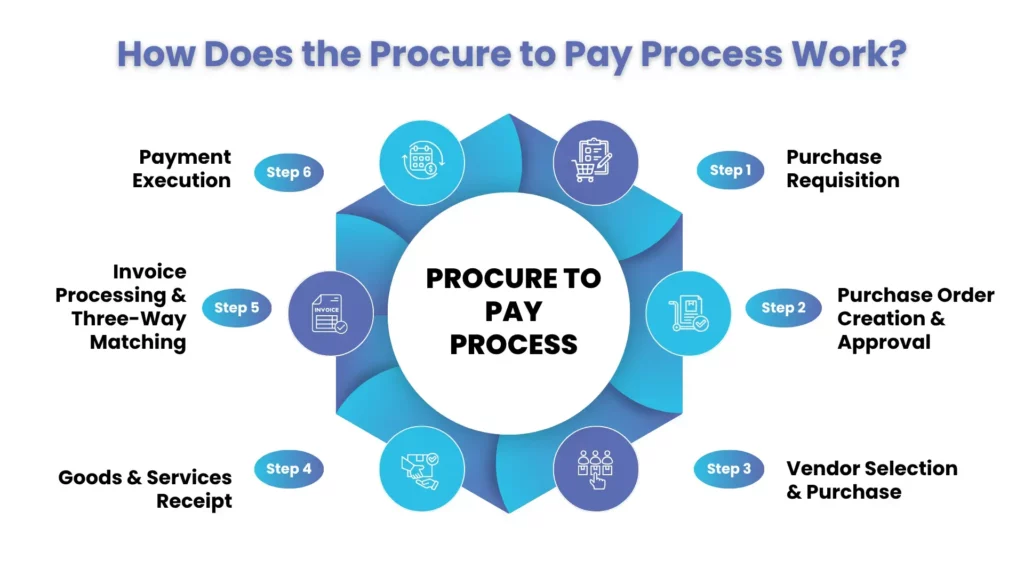
Step 1: Purchase Requisition
Employee recognizes a need and fills out a Purchase Requisition. In manual workflows, this travels by email, adding days of delay. Automated systems route requisitions electronically to the correct approver the moment they are submitted.
Step 2: Purchase Order Creation & Approval
If approved, the requisition will become a purchase order (PO) and include details of the quantity, price, vendor and delivery terms. Automation enforces budget controls before the PO is issued, flagging requests that exceed pre-set thresholds or fall outside approved vendor lists.
Step 3: Vendor Selection & Purchase
The PO is automated and sent to the vendor via an integrated portal. Automated systems verify W-9s, banking details, and vendor identity against watchlists before activation, a critical fraud prevention step given the BEC trends cited above.
Step 4: Goods & Services Receipt
When receiving goods/services, the receiving team verifies against the PO. Barcode scanning or digital sign-off generates the receipt record automatically, timestamped and audit-ready.
Step 5: Invoice Processing & Three-Way Matching
Here is where the breakdowns in the manual accounts payable process most often happen. Three-way matching of the invoice with the PO and receipt should be done prior to payment. AI-powered OCR automatically captures invoice information and automatically matches invoices in mere seconds while highlighting any discrepancies to review, typically the highest-returning aspect of procure to pay automation Process.
Step 6: Payment Execution
After a match, funds are then deposited by ACH, wire transfer, or virtual card and the transaction is entered into the general ledger. Automated execution eliminates late fees, and also records early payment discounting, which was found in the 2026 survey by the Federal Reserve to be almost universal among the institutions reporting. With the Federal’s survey in 2026 showing ACH fraud almost ubiquitous among the institutions responding; early-payment discounting is a risk better managed in an automated, permissioned payment workflow.
Procure to Pay vs. Source to Pay: Key Differences Explained
Accounting and finance teams frequently conflate procure to pay with source to pay (S2P), but they cover different scope.
| Aspect | Procure to Pay (P2P) | Source to Pay (S2P) |
| Starting Point | Purchase requisition | Sourcing & supplier identification |
| Core Focus | Requisition → PO → invoice → payment | Strategic sourcing → contracts → P2P process |
| Includes Vendor Negotiation | No | Yes |
| Includes Spend Analysis | Limited | Extensive, strategic |
| Typical Owner | Accounts payable / procurement ops | Procurement leadership / strategic sourcing |
| Automation Priority | Transactional efficiency | Strategic supplier value |
Source to pay is the broader umbrella covering sourcing, negotiation, and category strategy, while the P2P process is the transactional layer once a vendor relationship exists. Most businesses prioritize automating the P2P process first, since it delivers faster, measurable ROI before expanding into full source to pay capability.
Why Manual P2P Processes Are Holding Your Business Back
Procure-to-pay and accounts payable workflows using paper forms and email approvals result in expensive bottlenecks for medium and large enterprises. A CFO managing 500+ monthly invoices across three business units cannot maintain consistent three-way matching accuracy without either automation or a proportionally larger AP team.
Moreover, such inefficient workflows increase the risks associated with them, as manual data handling is vulnerable to fraud in check-based payments and email-based business scams, as shown in the research provided by the Federal Reserve. At the same time, an increased pressure is put on the workforce due to automation that decreased the need for bookkeeping and accountancy clerks. This is precisely the gap that procure to pay automation is designed to close.
Key Benefits of Procure to Pay Automation
For accounting firms advising large and mid-size businesses, procure-to-pay automation delivers clear financial accounting and operational gains.
- Increase in speed of processing of invoices due to automatic three-way matching of invoices
- Reduction in cost of processing per invoice through elimination of manual keying, paperwork, and reconciliations
- Enhanced fraud protection and compliance through automatic approval workflow and payment authorization control
- Increased visibility into cash flow status through automatic real-time tracking of payable accounts and obligations
- Superior vendor relations through prompt payments and increased discount savings
- Easier scaling and auditable transaction records for increasing transaction volume without requiring additional staffing
Overall, it strengthens efficiency, control, and scalability across the entire accounts payable and procurement function.
What Do Procurement Automation Case Studies Show?
Corient client engagement : Healthcare Network (P2P Process Automation)
A mid-market distribution client processing invoices manually across multiple business units was facing recurring late-payment penalties and limited spend visibility. Corient implemented automated three-way invoice matching and centralized vendor management, cutting average invoice processing time significantly and improving on-time payment rates within the first two quarters, while giving finance leadership real-time visibility into spend for the first time.
How AI and Robotic Process Automation (RPA) Are Reshaping P2P Automation
Artificial Intelligence and robotic process automation are moving P2P beyond basic digitization toward predictive, self-healing workflows:
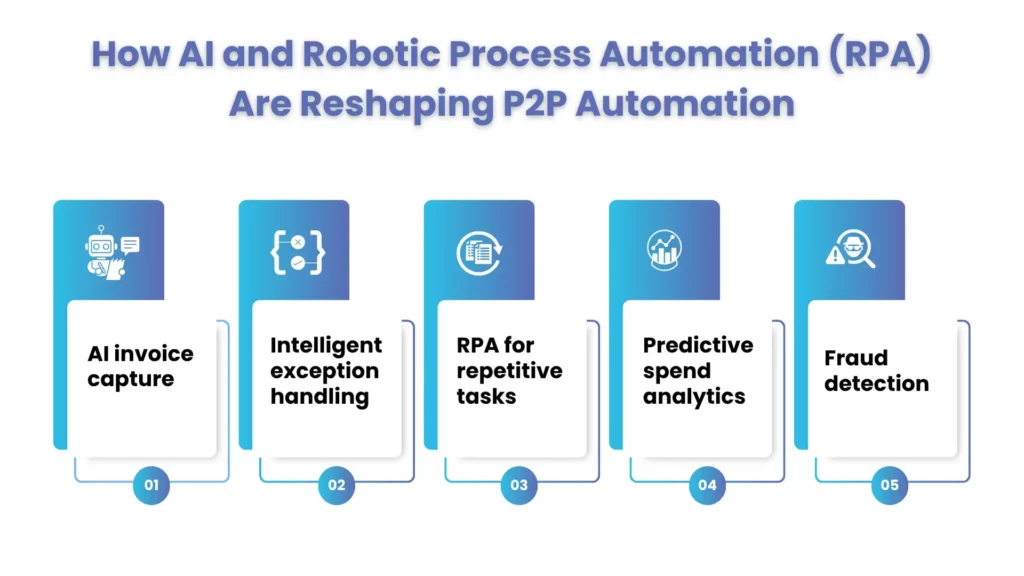
- AI invoice capture: OCR with machine learning extracts structured data from unstructured invoices including PDFs, scanned images, and portal submissions with accuracy above 98% in leading platforms.
- Intelligent exception handling: Rather than reviewing every invoice, AP teams review only the exceptions the AI flags, typically 3–8% of volume.
- RPA for repetitive tasks: Bots handle data entry, ERP posting, and status updates freeing AP staff for higher-value work.
- Predictive spend analytics: AI identifies off-contract purchases and spend pattern anomalies before they accumulate.
- Fraud detection: New sentence Vendor banking change requests a primary BEC attack vector are automatically flagged and require multi-factor confirmation before any payment record update.
Federal adoption is accelerating the GSA’s Elimination, Optimization and Automation Handbook documents automation implementations at NASA, the Department of Education, and other agencies managing large procurement volumes.
Procure to Pay Automation Best Practices
Procure to Pay automation works best when approached step by step. Start by mapping your current process and identifying key gaps, then focus on high-impact areas like approvals and invoice matching. Ensure alignment between finance, procurement, and IT teams for smooth integration. Onboard major suppliers early and roll out the system in phases to reduce disruption and improve adoption.
Audit Your Current Workflow First
Before automating procure to pay process, map every step of your existing workflow, including informal workarounds skipping this step is the leading cause of failed P2P implementations.
Priorities High-Impact Areas
Start with the bottlenecks causing the most cost or delay, typically invoice matching and approval routing, rather than a full-system overhaul on day one.
Align Stakeholders Across Finance, Procurement & IT
Early alignment on goals and approval rules prevents conflicting requirements mid-implementation, since P2P software must integrate with existing ERP systems.
Onboard Suppliers Proactively
Vendors need clear instructions on submitting electronic invoices; prioritize your highest-volume vendors first for the fastest efficiency gains.
Roll Out in Phases
Begin with an approach by departments or transaction types, and then test the solution for 60-90 days before a full-scale roll-out across the organization.
Measure, Optimize, Repeat
Track cycle times, cost per invoice, exceptions and discounts; ongoing optimization is key in the implementation of Procure to Pay automation software, as volumes change all the time.
What to Look for in a Procure to Pay Automation Software
Ensure that the procure to pay software solution works well with your accounting solution or ERP software:
| Platform | Best For | ERP Integrations |
| Tipalti | Mid-market, high-volume AP | NetSuite, QuickBooks, Xero |
| Bill.com | SMB to mid-market | QuickBooks, Xero, Sage |
| Stampli | AP-focused invoice automation | SAP, NetSuite, Microsoft Dynamics |
| Coupa | Enterprise P2P and S2P | SAP, Oracle, Workday |
| SAP Ariba | Large global enterprises | SAP ERP (native integration) |
Choosing a solution with these capabilities helps streamline accounts payable operations, improve accuracy, strengthen financial controls, and support scalable business growth.
Common Mistakes to Avoid During P2P Implementation
- Skipping process mapping: Automating a broken process makes it break faster. Document the current state first.
- Underestimating supplier onboarding time: Vendor portal setup typically takes 4–8 weeks for high-volume suppliers.
- Setting vague approval limits: Define spend thresholds and approver hierarchies before go-live, not after.
- Neglecting change management: AP staff need training and a clear reason why not just a new system to log into.
- Choosing software that won’t scale: Validate that your chosen platform handles 5× your current invoice volume before signing a contract.
- Skipping ERP integration: A P2P tool that doesn’t connect to your general ledger creates a new manual reconciliation problem.
Get a Customized P2P Automation Assessment for Your Business.
People Also Ask
What is the purpose of Procure of pay automation in simple terms?
It is software that manages the entire purchasing and payment process from requisition to final payment without manual steps, helping businesses reduce errors, paperwork, and processing delays.
How is procure to pay different from source to pay?
Procure to pay covers operational steps like requisition, purchase orders, invoicing, and payment, while source to pay also includes supplier sourcing, evaluation, and contract negotiation before purchasing begins.
What are the biggest benefits of P2P automation for large businesses?
It improves invoice speed, reduces processing costs, strengthens fraud controls, enhances cash flow visibility, and minimizes dependence on manual accounting teams as transaction volumes increase.
Does procure to pay automation reduce fraud risk?
Yes, it reduces fraud risk through automated approvals, invoice matching, and digital audit trails that help detect unauthorized payments, check fraud, and email-based payment scams earlier.
Is procurement to pay automation only for large enterprises?
No, while large enterprises benefit most due to scale, mid-size businesses also adopt it to improve efficiency, accuracy, and faster payment cycles while staying competitive.
Conclusion
Procure to pay automation is not an option anymore; rather, it is the standard way of working for major and mid-sized organizations in the U.S. that deal with large numbers of invoices, increasing fraud risks, and limited number of accounting solution clerks manually doing the job. By integrating the requisition and payments processes into one automated process that is also auditable, financial professionals are able to cut down on costs, increase speed, improve the fraud control process, and allocate professional personnel to more important advisory work.
Should your Accounting Support team or finance department be interested in the modernization of the accounts payable process, Corient Business Solutions will gladly help you develop the best procure to pay automation strategy for your organization. Please contact Corient Business Solutions now to get a consult and See how proactive accounting services can benefit your P2P process.