




What Is AR Automation?
AR automation is the use of software to manage the accounts receivable process end to end, generating and delivering invoices, collecting payments, applying cash, and reconciling accounts. For US enterprise finance teams, it lowers Days Sales Outstanding (DSO), accelerates cash flow, and enforces compliance with US GAAP, ASC 606, and SOX.
DSO measures the average number of days it takes to collect payment after a sale. It is calculated as:
DSO = (Accounts Receivable ÷ Total Credit Sales) × Number of Days in the period.
For example, a US enterprise with $200M in annual credit sales and $26M in receivables has a DSO of roughly 47 days.
At a high level, AR automation covers four connected jobs:
- Invoice generation and multichannel delivery
- Payment collection and automated follow-up (dunning)
- Cash application, matching payments to open invoices
- Reconciliation and audit-ready reporting
The integration with ERP solutions enables AR automation to create consistency in processes, eliminate errors, and comply with US GAAP, ASC 606, and SOX. The main benefit that accounts receivables automation provides is a lower Days Sales Outstanding (DSO). ). Manual AR processes cause invoicing delays, inconsistent follow-ups, and reconciliation bottlenecks that all strain cash flow, whereas AR automation accelerates collections, improves accuracy, and provides clear visibility into receivables, helping finance teams manage working capital more effectively.
The Hidden Cost of Manual AR at Enterprise Scale
Most CFOs underestimate the true cost of managing accounts receivable manually. According to industry benchmarks, US B2B DSO typically ranges from 45 to 65 days, and manufacturing and consumer-goods companies often exceed 70 days. When companies automate AR, DSO commonly falls to 30 to 42 days.
Manual invoice management processes are not only inefficient but also unreliable. Not being able to correlate payment made with the right invoices due to a lack of remittance data is a process inefficiency that affects working capital negatively. There is also significant compliance risk: the lack of automated, timestamped audit trails leaves companies exposed to penalties under SOX 302 and 404, SEC reporting rules, and ASC 606 revenue-recognition standards.
When skilled analysts spend 60 to 70 percent of their time chasing payments — at a time when finance talent is increasingly expensive — the result is higher borrowing costs and missed early-payment discounts for CFOs managing hundreds of millions of dollars in receivables.
What Enterprise AR Automation Actually Covers
Modern AR automation is not a single tool it is a connected layer across the entire order-to-cash services:
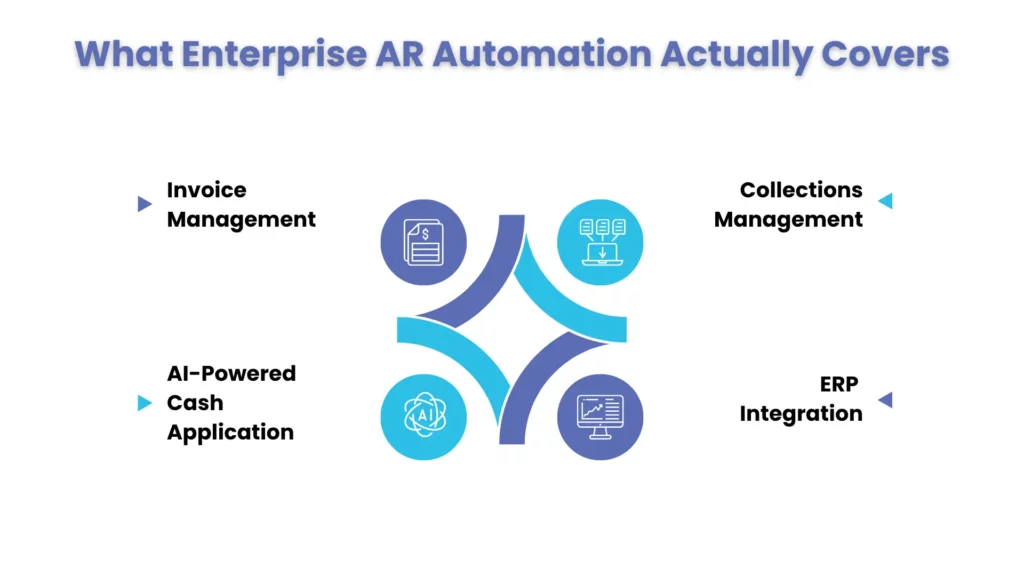
- Invoice Management: Auto-generation, GAAP-compliant formatting, and multichannel delivery including email, EDI, and customer self-service portals with delivery confirmation built in. Faster, accurate invoice delivery is often the single biggest driver of early DSO improvement.
- AI-Powered Cash Application: Automatically matches payments to open invoices even with partial payments, short pays, or missing remittance data achieving straight-through processing rates of 80 to 90percent. This is especially critical with ACH, wire, and virtual card transactions that often arrive without structured remittance information.
- Collections Management: Automated dunning sequences, escalation workflows, and priority scoring based on customer risk profile and payment history
- ERP Integration: Seamless two-way integration with SAP, Oracle Fusion, NetSuite, and Microsoft Dynamics ensures AR data is audit-ready at all times.
5 Costly AR Challenges Automation Solves
Knowing where AR Challenges when scaled becomes the foundation of any successful automation strategy, these include:
- Inconsistency in collections outreach: Without automation, the timing of collections outreach relies heavily on individual analysts, causing delays of several days for working through portfolios of invoices.
- Backlogs in manual cash applications: Manual cash applications create unapplied cash which builds up the AR balance and makes the DSO calculation meaningless.
- High deduction volumes: Consumer-goods companies and distributors face large volumes of deductions. Managing them manually is error-prone and slow; automation helps recover the revenue leakage they cause.
- Inability to monitor portfolio performance: Overnight aging reports make it hard to track real-time performance, thus making real-time dashboards an imperative.
- Disconnected systems: Non-integrated AR software with the ERP or CRM systems creates audit trails that make GAAP compliance and SOX audits risky.
Benefits of AR Automation for Large Enterprises
Finance teams that automate accounts receivable consistently see DSO improvements of 20 to 30 percent (up to 35 percent in some cases), driven by faster invoicing, automated reminders, and more efficient cash application. For enterprises, every day of DSO reduction on $200 million in annual revenue frees roughly $548,000 in cash, an outcome that resonates with CFOs under pressure from stakeholders to conserve cash.
Besides working capital efficiency, AR automation helps improve audit preparedness through audit trails with timestamps and role-based audit trails, which comply with GAAP and SOX guidelines. Lastly, accounts receivable automation makes it possible for enterprises to increase revenues without hiring additional staff, a significant benefit to fast-growing corporations in the US.
Manual vs. Automated AR at a Glance
| Dimension | Manual AR | Automated AR |
| DSO | 45–65+ days | 30–42 days |
| Cash application | Backlogs, unapplied cash | 80–90% straight-through |
| Collections outreach | Inconsistent, analyst-dependent | Automated, risk-prioritized |
| Audit trail | Gaps; SOX exposure | Timestamped, role-based |
| Scaling | Needs more headcount | Scales without added staff |
Enterprise Technology Stack: What Large US Companies Are Using
The US AR automation market has matured significantly. HighRadius leads in enterprise AI-powered AR automation and collections at scale. Esker offers deep order to cash process automation with robust SAP integration, while Versapay focuses on collaborative AR with self-service portals and built-in dispute resolution. Billtrust brings strong invoice delivery and payment network capabilities.
Leading US AR Automation Platforms Compared
| Platform | Best for | Key strength | ERP fit |
| HighRadius | Large enterprises | AI-powered AR & collections at scale | Broad |
| Esker | Order-to-cash automation | Deep O2C; strong SAP integration | SAP |
| Versapay | Collaborative AR | Self-service portals; dispute resolution | Mid–large |
| Billtrust | Invoice delivery & payments | Payment network; invoice delivery | Broad |
Most large US enterprises layer a best-of-breed platform on top of their core ERP Oracle Fusion AR, SAP FSCM, or Microsoft Dynamics since native ERP modules typically lack the advanced AI capabilities and purpose-built collections management that dedicated platforms provide.
On cost: enterprise AR automation pricing usually scales with invoice or transaction volume, number of users, and ERP-integration complexity, and is typically sold as an annual subscription. Most US enterprises weigh total cost of ownership against projected DSO savings — and, as the ROI example below shows, the working-capital benefit often exceeds platform cost within the first year.
SOX Compliance: The Enterprise Non-Negotiable
In publicly held US corporations, automating accounts receivable management is directly tied to compliance with the Sarbanes-Oxley compliance. SOX Sections 302 and 404 require documentation of internal controls, and the accounts receivable module happens to be one of the riskiest modules when it comes to deficiencies in control procedures. AR automation resolves this problem by delivering:
- Roles-based controls enforcing proper segregation of duties
- Audit trails that are fully documented and traceable for each invoice and payment
- Revenue recognition controls according to ASC 606 guidelines
- Exception alerts delivered in real time
Manual finance procedures pose significant risks within this framework. Automation of internal controls is no longer an option.
AI-Powered Collections: The New Enterprise Standard
The integration of artificial intelligence into AR collections is the most significant shift in enterprise financial operations in the last five years. Modern platforms go beyond sending automated reminders; they analyze payment probability, identify at-risk customers before they miss due dates, and personalize outreach messaging based on each customer’s history and behavior.
AI in finance can also detect early signs of disputes and flag invoices likely to require deductions. These capabilities alone reduce collections workload by 15 to 25 percent for account managers handling large portfolios enabling teams to focus on strategic relationships rather than routine follow-ups.
Enterprise AR Automation ROI: Real Numbers
ROI from accounts receivables automation at enterprise scale is significant and consistently measurable across industries:
| Metric | Typical Improvement |
| DSO Reduction | 20–35% |
| Cash Application Automation Rate | 75–90% straight-through |
| Collections Productivity Gain | 25–40% |
| Bad Debt Write-Off Reduction | 10–20% |
| Invoice Processing Cost Reduction | 40–60% |
To illustrate: a US enterprise with $200M in annual revenue and a DSO of 48 days that reduces it to 34 days frees approximately $7.7M in working capital, an outcome that typically exceeds the total platform cost within the first year.
Building the Enterprise DSO Performance Dashboard
A real-time DSO performance dashboard is essential to any successful implementation. Finance leaders should track:
- Current DSO vs. target
- Best Possible DSO (BPDSO) to separate process inefficiency from customer behavior
- Aging bucket distribution: current, 1–30, 31–60, 61–90, and 90+ days
- Cash application straight-through rate
- Collector Effectiveness Index (CEI)
- Days Deduction Outstanding (DDO) and dispute resolution cycle time
All metrics should be available in real time, segmented by business unit and customer segment, so leadership can act before issues impact quarterly cash flow and before they create SOX or earnings-call surprises.
Implementation Roadmap for Enterprise Teams
A structured implementation follows four phases:
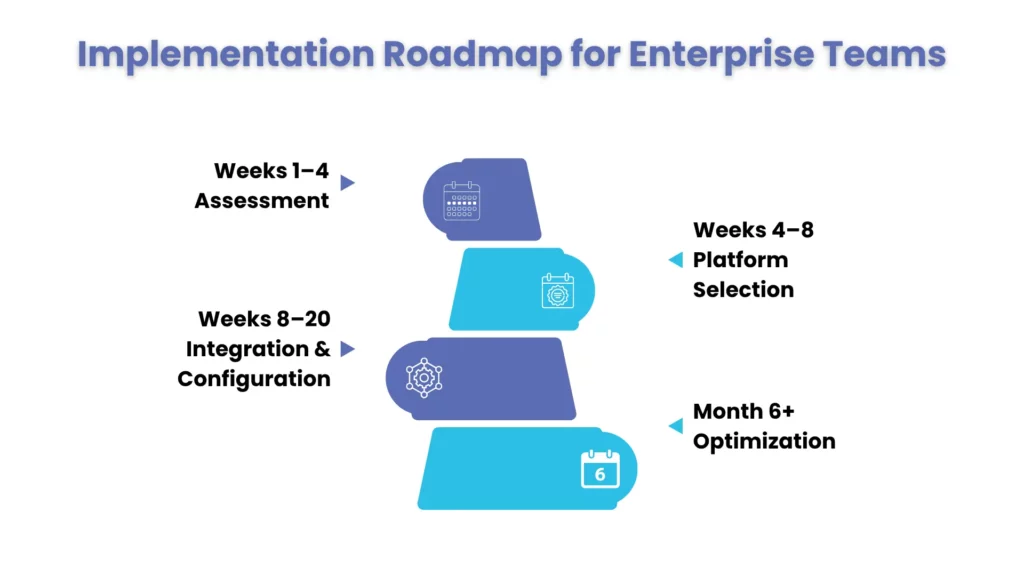
- Weeks 1–4 Assessment: Evaluate current DSO, cash application rates, and collections efficiency. Identify the highest-cost manual touchpoints.
- Weeks 4–8 Platform Selection: Evaluate vendors on ERP compatibility, AI capability, SOX compliance features, and scalability.
- Weeks 8–20 Integration & Configuration: ERP setup, workflow configuration, user training, and parallel testing before go-live.
- Month 6+ Optimization: Refine AI models, expand automation to additional business units, and track ROI against Phase 1 baseline.
People Also Ask:
How does AR automation help reduce DSO?
AR automation reduces DSO by delivering invoices faster, collecting outstanding payments through automated follow-up, and applying cash more quickly. It removes delays and shortens the overall payment cycle.
Can AR automation integrate with SAP and Oracle ERP systems?
Yes. Leading AR automation solutions offer native connectivity with SAP, Oracle Fusion, NetSuite, and Microsoft Dynamics for seamless two-way data synchronization.
How does AR automation help with SOX compliance?
AR automation enforces segregation of duties, builds complete digital audit trails, and enables real-time exception reporting — all important for SOX Sections 302 and 404, as well as GAAP and ASC 606 revenue-recognition standards.
How long does it take an enterprise to recover its investment in AR automation?
Most US enterprises recover their initial investment within 12 to 18 months through improved DSO, greater collections efficiency, and lower invoice-processing costs. Better cash-flow visibility also supports more effective financial decision-making.
What is the difference between AR automation and ERP-native AR?
Native ERP modules handle routine tasks like invoicing and recording payments. Dedicated AR automation software adds cash application, collections prioritization, deduction management, and analytics that native modules lack.
Conclusion:
AR automation is no longer just an efficiency initiative. For US enterprise finance teams, it has become a strategic lever for working-capital optimization, regulatory compliance, and scalable growth. Reducing Days Sales Outstanding by even 10 to 15 days at enterprise scale can deliver meaningful balance-sheet improvements, strengthen cash-conversion metrics, and increase investment capacity.
As AI-powered financial automation matures and US e-invoicing and electronic-payment adoption — ACH, wire, virtual cards, and real-time payment rails — continues to accelerate, automated accounts receivable becomes more relevant every day for improving cash flow and operational efficiency. Corient Business Solutions helps enterprises navigate this transition with end-to-end finance transformation solutions.