

The month-end close process is one of the most challenging times of the year in the accounting calendar of U.S. finance teams. One missed journal entry or reconciliation loss might delay the presentation of financial reports, cause findings during a SOX audit or generate difficulties during IRS reporting. It is necessary that the compliance with the U.S. GAAP, FASB standards, and, in the case of a public company, SEC reporting requirements be followed.
Month end close checklist: The checklist will help the teams to be organized by defining what tasks should be done by specifying the responsibility assigned to each member and the date by which each should be done. This strategy simplifies workflows in order to cash pro (O2C), procure to pay (P2P), record to report (R2R), error reduction, and the provision of correct financial statements to management, auditors and regulating bodies.
This manual offers a step-by-step guide, traps to watch out when and avoid, best practices and a template to standardize your month end close to the standard practices of U.S. fiscal year end practices.
What Is the Month End Close Checklist?
A month-end accounting checklist is a simple, structured document that US finance teams can refer to as a guide in ensuring that their books are accurate and compliant with US GAAP and FASB rules. It supports the record to report process, order to cash process, and procure to pay process, ensuring smooth accounts receivables and accounts payable management.
This data is then used in generating key reports such as the income statement, balance sheet, and cash flow statement, which are used by various stakeholders such as management, auditors, and, in certain cases, the IRS or SEC. It outlines what has to be done, who has to do it, and by when it has to be done. It also assists teams in achieving O2C, P2P, and R2R processes, as well as being SOX 404 audit-ready, IRS compliant, and audit-ready.
Why the Month End Close Checklist Matters
A well-managed ERP month-end close using a standardized checklist transforms the stressful, deadline-driven process into a controlled, repeatable workflow that facilitates the US GAAP financial reporting, strengthens accounts receivables and accounts payable, and ensures good internal controls as per SOX and IRS standards. It assists the US finance teams and accountants to close their books quickly and to eliminate last-minute rush and repetitive manual repairs. Good checklist enhances accuracy since all transactions are registered, reconciled, and adjusted before reporting to the management, auditors or IRS. It minimizes errors and missing information (particularly in mid-market and enterprise settings) by standardizing tasks, responsibilities and deadlines.
It also accelerates reporting, which enables the teams to generate the profit and loss account, balance sheet and cash flow statement in days rather than weeks, which is in line with the monthly reporting and quarterly IRS submission deadlines. Reported approvals, reconciliations, and period-end procedures enhance internal controls and equip teams with SOX 404 audits. The checklist checks conformity to the US GAAP, FASB accounting instructions and IRS regulations such as the use of uniformity of accruals, deferrals, as well as other adjusting entries. It can bring a record-to-report and O2C, P2P, and payroll data alignment (e.g., ADP or Gusto), enhancing end-to-end integrity of data in the organization.
Lastly, it minimizes stress and rework, as it substitutes the process of ad-hoc with one that is predictable and repeatable- assisting finance teams in remaining efficient even in high-growth US SaaS, healthcare and manufacturing businesses.
Pre-Close Preparation Checklist
The Pre-Close Preparation Checklist ensures that data is correct, complete and prepared before the end of the month close process begins, including accounts receivable, accounts payable, and procure to pat process inputs. Preparation time will enable the United States finance teams to avoid surprises at the end of the day, misstatements as required by US GAAP, and fasten the reconciliations. It has dominance on the record-to-report cycle and supports SOX-compliant controls and IRS-compliant reporting.
What the Pre-Close Preparation Checklist Includes
Establish a cut-off date on sales, expenses and payroll to ensure that all transactions are mentioned in the appropriate period according to the US GAAP revenue and expense recognition and IRS period-end cut-offs.
Authenticate any supporting records including bank statements, credit-card feeds, invoices, expenses reports and payroll records at ADP, Gusto or Paychex. Ensure that the inputs received in the entire departments such as sales, procurement, human resource, and finance are timely and duly approved.
Why This Phase Matters
Eliminates the risk of transactions being posted to the wrong period, which leads to proper reporting of revenue, expenses and cash-flow under US GAAP which is essential in the compliance of the IRS and SOX 404 tests. Eliminates errors at month end close by detecting unapproved expenditure, invoices or duplicate entries early in the month before they affect financial statements.
Ensures that month-end close balances with order-to-cash, procure-to-pay, and payroll transactions to enable information to flow freely into the General Ledger and provide audit-ready trial balances and financial statements.
The Month-End Close Checklist — Step by Step
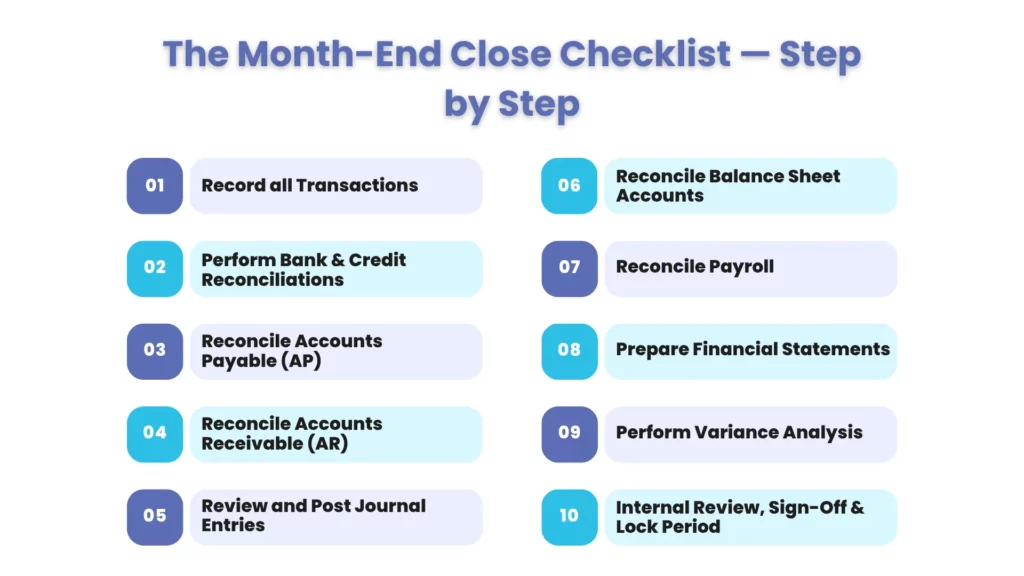
The Month End Close Checklist gives U.S. financial groups a concise, standardized process of transforming raw transactions into GAAP compliant, IRS compliant financial records. These measures will minimize mistakes, speed up the close, and ensure that the records to report, order to cash, and procure to pay cycles will be in line with SOX404 and SEC requirements Month-End Guide.
1.Record All Transactions:
Reflect all income, expenses and bank related documents up to the end of the month such invoices, bills, receipts and payroll information on systems like ADP, Gusto, or Paychex. Prepare code entries correctly to the General Ledger, the department, and the project to ensure that reporting and compliance with the U.S. GAAP are set at the beginning of the record to report process.
2.Perform Bank & Credit Reconciliations:
Maintain internal records as compared to bank and credit-card statements, correcting timing discrepancies, missing transactions, or errors. This tradition maintains a clean balance sheet and cash flow, ensuring proper ERP month end close reconciliation and accounts payable tracking.
3.Reconcile Accounts Payable (AP):
Ensure that all invoices of vendors are in the system and are matched with purchase orders or receiving reports. Check AP aging of old debts, duplicates or unapplied credit and fix accruals of liabilities that pertain to the current period as per the U.S. GAAP and procure to pay process.
4.Reconcile Accounts Receivable (AR):
AR subledger to the General Ledger Reconcile the AR subledger with the General Ledger and ensure that all the customer invoices and payments are accurate. Identify order-to-cash process issues with AR report and adjust the revenue and allowance accounts to ensure proper accounts receivables management.
5.Review and Post Journal Entries:
Study how entries in U.S. GAAP and IRS rules are adjusted including accruals, deferrals, prepaids, depreciation and tax provisions. Publish only the entries which have been properly documented, approved and cited to the record to report process.
6.Reconcile Balance Sheet Accounts:
Attraction Key accounts cash, receivables, payables, prepaids, loans, equity and fixed assets Reconcile to external statements, sub-ledgers, or asset registers. Proper adjustment of material variances to ensure balances at the end of the year and reduce audit findings, especially in organizations that report in compliance with the SOX 404 and SEC rules.
7.Reconcile Payroll:
Match payroll information in ADP, Gusto or Paychex with the General Ledger and check the accuracy of salaries, bonuses and deductions, as well as benefits. Adjust accruals of wages or bonuses of the current month in such a way that payroll liabilities and expenditures are matched to IRS and state tax period-end dates.8
8.Prepare Financial Statements:
Make up Profit and Loss statement, Balance Sheet and Cash Flow Statement based on reconciled and adjusted data. Confirm that these statements are linked to the General Ledger and sub ledgers with revenue, expenses, assets and liabilities having been properly categorized according to the standards of U.S. GAAP and FASB.
9.Perform Variance Analysis:
Compare to the budget, the previous month and the previous year to see unusual movement in the revenue, margins or expenses. Prepare document variances and present them to the functional leaders to facilitate the planning and audit explanations to the U.S. CFOs and controllers.
10.Internal Review, Sign-Off & Lock Period:
Conduct a review meeting in which managers and controllers to give approvals to reconciliations, journal entries and financial statements. Seal the time in your ERP, be it NetSuite, Oracle, SAP or Microsoft Dynamics, to further entries, allocate final reports and still maintain documentation to comply with SOX, IRS and external audit compliance.
Common Month-End Close Mistakes to Avoid
In the United States, many teams in finance and accounting continue to make avoidable mistakes that postpone the closing process, give rise to audit risk, and fail to comply with SOX 404 and IRS-compliant reporting. The identification of these pitfalls will help the US CFOs, controllers, and auditors to avoid the misstatements as per the US GAAP and FASB.
- Omission of important reconciliations: The inability to complete reconciliation of bank accounts, accounts receivable and accounts payable may lead to material misstatements in the balance sheet and cash flow statement especially when subjected to scrutiny of US GAAP and SOX.
- Exclusion of accruals and deferrals: Failure to capture accruals, prepaids and deferrals is not only a distortion of financial performance but also may violate the matching principle of GAAP as well as tax-timing regulations of the IRS, leading to last-minute recordings.
- False reporting of time of transaction: Revenue or expense recognition in the wrong period, by choosing a wrong cut-off date, cripples’ compliance with US GAAP, SOX controls and IRS reporting of sales, payroll and vendor expenses.
- Duplication or wrong coding of entries: Entry of transactions in the accounts twice or in the wrong account (because of data entry error, bank problems, or not clearly mapped in the GL) misleads the P&L and the balance sheet and puzzles the auditors when they review the SOX and IRS controls.
- Bad paperwork and examination: Not doing a proper review of journals and to justify the reason why they were made, compromises the SOX 404 documentation standards and impairs the auditors to substantiate the adjustments.
- Confusion of ownership and time line: Failing to assign responsibility and timeframes to reconciliations and reviews brings about bottlenecks, last-minute rush, and missed cut-offs in SOX 404 and IRS.
- Excessive use of spread sheets: Use of manual spreadsheets as opposed to ERP or close-automation products (i.e., NetSuite, BlackLine, or FloQast) risks more errors, version-control issues, and low-quality SOX-ready controls.
Best Practices to Optimize Your Checklist
Streamlining your month-end accounting checklist will help US finance department reduce mistakes, speed up reporting, and strengthen compliant-with-GAAP, and compliance with SOX controls.
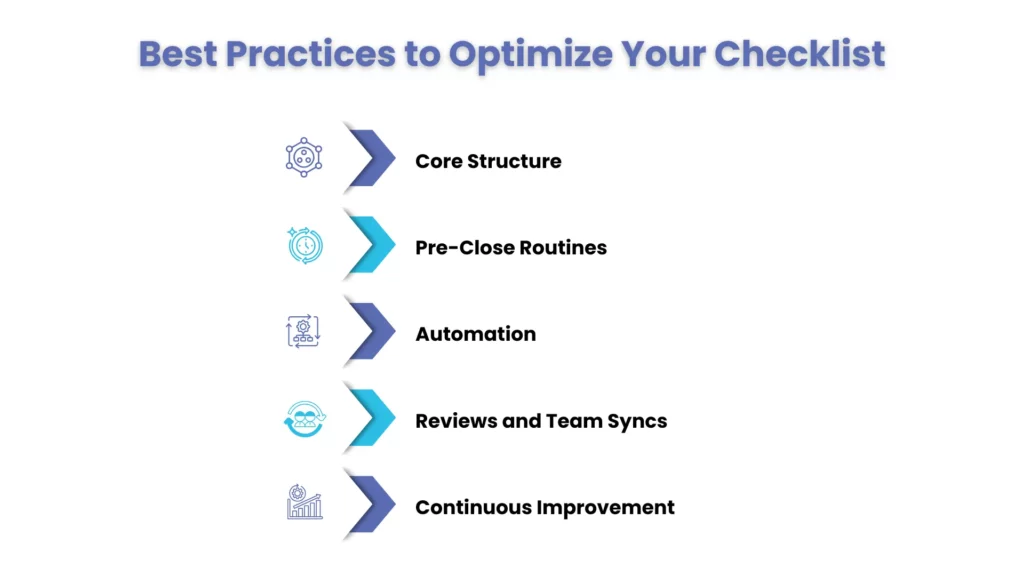
- Core Structure: Assign each activity an owner, deadline and dependence (i.e., post transactions before reconciliations). Use a common calendar or an application like NetSuite, BlackLine, or Asana to track the progress.
- Pre‑Close Routines: Start few days before end of month: ensure cut-offs, synchronize systems and receive data of Account Payable, Account Receivable, payroll (e.g., ADP, Gusto, Paychex), credit-card feeds. Address any problem that arises in time so that the close can be audit-ready.
- Automation: Control your ERP or accounting software with automation tools to align bank and reconcile invoices and calculate accruals. The method eliminates the use of manual spreadsheet and improves the SOX-compliant controls.
- Reviews and Team Syncs: Hold pre-close meetings to look into journal entries and bottlenecks. By the end of the month, consider some of the factors that slowed down the process and realign workflows in the following month.
- Continuous Improvement: Periodically update the checklist in line with the frequent problems and delays. Use project-tracking tools in order to make the month-end close more expedited, dependable and closer to the US GAAP, IRS, and SOX requirements.
How Automation Transforms the Month End Close Checklist
Automation simplifies and speeds up the month-end close process, handling repetitive tasks like accounts payable reconciliations and journal entries, and record to report process tasks. Tools that integrate with your ERP or close management software such as NetSuite, BlackLine, or FloQast can automatically match transactions, flag exceptions, and generate reports, cutting close time by 30–50% for US finance teams.
By reducing manual work, automation gives teams more time to analyze data, forecast results, and support strategic decisions. It also keeps order-to-cash (O2C) and procure-to-pay (P2P) cycles in sync, ensuring reconciliations and journal entries stay aligned across all upstream systems.
Your month-end close deserves a better system. Grab the free template and never miss a reconciliation again.
People Also Ask:
How Long Does the Month-End Close Take?
The month-end close process usually ranges between 3-7 business days in efficient mid-sized businesses with automation; it may range between 10-18 days in large
businesses. High performers may close in 1-3 days with streamlined processes and automation.
What are the steps for the month-end closing?
The month-end close process includes all journal entries such as invoices and payments; bank account, accounts receivable, accounts payable, and inventory
reconciliation; accruals and deferrals; trial balance; financial statement generation such as profit and loss and balance sheet; final reviews; closing the books; and reporting to stakeholders.
What is the purpose of the month-end close process?
The main objectives of the month-end close process are to ensure accurate financial statements that reflect the true financial performance of the company; ensure compliance with laws; obtain timely information to aid in budgeting and business decisions; identify potential problems; and ensure successful quarterly and yearly close processes
What are the biggest risks of a slow financial close?
A slow month-end close process leads to potential errors in financial data due to manual processes; regulatory fines and increased audit costs; loss of stakeholder trust and company stock prices; improper allocation of resources resulting in burnout; and cash flow and financial stability.
Who is involved in the month-end close process?
The key participants in the month-end close process include accountants; controllers/finance managers; accounts payable and accounts receivable; and executives. Additionally, input from other departments such as FP&A, payroll, sales (RevOps), procurement, and IT for data and analysis
Can Corient improve visibility into financial data during the close?
Yes, Corient enhances visibility with R2R automation, live dashboards tracking tasks or overdues, real-time data from ops systems, AI reconciliations, and Power BI integration for close progress and insights.
Conclusion
A well built month end close checklist especially one that uses automation—can make a real difference. It turns a confusing, stressful period into a structured, manageable workflow that produces accurate financial reports on time. This approach helps reduce mistakes, keeps teams aligned, and ensures compliance with US GAAP, SOX, and IRS requirements with Corient Month-End Guide. The month end close checklist also gives finance leaders a clear view of performance and supports better, data driven decision making. For accounting firms and US finance teams, it is an essential tool for SEC reporting and audit readiness with Corients Financial Close.