


Choosing the right CPA outsourcing solution for a US accounting firm depends on seven critical factors: deep US tax and GAAP expertise, a proven track record with American CPA firms, compatibility with your existing software stack, robust data security and GLBA compliance, scalable staffing capacity, clear communication and turnaround standards, and transparent pricing with no hidden fees. This guide explains each criterion in detail and shows you what to ask every vendor before signing.
Demand for outsourced accounting services is accelerating. The Bureau of Labor Statistics reports that the job openings for accountants and auditors will increase by 6% up to 2032. However, there remains a major issue in terms of the lack of talent. Furthermore, the AICPA Pipeline Advisory Group reports a drop in new CPA applicants.
This guide walks you through everything you need to know to make a confident, well-informed decision when evaluating accounting outsourcing partners, with a close look at why Corient Business Solutions stands out as a trusted choice for US accounting firms.
What Is CPA Outsourcing?
CPA outsourcing is the practice of delegating accounting, tax, audit support, and outsourced bookkeeping tasks to a specialized external provider. Rather than adding more employees to the payroll, accountancy firms will take advantage of outsourcing services that become an extension of their own office.
Unlike general business process outsourcing (BPO), CPA-specific outsourcing is tailored exclusively to accounting firms. Providers are staffed with qualified CPAs, Enrolled Agents, and senior accountants who understand US GAAP, IRS tax code, and the workflow expectations of US CPA firms, not just generic data-entry operators.
Key Challenges CPA Firms Are Facing Right Now
Before proceeding with determining factors that may help a company when choosing a CPA outsourcing partner, it is useful to analyze the factors that influence the decision of accounting firms to outsource their accounting activities.
| Challenge Facing Accounting Firms | Impact on Firms | How CPA Outsourcing Helps |
| Talent Shortage and Pipeline Gap | Fewer CPA candidates make hiring and retention harder for firms. | Gives firms skilled accounting and tax professionals without local hiring challenges. |
| Rising Labor Costs | Rising CPA salaries increase costs and reduce profitability. | Lowers staffing costs without compromising service quality. |
| Seasonal Capacity Strain | Busy seasons like tax time and year-end strain fixed staff capacity. | Provides flexible staffing that adjusts to workload peaks. |
| Technology Investment Pressure | Clients expect cloud accounting and real-time reporting, increasing technology costs. | Provides access to modern tools and technology without additional investment. |
| Client Retention and Growth | Staff focused on routine tasks limits firms’ advisory services and growth. | Frees staff to focus on clients, advisory work, and growth. |
CPA outsourcing addresses all of these challenges by providing flexible, expert capacity exactly when and where it is needed.
Which Tasks CPA Firms Typically Outsource
Understanding the full scope of what can be outsourced helps firms plan more strategically. Here is a summary of the most commonly outsourced functions:
| Function | Typical Outsourced Tasks | Complexity Level |
| Tax Preparation | Preparation of individual (Form 1040), corporate (Form 1120), partnership (Form 1065), and state tax returns | Medium to High |
| outsourced bookkeeping | Bank reconciliations, accounts payable and receivable management, and general ledger maintenance | Low to Medium |
| Audit Support | Workpaper preparation, confirmation procedures, and trial balance analysis | High |
| Payroll Processing | Payroll calculations, tax filings, and W-2/1099 preparation | Medium |
| Financial Reporting | Preparation of compilations, reviews, management reports, and cash flow statements | Medium to High |
| International accounting | IFRS reconciliation, transfer pricing support, foreign entity reporting | High |
| CFO & Advisory Support | Financial modeling, forecasting, budgeting, and KPI dashboard development | High |
Corient Business Solutions provides support across all these areas, making it a comprehensive accounting outsourcing solution rather than a narrow task-based vendor.
7 Criteria for Choosing a CPA Outsourcing Partner
However, not all CPA Outsourcing services providers offer the same level of expertise. The following are some crucial factors to consider when selecting a CPA Outsourcing company.
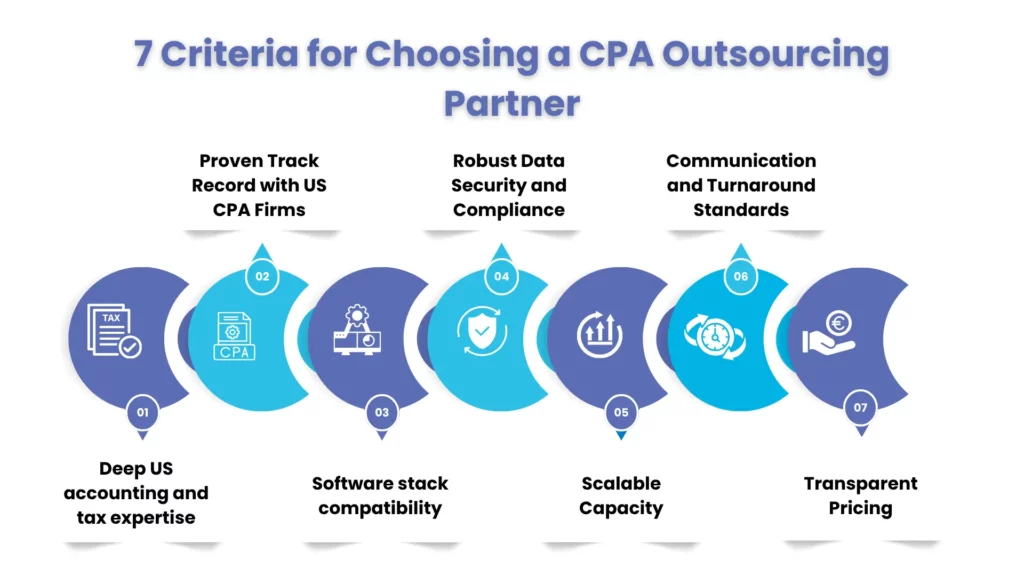
1.Deep US accounting and tax expertise
The outsourcing company should have experienced staff consisting of qualified CPAs, Enrolled Agents, and senior accountants who understand US taxation regulations, GAAP, and firm workflow.Ask specifically about their team’s familiarity with your practice areas, for example, whether they have experience with R&D tax credits, cost segregation studies, or multi-state nexus issues if those are relevant to your clients. Corient’s team is trained exclusively in US standards.
2.Proven Track Record with US CPA Firms
Seek a partner with a demonstrable history of working with US-based firms. Request at least two or three client references you can speak with directly, not just written testimonials. Ask specifically how long those firms have used the provider and whether they’ve renewed contracts, longevity is the most reliable signal of quality. It is advisable to ask for case studies, referrals, and years of experience.
3.Software stack compatibility
The top CPA Outsourcing partners should seamlessly integrate with your firm’s accounting software, QuickBooks, Xero, UltraTax, CCH Axcess, Lacerte, or Thomson Reuters, without making any changes on your end.Also confirm compatibility with your document management and workflow systems (e.g., SmartVault, ShareFile, Karbon) since file handoff friction is a common pain point in outsourcing relationships.
4.Robust Data Security and Compliance
Client financial data is subject to the Gramm-Leach-Bliley Act (GLBA), enforced by the FTC, which requires accounting firms and their service providers to implement written information security programs. Before signing any contract, request a copy of your prospective partner’s Information Security Program (ISP), ask whether they undergo SOC 2 Type II audits, and confirm that file transfers use AES-256 encryption. Corient signs full confidentiality NDAs with every client and operates under enterprise-grade security protocols.
5.Scalable Capacity
The core advantage of outsourcing is flexibility. Your partner should be able to absorb demand surges during tax season (January–April) and year-end (October–December) and scale back during quieter periods, without imposing minimum monthly billing commitments or charging overage penalties for volume spikes. Ask for a written capacity commitment and understand their bench depth, how many qualified staff can they actually deploy to your account within 48 hours if a deadline hits?
6.Communication and Turnaround Standards
Any delays in the outsourcing process affect the entire workflow of delivering service to your clients. Set specific SLA expectations in writing before engagement begins: standard turnaround for a 1040, for a corporate return, for a bookkeeping close. Confirm whether the partner operates in overlapping US business hours (critical for same-day query resolution) and whether you will have a single, named account manager or be routed through a generic support queue.
7.Transparent Pricing
Make sure that the company does not have hidden fees or any unclear billing policies, especially scope creep. Ask for an itemized fee schedule covering per-return pricing, per-hour bookkeeping rates, and any setup or onboarding fees. Confirm what constitutes “scope creep” and how additional work is authorized and billed. Corient offers multiple engagement models, per-return, hourly, and dedicated-staff retainer, with no hidden charges.
What to Avoid When Choosing a CPA Outsourcing Partner
Not every outsourcing vendor will be upfront about their limitations. Watch for these warning signs during the evaluation process:
- Refuses to provide references from current US CPA firm clients
- Cannot produce a written Information Security Program or evidence of SOC 2 compliance
- Offers a single flat monthly fee with no transparency on how work is scoped or allocated
- Uses staff who are not accountants or who lack US-specific tax training
- Cannot name specific software they support, or claims to support “everything”
- Has no dedicated account manager model, you’re routed through a generic support ticket system
- Cannot provide a written SLA with defined turnaround times
- Has no process for handling errors or rework at no additional charge
CPA Outsourcing vs. Hiring In-House: Which Is Right for Your Firm?
| Factor | In-house hiring | CPA outsourcing |
| Time to productive capacity | 3–6 months (recruiting, onboarding, training) | 2–4 weeks |
| Scalability | Fixed headcount; slow to scale up or down | Flex up or down within days |
| Turnover risk | High in current market; replacement costs are significant | Provider absorbs turnover; continuity guaranteed |
| Specialisation depth | One hire = one skill set | Access to a team with varied specialisations |
| Best suited for | Client-facing advisory and relationship roles | Compliance, tax prep, bookkeeping, audit support |
The optimal model for most growing US firms is a hybrid approach: retain in-house staff for client advisory, relationship management, and firm leadership, and use a CPA outsourcing partner for all compliance and back-office production work.
Benefits and ROI of CPA Outsourcing for US Firms
Outsourcing isn’t only cost-effective, this is what makes outsourcing strategic for CPAs:
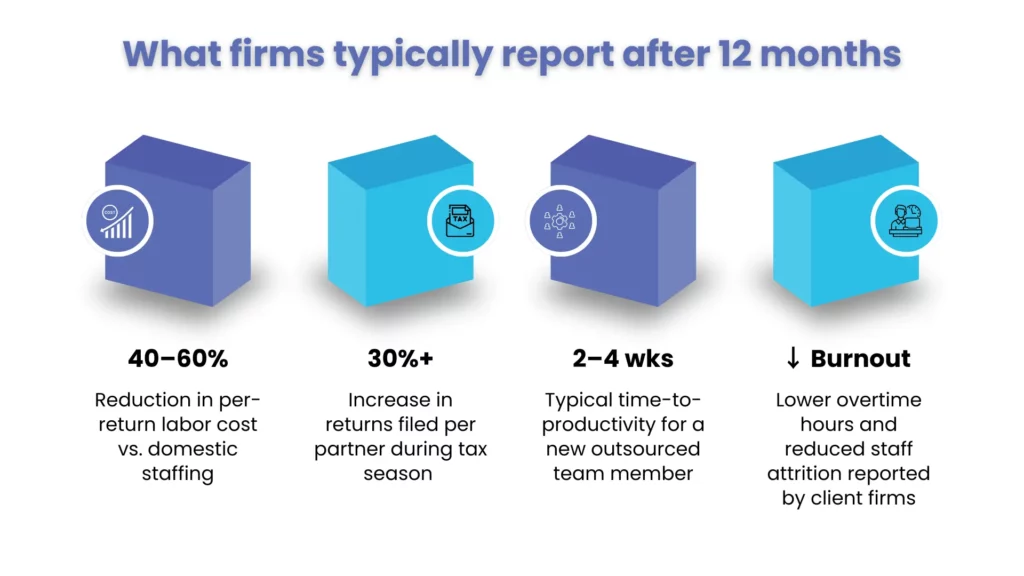
- High level of cost savings: Not needing to spend money on recruiting, hiring, providing benefits and workspace results in savings in the range of 40 to 60 percent when compared to domestic staffing.
- Faster processing speed: Outsourced team members who have to do nothing but work on your project may be able to provide quicker service than overworked in-house professionals.
- Specialization in certain fields: By outsourcing accounting, you can obtain help from experts in some tax area, international accounting or a certain business field without hiring a full-timer.
- Scalability: You can afford to take on more projects at busy times of year without rejecting opportunities and compromising on quality.
- More time for advisory services: With all routine matters out of the way, your partners will have more time for high-value advice and client relationships.
- Less burnout and turnover: The burden of the workload can be shared with an external team to keep your in-house employees fresh and prevent attrition.
How to Transition from In-House to Outsourced Accounting (Step-by-Step)
A successful transition to CPA outsourcing is a process, not an event. Here is a practical roadmap:
- Audit your current workflow. Identify which tasks consume the most in-house hours but require the least client-facing judgment. Tax return preparation and bookkeeping are the most common starting points.
- Define your SLA requirements. Before approaching vendors, write down your non-negotiable turnaround times, quality standards, and communication expectations.
- Run a pilot engagement. Start with a defined subset of returns or clients — ideally 20–30 returns over one tax season — before committing to a full-volume relationship.
- Establish a secure file-transfer process. Agree on the document management system, access controls, and handoff protocols before work begins.
- Assign an internal point of contact. Designate one person at your firm who owns the outsourcing relationship, reviews work, and escalates issues.
- Review and calibrate after the first season. Assess turnaround times, error rates, and staff satisfaction. Use findings to adjust scope and process for the next season.
Who Benefits Most from CPA Outsourcing Services?
The CPA outsourcing services business provides very good return on investment (ROI) for any kind of firm. Large regional or national firms get benefits in terms of retaining high quality and capacity in various practices without adding more people. Small firms that experience quick growth can overcome the problem of lack of staff before the actual hiring process takes place, and those that have seasonality issues can manage to take care of their demands in a better way.
Those firms that have started offering advisory services in place of traditional compliance-related activities can delegate routine tasks to someone else, allowing their employees to engage more in strategizing client relations.
- Large regional and national firms (50+ staff): Use outsourcing to maintain production quality and capacity across multiple practice areas without proportional headcount growth. Best suited for high-volume tax and audit support outsourcing.
- Mid-size firms (10–50 staff) experiencing rapid growth: Outsourcing bridges the gap between current staff capacity and new client commitments while a permanent hiring plan catches up.
- Boutique firms with strong seasonal patterns: Avoid the cost of carrying year-round staff by scaling outsourced capacity up during January–April and October–December and reducing it in the off-season.
- Advisory-focused firms transitioning away from compliance: Delegate routine compliance to an outsourcing partner so in-house staff can shift toward CFO advisory and financial planning services, a higher-margin offering.
Why US Accounting Firms Choose Corient Business Solutions
Corient Business Solutions is a professional accounting outsourcing solution tailored to US CPA firms, providing specialized services such as tax, bookkeeping, audit, payroll and financial reporting.Corient has partnered with accounting firms across the United States for over a decade, supporting both Big Four-adjacent regional practices and independent boutique firms. Below are some reasons why larger and medium-sized firms go for Corient:
- US specialisation: Team members are trained exclusively in US tax law, US GAAP, and American CPA firm processes.
- Comprehensive service range: Tax prep, bookkeeping, audit support, payroll, and financial reporting — all under one relationship.
- Technology-neutral: Operates seamlessly with QuickBooks Online, Xero, Drake, CCH Axcess, Lacerte, UltraTax, and Thomson Reuters.
- Scalable teams: Scale up or down without minimum commitments.
- Enterprise-grade data security: SOC 2-aligned security policies, AES-256 file encryption, and signed NDAs with every client.
- Dedicated account management: One named account manager per firm for consistent communication and faster turnaround.
- Transparent pricing: Per-return, hourly, and dedicated-staff engagement models with no hidden fees or scope-creep charges.
Find out how much your firm could save with outsourcing? Schedule a free 30-minute consultation with Corient and discover your highest-ROI outsourcing opportunities.
People Also Ask:
What is CPA outsourcing for accounting firms?
CPA outsourcing is the practice of delegating accounting, tax preparation, audit support, and bookkeeping tasks from a CPA firm to a specialised external provider. The outsourcing partner functions as a seamless extension of the firm, handling production work that would otherwise require additional in-house headcount, while the firm retains control of client relationships and reviews all deliverables before they go out. It differs from general BPO in that CPA outsourcing providers are staffed specifically with US-trained accountants, not generalist data-entry staff.
Why do CPA firms outsource accounting services?
The three most common reasons are: (1) the structural shortage of qualified CPA candidates in the US, which makes domestic hiring slow and expensive; (2) the need to scale up capacity during tax season without carrying the overhead of year-round headcount; and (3) the desire to free up in-house partners for advisory services, which generate higher margins than compliance work. Firms that have outsourced successfully also report lower staff burnout and reduced attrition.
Which accounting tasks can be outsourced?
Any task that does not require direct client-facing interaction can be outsourced. The most commonly outsourced functions are individual and business tax return preparation, monthly bookkeeping closes, payroll processing, audit workpaper preparation, financial statement compilations, and management reporting. Higher-complexity tasks such as financial modeling, international tax, and advisory support can also be outsourced to providers with the right specialist depth, though most firms start with core tax prep and bookkeeping before expanding scope.
Is outsourced accounting secure for CPA firms?
Yes, when working with a vetted provider. US accounting firms are subject to the Gramm-Leach-Bliley Act (GLBA), which requires that service providers handling client financial data maintain a written Information Security Program. Before engaging any outsourcing partner, request evidence of SOC 2 Type II compliance, confirm that all file transfers use AES-256 encryption, verify that access to client data is role-restricted and logged, and ensure that a signed NDA and data processing agreement are in place. Corient meets all of these requirements.
How does outsourcing help CPA firms scale faster?
Outsourcing removes the two biggest bottlenecks to growth: recruiting time and training time. A new in-house hire typically takes 3–6 months to reach full productivity. An outsourced team member from a qualified provider can typically be onboarded and producing work within 2–4 weeks. During busy seasons, additional outsourced capacity can be deployed with little notice, allowing firms to accept new client engagements without the risk of missing deadlines or compromising quality.
What is the difference between CPA outsourcing and offshoring?
The terms are often used interchangeably, but there is a practical distinction. Offshoring refers specifically to having work performed in another country, which is a feature of most CPA outsourcing relationships (providers in India and the Philippines are common for US firms). CPA outsourcing is a broader term that describes the engagement model, the firm contracts with a specialist provider, regardless of where that provider is physically located. The key differentiator to evaluate is not geography, but whether the provider’s team is trained and certified to work to US accounting standards.
How do I know if my state’s CPA board rules allow outsourcing?
Most state CPA boards do not prohibit outsourcing, but they do hold the CPA firm responsible for all work products regardless of where it is prepared. This means the partner or manager at your firm must review and sign off on all returns and deliverables before they are issued to clients. Some states have additional client disclosure requirements if work is prepared outside the firm. Check with your state board directly, or ask your outsourcing provider, a good partner will be familiar with these requirements and can help you structure the engagement appropriately.
What should I look for in third-party accounting and outsourcing services?
US-specific expertise (GAAP, IRS, state compliance), data security certifications (SOC 2), transparent pricing, and dedicated staff rather than a rotating pool. Corient is built around these criteria for CPA firms and businesses evaluating a third-party partner.
How do I choose the right outsourcing partner for my accounting needs?
Check their US tax/GAAP experience, data security standards, communication model, and whether they offer dedicated vs. shared staff. Corient has supported US accounting firms for over a decade against exactly this criteria.
Can you recommend top companies that specialize in co-sourcing services?
Co-sourcing providers include Corient, TOA Global, and CBIZ, each blending an internal team with dedicated external staff rather than fully offshoring the function. Corient’s co-sourcing model keeps clients in control while extending capacity through its India and UK delivery teams.
Conclusion:
Indeed, the outsourcing of CPAs has been confirmed to be a good approach for companies dealing with shortages of manpower, rising costs, and increased customer demands. Through the services provided by outsourcing, the accounting firm will be able to grow, improve efficiency, retain its employees, and maintain high-level performances during expansion activities.
To choose the right outsourcer, one needs to consider experience, security, scalability, communication, and industry expertise. Corient Business Solutions meets all these criteria, making it possible for American accounting companies to receive excellent outsourcing services. Learn more about CPA outsourcing and the ways Corient can assist your business by scheduling a free meeting today.