


A slow close is usually treated as an accounting inconvenience rather than a business problem. The research suggests otherwise. Ventana Research’s benchmark on the Office of Finance (PDF) found that only 53% of companies complete their monthly close within six business days, and the analysts note even that figure likely overstates it, because closing quickly means little if material adjustments keep landing after the books were signed off.
This guide covers what the month-end close process involves, the ten steps and the checklist that go with them, how long it should realistically take, and, in the section most guides skip, where the delays actually originate.
Key takeaways
- The month-end close is the accounting routine that finalises the previous month’s financial records so the business can produce statements it can actually rely on.
- Most US finance teams should be closing inside five to ten business days. Where they are not, the cause usually sits upstream of accounting, in procurement, billing and data collection, rather than inside the close itself.
- A documented checklist with named owners is the single cheapest improvement available to a team that closes late.
What is the month-end close process?
The month-end close process is the sequence of accounting tasks a finance team completes after the end of each calendar month to finalise that month’s financial records and produce reliable financial statements.
In practice that means three things: confirming every transaction for the period has been captured, proving the balances are correct by reconciling them against independent sources, and posting the adjustments that put revenue and expenses in the period they actually belong to. Once those are done, the books are locked and the income statement, balance sheet and cash flow statement can be issued.
The close exists because raw transaction data is never complete or correctly dated on the last day of the month. Invoices arrive late. Payments sit unapplied. Costs are incurred before anyone is billed for them. The close is the structured process that turns an incomplete ledger into a defensible set of numbers.
Why the month-end close matters
A close that runs on schedule gives leadership a current view of margin, cash and liabilities while there is still time to act on it. A close that runs late does not simply delay a report; it forces decisions to be made on estimates.
It also compounds. Every discrepancy left unresolved in one month becomes a larger, older and harder-to-trace problem in the next. Teams that reconcile properly each month arrive at year-end with a clean file. Teams that don’t spend weeks reconstructing history under audit pressure.
The other benefit is control. Reconciliation is one of the few routine processes that reliably surfaces duplicate payments, misclassified spend, revenue recognised in the wrong period, and unauthorised activity. Skipping or rushing it removes that detection layer entirely.
Month-end, quarter-end and year-end close compared
The three closes share the same foundation. What changes is the scope of reporting and review layered on top.
| # | Month-end close | Quarter-end close | Year-end close |
|---|---|---|---|
| Frequency | Every month | Every three months | Once a year |
| Typical duration | 5–10 business days | 7–12 business days | 3–6 weeks |
| Core work | Reconciliations, adjusting entries, standard statements | Everything monthly, plus consolidated quarterly reporting | Everything quarterly, plus full-year review |
| Added activities | — | Quarterly analysis, investor or lender reporting | Tax provisions, retained earnings, fixed asset review, audit support |
| External scrutiny | Internal only | Investors, lenders, board | Auditors, tax authorities, regulators |
The practical implication is that the quality of your monthly close determines the cost of your annual one. Businesses that treat the monthly close as optional pay for it in January.
Who is involved in the month-end close?
Accounting owns the close, but it cannot complete it alone. Most delays trace back to an input that never arrived, not to an accounting task that was done slowly.
| Role | Responsibility during the close |
| Controller / Finance Manager | Owns the close calendar, reviews reconciliations and journal entries, signs off the statements |
| Staff accountants | Post entries, prepare reconciliations, resolve variances |
| Accounts payable | Confirm all vendor invoices are captured, reconcile the AP sub-ledger, provide accrual data for unbilled costs |
| Accounts receivable | Apply cash, reconcile the AR sub-ledger, review aging and credit notes |
| Payroll | Confirm wages, taxes, benefits and accrued leave are posted |
| Department heads | Submit expense claims and accrual estimates before the cut-off |
| Procurement | Close out open purchase orders and confirm goods-received-not-invoiced positions |
| FP&A | Run variance analysis and prepare the management reporting pack |
| IT / Systems | Keep integrations and bank feeds running so data lands where it should |
If any one of these inputs is late, the close is late. That is the single most useful thing to understand about the process, and it is why improving the close is a coordination problem as much as an accounting one.
The three phases of the month-end close
Splitting the close into phases makes it far easier to see where time is being lost.
Phase 1: Pre-close preparation (the last two or three days of the month)
Pre-close work happens before the period ends. Its purpose is to reduce the amount of discovery that has to happen once the clock starts.
- Issue cut-off reminders to every department with a deadline for invoices, expense claims and accrual estimates
- Chase outstanding vendor invoices and review goods received but not yet invoiced
- Confirm recurring journals, depreciation schedules and amortisation runs are set up correctly
- Check that bank feeds, ERP integrations and sub-ledger syncs are current
- Review open purchase orders and revenue recognition schedules
- Clear anything sitting in suspense or holding accounts
- Start intercompany reconciliations for multi-entity structures
Example: A distribution business with 400 monthly vendor invoices sets a hard cut-off on the 28th and accrues anything received afterwards. That one rule removes most of the late-arriving cost adjustments that otherwise reopen completed reconciliations.
Phase 2: Execution (business days 1 to 5)
This is the core of the close: verify, reconcile, adjust, report. The ten steps below sit in this phase.
Phase 3: Post-close (business days 6 and 7)
Post-close work is where most organisations get the least value, because they skip it.
- Lock the period in the accounting system
- Distribute the statements and management pack to stakeholders
- Hold a short debrief on what caused delay or rework this cycle
- Archive workpapers, reconciliations and supporting documentation
- Update the close calendar for the coming month
The debrief matters more than it looks. Fifteen minutes of documented observations, repeated monthly, is what turns a twelve-day close into a six-day one over two or three quarters. Nothing else produces that improvement as cheaply.
The 10 core steps of the month-end close process
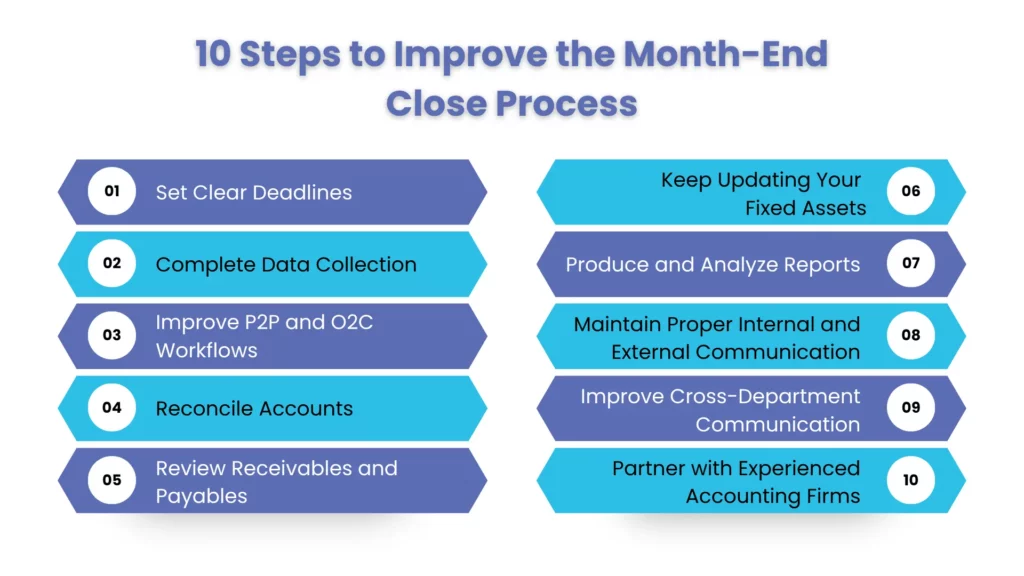
1. Capture every transaction for the period
Pull all activity into the general ledger: revenue, vendor invoices, payroll, employee expenses, card spend, bank transactions and any manual entries. Nothing downstream can be right if the ledger is incomplete, and gaps discovered on day four are far more expensive than gaps discovered on day one.
2. Reconcile bank and credit card accounts
Match cash and card activity against the statements from the bank and card issuer. Every unmatched item needs an explanation: timing difference, unrecorded fee, error, or something that requires investigation. This is where unauthorised activity is most often caught.
3. Reconcile the AP and AR sub-ledgers to the general ledger
The accounts payable and accounts receivable sub-ledgers should agree to their control accounts in the GL. Where they don’t, the usual causes are duplicate invoices, misapplied customer payments, unrecorded credit memos and manual journals posted directly to a control account.
4. Review and support every balance sheet account
Each balance sheet line should be backed by documentation you could hand to an auditor without preparation. Prepaid expenses, accrued liabilities, inventory, fixed assets and intercompany balances are the accounts that most often carry stale amounts nobody has questioned for months.
5. Post adjusting journal entries
Adjusting entries are what make the statements reflect the period rather than the payment dates.
| Entry type | Typical example | Effect |
| Accrued expense | Utilities consumed but not yet billed | Increases expense and liability |
| Accrued revenue | Work delivered but not yet invoiced | Increases revenue and receivable |
| Prepaid expense release | Monthly share of an annual insurance premium | Reduces prepaid asset, increases expense |
| Deferred revenue release | Monthly share of an annual subscription | Reduces liability, increases revenue |
| Depreciation | Monthly charge on equipment | Increases expense, reduces asset carrying value |
| Bad debt provision | Allowance against doubtful receivables | Increases expense, reduces net receivables |
If your business runs on accrual accounting, this step is where the method actually gets applied. Skipping it produces a cash-basis result wearing an accrual label.
6. Update the fixed asset register and record depreciation
Record additions, disposals, transfers and impairments, then confirm the depreciation charge matches the register. Asset-heavy businesses lose more time here than they expect, usually because purchases were coded to expense and never capitalised.
7. Verify payroll and benefits postings
Reconcile the payroll provider’s reports to the general ledger: gross wages, employer taxes, benefit deductions, accrued leave and any bonus provisions. Payroll is high-value and low-visibility, which is a poor combination to leave unchecked.
8. Produce draft financial statements
Generate a draft income statement, balance sheet and cash flow statement. Read them before anyone else does. Balances that look wrong at this stage usually are, and it is far cheaper to correct them now than after distribution.
9. Run variance analysis
Compare the period against the prior month, the same month last year and budget. Every material movement needs an explanation you can give in one sentence. Unexplained variances are the most reliable indicator that something earlier in the close was missed. Turning these numbers into a usable narrative is covered in more depth in our guide to reading financial reports as insight.
10. Final review and sign-off
A senior reviewer who did not prepare the work checks the reconciliations, the journal entries and the statements. Only then is the period locked. Reopening a closed period should require a documented reason, because in most systems it silently invalidates everything downstream of it.
Month-end close checklist
Use this as a working checklist. Assign a named owner and a due day to each line; a checklist without owners is a list of hopes.
Pre-close
- Cut-off reminders issued to all departments
- Outstanding vendor invoices collected
- Employee expense claims submitted
- Goods-received-not-invoiced position reviewed
- Recurring journals and depreciation runs verified
- Bank feeds and system integrations confirmed working
- Suspense and holding accounts cleared
- Intercompany reconciliations started
Execution
- All revenue transactions recorded
- All expense transactions recorded
- Payroll posted and reconciled
- Bank accounts reconciled
- Credit card accounts reconciled
- AP sub-ledger agreed to the general ledger
- AR sub-ledger agreed to the general ledger
- Balance sheet accounts reviewed and supported
- Accruals and prepayments posted
- Deferred revenue released
- Fixed asset register updated and depreciation posted
- Draft statements produced and reviewed
- Variance analysis completed with written explanations
- Final review completed and sign-off obtained
Post-close
- Period locked in the accounting system
- Statements distributed to stakeholders
- Debrief held and issues documented
- Workpapers archived
- Close calendar updated for next month
How long should the month-end close take?
Five to ten business days is the working range for most mid-sized US businesses. Under five days puts you in the top quartile. Beyond twelve days, the reports are arriving too late to influence the decisions they were meant to inform.
Note for the editor: re-verify these two benchmark figures against the current APQC Open Standards Benchmarking data and the latest Ledge close benchmark report before publishing, and cite whichever you use directly rather than via a secondary source. Do not reuse a competitor’s citation of the same study.
What actually determines your number:
- Transaction volume: More transactions means more reconciliation, and reconciliation scales badly by hand.
- Entity and currency complexity: Consolidation, intercompany eliminations and FX revaluation add days that no amount of effort removes.
- Automation level: Teams reconciling in spreadsheets rarely close in under ten days once volume passes a few thousand transactions a month.
- Team size and key-person risk: If one person knows how a reconciliation works, your close time is hostage to their calendar.
- Upstream data quality: This is the largest factor and the least discussed. See the next section.
Where close delays actually originate
This is the part most guides skip. In our experience running finance operations for US businesses, the majority of month-end delay is created before the close begins, in three upstream processes.
Procure-to-pay
Late vendor invoices, incomplete purchase orders and unmatched receipts force accounting to investigate rather than record. Every invoice that arrives after cut-off becomes an accrual estimate, and every accrual estimate becomes a reversal and a true-up next month. A disciplined procure-to-pay process with three-way matching and enforced submission deadlines removes a large share of reconciliation work before it is ever created. Our procure-to-pay services are built around exactly this.
Order-to-cash
Revenue cannot be recognised correctly if billing is wrong. Invoicing errors, unapplied receipts, disputed balances and credit memos issued outside the system all surface during the AR reconciliation, at the worst possible moment. Fixing them in the order-to-cash process means the AR sub-ledger reconciles the first time.
Record-to-report
If data has to be manually assembled from multiple systems every month, the close will never be fast, because the first two days are spent gathering rather than verifying. A structured record-to-report process validates data at source and feeds reporting continuously.
The practical conclusion: if your close takes twelve days, hiring another accountant will not fix it. Fixing AP intake and billing accuracy will.
Warning signs your close is holding the business back
- Statements reach leadership more than ten business days after month-end
- Reconciliations depend on spreadsheets stored on individual machines
- The same accounts throw up unexplained differences every month
- Departments routinely miss the submission deadline and there is no consequence
- The team works late every close, but the close time never improves
- Nobody can say, mid-close, what percentage of tasks are complete
- Prior-period adjustments appear regularly after the books were locked
Two or more of these is a process problem, not a workload problem.
Best practices for a faster, more accurate close
- Document the process and assign owners: A written close calendar with a named owner and due day for every task is the highest-return change available. It removes ambiguity, reduces key-person risk and makes bottlenecks visible.
- Move work into the month: Reconcile high-volume accounts weekly rather than waiting for the period to end. The close then becomes a verification exercise instead of a discovery exercise, which is where most of the time saving comes from.
- Set materiality thresholds: Not every difference deserves investigation. Agree a threshold, document it, and stop spending hours on variances that cannot change a decision.
- Enforce the cut-off: A deadline with no consequence is a suggestion. Accrue anything that arrives late rather than reopening completed work.
- Automate reconciliation before anything else: Transaction matching is high-volume, rules-based and error-prone by hand, which makes it the best first candidate for financial close automation.
- Separate preparation from review: The person who prepared a reconciliation should not be the one who approves it. This is a control, not bureaucracy.
- Measure the close: Track days to close, number of post-close adjustments, rework hours and on-time task completion. Without these you cannot tell whether a change helped.
- Debrief every month: Fifteen minutes, documented. This is what compounds.
What a high-performing close looks like
The following reflects a common pattern among mid-sized businesses that restructure the close rather than simply working harder at it.
| # | Before | After |
| Time to close | 12 business days | 5 business days |
| Reconciliations | Manual, in spreadsheets | Automated matching, exceptions reviewed |
| Data collection | Assembled from several systems by hand | Centralised and continuous |
| Cut-off discipline | Informal | Enforced, with accruals for late items |
| Post-close adjustments | Several each month | Rare |
| Reports reach leadership | Mid-way through the following month | First week |
The difference is not effort. It is that the work was moved earlier, made repeatable, and taken off spreadsheets.
The direction of travel: continuous close
The clearest shift in finance operations is away from the close as a monthly event and toward continuous accounting, where reconciliation, matching and exception review happen throughout the period rather than after it.
What this changes in practice:
- Data syncs from source systems continuously instead of being pulled at period end
- Reconciliation runs daily, with only exceptions reaching a person
- Recurring and accrual entries are generated and routed for approval before the period closes
- Anomalies are flagged as they occur rather than found during variance analysis
- Close status is visible in real time rather than tracked over email
None of this removes the accountant. It moves their time from assembling data to interpreting it, which is where the value was always supposed to be.
Not sure where your close is losing days? A short review of your current process usually finds it in the first conversation.
People Also Ask:
How long does the month-end close take?
Most mid-sized US businesses close within five to ten business days. Teams in the top quartile close in under five. Anything beyond twelve days usually points to manual reconciliation, late upstream data, or both.
What are the steps in the month-end close process?
Capture all transactions, reconcile bank and card accounts, agree the AP and AR sub-ledgers to the general ledger, review balance sheet accounts, post adjusting entries, update fixed assets and depreciation, verify payroll, produce draft statements, run variance analysis, and complete a final review before locking the period.
What is the purpose of the month-end close process?
To confirm that the period’s transactions are complete and correctly recorded, so the resulting financial statements can be relied on for decisions, reporting and audit.
What is the difference between month-end close and year-end close?
Month-end close finalises a single period and produces standard statements. Year-end close covers the full fiscal year and adds tax provisions, retained earnings entries, fixed asset review and audit preparation, which is why it takes weeks rather than days.
What are the biggest risks of a slow close?
Decisions made on outdated numbers, errors that compound across periods, weakened audit readiness, and reduced visibility into cash and margin at exactly the point where that visibility matters.
Who is responsible for the month-end close?
The controller or finance manager owns it, but completion depends on inputs from accounts payable, accounts receivable, payroll, procurement, department heads and FP&A. Coordination failure between these groups is the most common cause of delay.
Why is a month-end close checklist important?
It makes the process repeatable regardless of who performs it, prevents steps from being missed, exposes bottlenecks, and shortens onboarding when the team changes.
Conclusion: Closing the books faster, without losing accuracy
A slow close is rarely an accounting problem in isolation. It is usually the visible symptom of weak upstream processes: invoices that arrive late, billing that has to be corrected, and data that has to be assembled by hand every month.
At Corient, we work with US businesses on both sides of that equation, running the close itself, and fixing the procure-to-pay, order-to-cash and record-to-report workflows that determine how long it takes. The outcome our clients care about is not a shorter close for its own sake; it is getting reliable numbers early enough to act on them.
If your close is taking longer than it should, tell us what your current process looks like and we will tell you where the time is going.