


Consider the situation of a mid-sized manufacturing company in Texas that receives hundreds of invoices (managing volumes of invoices is a highly challenging task). Among these invoices, one invoice slipped through the system, a $48,000 for equipment that was never delivered.
At first glance, the invoice looks legitimate, the vendor’s name is correct, and the amount matches the purchase order, so the payment is done. But after a few weeks, your finance team realized that the goods had not been received. To avoid such situations, 3 Way Matching in Accounts Payable was born.
According to the Association of Certified Fraud Examiners (ACFE), Occupational Fraud 2024: A Report to the Nations, Certified Fraud Examiners (CFEs) found that between January 2022 and September 2023, organizations lost an estimated 5% of revenue to fraud each year.
However, it can be avoided by implementing 3-way matching in the accounts payable process. This can significantly reduce invoice errors, prevent fraud, and improve financial accuracy.
What Is Three-Way Matching in Accounts Payable?
3 way matching in accounts payable is a financial control process where an invoice is verified with the purchase order and the order receipt before the payment is made. In this process, three documents are integral.
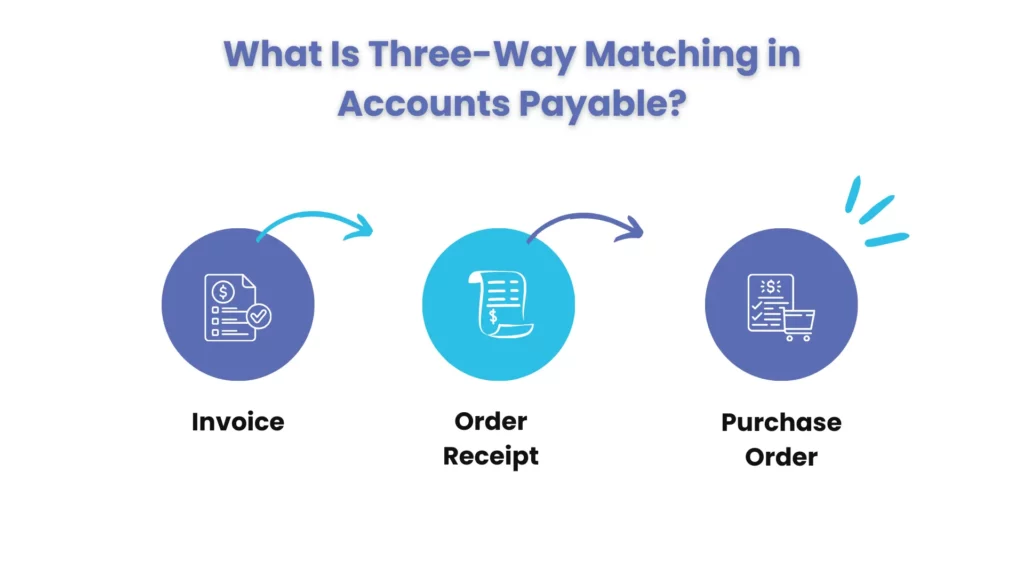
- Invoice: It’s a request for payment by the vendor to you. It contains necessary information to facilitate the sale, such as a unique invoice number, vendor contact details, discounts or credits applicable, and the total amount due.
- Order Receipt: It is delivered with the goods, with details in it like which goods are included in the shipment and the payment method.
- Purchase Order: The official confirmation receipt of the order sent by you to the vendor. This document is used to authorize the purchase. It includes a PO number, payment information, and descriptions of the goods or services sold, as well as the quantity.
Only when all three documents match does the system approve the payment.
This verification step plays a crucial role in the P2P Process (Procure-to-Pay Process) by ensuring that companies only pay for goods and services that were actually ordered and received.
An Example of Three-Way Matching
A business orders 500 office chairs.
Purchase Order:
• 500 chairs at $120 each → $60,000
Goods Receipt:
• Warehouse confirms delivery of 500 chairs.
Invoice:
• Vendor sends invoice for $60,000.
The 3-Way Matching process confirms that:
• Quantity matches
• Price matches
• Goods were received
The invoice is approved.
In case the invoice states 600 chairs instead of 500, the 3-way matching system will flag a discrepancy before payment is made.
When Should You Implement a Three-Way Match?
Any business that is involved in frequent purchasing of goods and high-value services is recommended to implement the 3-way match process. It’s a must if you are involved in:
- Processing large volumes of invoices
- Operating across multiple locations
- Working with multiple suppliers
- Managing complex procurement operations
According to research from the Institute of Finance & Management, businesses that have invested in structured invoice processing have benefitted with fewer errors and vendor disputes. In short, if your finance team handles procurement invoices regularly, 3-Way matching should be a standard control.
How the Three-Way Matching Process Works (Step-by-Step)
The 3-way matching process in accounts payable is quite simple.
Step 1: Creation of Purchase Order
Start by generating the purchase order when any of your departments orders goods or services.
Step 2: Goods Receipt Confirmation
When the items ordered arrive, the receiving team records the delivery.
Step 3: Invoice Submission
Once the delivery of goods is done, the supplier will send you the invoice requesting payment.
Step 4: Document Comparison
Following the process of 3 way matching in accounts payable, compare the purchase order, order receipt, and invoice.
Step 5: Approval or Exception
If the data in all three documents matches, only then will the invoice be approved, and payments will be made. In case of discrepancies, the invoice will be flagged for further review.
By following this structured process, incorrect payments are avoided.
Benefits of 3-Way Matching for Businesses
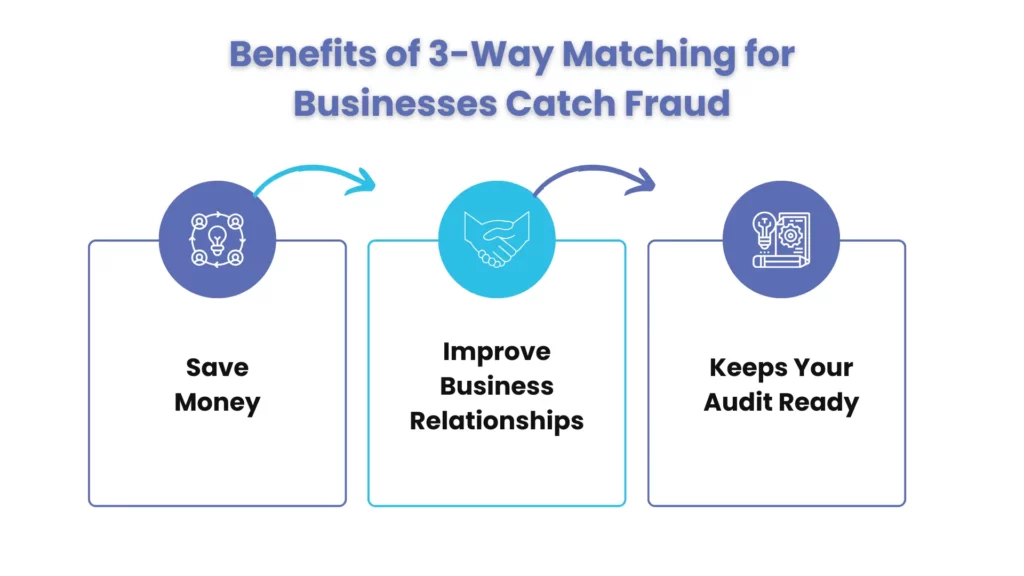
Multiple businesses have adopted a 3-way matching process, not because it’s best practice, but due to the benefits it puts on the table. Some of those benefits are:
Catch Fraud
3-way matching works as a fraud detector to ensure that invoices received by you are legitimate. By comparing the invoices with POs and order receipts, you will be confident about issuing payments.
Save Money
The process helps in identifying fraudulent invoices, thus saving you from paying dollars to phony suppliers. The 3-way process will also help you in identifying discrepancies that might lead to overpayment or underpayment. When this process is automated, you will be in a position to make payments on time and avail the discounts for it.
Improve Business Relationships
The 3-way matching process contributes to the reduction in discrepancies, disputes, and delays, and promotes trust and cooperation between you and your suppliers. Suppliers will surely appreciate timely and error-free payments, enabling them to trust you and establish an even deeper business relationship.
Keeps Your Audit Ready
The documents that you need for the 3-way matching process are also needed for internal and external audits. Thus, the process keeps you audit-ready beforehand.
Using Three-Way Matching to Minimize Fraud Risk
Under accounts payable, the risk of fraud is great, and without verification, you will face an increased chance of paying against fraudulent invoices. The verification we are talking about is a 3-way matching process that creates a powerful shield that can be crossed only with proper proof of purchase and delivery.
Fraud Cases from the Real World
Procurement fraud schemes are surprisingly common.
According to the AFP Payments Fraud and Control Survey Report for 2025, 79% of businesses experienced actual or attempted fraud in 2024.
Common fraud scenarios include:
- Fake vendors submitting invoices
- Employees approving duplicate payments
- Inflated invoices for partial deliveries
With 3 way matching in accounts payable, these frauds are far harder to execute because every invoice must match a legitimate purchase order and delivery record.
Best Practices for Effective 3 Way Matching in Accounts Payable
3 way matching in accounts payable is always better than manual, but it should be your goal to get the best out of it. For that, you will need to follow the tips below that will make 3-way matching more efficient.
Value Threshold
You must create a threshold so that only those invoices and purchase orders that are over a certain dollar amount will be subjected to 3-way matching. It makes sense because not checking high-value purchases can lead to bigger financial loss.
Discrepancy Threshold
Another way to speed up the 3-way matching process is by authorizing your staff to pay for invoices that are within the specified percentage of the purchase order amount. Small discrepancies can be taken care of, like adding a legitimate charge.
Rate Your Suppliers
Start rating your suppliers based on the accurate invoices they send. Only those suppliers that consistently send accurate invoices must be given high ratings. Such ratings will guide your staff that invoices coming from these suppliers must be subjected to only a periodic spot check.
Automating the Process
Select automated matching tools that are easy to understand and train your staff on, and automate the entire 3-way matching process. Only when the tools highlight a discrepancy will your staff get involved.
3-Way Matching Automation
Manual 3-way matching is a time-consuming and labor-intensive process, and when you try to speed it up, it becomes a major impediment. The only way to speed up is through a 3-way matching automation. It achieves that by streamlining the accounts payable process and handling higher workloads without any errors.
Other benefits of 3-way matching automation are:
- No requirement for additional hiring
- Reduces the time spent on each task
- Faster payment towards your supplier, leading to greater satisfaction
- Less human error leads to less time spent on corrections
- Keeps you audit-ready by keeping a paper trail
Common Problems with Manual Invoice Matching
Even with the visible benefits of automating 3-way matching, many businesses prefer to keep the process manual. Yes, it’s easy to understand, and you will get access to physical documents, but there are far more disadvantages when compared to automated solutions.
Costs More
Manual invoicing matching process costs approximately $12-$30 per item. When you adopt automated processing, you will save a considerable amount of budget that goes into manual handling.
Time-Consuming
The manual matching process is time-consuming and requires multiple staff members to work together. Gathering your staff to keep the process running smoothly takes time, not to forget the effort that goes into physically comparing each paper.
Late Payments
You must be striving hard to make payments to your suppliers quickly, but the manual process does not allow that due to the usual misplacement of documents and backlogs. Delays in payments affect your reputation and will affect future transactions.
Human Error
It is highly labor-intensive and prone to errors. There is a high chance of documents getting misplaced, lost, or damaged due to improper storage.
2-Way vs 3-Way vs 4-Way Matching – What’s the Difference
| Matching Type | Documents Compared | Typical Use Case |
| 2-Way Matching | Purchase Order + Invoice | Simple service purchases |
| 3-Way Matching | Purchase Order + Goods Receipt + Invoice | Standard procurement |
| 4-Way Matching | PO + Receipt + Invoice + Quality Inspection | Manufacturing and regulated industries |
Among these methods, 3 way matching in accounts payable remains the most widely used approach for general procurement verification.
How Corient Business Solutions Helps US Companies Streamline 3 Way Matching
To implement the 3-way matching in accounts payable seamlessly, you will need to have expertise in both process and technology, which we understand that you and many of your counterparts might lack.
However, when one-way closes, another opens, and that other way is called outsourcing, and an even better way is choosing Corient as your outsourcing partner. We support US businesses by helping them streamline their accounts payable operations.
Our finance and accounting services will assist with:
- Structured invoice validation workflows
- Procurement and invoice matching processes
- Optimized P2P Process management
- Integration with financial systems
- Improved financial reporting and controls
By combining process expertise with operational support, we help businesses reduce invoice errors, prevent fraud, and improve overall financial efficiency.
Fortify Your AP Against Fraud
Contact us now
Integrate 3-way matching into your Account Payable strategy to prevent fraud, enhance controls, and scale securely. Discover the modern tactics shaping the future of AP.
People Also Ask:
What Are Matching Tolerances and Why Are They Important?
Matching tolerances allow small differences between documents (such as minor price or quantity variations) without blocking invoice approval.
How Does the Invoice Hold Process Function?
If discrepancies are detected during 3-Way matching, the invoice is placed on hold until the issue is reviewed and resolved.
Why Is Proper Document Management Critical for Three-Way Matching?
Accurate and accessible documentation ensures that purchase orders, receipts, and invoices can be verified quickly and reliably.
What Challenges Come with Manual Three-Way Matching?
Manual matching is time-consuming, prone to human error, and difficult to scale for businesses processing large invoice volumes.
What is 3-way matching and 2-way matching?
3-way matching is a process where the purchase order, the supplier’s invoice, and the delivery receipt are matched before payment is made. In the 2-way matching process, only the invoice is matched with the purchase order.
Conclusion
These days, invoice errors and procurement fraud are costing businesses a lot of loss. But the good part is that it can be prevented easily through strong financial controls; these controls will never allow the payments for suspicious invoices.
Among these controls comes the critical 3-way matching in accounts payable. This process will verify purchase orders, delivery confirmations, and supplier invoices, ensuring every payment is accurate, legitimate, and properly authorized.
When you choose Corient’s procure to pay services combined with 3-way matching automation, your financial control becomes strong, and efficient.
Are you suffering from multiple invoice frauds and errors? Approach us via our contact form and get rid of this menace once and for all.