


Imagine a typical Tuesday morning at the US headquarters of a mid-to-large scale manufacturing outfit – the place is always buzzing but today’s AP desk is drowning in an absolute mess of invoices. Some are showing up as PDFs stuffed into crowded email inboxes, some are coming in through a company legacy portal that’s about as up to date as a vinyl record & a few are still stuck in the dark ages – arriving via snail mail. Just as things can’t get any worse a big supplier calls up, understandably irate about a payment that’s been stuck 45 days late – despite the fact that their services were handled months ago. In this kind of situation, a company isn’t just losing money on late fees & dodgy legal threats, they’re systematically poking holes in their vendor relationships and wasting thousands of man-hours on reams of paperwork.
For Large Businesses in the Enterprise space, the accounts payable process is often this quiet, hidden slowdown, that’s crippling the whole financial engine of the organisation. Getting the accounts payable process right, from purchase order to final reconciliation, is one of the fastest ways an enterprise finance team can protect cash flow and vendor trust.
What Is the Accounts Payable Process?
At its core, the Accounts Payable process is the systematic approach an enterprise takes to manage, track, verify, and settle its financial obligations for goods and services procured from vendors. Within an industry context, think of it as the financial “exit ramp” for corporate capital. It is the final gatekeeper of your cash outflows.
When executed correctly, the process is a frictionless, automated flow that maintains liquidity and builds creditworthiness. When handled with fragmented, manual interventions, it becomes a liability, exposing the company to fraud, duplicate payments, and severe cash flow forecasting inaccuracies.
Why the Accounts Payable Process Matters
An efficient accounts payable process isn’t just an accounting formality, it’s a direct lever on working capital, supplier trust, and audit readiness. Enterprises that treat their accounts payable procedures as a strategic function, rather than back-office paperwork, consistently see measurable gains across five areas:
- Cash Flow Visibility: A well-run accounts payable workflow gives finance leaders real-time insight into upcoming liabilities, which improves forecasting accuracy and supports better working capital decisions.
- Fraud Prevention: Structured accounts payable processing, with segregation of duties and automated matching, closes the gaps that allowed fraud like Meridian’s shell-vendor scheme (see case study below) to go undetected for months.
- Stronger Vendor Relationships: Consistent, on-time payment through a reliable accounts payable process earns better credit terms and early-payment discounts over time.
- Audit Readiness: Digitized accounts payable procedures create a clean, timestamped trail auditors can review in minutes instead of days.
- Lower Cost Per Invoice: According to the Institute of Finance & Management, up to 84% of a typical AP staffer’s day is spent on manual tasks — time that a modernized accounts payable process reclaims for higher-value work.
The Full Accounts Payable Cycle: Step by Step
To achieve financial transparency and operational excellence, large business enterprises (LBEs) must master the full accounts payable cycle of the accounts payable process. Each step carries the potential for optimisation or failure.
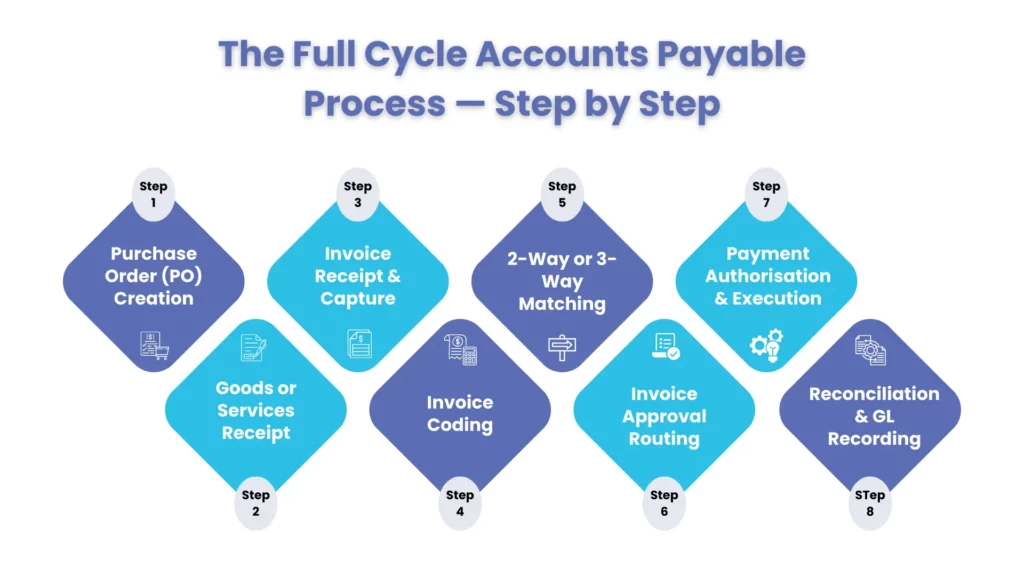
Step 1: Purchase Order (PO) Creation
The journey begins with the PO. This formal request is documented, approved by authorised budget holders, and sent to a vendor. Without a PO, the enterprise lacks a baseline for verifying the subsequent invoice, making it nearly impossible to ensure that the company only pays for what was pre-approved.
Step 2: Goods or Services Receipt
Before the invoice processing is done, the enterprise must verify that the items ordered were actually received. This “Good Receipt” note is a critical control point. Without it, companies risk paying for goods that were never delivered or were delivered in damaged condition.
Step 3: Invoice Receipt & Capture
Whether via Optical Character Recognition (OCR), Electronic Data Interchange (EDI), or manual input, this step involves pulling data into the ERP. High-performing enterprises use automated capture to eliminate the “manual data entry” stage.
Step 4: Invoice Coding – Getting it Right
Accurate financial reporting starts with assigning the right General Ledger (GL) account, cost center, and project code to each invoice. And let’s face it, manual coding is a recipe for disaster – one slip-up and your financial statements are going to be way off.
Step 5: 2-Way and 3-Way Matching in Accounts Payable
This is the control point most audits and fraud cases trace back to. Getting it right is central to a reliable accounts payable process:
- 2-Way Matching: Compares the invoice only against the purchase order. It’s faster, but it can’t confirm that goods were actually received, which is exactly the gap that cost Meridian $18,000 in unchallenged charges.
- 3-Way Matching: Compares the PO, the receiving report, and the invoice. This is the gold standard for large enterprises because it verifies all three: what was ordered, what arrived, and what’s being billed.
- 4-way matching: Some enterprises add a fourth control, an inspection or quality report, for high-value or regulated purchases.
2 Way Matching is a good starting point – just matching the PO to the Invoice and hoping for the best.
3 Way Matching in Accounts Payable Though is Where It’s At – matching the PO, the Receiving Report, and the Invoice. For big companies, this is the gold standard when it comes to accuracy and keeping an eye out for any funny business.
Step 6: Invoice Approval Routing
Once matched, the invoice is routed electronically to the appropriate budget holder for sign-off. The goal here is to minimise the “time-to-approval” to ensure vendors are paid within their credit terms.
Step 7: Payment Authorisation & Execution
Once all internal controls are satisfied, the funds are released via ACH, wire, or virtual card. This step must be tightly controlled to prevent unauthorised disbursements.
Step 8: Reconciliation & GL Recording
Finalising the ledger entry and ensuring the books close accurately. This provides the audit trail required by regulators.
Meet Meridian Industrial: Where One Skipped PO Sparked a $400,000 Problem
Marcus, Meridian’s operations manager, was having a rough Tuesday. A conveyor belt had broken down on the plant floor, production was halting by the hour, and he needed a $120,000 replacement system, fast. So he did what felt practical in the moment: he called the vendor directly, skipped the PO, and told his AP team to “figure it out later.”
That one shortcut cost Meridian $18,000 in unchallenged installation charges they never agreed to. With no PO on file, they had nothing to dispute.
It didn’t stop there.
The same week, a warehouse supervisor signed off on a delivery of industrial components without counting the units, too busy, too stretched. AP paid for 500. Only 400 had arrived. $14,000, gone. Caught six weeks later during a stock audit.
Meanwhile, the AP team of three was drowning, manually keying invoices arriving from four different email inboxes, a clunky vendor portal, and the occasional envelope with a stamp on it. At $12 per invoice across 8,000 monthly invoices, Meridian was burning $96,000 a month just on data entry. One tired keystroke turned a $1,540 invoice into a near-$15,400 wire transfer.
And nobody had set up 3-way matching.
That oversight gave one AP clerk eleven quiet months to approve invoices from a vendor that didn’t exist, small enough amounts to stay under the radar, consistent enough to drain $230,000 into a shell company before an external auditor caught it.
By year end, the CFO pulled the numbers together. The total damage, late fees, fraud, overpayments, manual overhead, audit costs, came to over $436,000. Not from one big disaster. From six small process gaps, hiding in plain sight.
Three AP staff had quit by Q3. The procurement lead was spending more time apologising to suppliers than negotiating with them. And Marcus? He was still skipping POs when things got urgent.
This is what a broken AP process actually costs. Not a single explosion, just a slow, steady leak that nobody notices until the damage is already done.
Upstream vs. Downstream: How the AP Process Really Flows
The upstream phase encompasses the procurement strategy and PO issuance. This is where the enterprise sets the rules. If the upstream process is messy, meaning orders are placed without clear documentation, the downstream process (where the AP department attempts to match invoices to non-existent or unclear POs) will always suffer from high exception rates. Fixing AP often means fixing the procurement behavior that occurs before the invoice is even generated.
Top 5 AP Performance Metrics Every US Enterprise Finance Leader Should Own
To measure the health of your accounts payable process, monitor these six KPIs:
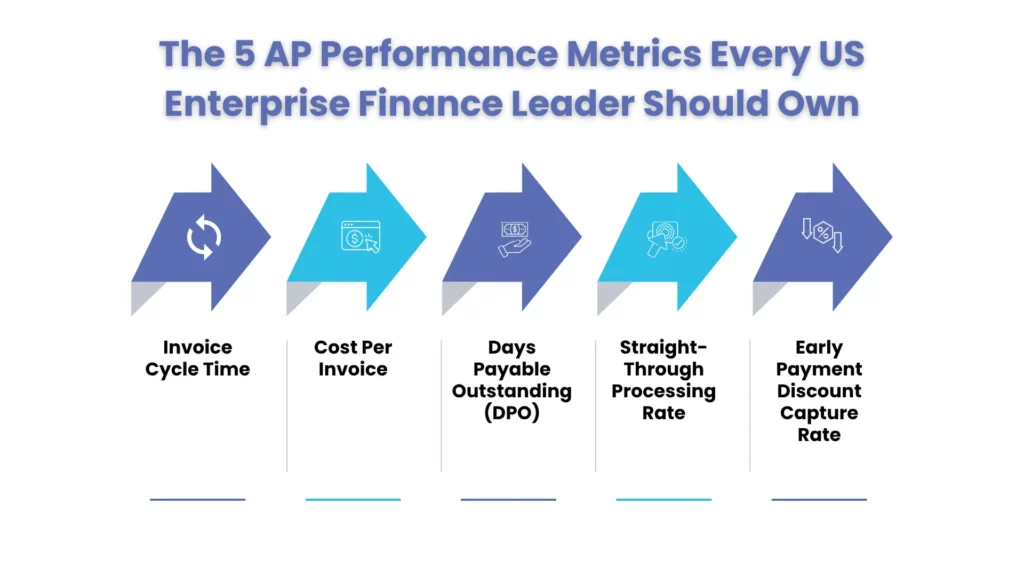
- Invoice Cycle Time: The time between the receipt of the invoice and payment.
- Cost Per Invoice: The sum of AP department labor and tech expenditure/divided by the number of invoices processed.
- Days Payable Outstanding (DPO): How many days does your company take to pay bills.
- Straight-Through Processing Rate: The percentage of invoices that have gone through without any episode of human action.
- Early Payment Discount Capture Rate: It is the measurement of the effectiveness of paying vendors early in order to take advantage of 2/10 net 30 discounts.
Most Common Accounts Payable Process Problems in Large US Enterprises
Large organisations suffer from unique accounts payable process challenges. Industry research from Ardent Partners consistently finds that exception handling, invoices that don’t match cleanly, is the single largest driver of AP labor cost in large enterprises.
The most prevalent include:
- Manual Data Entry: In spite of the up-to-date software, a large number of LBEs continue to use manual keying, which is prone to human error and high operational expenses.
- Visibility Lapse: Due to invoices being lodged in a stagnant email inbox at the departmental levels, CFOs are not able to see total liabilities in real-time.
- Siloed Communication: AP, Procurement, and Vendors are being served by separate systems, which means there is always a status back and forth.
- Duplicate Payments: Due to the disintegrated entry points through which an invoice is posted through the portal and email at the same time.
For Example,
A healthcare group discovered $67,000 in duplicate payments over one fiscal year, caused by the same invoice being submitted via email and their vendor portal simultaneously, with no deduplication check in place.”
Accounts Payable Process vs. Procure-to-Pay Process: What’s the Difference
Although AP is about payment and settlement of invoices, the overall umbrella is the Procure-to-Pay Process (P2P), which involves requisitioning, sourcing and purchasing of goods before even an invoice has been made. AP is actually the last and very important phase of the bigger P2P lifecycle.
Manual vs. Automated Accounts Payable Processing
Every enterprise runs its accounts payable process somewhere on a spectrum between fully manual and fully automated. Understanding where you sit helps prioritize what to fix first:
| Factor | Manual AP Process | Automated AP Process |
| Cost per invoice | $10–$15+ | Under $3.00 |
| Invoice cycle time | 15–20+ days | Under 5 days |
| Error/duplicate rate | High – dependent on manual keying | Low – automated 3-way matching flags discrepancies |
| Visibility | Siloed, email-based, hard to audit | Centralized, real-time, audit-ready |
| Fraud exposure | Higher – easier for anomalies to go unnoticed | Lower – automated anomaly detection flags unusual patterns |
Most enterprises don’t need to rip out their ERP to move from the left column to the right, a P2P layer on top of the existing system can automate the manual steps of the accounts payable process while keeping the system of record intact.
How CFOs, AP Managers, and Procurement Leads Each Experience the Process
- CFOs: Sees AP process in strategic perspective- as a means of working capital management, risk mitigation and supplier partnerships.
- AP Managers: Focus on execution tactics: productivity, invoice throughput and reduction of errors.
- Procurement Leads: The Leads prefer to focus on compliance, adherence to vendor contracts, and ensuring the organisation is receiving the best possible price.
Key AP Metrics Every US Enterprise Finance Team Should Track
| Metric | Industry Benchmark (Top Performers) |
| Invoice Cycle Time | < 5 Days |
| Cost Per Invoice | < $3.00 |
| Straight-Through Rate | > 80% |
Before-and-After AP Metrics:
One Corient client reduced invoice cycle time from 18 days to 4 days and cost-per-invoice from $11.40 to $2.80 within two quarters of P2P service engagement.
Steps to Improve Your Accounts Payable Process Without Starting Over
Improving your accounts payable process doesn’t require replacing your ERP. Small, sequenced changes to your accounts payable workflow compound quickly:
- Centralise Ingestion: Force all vendor invoices to a single, digital intake channel.
- Standardise Coding: Use a master vendor list to automate GL coding based on vendor history.
- Automate Matching: Leverage your existing ERP’s built-in 3 way matching in accounts payable capabilities to handle 80% of volume.
- Digitise Approvals: Move from email-based manual approvals to automated workflow triggers that escalate if an invoice is stuck.
When US Enterprises Should Consider Professional AP and P2P Support
When your internal team is trapped in “firefighting mode,” your exception rates consistently exceed 15%, or you are missing early payment discounts, your enterprise is likely bleeding capital. Scaling a finance function internally is resource-intensive; then your accounting services allows you to leverage existing expertise without the overhead of scaling an in-house team.
For Example,
A $200M consumer goods company with a 22% exception rate and a team spending 60% of their time on manual follow-ups engaged Corient’s P2P support. Within 90 days, exception rates dropped below 8% and the team refocused on strategic vendor negotiations.
At Corient Business Solutions, we provide specialised Procure to Pay services built for large-scale operations. By overlaying our proprietary processes onto your existing ERP, we help enterprises:
- Reduce manual intervention by up to 70%
- Maintain audit-ready documentation for every transaction
- Manage cash strategically to maximise DPO without damaging vendor relationships
Fix Your Accounts Payable Process Before It Costs You
Late fees, duplicate payments, and manual errors add up fast. Talk to Corient’s Procure-to-Pay specialists about what a modernized AP process looks like for your team.
People Also Ask:
How does automated 3 way matching in accounts payable improve fraud prevention?
The PO, receipt and invoice are matched systematically by automated matching. When there are discrepancies in the numbers, e.g. when the invoice value is greater than the PO value, the system automatically throws a warning flag on the invoice, which saves unauthorised or duplicate payments, which would otherwise go undetected by the human eye.
What is the biggest challenge for LBEs in the AP process?
In the case of LBEs, the greatest challenge is that the data is not cohesive among various business units, resulting in inconsistent coding and visibility problems, making forecasting of real-time cash flow almost unfeasible.
How do I choose between internal AP and outsourced P2P support?
If your AP department is primarily focused on strategic initiatives, internal is fine. If your team is bogged down by high-volume, low-value transactional processing, outsourcing to experts like Corient provides better scalability and significantly lower cost-per-invoice.
How does the AP process impact working capital?
An effective AP process will enable the finance leaders to manage the outflow time to ensure that your DPO (Days Payable Outstanding) is maximised and that the company can keep cash in its hands to make strategic investments or earn interest on corporate deposits.
Can I implement these improvements without changing my ERP?
Yes. Professional P2P support providers often work as a “layer” on top of your existing ERP, automating the manual steps while keeping your core system of record entirely intact.
How does the accounts payable process work in a company?
The accounts payable process works through 8 steps, PO creation, goods/services receipt, invoice capture, invoice coding, 2-way/3-way matching, approval routing, payment execution, and reconciliation with GL recording. Together these steps ensure a company only pays for what was ordered, received, and approved, keeping cash flow accurate and fraud risk low.
Conclusion
The accounts payable process is about more than just keeping the books in order, it’s a sign of a company’s financial maturity. Enterprises that master their full cycle accounts payable process today are the ones setting the payment terms, not scrambling to meet them. The ones that still haven’t modernized their AP workflow by 2026 risk being left behind – caught up in the dust left by competitors who are agile and forward-thinking. By getting these cycles running smoothly though, businesses can turn a cost center into a real source of strength – better financial efficiency, a healthier cash flow, and much happier suppliers.
Ready to Fix Your Accounts Payable Process?
Corient helps US enterprises cut invoice cycle times, reduce manual errors, and get audit-ready, without replacing your existing ERP. Talk to our Procure-to-Pay specialists about what a modernized AP process could look like for your team.