

Outsourced bookkeeping for CPA firms means handing the repeatable production work (reconciliations, transaction coding, AP/AR support and month-end prep) to an outside team that works in your software and under your review. You keep the client, the final review and the professional responsibility. Many firms call it bookkeeping outsourcing for CPA firms or client accounting support, and for a lot of them it’s the fastest way to take on more clients without adding to payroll.
This guide is for partners and managers who are weighing it up. It covers how the arrangement works, what it costs, how to choose a provider, and the mistakes we see most often.
Key takeaways
Hand off the production work (data entry, categorization, reconciliations, cleanup). Keep review, sign-off, tax strategy and client advice in-house.
- For most firms the real issue is capacity, not budget. The US Bureau of Labor Statistics (BLS) projects that employment of bookkeeping, accounting and auditing clerks will fall 6% between 2025 and 2035, so hiring alone is unlikely to fix it.
- Sort out security and disclosure before a single client file moves. That covers the AICPA confidentiality rules, your state board, IRS Publication 4557 and your engagement letters.
The best outsourced bookkeeping service for CPA firms isn’t the cheapest quote. It’s the one that works in your software, follows your review process and can show you its security controls.
- Judge providers on total cost, not hourly rate. Add your own review time, management time and rework to the fee, then hold that up against an in-house hire, which runs about $72,400 a year fully loaded at the BLS median wage.
- Pilot it for four weeks with a few clients whose books are clean and documented. Look at accuracy, turnaround and rework before you add more.
- White-label means the provider works in your software under your brand. Your clients still have to be told that a third party may see their data.
What is outsourced bookkeeping for CPA firms?
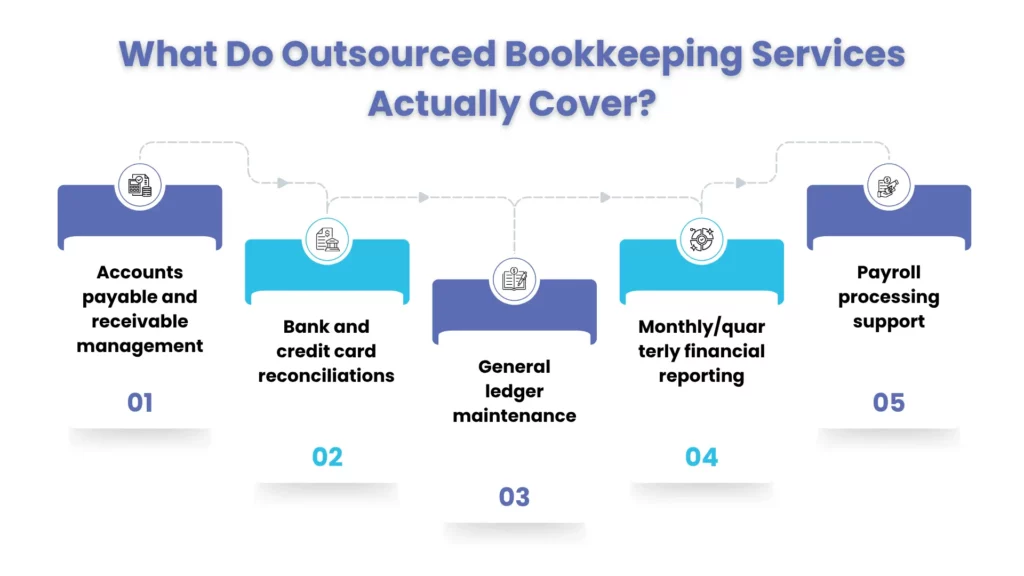
Think about what your staff does in a typical month. There are bank and credit-card reconciliations, transaction coding, payables, receivables, journal entries, financial statements, the occasional cleanup project and the close itself. Some of it calls for a CPA’s judgment. Most of it doesn’t. It just needs a competent person doing the same steps the same way each time, and in most firms that second pile is the larger one.
Outsourcing moves that pile to an outside team, which might be onshore, nearshore or offshore. Some firms use a dedicated team that works like part of their staff, and others buy a managed service. It’s a different thing from the bookkeeping that gets sold straight to small-business owners. In this setup the provider works inside your software, follows your rules and answers to your reviewer. The work moves out the door, but the client stays with you.
You’ll run into the term Client Accounting Services (CAS) as well. It overlaps with bookkeeping outsourcing for CPA firms but is broader, since CAS can include advisory work. Vendors, job postings and surveys use the two names interchangeably, so it pays to search for both when you’re comparing providers.
Quick example: A 12-person firm has 40 monthly clients. Reconciliations and coding take its seniors about two weeks of every month, so they have no room to take on new clients. An outside team handles that production work by day 5 or so, the seniors review it, and the firm can say yes to referrals again.
What bookkeeping tasks can a CPA firm outsource?
Nobody says you have to send everything out. Most firms start with whatever eats the most hours and needs the least senior input.
| Work | What the outsourced team does | What your firm keeps | Typical cadence |
|---|---|---|---|
| Transaction processing | Records and categorizes transactions under your documented rules | Approves the chart of accounts and rules; reviews exceptions | Daily or weekly |
| Reconciliations | Reconciles bank and card accounts by an agreed business day (for example, day 5) and flags unreconciled items | Reviews flagged items and signs off | Monthly |
| AP and AR support | Processes invoices, records payments, tracks receivables | Approves payments and sets control policy | Weekly |
| Month-end and year-end close | Prepares reconciliations, adjustments and draft financial statements | Reviews, adjusts and issues the statements | Monthly and annual |
| Cleanup and catch-up | Works through historical transactions against a defined cleanup plan | Decides scope and reviews opening balances | One-off project |
A growing number of teams combine human review with AI-assisted categorization and OCR receipt capture. The software copes with the volume, but somebody with a name and a title still needs to own the exceptions and the odd items.
What your firm always keeps
Some things don’t leave your firm, whatever you outsource. You sign off on the financial statements. You talk to the clients and own the engagement letter. Tax strategy, return sign-off and advisory judgment are yours, and so is professional responsibility for the work product and for client data. You also decide what gets outsourced and to whom.
What outsourced bookkeeping services do not include
A standard bookkeeping package covers production work. Tax return preparation and filing, audit and compliance support, catch-up work on historical books and strategic analysis like forecasting (really CFO and advisory work) are normally scoped and priced on their own. Ask each provider where bookkeeping ends and controller-level work begins, and have cleanup quoted as a separate line.
How does outsourced bookkeeping work?
Resist the urge to send hundreds of client files to a provider you barely know. Get the process right first. The details change from one provider to the next, but it usually goes like this.
A simple 5-step workflow diagram (Onboard → Daily transactions → Monthly reconciliation → CPA review → Refine).
1. Onboarding and setup: Write the work down in terms you can measure. For example: bank accounts reconciled by the fifth business day, transactions coded to the approved chart of accounts, unreconciled items flagged, anything unusual escalated and finished files passed to a CPA for review. It helps to standardize each client’s books beforehand so the team isn’t starting from a mess. After that, set up secure access and software permissions, and agree on a single channel for communication, with response times and escalation contacts.
2. Daily transaction management. The team records and categorizes transactions as they come in, following your documented rules. If something looks strange, they escalate it instead of guessing.
3. Monthly reconciliation: Bank and card accounts are reconciled against statements by the agreed day. Whatever doesn’t match goes to your reviewer.
4. Financial reporting and CPA review: The team drafts the profit and loss, balance sheet and cash flow statements. Your people review them, make adjustments and issue them, so clients only ever see your brand and your judgment.
5. Ongoing support and refinement: After month one, look at a few things. Did reconciliations arrive on time? How many items needed rework? How many questions went up to senior reviewers? Were procedures followed? There’s a bonus here too. Writing down each client’s categorization rules and approval chain gets your firm’s habits out of people’s heads and onto paper, where a new team can pick them up.
Security, confidentiality and client disclosure
Your firm holds sensitive financial and taxpayer data, so deal with this before anything else.
Data protection. The IRS offers Publication 4557 as guidance on safeguarding taxpayer data, and the AICPA points out that using a third party brings risks your firm has to identify, assess and manage. Before work starts, put role-based access, multi-factor authentication, encryption, secure document exchange and confidentiality agreements in place, along with review and escalation procedures. When you talk to providers, ask for their most recent SOC 2 Type II report and read the exceptions section, not just the cover page. Ask, too, how they remove access the day a team member leaves. The FTC Safeguards Rule applies to firms that prepare tax returns, too. It says you must select service providers able to maintain appropriate safeguards, require those safeguards by contract and assess providers from time to time (16 CFR 314.4(f)). That means your written information security plan has to cover any outside provider.
Disclosure and consent. Rules differ by state and they change, so use the table below as a checklist for your own review.
| Requirement | What it means |
|---|---|
| AICPA Code of Professional Conduct | The confidentiality provisions deal with third-party service providers. Under the confidential client information rules (ET 1.700.040), a firm should tell clients, preferably in writing and before sharing data, that it may use an outside provider. It should also have a confidentiality agreement with that provider or get the client’s specific consent. The AICPA publishes sample client disclosure language you can adapt. |
| Tax return information | If the work involves tax return information, IRC §7216 and its regulations limit disclosure and use without the client’s consent. Consent is always required before tax return information goes to a preparer located outside the United States, and extra conditions apply when Social Security numbers are sent abroad. |
| State boards of accountancy | Requirements vary by state. Check your board’s rules before sending client data to any provider. |
| Engagement letters | Most firms update these to say a third party may access client data, or they collect consent where it’s required. |
Whatever the rules turn out to say, your firm remains professionally responsible for the outsourced work and for client data. Check current requirements with your state board and legal counsel.
Benefits of outsourced bookkeeping for CPA firms
When you talk to providers, ask for their most recent SOC 2 Type II report and read the exceptions section, not just the cover page. Ask, too, how they remove access the day a team member leaves. It may have a capacity problem. The BLS expects employment of bookkeeping, accounting and auditing clerks to fall 6% from 2025 to 2035. So instead of competing for every available hire, you can team your own professionals up with an outside production crew.
The benefits firms report most often are these:
- Senior time back: Production work leaves your reviewers’ desks, which frees partners and managers to spend more of the week on review, advisory work and bringing in new clients.
- Capacity that bends: With hourly or per-client pricing you can add people around deadlines and ease off in quiet months, a bit like a tax-season staffing plan, without carrying a fixed headcount all year.
- Lower cost, if you count properly: There’s no recruiting, no benefits, no training and no idle time to pay for. The cost section below shows how to run the comparison.
- Fewer errors and less fraud risk: When one person enters, another reconciles and you approve, you get a separation of duties that a lone in-house bookkeeper can’t provide.
- Better client financials: Books that close on a fixed schedule are a stronger starting point for advisory work like cash flow forecasting.
- A calmer tax season: Clean, reconciled books show up earlier, so fewer weeks of busy season and extension season go to untangling last year’s mistakes.
- Better people and tools: A provider spreads training and software costs across many clients, so you don’t have to build that stack on your own.
Outsourced vs. in-house bookkeeping
| Factor | In-house | Outsourced |
|---|---|---|
| Speed to scale | Hire and train for each new person | Often faster than hiring, though it depends on the provider and how well you’ve documented your rules |
| Cost structure | Fixed, year-round | Can scale down in slower months |
| Client knowledge | Builds faster | Needs documented processes to close the gap |
| Oversight | Management time | Vendor management plus review time |
| Continuity | Gaps during absence and turnover | Team-based cover |
Who is outsourced bookkeeping best for?
Outsourced bookkeeping works for CPA firms of every size, from solo practitioners and small firms to mid-sized and large regional practices, especially those growing their client accounting services, running out of room every busy season or struggling to hire bookkeeping staff locally. If your volume is steady and you’ve got the budget to hire, staying in-house or going hybrid could suit you better.
Signs your firm is ready to outsource
Count how many of these are true for you. You’re turning away referrals because the team is full. Senior staff burn the first weeks of the busy season fixing last year’s bookkeeping errors. Client financials regularly arrive after the 20th of the month. If you nodded at two or more, the sensible next move is a scoped conversation with a provider, not another round of searching.
How to choose the best outsourced bookkeeping service for CPA firms
Providers aren’t interchangeable, so compare them against a short checklist.
- CPA-firm experience: Pick a team that already works behind accounting firms, not only one that sells to small-business owners. A white-label bookkeeping service for CPA firms follows your rules, works under your brand and expects a review step.
- Software: They should work in what you already use, such as QuickBooks Online, Xero or Sage, plus your tax and practice-management tools. Write down your must-have tools before the first call. If a provider needs you to switch software, that’s a cost too.
- Frequency: Ask how often transactions get categorized and by which business day accounts are reconciled. Daily or weekly processing with a fixed monthly close is better than a pile-up at month-end.
- Scalability: Find out whether capacity can flex in busy season and as your client list grows. One person rarely can. A dedicated bookkeeping team can.
- Pricing: Know the model (hourly, dedicated FTE, per client or per project), what the fee includes and what gets billed on top, such as cleanup.
- Security: Ask about access controls, encryption, multi-factor authentication, SOC reports and contract terms, and measure the answers against the disclosure rules above.
- References: Talk to CPA firms of a similar size, and run a short pilot so you can test accuracy and turnaround yourself.
A few red flags: a quote with no list of deliverables, no named close date or no direct access for you to your own books.
Seven questions to ask every provider
- Which CPA firms of our size do you work with, and can we speak to one?
- Who reviews the work before it reaches us, and what happens when a reconciliation doesn’t tie out?
- Who will actually work on our clients’ books, and how are they trained on our rules?
- Can we see your latest SOC 2 report and your data-handling policy?
- What does the quote include, and what is billed extra (cleanup, rework, year-end)?
- What happens to our data and access if we end the contract?
- How much notice do you need to add capacity for busy season?
Types of outsourced bookkeeping companies for CPA firms
| Option | Strengths | Limits |
|---|---|---|
| Single outsourced bookkeeper | Lowest cost; one point of contact | No backup when they are out; one person may enter, reconcile and approve |
| Freelancer marketplace | More choice and flexible hours | Little control over quality or security |
| Bookkeeping outsourcing firm | A team with defined review and backup | Less personal; scope can be rigid |
| White-label bookkeeping service for CPA firms | Works in your software and under your brand, so clients deal only with your firm | Disclosure duty still applies; confirm review and security controls |
Once you have any real client volume, a team-based provider is the safer choice.
Onshore vs. offshore bookkeeping
| Factor | Onshore | Offshore |
|---|---|---|
| Time-zone overlap | Usually high | May be limited; needs defined handoffs |
| Labor cost | Generally higher | Generally lower |
| Talent pool and scalability | Limited by US hiring | Broader pool, more flexible capacity |
| Security diligence | Standard vendor due diligence | Enhanced due diligence, plus the consent questions above |
Don’t decide on geography or price alone. Security, quality control, software compatibility, communication and review processes weigh more than where the team happens to sit. A well-run offshore accounting team with documented review controls closes most of the gap, and it’s worth understanding how a dedicated offshore team differs from a staffing agency.
Outsourced bookkeeping mistakes to avoid
Most problems begin with the setup rather than the provider.
| Mistake | What to do instead |
|---|---|
| Skipping disclosure | Update engagement letters and confirm consent rules before client data moves |
| Sending clients over without documented rules | Write down charts of accounts and approval chains first; gaps cause rework and slow closes |
| No named senior reviewer | Assign one, so errors don’t surface at tax time |
| Vague scope and pricing | Get deliverables, cleanup and out-of-scope work in writing, and don’t assume a bookkeeper also gives advisory guidance |
| Weak communication setup | Agree on channels, response times and escalation contacts to cover time-zone gaps |
| Ignoring tools and ownership | Confirm the team works in your software, and that you keep admin access and own the data |
| Scaling before a pilot | Prove accuracy and turnaround on a few clients first |
How Much Does Bookkeeping Outsourcing For CPA Firms cost?
What you pay depends on client volume, complexity and level of service, so compare totals instead of hourly rates. Published guides written for business owners give a rough picture:
| Provider type | Typical monthly cost | Best for |
|---|---|---|
| Freelance bookkeeper | About $200-500 | Basic services and simple books |
| Bookkeeping firm | About $500-2,500, depending on volume and services | Higher volume and team coverage |
| Virtual CFO-level services | $2,500 and up | Strategic financial guidance |
Those ranges come from a Mercury guide aimed at business owners. CPA-firm engagements are normally priced per client or per dedicated team member instead.
The price shifts with transaction volume, the number of clients and entities, payroll and AP/AR scope, any cleanup or catch-up work and how often you want reports and reviews.
Providers usually charge in one of four ways:
| Model | How it works | Best for |
|---|---|---|
| Hourly | You pay for hours worked | Fluctuating volume and short projects. Watch the scope, because costs can climb quickly if it’s loose |
| Dedicated FTE | A named team member works only for your firm at a fixed monthly fee | Steady, year-round volume |
| Per-client monthly | A fixed fee per client for an agreed scope | Many clients with similar needs. Confirm exactly what’s excluded |
| Project-based | A one-off fee | Cleanup and catch-up work. Ask for it as a separate line item |
A good way to sanity-check a quote is to set it against the fully loaded cost of an in-house hire. At the BLS median wage of $50,670 (May 2025), that works out to about $72,400 a year once benefits are included (wages make up roughly 70% of private-industry employer compensation costs, per BLS June 2026 data). And that’s before software, workspace, recruiting and turnover. On the outsourcing side, add your own review time, management time and rework to the fee.
Want to price a pilot for your client base? Talk to Corient’s CPA outsourcing team and we’ll scope it with you.
How to get started: a four-week pilot
Pick clients with predictable workflows, documented rules, moderate transaction volume and compatible software, and an internal reviewer who will give honest feedback.
| Week | Focus | What happens |
|---|---|---|
| 1 | Document | Map the workflow, assign responsibilities and write down client-specific rules. |
| 2 | Set up | Establish secure access, software permissions, communication and file sharing. |
| 3 | Train | Walk the team through sample transactions, reconciliations, reports and exception scenarios. |
| 4 | Run and review | The team processes real work while your professionals review it. |
When the month is over, look at accuracy, turnaround, rework, open queries, review effort and service levels. If the numbers hold steady, move more clients across a few at a time.
People Also Ask:
What is outsourced bookkeeping for a CPA firm?
It’s an arrangement where an outside team handles the repeatable bookkeeping work (reconciliations, coding, AP/AR support and close prep) inside your systems, and your firm reviews and signs off. The client relationship and the professional responsibility stay with you.
Is outsourced bookkeeping safe for client data?
It can be, if the provider has the right controls and you’ve checked them. Look for multi-factor authentication, encryption, role-based access, a recent SOC 2 Type II report and a signed confidentiality agreement. Your firm stays responsible for client data either way, and the FTC Safeguards Rule expects you to assess providers and require safeguards by contract.
Do we need client consent to outsource bookkeeping?
Often you need to at least tell them. The AICPA’s guidance is that a firm should notify clients, preferably in writing and before sharing data, and have a confidentiality agreement with the provider or get the client’s consent. If tax return information is involved, IRC §7216 requires consent, and always before it goes to a preparer outside the US. State boards differ, so check yours and ask your counsel.
Will my clients know their books are handled by an outsourced team?
With a white-label provider, clients deal only with your firm and see your brand. That doesn’t remove your duty to disclose that a third party may have access to their data. Most firms handle this through the engagement letter.
How long does onboarding take?
Plan on about four weeks for a pilot with a few clients: document, set up, train, then run live work with your review. Rolling out your whole client list takes longer and depends mostly on how well your rules and charts of accounts are already documented.
Can outsourced bookkeeping scale during tax season?
Usually, if you set it up for that. Hourly and per-client models flex more easily than a fixed dedicated team. Ask each provider how much notice they need to add people, and put it in the contract.
How much does outsourced bookkeeping cost?
It depends on the number of clients, transaction volume and scope. Published small-business ranges run from about $200-500 a month for a freelancer to $500-2,500 for a firm, but CPA-firm work is usually priced per client or per dedicated team member. Compare total cost, including your review and management time, as shown in the cost section above.
Is offshore bookkeeping cheaper than hiring in the US?
Labor cost is generally lower offshore, and the talent pool is wider. But the saving only counts if quality and review effort hold up. Offshore also means extra due diligence and the consent rules for tax return information, so compare total cost and risk, not just the rate.
Conclusion
Outsourced bookkeeping for CPA firms lets you split production from professional judgment, standardize the recurring work and add capacity without growing headcount at the same pace. Who you pick matters most. A cheap vendor that creates rework, communication headaches or security worries is just one more thing to manage, while a good provider behaves like an extension of your team. Use the questions and scorecard above to find the best outsourced bookkeeping service for CPA firms, and start small. If you’re comparing options, start with a scoped pilot. To see how it would fit your client base, talk to Corient’s CPA outsourcing team.