



Do you know what is quietly hurting your cash flow? Your clients owe you $2.3 million tied up in accounts receivable — and many enterprise AR teams are still chasing payment manually on spreadsheets. Late payments are not just a client issue. They are process failures that drain working capital and force businesses to borrow to cover what they are already owed.
This 7-step plan helps US enterprise finance teams recover $833K per $100M in accounts receivable using platforms like NetSuite, QuickBooks, and HighRadius. Organizations that implement these steps typically reduce Days Sales Outstanding by 15–25 days within 6–12 months, unlocking significant trapped capital. The goal: measure collection speed, not just new contracts.
This guide offers strategies and examples to help enterprise finance and O2C professionals improve cash flow by streamlining invoicing and boosting collections.
What Is Days Sales Outstanding (DSO)?
What is Days Sales Outstanding (DSO)?
DSO is a key working capital metric that shows how long it takes a company to actually get paid by customers who put something on credit. It’s a pretty important gauge, if you ask people on Wall Street.
What this means:
- If your DSO is low, then the company’s got more cash kicking around and that’s a good thing. But if your DSO is high, that means it’s taking forever for you to turn those credit sales into actual cash, which can leave you a bit short on liquidity. Wall Street Prep told us as much
- A lot of companies in lots of industries aim for a DSO of around 30 to 45 days, that’s considered a benchmark. People at Salesforce seem to think that’s the way to go
Why it matters at all:
Cash flow is what makes a business tick, so getting paid by your customers as soon as humanly possible is a good idea. If your DSO starts to creep up, it could mean your customers are having trouble paying, you’re not being strict enough about who gets credit, or your collection methods are just plain inefficient.
How Do You Calculate Your DSO?
The Days Sales Outstanding formula measures how long, on average, your enterprise takes to collect payment after an invoice is issued.
The Formula:
Days Sales Outstanding (DSO) = (Accounts Receivable ÷ Total Credit Sales) × Number of Days in Period
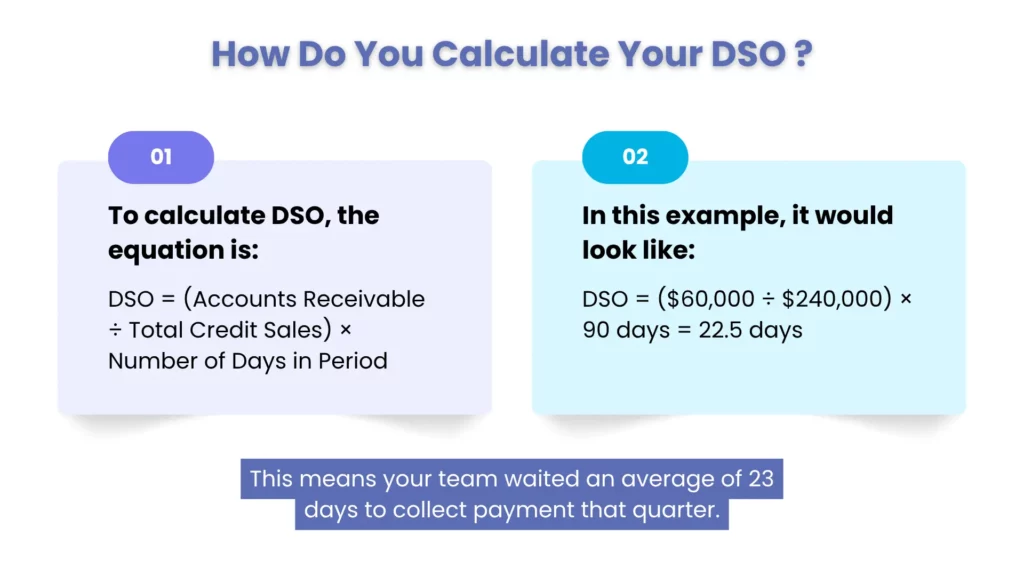
This means your team waited an average of 23 days to collect payment that quarter.
A DSO of 23 days means your cash is moving. For enterprise O2C teams, anything above 45 days signals a process problem — not just a client behavior problem. Best-in-class organizations stay below 30 days.
Why DSO Is Important
Days Sales Outstanding is a leading indicator of financial health across three critical areas:
- Cash Flow: Each additional day of DSO means the business has locked up working capital that could be deployed for operations, payroll, or growth investment. Reducing Days Sales Outstanding is one of the fastest ways to free up cash flow without increasing revenue.
- Credit Risk: In the B2B enterprise world, each day of Days Sales Outstanding increases the likelihood of bad debt write-offs. The longer an invoice ages in accounts receivable, the less likely it is to be collected in full.
- Operational Efficiency: When DSO remains high over time, it signals broken steps in the order to cash process — from invoicing inaccuracies to manual collections workflows that slow down cash flow recovery.
According to the Credit Research Foundation’s quarterly DSO Benchmarking Report, the median Days Sales Outstanding for US enterprises ranges from 35 to 45 days. Organizations that maintain DSO below 30 days consistently tend to be those with automated order to cash processes that optimize every stage of the accounts receivable cycle.
Here Are the Top 7 Strategies to Reduce DSO and Improve Cash Flow
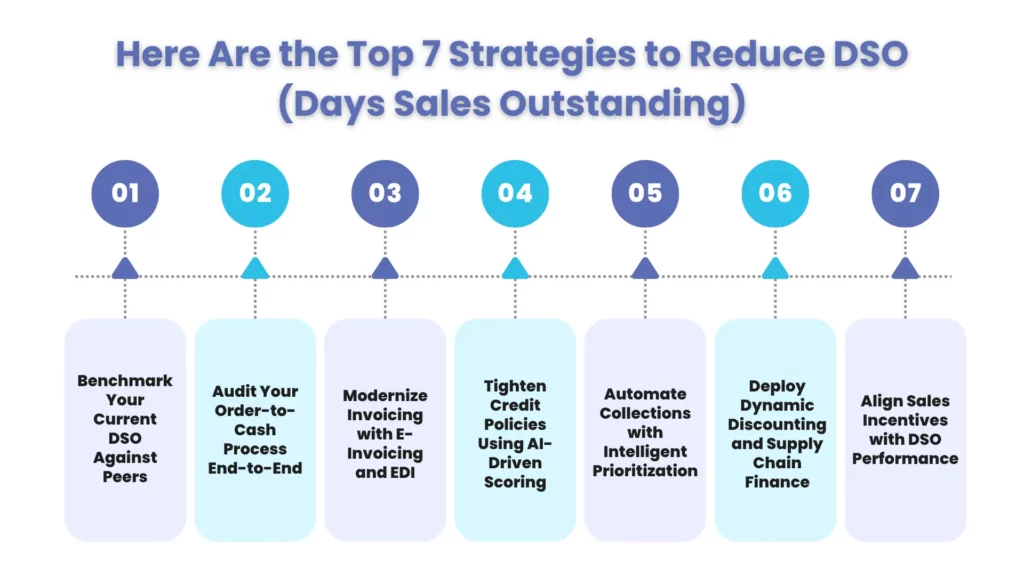
Step 1: Benchmark Your Current DSO Against Peers
Benchmarking means comparing your Days Sales Outstanding against industry peers to understand where you actually stand — not just whether the number looks acceptable internally.
Break it down by client tier (Fortune 500 vs. mid-market), industry vertical, and payment terms (Net 30 vs. Net 60). The Credit Research Foundation places the median US enterprise DSO at 35 to 45 days — use that as your baseline for evaluating your accounts receivable process.
Identify which 20% of clients are driving 80% of your DSO variance. Set a 3-to-5-day Days Sales Outstanding reduction target over 90 days. That is where your order-to-cash process improvement begins.
For a deeper look at how the O2C process connects to DSO, read: Order to Cash Automation: How US Enterprises Can Stop Revenue Leakage
Step 2: Audit Your Order-to-Cash Process End-to-End
Auditing your order-to-cash (O2C) process means reviewing every step between raising an invoice and receiving payment to find where time is being lost. Most enterprise finance teams assume late payment is a client problem — but the delay often starts internally.
Common internal gaps that extend DSO:
- Invoices going out late because of contract or shipping delays
- Manual approval steps that slow down credit memos
- Data entry errors that create invoice mismatches and leave AR open longer than necessary
Fixing these internal gaps directly reduces Days Sales Outstanding without changing a single payment term or client relationship.
Related: How 3-Way Matching in Accounts Payable Prevents Invoice Errors and Fraud — invoice accuracy is one of the most overlooked internal causes of high DSO.
Once you know where time is being lost internally, the next step is modernizing how invoices reach your clients in the first place.
Step 3: Modernize Invoicing with E-Invoicing and EDI
Outdated invoicing methods are one of the most overlooked causes of high Days Sales Outstanding. Moving to electronic invoicing (e-invoicing) with EDI (ANSI X12) puts invoices directly into your clients’ ERP systems, eliminating manual delays and accelerating the payment cycle.
Key EDI transaction types for enterprise O2C teams: Purchase Orders (EDI 850), Invoices (EDI 810), and Shipping Notices (EDI 856). Platforms like HighRadius, Billtrust, and Coupa handle this at scale, while FirstB2B supports clients still operating on PDF-based workflows.
What well-implemented e-invoicing delivers:
- Embedded state tax compliance
- SOC-ready audit trails
- Real-time DSO dashboards
Even a 3–7-day DSO improvement on $100M in AR frees $833K–$2.3M in working capital. Start with your top three clients — a 5-day improvement is achievable within 30 days of implementation.
With invoices reaching clients faster and more accurately, the next risk to address is who you are extending credit to in the first place.
Step 4: Tighten Credit Policies Using AI-Driven Scoring
Most DSO problems start before an invoice is ever sent. Manual credit limits create early-stage risk that compounds through the entire collection cycle. AI-powered platforms like HighRadius, Billtrust, and Growexx use Dun & Bradstreet and Experian data, real-time US payment behavior, and macroeconomic trends to adjust credit limits dynamically.
For enterprise O2C and finance teams:
- Quarterly credit reviews for top 20 clients (typically 60% of total AR)
- Auto-escalation for accounts that breach terms twice within 12 months
- FCRA-compliant credit decisions covering 95% of credit checks
- Manual credit reviews reduced from 4 hours to 4 minutes via AI assessment
Implementation timeline: API connections in week one, model training on 12 months of payment history by week three, live by week four. Expected outcome: a 3–5-day DSO reduction and 15–25% less bad debt within two months.
With credit risk under control, the next lever is how your collections team operates day to day.
Step 5: Automate Collections with Intelligent Prioritization
Manual spreadsheet-based AR management slows enterprise O2C teams down. Many AR functions still rely on Excel for collections tracking — a workflow that does not scale when invoice volumes are high or client portfolios are complex. According to the PYMNTS and American Express B2B Payments Innovation Readiness Playbook, businesses that rely on manual AR processes have an average DSO 30% longer than those with medium to high levels of automation.
AI-powered platforms like HighRadius, Billtrust, and Esker score invoices by payment likelihood and dispute probability, creating prioritized worklists so collections teams focus on cash impact rather than noise.
Automated dunning sequences, self-service payment portals, and dispute routing let collectors handle significantly more accounts with less effort. The outcome: a 7–12-day DSO reduction and a shift from reactive chasing to proactive cash management within 30 days of deployment.
Better collections gets cash in faster — but the cost of waiting for payment can also be offset by offering clients flexibility upfront.
Step 6: Deploy Dynamic Discounting and Supply Chain Finance
Long payment terms slow cash flow. Dynamic discounting lets clients choose an earlier payment date in exchange for a modest discount, while supply chain finance extends client payment terms without slowing down your cash receipt.
Platforms like Taulia, C2FO, and Prime Revenue integrate directly with QuickBooks and NetSuite. Target your slowest-paying clients first. Organizations implementing dynamic discounting typically see a 5–15-day DSO reduction, freeing approximately $1.37M per $100M in AR on a 5-day improvement, with no added credit risk.
Even after optimizing the entire AR and collections process, one structural issue often remains: sales teams that are rewarded for closing deals, not for collecting cash.
Step 7: Align Sales Incentives with DSO Performance
Revenue-only commission structures can quietly inflate Days Sales Outstanding. When deals close on Net 90 terms, AR teams are left chasing agreements that sales did not structure for collection — and your DSO absorbs every day of that gap. Holding 10–15% of commissions until payment is received closes that misalignment and gives sales a direct stake in Days Sales Outstanding performance.
A practical incentive structure for enterprise teams:
- Sales reps track client DSO on a shared real-time dashboard
- Commission released 90 days post-invoice, upon confirmed cash receipt
- Team bonus tied to DSO improvement: a 5% DSO reduction earns a 2% SPIFF (Sales Performance Incentive Fund)
- Integrates with NetSuite, QuickBooks, Salesforce, HighRadius, Billtrust, and Outreach
Expected outcome: 8–12-day DSO reduction and a sales team that treats cash collection as part of the deal, not someone else’s problem.
Measuring Progress: Enterprise DSO Dashboard KPIs
| KPI | Formula | Target | Why It Matters |
| DSO (90-day rolling) | (AR ÷ Credit Sales) × 90 | −10 days | Headline metric, segmented by client tier |
| Best Possible DSO | Days Sales Outstanding if all clients paid on terms | Below actual DSO | Shows process gap vs. client behavior gap |
| Collections Effectiveness Index | (Beg AR + Sales − End AR) ÷ (Beg AR + Sales) | Above 85% | Measures collection effectiveness as a percentage |
| Dispute Rate | Disputes ÷ Total Invoices | Below 2% | Flags invoicing and contract issues upstream |
| Cash Application Rate | Auto-applied ÷ Total Cash Received | Above 90% | Validates AR accuracy and automation coverage |
For US enterprise finance teams, connect Tableau or Power BI directly to NetSuite or QuickBooks for real-time client DSO tracking against industry benchmarks.
Related: The Complete Month End Close Checklist — DSO tracking belongs in your monthly close cycle, not just in quarterly reviews.
People Also Ask:
What is a good DSO benchmark for US enterprises?
Below 30 days is best-in-class. 35–45 days is the industry average according to the Credit Research Foundation. Above 60 days needs immediate process review. SaaS and professional services companies typically achieve sub-30-day DSO; manufacturing and distribution often run 50+ days due to longer payment terms.
How fast does automation deliver DSO results?
Expect a 3–7-day improvement within the first 60–90 days. As credit policies and e-invoicing scale across the client portfolio, organizations typically see a 15–25-day reduction after 6–12 months.
What is the difference between DSO and Best Possible DSO (BPDSO)?
BPDSO assumes every client pays exactly on their agreed terms. The gap between your actual DSO and BPDSO reveals how much of your problem is internal process inefficiency versus genuine client behavior.
Will these strategies hurt client relationships?
No. E-invoicing, self-service payment portals, and dynamic discounting improve the buyer experience by reducing friction. Smart escalation protocols protect strong relationships while addressing late payers through structured, non-confrontational workflows.
How does DSO impact credit rating?
High DSO signals cash flow weakness to lenders, which leads to higher borrowing rates and tighter covenants. A declining DSO demonstrates financial discipline and can unlock better financing terms.
Conclusion:
Every invoice that goes unpaid ties up capital that could fund growth, cover payroll, or reduce borrowing costs. The enterprise finance teams winning on cash flow are not just billing more — they are collecting faster, smarter, and with significantly less manual effort.
This 7-step roadmap — from benchmarking and O2C process audits through to sales incentive alignment — gives enterprise O2C teams a structured path to meaningful DSO reduction without disrupting client relationships.
Ready to start improving your O2C cash flow? Partner with Corient to build a collections process that works from day one.
Also read: Procurement News Alert: Is Your Enterprise Losing Control of Procure-to-Pay? — because the P2P and O2C cycles are two sides of the same cash flow equation.