

In the United States procurement news for the year 2026 is becoming more connected to the Securities and Exchange Commission style Environmental Social Governance Disclosures Artificial Intelligence driven sourcing and federal level supply chain rules. If your United States finance or accounting team still thinks of procure to pay as a task that is done in the back office you are, at risk of missing the signs that affect what the auditors find the money you have available to run your business and the rules that govern your business.
Hundreds of invoices come into the accounts department each week but large purchases are made outside of normal channels and some vendors later cause ESG or cybersecurity-risk flags. By the time the internal audit team finds these gaps the company has already paid millions to suppliers that do not follow the rules because procure-to-pay controls were never aligned with procurement news.
Who This Is For?
This is for US CFOs, controllers and finance directors in mid- to enterprises. It is also for procurement and category managers in US-based or US-listed organizations. 9Additionally, it is for audit, compliance and IT leaders who oversee SEC-style ESG, SOX and ERP-integrated P2P workflows.
In short it is for anyone who needs to connect procurement news with US-style disclosure rules federal procurement signals and AI-driven P2P automation.
Why Procurement News Is Moving Faster Than Ever
Let’s be honest — keeping up with procurement news in 2026 feels like drinking from a firehose. Supply chain shake-ups, new U.S. trade policies, AI taking over purchasing workflows, and fresh compliance mandates are all hitting at the same time, leaving finance and ops teams scrambling to stay current. The rules that governed how American businesses sourced, spent, and reported just a couple of years ago have already been rewritten — sometimes more than once. Missing a regulatory update or ignoring a market shift isn’t just an inconvenience anymore; it can mean compliance gaps, audit risks, and real dollars walking out the door. The procurement function has moved to the center of the business conversation, and the leaders who treat it that way are the ones pulling ahead.
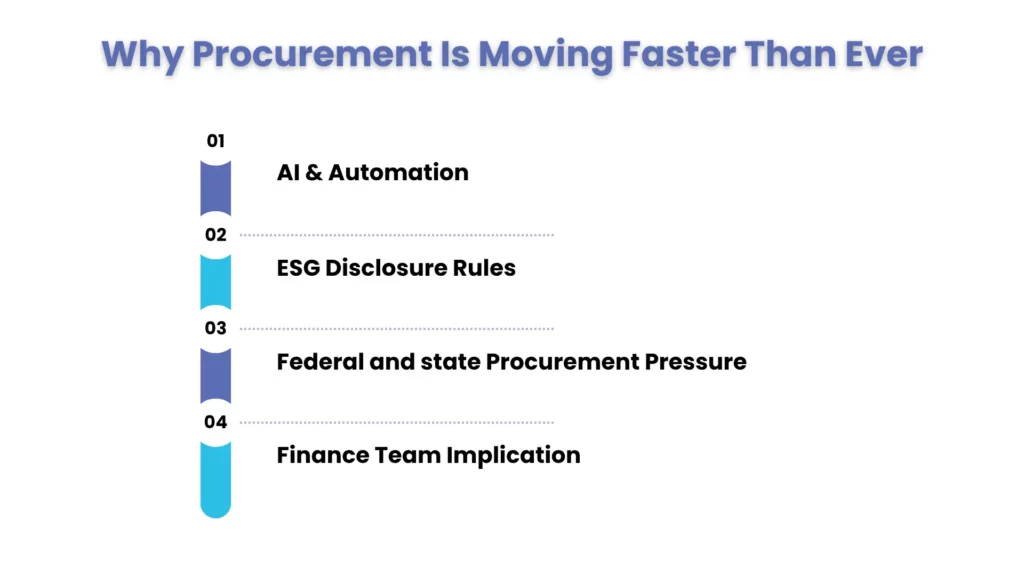
- AI & Automation: Big US companies are using AI to make buying smoother. This is helpful for onboarding suppliers quickly and processing invoices without any issues. This leaves more time for finance teams to focus on bigger issues.
- ESG Disclosure Rules: New SEC-style requirements mean companies have to track where their money is going and what impact it is having on the environment, people, and communities. This means procurement teams have a big role to play in reporting these issues to investors.
- Federal and state Procurement Pressure: Government requirements at state and federal levels mean organizations have to “do more for less.” This means finance teams have to be more efficient, cut costs, and make sure every dollar is accounted for.
- Finance Team Implication: The procurement function is no longer just about finding suppliers. It is a window into Financial Accounting internal controls and investor reporting. This is something finance teams have to keep a close eye on.
What Enterprise Procure-to-Pay (P2P) Really Means
Enterprise procure-to-pay (P2P) is the end-to-end US-friendly process from requisitioning through to payment, tightly controlled and highly visible through procurement, accounts payable, and audit. At scale, this includes:
- Requisition & approval workflow (which can be multi-level and SOX-like in its controls).
- Vendor master management & onboarding (including KYC, Sanctions, and ESG checks).
- Purchase order creation, PO-matching, and change order tracking.
- Invoice receipt, 2-way & 3-way matching, and early payment discounting.
- Payment scheduling, 1099/W-9 tracking, and working capital optimization.
A mature US-style P2P tech stack in 2026 is one that integrates procurement news, supplier risks, and ERP-based financial reporting into a single auditable chain.
Challenges Large Enterprises Face Without Structured P2P Support
Lacking P2P enablement for P2P, US-based enterprises will commonly experience:
- Manual approval systems using email, spreadsheets, and shared drives, which cause lost discounts for early payments, as well as SOX-style control issues.
- Procurement and AP data in silos, making it impossible for finance teams to track spend leakage and link spend to ESG metrics, BREX-style supply chain resiliency metrics, and federal contract compliance metrics.
- Supplier risk management is lacking, particularly for tail spend suppliers that were never effectively onboarded and monitored for sanctions and cybersecurity risks.
In the age of US federal procurement news and disclosure mandates, this translates into audit risks, SEC-style disclosure risks, and reputational risks.
Why 2026 Demands a New Approach to Enterprise P2P
The way businesses handle procure-to-pay has changed — and frankly, the old playbook just doesn’t cut it anymore. Between tightening IRS filing requirements, rising compliance pressure, and teams stretched thin across remote and hybrid setups, finance leaders across the U.S. are feeling the gap. Add in new digital asset reporting rules and the phase-out of paper refund checks, and it’s clear that manual, disconnected P2P processes are a liability — not just an inefficiency. In 2026, a smarter, end-to-end approach isn’t optional; it’s how American businesses stay competitive and audit-ready.
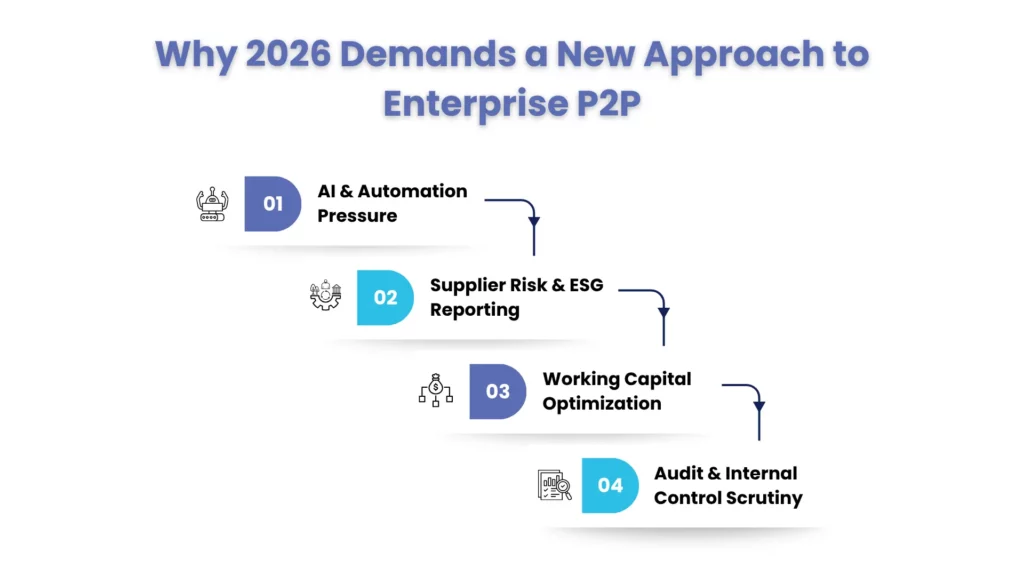
AI & Automation Pressure:
Finance teams in the US are under pressure to operate leaner businesses with AI-assisted tools that can automate approval processes, matching, and exception handling. AI in finance currently impacts various steps in the procure-to-pay process, including invoice coding, anomaly detection, and fraud risk scoring.
Supplier Risk & ESG Reporting
The news feed in procurement today sounds like a risk management screen: sanctions, geo-politics, cybersecurity, and ESG ratings. A new US-style P2P workflow will need to include supplier risk scores and ESG metadata in the P2P workflow so that finance can identify “high-risk” suppliers at the invoice level and use that information in US Securities and Exchange Commission (SEC)-style reports.
Working Capital Optimization
Reduced budgetary flexibility and interest rate pressures, US CFOs cannot afford to think of P2P as merely a cost center. Optimized P2P cycles, early payment incentives, and dynamic discounting are all part of the same P2P stack that includes supplier risk & ESG reporting and investor reporting models.
Audit & Internal Control Scrutiny
Regulatory requirements, internal audit teams, and external auditors demand complete transparency in P2P workflows for US-listed and US-governed entities, including complete audit trails of who initiated what, when, and why, and how approvals were routed. The disconnect between procurement news and payment records becomes a major risk in SOC-2, SOX, or ESG audit reports.
How Our Enterprise Procure-to-Pay Services Help
Our enterprise Procure-to-Pay Services are built for US organizations that need to align procurement operations with financial controls and reporting requirements. We provide:
- Pre configured P2P Workflows: Seamlessly integrate with US-friendly ERP systems and AP automation tools to streamline approvals and payments.
- Supplier-Risk & ESG Insights: View sanctions, cybersecurity risks, and ESG scores at the invoice level for smarter, compliant decision-making.
- SOX Aligned Controls: Automated approval routing and audit-ready logs ensure every step in the P2P cycle meets internal control and regulatory standards.
Small before/after examples
Before:
- Regional buyers in the US cut POs in local systems not synced to the corporate ERP.
- Suppliers submit invoices via email; AP teams manually key them, missing PO mismatches.
- Audit finds unapproved spend, duplicate payments, and poor ESG spend visibility.
After:
- All US requisitions flow through a central P2P platform linked to ERP and category management tools.
- Invoices are auto matched and routed; exceptions trigger compliance checks and change order workflows.
- Finance exports a single P2P driven report that answers ESG, federal contract, and audit questions in one view.
Key Takeaways
- Procurement news 2026 is financial control news in the US. AI, ESG, and resilience are all embedded in the procure to pay process.
- US enterprises that ignore P2P governance face compliance risk, audit findings, and working capital leakage.
- Integrated P2P support—between procurement, finance, and risk teams—is now a core part of US enterprise control and strategy.
Procurement gaps don’t show up until it’s too late — audit findings, missed ESG disclosures, and duplicate payments are already a warning sign. Don’t wait for the next audit to fix your P2P controls. Get Started
People Also Ask:
How does P2P software integrate with US ERP systems?
Modern P2P platforms for US enterprises sync with ERP (e.g., NetSuite, SAP, Oracle, Microsoft Dynamics) via APIs, mapping requisitions, POs, invoices, and payments into a single, auditable ledger.
What are the biggest procurement compliance risks for US companies in 2026?
Top risks include incomplete ESG disclosures, inadequate supplier risk checks, and non compliant P2P controls that fail to track sanction linked or high risk spend—especially for federal facing or SEC-regged entities.
How can US finance teams use P2P to improve working capital?
By automating approvals, matching earlier, and negotiating early payment discounts or dynamic discounting terms inside the P2P workflow, US finance teams can extend DPO or capture discounts more deliberately.
What’s the difference between procurement and accounts payable in the US?
Procurement focuses on sourcing, negotiating, and managing suppliers; accounts payable records liabilities and pays invoices. P2P is the US centric bridge that connects both, ensuring every payable is rooted in an approved, compliant procurement event.
How do I know if my US company needs managed P2P services?
You likely need managed P2P support if: there is no central P2P stack, manual approvals dominate, supplier risk and ESG data are siloed, or audit findings repeatedly flag PO invoice mismatches or non standard vendor onboarding.
Conclusion
But if your US business thinks procurement news is an afterthought rather than a core part of its financial operations, then you’re already falling behind. By 2026, the lines between supplier risks, ESG disclosures, and SOX compliance are no longer relevant as procure-to-pay becomes the strategic backbone that links procurement decisions to investor reports and audit results. Gain a Competitive Edge with a Unified P2P Framework. Join forces with Corient Inc. to turn regulatory challenges into compliant and optimized financial operations.