



Imagine a bustling hospital ward where every heartbeat, bandage, and prescription translates to dollars but one billing error could spell financial chaos. That’s where healthcare accounting steps in as the unsung hero of healthcare financial management. Supporting clinics, hospitals, and medical practices, it masterfully tracks revenue streams, tames escalating costs, and navigates a maze of complex regulations. Unlike standard business accounting, it juggles unpredictable patient cash flows, insurance reimbursements, and ironclad compliance rules making it indispensable for any practice chasing enduring financial health.
This guide describes what medical accounting is, who needs it, how it supports revenue cycle management and how professional healthcare accounting services can help ensure your practice is not harmed by their bottom line or reputation.
What Is Healthcare Accounting?
Accounting for healthcare services involves documenting, examining, and reporting financial information for medical practice, hospitals, laboratories, and clinics. It manages healthcare bookkeeping task such as patient billing, processes insurance claim, track salaries and overhead, and ensures compliance with tax and healthcare policies, such as HIPAA-like privacy rules and payer-specific reimbursement policies in the US.
Because healthcare revenue and processes, insurance codes, and patient eligibility, accounts integrate with clinical workflow and electronic health records (EHR) systems. This integration ensures that staff bill and post all visits tests, and procedures accurately, reducing errors and payment delays.
Who Needs Healthcare Accounting Services?
A qualified Healthcare Accountant should be used by any healthcare organization that invoices patients or insurers, such as a private practice, multi-specialty clinic, hospital, diagnostic center or dental or veterinary chain. Smaller practices typically maintain simple bookkeeping internally, however, with increasing patient volume and payer complexity, professional services become essential to prevent patient claim denials, cash-flow lapses, and audit risk.
Healthcare accounting services are particularly useful to:
- Multiple providers, multiple location practices.
- Clinics which handle Medicare, Medicaid and the private insurance companies.
- Increasing or broadening activities that require systems and reporting that are scalable.
- Specialized accounting can assist these organizations to remain compliant, enhance collections, and make clinicians more patient-centered opposed to seeking payments.
Core Accounting Principles in Healthcare
The Accounting Methods used in healthcare follow the same basic premises as general accounting, i.e., accrual-based recording, two-entry bookkeeping, and matching the expenses with revenues, but it introduces the levels of reimbursement guidelines and cost to service analysis. Key principles include:
- Revenue recognition: Revenue is recognized upon the performance of services and not when the cash is received particularly in insurance claims.
- Correct allocation of expenses: allocations of costs are made to departments, services, or location to enable you to know which of them is profitable.
- High internal controls: Separation of responsibility, workflow approval and system auditing prevent fraud and errors.
These principles will make sure that financial reports reflect the real financial picture of the practice and lead to rational decision-making.
Key Functions of Healthcare Accounting
Medical practice accounting covers nearly all the areas of operations of a medical practice. Key functions include: –
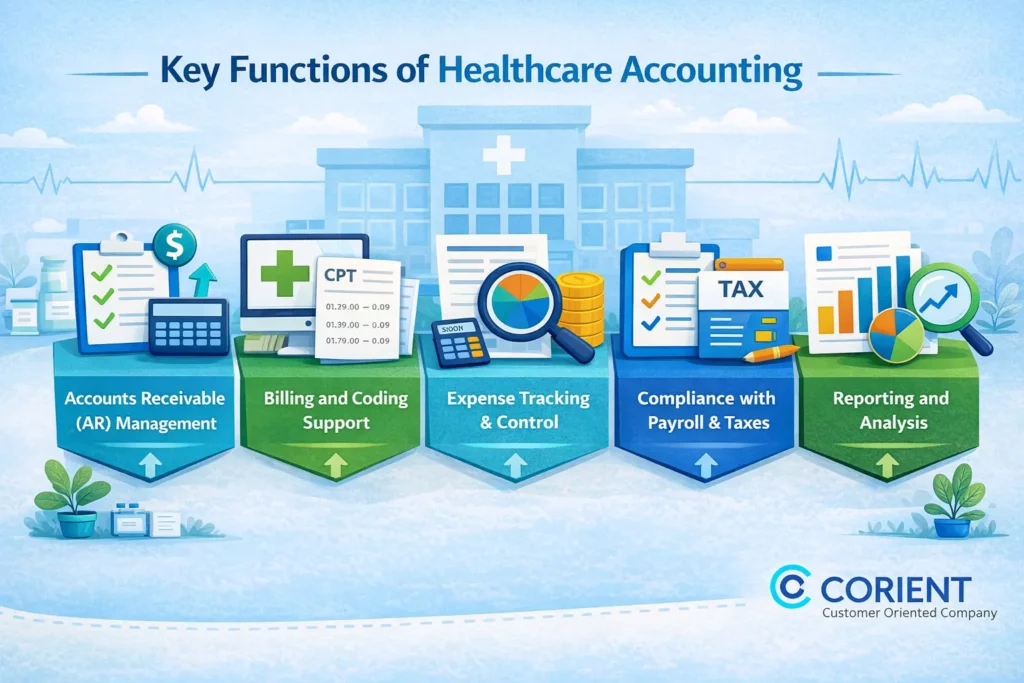
- Accounts receivable (AR) management: Monitoring payment of patients and insurance payments, recording payments, and pursuing denied or unpaid claims.
- Billing and coding support: This is to ensure that every service is coded appropriately to allow it to be billed properly to the insurers and to the patient.
- Expense tracking and control: Tracking salaries, rent, utilities, medical supplies and equipment, while monitoring procurement news to anticipate cost changes and comparing all figures against budget.
- Compliance with payroll and taxes: Payroll management, 1099s, and payroll taxes, and compliance with federal and state tax regulations with regard to the practice.
- Reporting and analysis: Making monthly and quarterly reports and dashboards to the owners and managers.
These functions assist practices in ensuring a good flow of cash, preventing unnecessary and expensive overpayments, and ensuring that they meet the stipulated deadlines when filling regulatory filings.
Revenue Cycle Management (RCM) — The Financial Heartbeat
Revenue cycle management (RCM) refers to the activity that begins when a patient makes an appointment and concludes when the practice gets the full amount of the payment made by the patient or the insurance company. RCM includes:
- Registration of patients and insurance check.
- Coding and charge entry
- Filing of claims against insurers.
- Posting and reconciliation of payment.
- Denial management and follow up.
Efficient RCM is a core pillar of healthcare financial management, leading to fewer claim denials, faster reimbursements, and better predictability of cash-flow. Automation and dashboards are also applied in the best-practice RCM to monitor the most important metrics such as days in accounts receivable and denial rates to ensure that practices can respond swiftly to non-performance.
Regulatory Compliance Every Healthcare Business Must Know
Numerous regulations that influence the billing and recording as well as storage of financial information are obligatory to healthcare providers. In the US, these can include:
- Tax laws and reporting requirements of the federal and state.
- False Claims Act and regulations concerning up-coding and fraud billing.
- Patient-related financial data-privacy regulations in the HIPAA fashion.
- Medicare, Medicaid and policies of commercial payers that regulates the way claims have to be documented.
A skilled Healthcare Accountant ensure that all transactions are recorded and coded and kept in auditing form. Inadequate accounting may result in recap, fines or even withdrawal of government programs, that is why most of the practices prefer to engage specialized accounting partners in healthcare.
Financial Statements Healthcare Organizations Must Maintain
Sound healthcare bookkeeping requires every medical practice to produce and analyze three basic financial statements on a regular basis. –
- Income statement (profit and loss): This statement displays revenues, expenditure, and net income or loss within a time. This assists owners in determining whether the practice is profitable on a service line or a department.
- Balance sheet: Records the assets, liabilities, and equity on a date and time, which is a source of information on the financial status of the practice.
- Cash-flow statement: The statement tracks cash inflows and outflows, and this indicates whether the practice is viable to meet the operating expenses and debt obligations.
Such reports are needed on a monthly or quarterly basis and discussed with the management to identify the trend early before it is too late like increasing balances of bad-debts or decreasing margins. This can be even more actionable by having dashboards summarizing the important performance indicators.
Budgeting and Cost Management
In healthcare finance, budgeting can be defined as predicting the number of patients, insurance payments and operating expenses and comparing the actual performance with the predicted performance. Best practices include:
- Splitting budgets into expense categories (staff, supplies, equipment, rent, marketing) in order to identify spending in an overspending budget in a short time.
- Industry-based benchmarking Benchmarking their overhead against industry norms that is 50 to 70% gross revenue of specialty, size.
- Enforcing multi-signature approval for large purchases and staying informed on procurement news helps prevent impulsive buying such as unplanned equipment orders.
Cost management is a complement of budgeting since it analyses the services that consume the greatest resources and the profitability of the services. The analysis can inform the decisions to include renegotiating vendor agreements, like changing the number of staff or eliminating low-margin services.
Key Financial KPIs to Track
Monitoring major financial KPIs can assist healthcare practices to transition to proactive rather than reactive management. The key KPIs are:
- Days cash on hand: This shows the number of days the practice can meet its expenses using the cash at hand. A period of more than 30-60 days is mostly regarded as healthy.
- Operating profit margin: Net profit or Revenue it should be constant, which is a sign of good pricing and cost management.
- Accounts receivables days: The average time it takes to collect it; the lower the better you convert cash.
- Claim Denial Rate: The percentage of got-denied claims by insurers; high-rate indicates the problem with coding or documentation.
Top Challenges in Healthcare Accounting
The accounting for healthcare services is complex, and the processes are exposed to a number of recurrent issues:
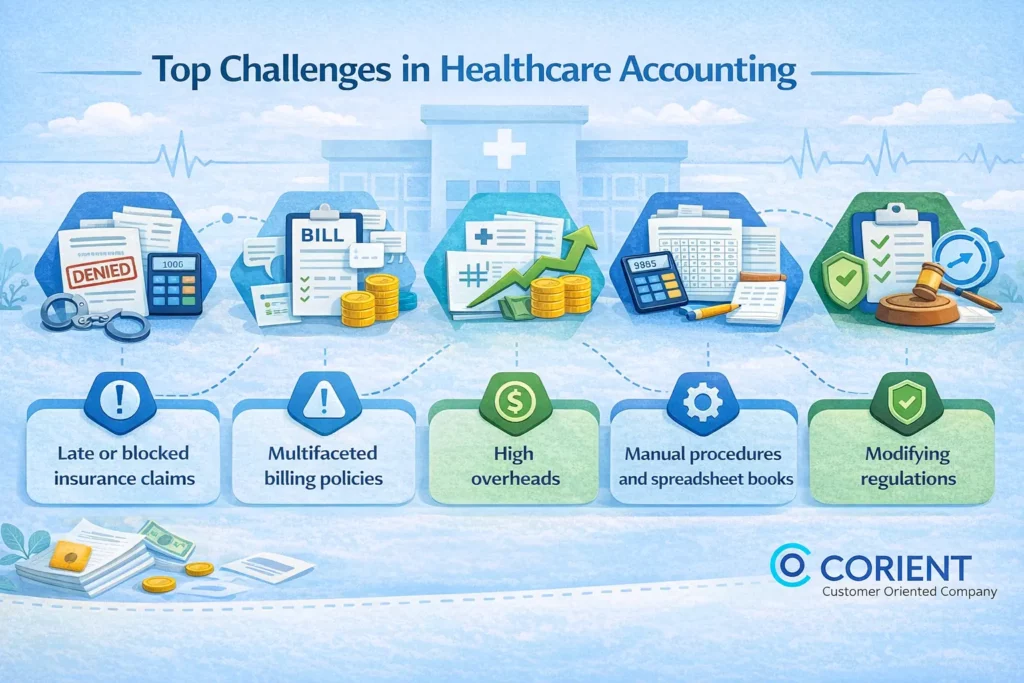
- Late or blocked insurance claims: Insurance companies can pay less or deny claims because of coding mistakes or lack of documentation.
- Multifaceted billing policies: It is difficult to standardize billing as a variety of payers have various requirements.
- High overheads: Staffing, equipment’s and compliance expenses will eat up significant revenues.
- Manual procedures and spreadsheets books: These are prone to error and slow to extend with increase in practice.
- Modifying regulations: The tax, billing, and privacy regulations are constantly changing and keeping up with procurement news is equally important for managing supply chain costs and vendor relationships.
These pitfalls may cause a lack of cash-flow, regulatory fines, and even termination of the practice.
Benefits of Professional Healthcare Accounting
Outsourcing or employing professional medical accounting support offers the following advantages:
- Better management of cash-flow: Accurate, timely billing and receivables follow-up decreases the time lag in developing service delivery and payment.
- Reduced billing errors and rejections: Seasoned accountants and coders assist in making claims clean and well documented.
- Compliance and Audit support: Professional firms will remain in touch with the regulatory requirements and may assist in preparing to be audited.
- Clinician time savings: Doctors and managers will be able to spend time on patients, and the figures on the numbers will be taken care of by accounting specialists.
These advantages come in the form of increased profitability, less risk and long-term sustainability.
Why Healthcare Accounting Services the Corient Advantage
Corient Business solution provides healthcare accounting and financial-management services to clinics, hospitals, and diagnostic centers specifically. The expertise of our team in accounting is combined with the knowledge of the healthcare working processes, payment regulations, and regulatory settings with Corient Inc, practices gain:
- Proper and current bookkeeping and Account Receivable management.
- Efficient revenue cycle operations and decreased denials.
- Periodical budgeting and KPI dashboards.
- Support of tax, billing and privacy regulations.
Through the collaboration with Corient Business Solution, healthcare providers will be able to be financially healthy and highly efficient in its operations and concentrate on providing high-quality care.
What to Look for in a Healthcare Accounting Partner
There are some key aspects to look for when selecting a healthcare accounting partner. First look for firms that have experience in medical practice accounting and a track record of working with medical practices, hospitals, or similar laboratories. Secondly, your healthcare accounting partner should have knowledge of revenue cycle management (RCM) and billing.
Thirdly, your healthcare accounting partner should be aware of the importance of complying with HIPAA-style data privacy laws, as well as tax laws and billing laws. Fourthly, your healthcare accounting partner should have access to modern accounting software that can be integrated with your existing electronic healthcare records system, and should also stay with procurement news to help make well-informed purchasing and vendor decisions.
Finally, it is important to look for the quality of services provided. It is important to look for a healthcare accounting partner that provides more than just data entry services.
Ready to strengthen your practice’s financial health? Contact Corient today for a free consultation and let our healthcare accounting experts handle the numbers while you focus on your patients. Connect us!
People Also Ask:
What is the difference between general accounting and healthcare accounting?
Healthcare accounting is based on the general accounting principles; however, it also includes insurance-based billing, recognition of patient revenue, and compliance requirements specific to the field of healthcare.
Why do small clinics need professional healthcare accounting services?
Small clinics deal with a variety of payers, late payments and complicated compliance regulations. This results in claim denials, cash flow gaps and audit risk without the support of specialists.
What financial reports should a healthcare practice review regularly?
Monthly sales statements of income, balance sheet, cash flow statements – and KPI dashboards of accounts receivable days and claim denial rates.
How often should a practice reconcile its accounts?
At least monthly for bank and insurance accounts, and weekly or biweekly for high-volume payers.
Can healthcare accounting help reduce operating costs?
Yes, it recognizes waste, underscores low-margin services and reveals chances to renegotiate vendor contracts.
Conclusion
Being in a medical practice is stressful when you are not even being slowed down by financial pressures. Healthcare financial management goes for beyond simple bookkeeping, it also ensures that your billing is correct, cash flow is maintained, informed awareness of procurement news and your practice is in compliance with its constantly evolving regulations.
Corient collaborates with clinics and hospitals to streamline the financial management process, enhance reporting, and release your time to do what is important in your life, your patients. We are here to assist you whether you are in need of increasing profitability, minimizing errors or simply acquiring peace of mind. Contact Corient today and schedule a free consultation and make the first step towards having a practice that is financially stronger.