

In 2026, the energy industry is no longer just about moving commodities; it’s about moving data. Whether you are managing a portfolio of renewable assets, overseeing a traditional utility, or navigating the complexities of oil and gas exploration, your financial health is inextricably linked to how well you track your energy flow.
As global regulations around carbon disclosure tighten and the energy mix becomes more decentralized, spreadsheets are no longer a viable solution. Enter Energy Accounting Software—a specialized breed of technology designed to handle the high-volume, high-volatility nature of the energy sector. This blog dives into the top software packages available today, transforming raw data into a strategic financial advantage with optimized Energy Accounting Software for energy companies.
What Should You Look for in Energy Management Software?
The needs of the energy sector go far beyond what a generic accounting platform like QuickBooks can offer. When evaluating Energy Accounting Software, certain non-negotiable features separate a simple ledger from a powerhouse business tool.
Key Features and Benefits
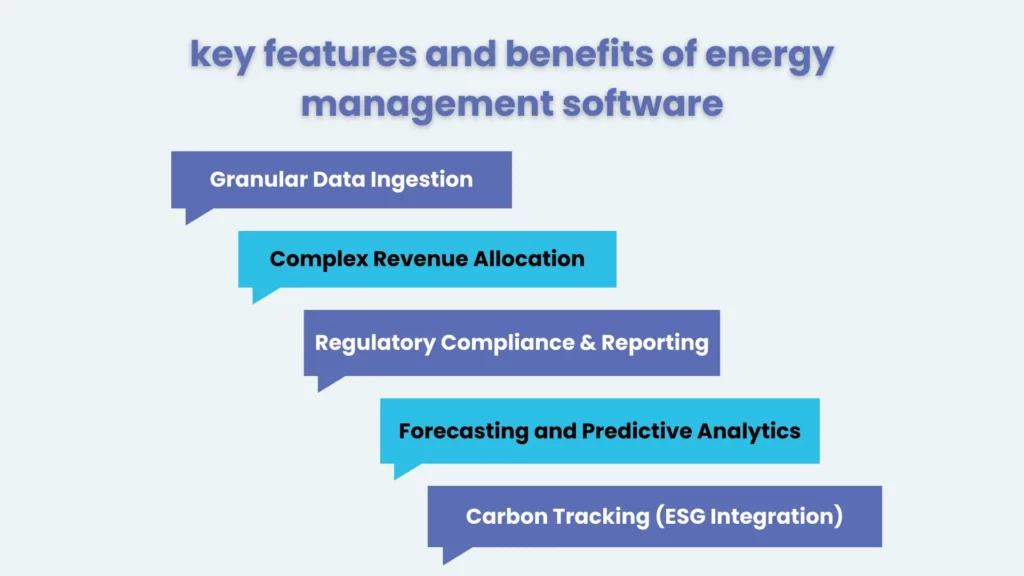
- Granular Data Ingestion: The ability to pull data directly from smart meters, IoT devices, and utility bills without manual entry.
- Complex Revenue Allocation: In the energy business, a single asset can have several owners. The software should be able to automatically deal with Joint Interest Billing (JIB) and Revenue Distribution.
- Regulatory Compliance & Reporting: Built-in templates for FERC, SEC, and international sustainability standards (like CSRD or TCFD) can help while accounting for energy companies.
- Forecasting and Predictive Analytics: Predictive analytics is the prediction of energy spend and production forecasting based on the historical data that can be used for better hedging and risk management decisions.
- Carbon Tracking (ESG Integration): Modern energy accounting should be able to correlate dollars spent to carbon emissions. This will provide a “Double Bottom Line” of financial and environmental impact.
Top 5 Energy Accounting Software Options in 2026
The landscape of energy accounting has matured significantly. Here are the five leading platforms that are defining the industry standard this year while Energy Sector Accounting.
1.EnergyCAP
EnergyCAP remains the gold standard for utility management and carbon accounting. It is particularly strong for organizations managing large building portfolios or government entities that need to audit every penny of their utility spend.
2.Workiva
Workiva is the powerhouse of narrative reporting. While it handles the numbers, its real strength lies in connecting financial data to the complex “story” energy companies must tell in their annual and ESG reports.
3.Microsoft Cloud for Sustainability
Leveraging the power of the Azure ecosystem, Microsoft has built a platform that allows energy companies to unify data from across their entire enterprise. It is the go-to for firms already heavily invested in the Microsoft 365 stack.
4.Simatic Software (Siemens)
Siemens Simatic is the choice for industrial energy accounting. It bridges the gap between the factory floor (OT) and the finance office (IT), making it ideal for manufacturing-heavy energy producers.
5.GridPoint
GridPoint focuses on the “edge” of the energy world. It excels at managing decentralised assets and provides deep visibility into site-level performance, making it a favorite for retail and multi-site commercial energy users.
Comparison Table: Pros & Cons
| Software | Best For | Pros | Cons |
| EnergyCAP | Utility & Carbon Accounting | Superior bill auditing; great automated data capture; long industry track record. | Can be complex to set up for smaller entities; focused primarily on consumption. |
| Workiva | Enterprise Disclosure | Best-in-class for SEC & ESG reporting; audit-ready “traceability” from data to report. | Higher price point; requires existing data sources (not a data collector itself). |
| Microsoft Cloud | Integrated IT Estates | Seamless integration with Power BI and Azure; highly scalable for global firms. | Requires a high level of technical expertise to customise and deploy fully. |
| Simatic (Siemens) | Industrial Operations | Real-time monitoring of industrial processes; strong link between production and cost. | Harder to use for non-industrial administrative energy management. |
| GridPoint | Multi-site Commercial | Excellent IoT integration; focuses on immediate cost reduction and site control. | Less focused on the “Corporate Finance” side of joint venture accounting. |
Common Challenges When Implementing Energy Accounting Software
Switching to a specialised energy accounting platform is a game-changer while Energy Sector Accounting, but the transition isn’t always smooth.
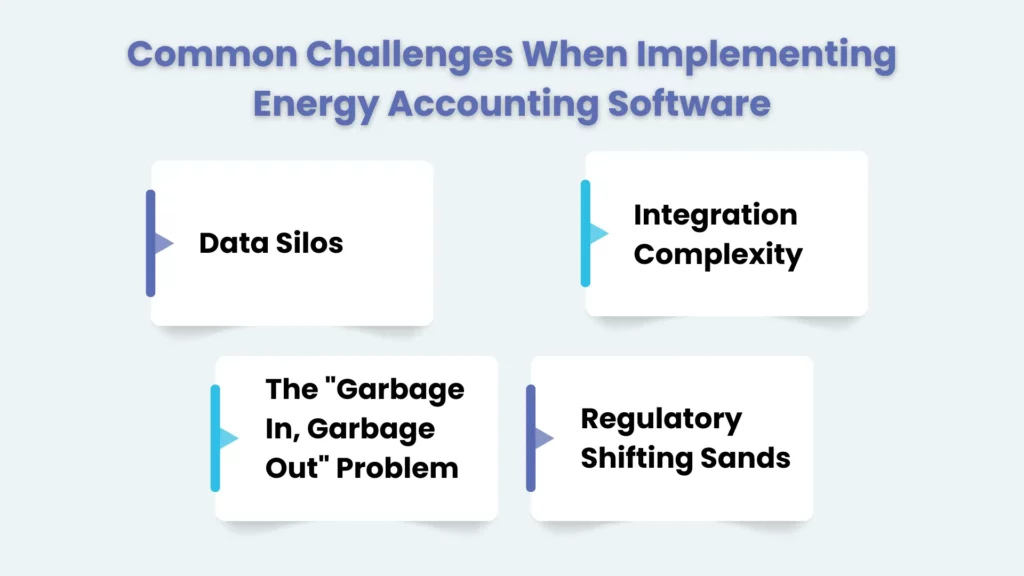
- Data Silos: Often, production data lives in the field (with engineers) while cost data lives in the office (with accountants). Getting these systems to “talk” to each other is the biggest hurdle.
- Integration Complexity: Many energy firms use legacy ERPs that are decades old. Mapping these to a modern, cloud-based energy platform requires careful architecture.
- The “Garbage In, Garbage Out” Problem: Your field meters are not calibrated, or your billing information is not consistent, your most expensive software in the world will not provide valid answers.
- Regulatory Shifting Sands: The software needs to be regularly upgraded to provide the adjustment to the changing carbon tax regulations and local utility rate versions.
How to Choose the Right Energy Accounting Software?
The selection of software does not deal with the best software, but the best that fits your operational model while Energy Sector Accounting.
- Define Your Scope: Are you an upstream producer needing JIB? A midstream distributor needing volume tracking? Or a consumer looking to cut utility costs?
- Evaluate Integration: Does it play nice with your current ERP (like SAP, Oracle, or Microsoft Dynamics)?
- Check the Audit Trail: An audit is no longer an option in the energy industry; it is a necessity. Make sure that the software gives a cradle-to-grave trail of all transactions.
- Prioritise User Adoption: When the field team cannot enter data into the software because it is too complicated, then your accounting will be lagging behind.
Why Choose Corient?
Navigating this software maze is where Corient adds immense value. We don’t just recommend a package; we act as your strategic advisor. Corient works closely with energy companies to identify the right software solution, aligning it with your unique business processes and strict compliance requirements.
Whether you are looking to automate your utility bill processing or need a full-scale ERP overhaul for a renewable energy startup, our team ensures that the technology you choose actually delivers the ROI you expect.
People Also Ask
What software do energy managers use?
Energy Management Systems (EMS) such as EnergyCAP or GridPoint are usually used by the energy managers to monitor the real-time usage, audit utility bills and measure their sustainability targets.
How much does energy management software cost?
Costs vary wildly based on the number of meters or sites. The small-scale solutions can begin with a few thousand dollars per year, whereas the platform at the enterprise levels of global companies can cost over six figures.
Which features are most important in accounting software?
For the energy sector, automated ingestion of data, the ability to record a joint venture, and integrated reporting of carbon are the most important features.
What software is used for energy auditing?
For auditing purposes specialised tools such as EnergyCAP or Siemens Simatic are generally used to determine the billing mistakes and operational inefficiencies.
Which software tools integrate with energy management software?
The majority of the current platforms can be connected to major ERPs (SAP, NetSuite), BI tools (Power BI, Tableau), and smart meter platforms to form a single data ecosystem.
Conclusion
The energy industry is at a crossroads where financial transparency and operational efficiency must coexist. The right energy accounting software does not just keep a record of transactions, but it also gives visibility to survive in the low-carbon and high-volatility economy.
We at Corient specialise in offering premium finance and accounting services, which help energy companies to remain on the frontier. From software selection and implementation to ongoing financial management, we ensure your back office is as efficient as your power generation.