



Most businesses fail not because they stop selling and they fail because the money stops moving in the right direction, and the right time. A full pipeline doesn’t necessarily mean a full bank account. If your money is stuck in unpaid invoices, excess inventory, or unnecessary expenses, the business might look healthy until it doesn’t. Cash Flow Management makes sure that a business has the ability to view, manage, and make decisions about the money in the business; this allows them to take a risk regardless of whether the company is experiencing dull period or an upward surge this is the core of cash management.
This tutorial will cover everything you need to know regarding cash flow management techniques from successful companies, regardless of whether they are leveraging AI or cash conversion cycle.
What is cash flow management?
Cash flow management involves the tracking, analysis, and optimization of the flow of money coming in and going out of the business. A strong cash flow strategy ensures these movements align with business goals.
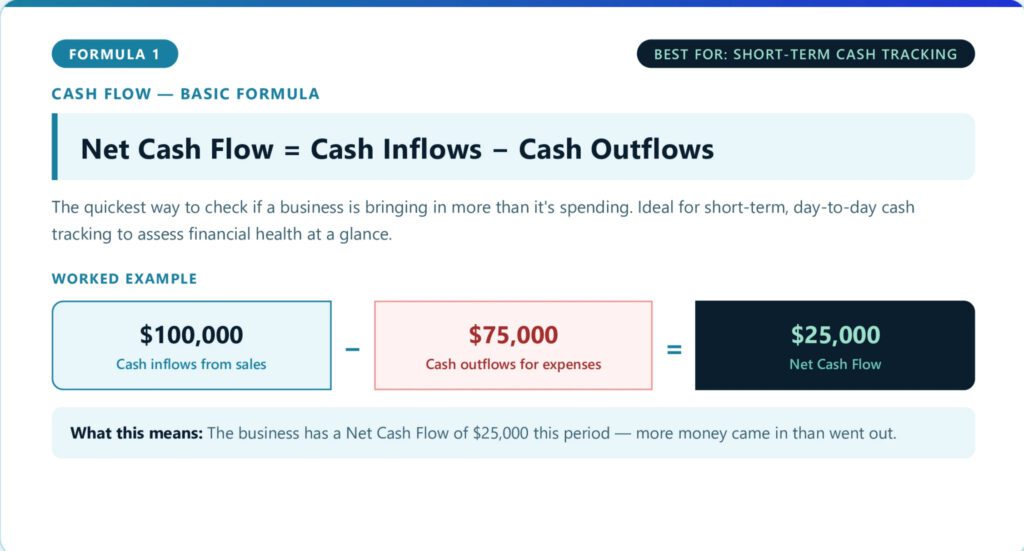
This formula offers a simple way to calculate net cash flow, ideal for short-term tracking to assess if a business generates enough cash to cover its costs.
There are three types of cash flow in business:
• Operating Cash – the flow of money from business operations such as sales and expenses.
• Investing Cash – the flow of money from assets or investments.
• Financing Cash – the flow of money from loans or debt.
This formula breaks down cash flow into operating, investing, and financing activities, helping with detailed financial analysis and reporting to understand money flow in the business.
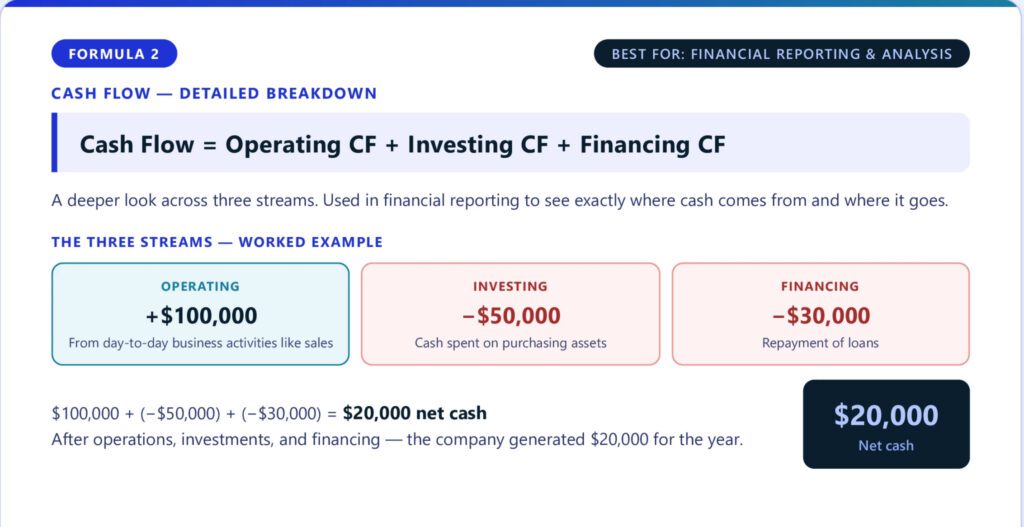
By tracking all three, business owners practicing effective cash flow management get a complete picture of where money is coming from and where it is going. For example, even a profitable business can suffer a liquidity crisis if clients are not paying on time — a gap that no cash flow strategy can afford to ignore. Cash flow management is not just accounting; it is the intelligence behind every sound business decision.
Why is Cash Flow Management Important for Businesses?
Cash flow management is the foundation of business survival and growth. Without a deliberate cash flow strategy, the risks compound quickly. In fact, 82% of business failures are caused by cash flow management problems — most often slow accounts receivable or poorly structured accounts payable — not by weak products or bad markets.
A business with a strong cash flow strategy does not just survive downturns — it uses them as opportunities while underprepared competitors struggle. That distinction is almost always built on disciplined cash flow management practiced consistently over time.
How to manage cash flow?
Four core habits make the difference:
- Monitor constantly – track inflows and outflows weekly to maintain control over managing cash flow.
- Forecast ahead – project cash 3–6 months out
- Accelerate collections – use early-payment discounts
- Control outflows – cut waste, extend supplier terms, and keep a 3-month cash reserve
These habits turn cash flow from a reactive worry into a proactive growth strategy.
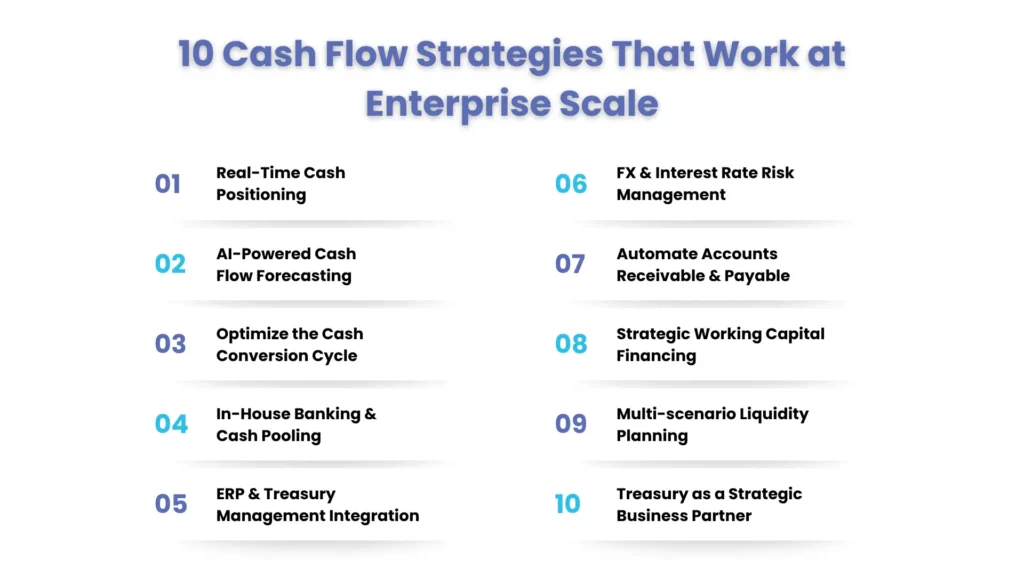
10 Cash Flow Strategies That Work at Enterprise Scale
When cash flow breaks down, the fallout happens faster than most businesses expect.
A missed supplier payment strains the relationship. A few more and supplies dry up entirely. To plug the gap, businesses reach for credit — which helps short-term but quietly builds a debt load that compounds every month. Inside the business, delayed payroll hits morale hard, and a disengaged team is rarely a productive one.
Most businesses don’t fail because their idea was wrong. According to a U.S. Bank study, 82% of US business failures come down to one thing — running out of cash.
Strategy 1: Real-Time Cash Positioning
Combines real-time bank positions from all accounts, currencies, and legal entities on one screen. Avoids delays due to manual matching and allows treasurers to deploy excess cash or manage liabilities instantly strong order to cash process ensures invoices move quickly into cash.
Strategy 2: AI-Powered Cash Flow Forecasting
Uses machine learning technology to evaluate past account payable, receivable, and seasonal data using probabilistic cash flow curves instead of traditional spreadsheets. This helps build a better approach towards handling cash flow management software over periods of 13 weeks and 12 months.
Strategy 3: Optimize the Cash Conversion Cycle
Works on three fronts by accelerating DSO through invoicing, extending DPO via negotiation, and lowering DIO using demand-driven supply chain management practices.
Strategy 4: In-House Banking & Cash Pooling
Establishes an internal bank by creating a centralized account where subsidiary balances are swept virtually or physically. Balances from subsidiaries with excess funds are used to cover those with shortages, thus saving on borrowing costs externally and earning maximum interest on netted balances.
Strategy 5: ERP & Treasury Management Integration And TMS
The ERP system is integrated with a TMS in such a way that all payments, bank statements, and general ledger postings are done automatically without using spreadsheets. It eliminates manual transfers of information from one system to another.
Strategy 6: FX & Interest Rate Risk Management
The company identifies the natural offsets in foreign exchange and interest rates. It uses forwards, options, and swaps to manage the remaining risks up to a point agreed upon by the board of directors.
Strategy 7: Automate Accounts Receivable & Payable
Utilizes and automates Accounts Receivable / Accounts Payable processes, eliminating manual touch-points and accelerating the order to cash process. The use of e-invoicing, auto-matching and automated approval processes reduce delay; dynamic discounting assists treasurers make decisions on whether they should make an early payment or retain their cash balance.
Why AP accuracy matters as much as AR speed: How 3-Way Matching in Accounts Payable Prevents Invoice Errors and Fraud
Strategy 8: Strategic Working Capital Financing
Selects from amongst supply chain finance, receivable factoring, revolvers, or commercial paper depending on cost, tenor, and flexibility of each funding alternative. Using multiple funding sources eliminates concentration risks and helps ensure funding is available when markets get stressed.
Strategy 9: Multi-scenario Liquidity Planning
Develops no less than three liquidity scenarios base, stressed and severely stressed – based on parametric assumptions of revenue, credit and market shocks. Negotiates contingency funding solutions upfront, such that liquidity management can be implemented in hours and not days.
Strategy 10: Treasury as a Strategic Business
Partner Seats treasury at the decision-making table during M&A evaluations, capital allocations, and business expansion discussions. Treasury can provide strategic modeling, financing, and risk quantification capabilities in order to execute on strategy.
The KPIs That Actually Tell You How You’re Doing
Is your business tracking its cash flow KPIs effectively? Let’s discuss how you can improve it!
Enterprise-Level Cash Flow Key Performance Indicators That the C-Suite Should Track
It is essential for any U.S. company to have a small set of flow key performance indicators that would link everyday performance with strategic issues of liquidity management and growth. Below we discuss some of the most important indicators that would help executives to keep track of financial sustainability, effective working capital management, and resilience in general.
According to the Association for Financial Professionals (AFP), best-in-class treasury functions track cash flow metrics in real time — not at quarter-end when it’s too late to act.
| Cash Flow KPI | What It Measures | Why the C-Suite Should Track It |
| Operating Cash Flow (OCF) | Cash generated from core business operations before interest and taxes | Shows whether the business is self-funding. Persistent negative OCF signals a cash flow management problem |
| Free Cash Flow (FCF) | OCF minus capital expenditures (CapEx) | Indicates how much cash is available for growth, dividends, debt reduction, or strategic investments — critical for capital-allocation decisions |
| Days Sales Outstanding (DSO) | Average days to collect payment from customers | High DSO slows cash recovery and can strain liquidity; it also reflects credit risk and collection efficiency |
| Days Payable Outstanding (DPO) | Average days the company takes to pay suppliers | Balances liquidity (longer DPO = more cash on hand) with supplier relationships and supply-chain stability |
| Days Inventory Outstanding (DIO) | Average days inventory is held before being sold | High DIO ties up working capital and increases obsolescence risk; low DIO improves cash-flow efficiency |
| Cash Conversion Cycle (CCC) | DSO + DIO − DPO | Measures how quickly the business converts cash into inventory, sales, and back into cash. Shorter CCC = better working-capital health |
| OCF / Revenue | Ratio of operating cash flow to total revenue | Shows how much of each revenue dollar converts into real cash, not just accounting profit |
| Cash Flow Coverage Ratio | OCF divided by total debt service (interest + principal) | Assesses whether the company generates enough cash to service its debt — key for lenders and rating agencies |
| Cash Burn Rate | Rate of monthly cash consumption during loss-making or high-investment phases | Critical for high-growth or early-stage firms to understand runway and when to raise capital or cut costs |
| Cash Reserve / Liquidity Ratio | Highly liquid assets divided by short-term liabilities | Shows ability to meet immediate obligations during shocks; a strong buffer supports ESG-related transition costs and volatility |
Tracking these well starts with a clean monthly close: The Complete Month End Close Checklist
What are the Cash Flow Management Software is Available?
| Software | Best For |
| Cash Flow Frog / Float | Short-term forecasting and cash tracking |
| Fathom | Budgeting and scenario planning for growing businesses |
| HighRadius / Kyriba | Enterprise-level treasury and risk management |
| QuickBooks / Sage | Teams that want cash flow built into their existing accounting tool |
The ideal software helps organizations develop forecasts, scenarios, and liquidity decisions associated with ESG.
Common Cash Flow Mistakes to Avoid
Miscalculations in cash flow can rapidly jeopardize liquidity, despite positive earnings. Companies often regard flow strategy and managing cash as secondary.
- A business can be profitable and still face a cash flow management crisis if timing is misaligned
- Slow payment collection and poor credit management reduce cash flow despite high sales volumes.
- Overly optimistic or stale forecasts lead to unanticipated cash shortages.
- Early payments to vendors or improper payment terms affect working capital negatively.
- Excessive inventories consume cash while increasing chances of obsolescence.
- The absence of cash reserve leaves the company vulnerable to emergencies and ESG-driven transition risks.
- The manual application of cash flow management software like Excel is prone to errors; utilizing specialized software enhances precision.
Considering cash flow strategy and managing cash as crucial elements, alongside a competent accounting partner, allows companies to safeguard their liquidity and foster sustainable development.
People Also Ask:
How could accountancy firms include cash flow analysis within a client’s audit and advisory services?
Firms should evaluate forecasts, verify important KPIs, and ensure that information about liquidity and risks linked to ESG meets actual figures and accounting principles.
What is the partner’s responsibility in regard to cash flow plans that align with ESG criteria?
The partner should view ESG initiatives as investments and manage capital allocation, verify ESG-linked KPIs, and make sure that ESG-related financing and reporting comply with US standards.
Which cash flow KPIs must be analyzed by accounting firms when advising US companies?
The list includes such indicators as OCF, FCF, DSO, DPO, DIO, CCC, cash flow coverage ratio, and cash burn rate.
How should accountants apply cash flow software in their work?
Accountants can use Cash Flow Frog, Float, Fathom, and TMS systems to examine forecasts, cross-check software results with figures from GLs, and improve their auditing and advisory services.
Which mistakes can auditors make while verifying cash flow disclosures of US companies?
Mistakes may include improper classification of cash flows, misalignment of KPIs, excessively optimistic forecasts, and inadequate disclosures related to climate change or ESG.
Conclusion:
Cash flow management done well is not about being conservative — it’s about having the visibility and the tools to make smart, fast decisions with confidence. The enterprises that handle it best are the ones where treasury isn’t reacting to problems; they’re anticipating them, modeling options, and keeping the business in a position to move when opportunities arise.
That takes the right data, the right processes, and usually the right partners. Corient works with US enterprise finance teams to build cash management functions that actually perform — connecting AR automation, AP discipline, ERP integration, and strategic forecasting into something that works together, not in silos.