



A business based in the USA had millions of dollars running into its finance systems every month. The sales were good, orders were coming in, and business looked perfect, but something was not adding up. Its finance team noticed that cash was coming in late and multiple invoices were disputed, leading to its accounts receivable team chasing customers without clear visibility into which invoices actually required attention. This situation screams that it’s time for that business to adopt order to cash automation process.
According to the 2025 Gartner AI in Finance Survey of 183 chief financial officers (CFOs) and senior finance leaders, 58% of finance functions were using AI. Since regulators such as the Securities and Exchange Commission emphasize strong financial reporting controls, while compliance frameworks like SOX (Sarbanes-Oxley Act) require accurate revenue recognition and audit trails. Fulfilling these requirements through the manual order to cash process is virtually impossible.
Here’s where order to cash automation becomes important for your business to stay compliant and to streamline billing, cash application, credit management, and collections using technology.
In this guide, we will explore:
- Why revenue leaks happen in enterprise finance operations
- Where the Order to Cash process breaks down
- How automation fixes the most common issues
- And how accounting firms can help you in implementing scalable order to cash services
What Is Order to Cash Automation and Why Does It Matter for Big Enterprises?
Order to cash automation refers to technology that will be used for streamlining the entire revenue cycle, from customer order to payment collection.
The Order to Cash Process (O2C) typically includes:
- Order management
- Credit approval
- Invoice generation
- Payment processing
- Cash application
- Collections and dispute management
When this process is handled manually, businesses have to face delays and errors. For this reason, many have turned towards automation, which integrates data, automates workflows, and provides real-time visibility across the entire revenue cycle. For large businesses processing thousands of invoices each month, automation means significant gains. If you want the full breakdown of how each of these stages works in a B2B context, we’ve covered the complete O2C cycle.
Where Large US Enterprises Are Leaking Revenue Right Now
Order to cash automation is rapidly expanding because businesses are discovering inefficiencies in their manual order to cash processes.
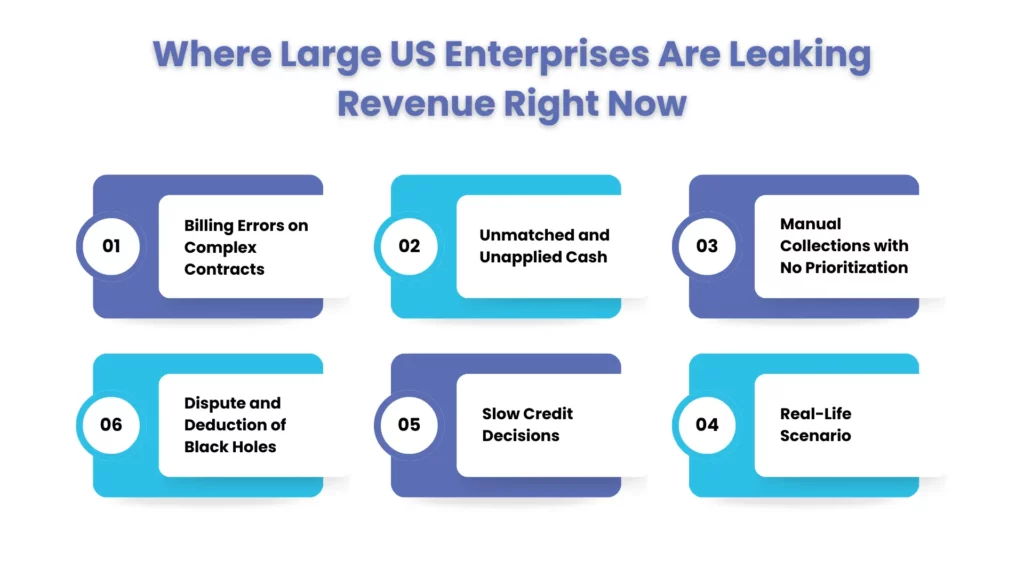
Here are some of the biggest areas where revenue leaks occur.
Billing Errors on Complex Contracts
You might come across complex contracts involving:
- Tiered pricing
- Usage-based billing
- Service agreements
- Discounts and rebates
Doing manual invoices increases the risk of errors, leading to customer disputes and delays in payments. Automation will subdue that risk and make invoice generation accurate based on the contract terms.
Billing errors often trace back to weak invoice controls upstream. Discover how 3-Way Matching in Accounts Payable prevents invoice errors before they become disputes.
Unmatched and Unapplied Cash
One of the major problems that you face while operating your business is unapplied payments.
Your customers might pay:
- Partial amounts
- Multiple invoices in a single payment
- Incorrect reference numbers
Without automation, your finance team will have to spend hours just matching payments with invoices. This matching can be done quickly using automated cash application tools.
Unapplied payments are a symptom of a wider problem. Find out how the full Accounts Payable Process impacts your cash flow accuracy.
Manual Collections with No Prioritization
It is surprising that there are still some businesses that rely on spreadsheets or email reminders to chase invoices. But not all invoices require such attention.
Automation will prioritize collections based on:
- Payment history
- Invoice value
- Customer risk profile
This improves recovery rates.
Dispute and Deduction Black Holes
There is a possibility of customer disputes getting lost in your email threads or internal systems. If you don’t know about it, how will you solve the disputes? Automations will centralize, track, and assign the ownership and push it towards faster resolution.
Slow Credit Decisioning
Approving credit manually interrupts order processing and increases risk. Using automation tools, you will be able to process customer creditworthiness in real-time, allowing faster approvals while protecting against bad debt.
Strong credit decisions start with clean financial data. Learn why businesses need Professional Accounting Services to stay ahead.
Real-Life Scenario
A large logistics company was managing thousands of invoices each month, and their finance team discovered:
- $4 million in unapplied payments
- 18% of invoices were disputed due to billing inconsistencies
- 25-day delays in collections
After implementing order to cash process automation, they reduced unapplied cash by 70% and improved collection times by nearly two weeks.
The 6 O2C Stages Where Automation Delivers the Most Impact
Adopting automation will lead to an improvement in the efficiency of all the stages of the revenue cycle.
Order Management Automation
When you automate, you will see orders getting processed automatically and directed towards the correct approval workflows. Such automation speeds up the process and eliminates errors created manually.
Credit Management Automation
Using automated credit tools, you will be in a position to analyze your customer data faster and the risk involved, thus enabling faster credit approvals while protecting your revenue.
Invoicing Automation
Generating an invoice manually is time-consuming, but when it gets automated using contract and order data, there will be a reduction in billing errors and faster payment cycles.
Cash Application Automation
The time-consuming task of matching every payment with invoices when automated using AI and payment reference data eliminates human manipulations, fraud, and errors.
Collections Automation
When reminders get automated, chances of missing out or sending timely reminders go down, leading to improved recovery rates. With the automation of reminder sending, your collection teams can concentrate on high-priority accounts. This kind of automation is also one of the fastest ways to bring down your Days Sales Outstanding without adding headcount to your AR team.
Faster collections also depend on how quickly your books close. Why Your Financial Close Process Is Delayed — And How R2R Fixes It
Dispute and Deduction Management
Automation tools track disputes and assign them to the right teams. This improves visibility and speeds up resolution.
What Order to Cash Automation Actually Costs You If You Wait
Delaying the upgradation of your order to cash services will lead to a slow degradation of your financial performance.
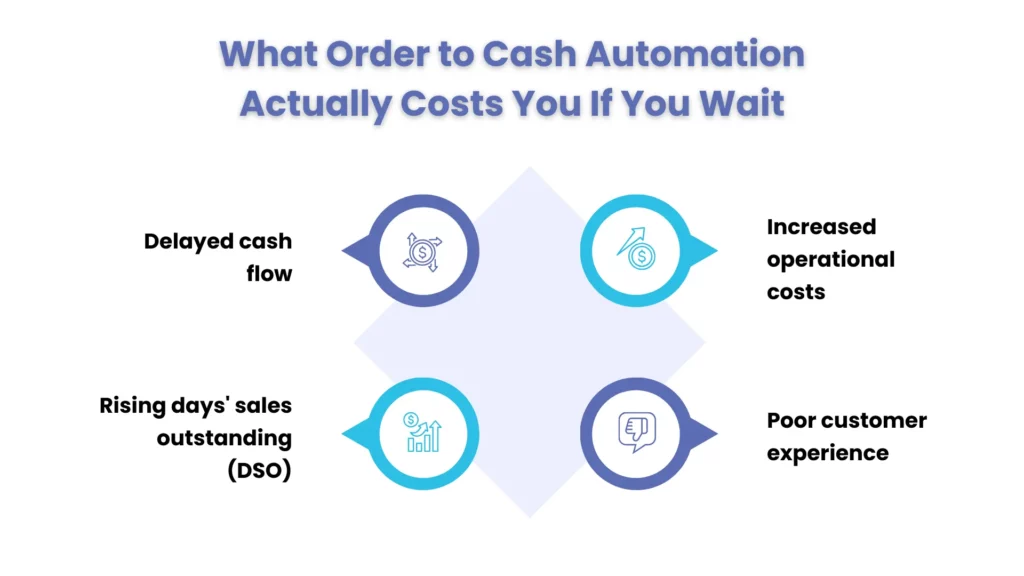
Here’s what happens when order to cash inefficiencies persist:
- Delayed cash flow
- Rising days’ sales outstanding (DSO)
- Increased operational costs
- Poor customer experience
According to Hackett Group research, top-performing companies have operated at 45% lower cost thanks to automation. In the meantime, businesses that have chosen to continue with manual order to cash services have faced higher processing costs and slower collections.
ERP Integration — The Question Every US Enterprise Finance Leader Actually Has
When it comes to automation, one thing will worry you the most: “Will this integrate with our ERP system?”
Most enterprises already operate platforms such as:
- SAP
- Oracle
- NetSuite
- Microsoft Dynamics
One business running on SAP automated its order to cash process instead of replacing its ERP system automation tool was integrated with it.
The results were:
- 60% faster cash application
- Fewer invoice disputes
- Improved working capital visibility
Modern order to cash process automation solutions integrate directly with these systems.
Signs Your Enterprise O2C Process Needs Automation Now
Businesses make the mistake of not automating their order to cash process until the moment they realize that their cash flow is slowing down. You don’t want to be in such situations.
Keep an eye on the following warning signs:
- Is your accounts receivable team spending much of its time manually matching payments?
- DSO continues to increase despite strong sales.
- Are customer disputes taking weeks to settle?
- Are errors in invoices becoming frequent?
- Finance teams rely heavily on spreadsheets.
If your accounts receivable process involves significant manual work, then it’s time to automate it. To dramatically improve your efficiency consider approaching a right accounting firm for your business.
These warning signs don’t just affect O2C — they ripple through your entire finance function. See the full picture of what automation means for your business → Finance and Accounting Services by Corient
How Our O2C Automation Services Help US Enterprises Stop the Leaks
At Corient, we help US businesses in modernizing their revenue cycle using intelligent automation and scalable finance operations. Our order to cash services combine automation technology with experienced finance professionals.
Our services include:
- Automated invoicing workflows
- AI-driven cash application
- Collections management automation
- Dispute tracking and resolution
- Credit risk monitoring
- ERP integration support
By combining automation with expert finance teams, we will help you:
- Accelerating your cash collection
- Reducing your revenue leakage
- Improving financial visibility
- Strengthening your compliance and reporting
This hybrid approach allows you to implement automation without disrupting the existing finance system.
Choosing the right tools matters just as much as the process. Explore the 10 Best Financial Reporting Tools for 2026
Ready to Stop Revenue Leakage for Good?
Corient’s Order to Cash experts help US enterprises automate billing, collections, and cash application — without disrupting your existing ERP setup.
What is the cause of revenue leakage?
Typical causes include billing errors, poor contract management, pricing issues, and weak communication.
What are the challenges in order to cash process?
Some of the major challenges in order to cash process are:
• Manual data entry and re-keying errors
• System silos and fragmented data
• Complex billing and mid-contract amendments
• Delayed anomaly detection and error remediation
• Time-consuming reconciliations
• Compliance and audit headaches
• Lack of visibility across the revenue cycle
Can automation reduce accounts receivable workload?
Yes. Automation significantly reduces manual work in accounts receivables, allowing finance teams to focus on analysis and strategic decision-making.
Conclusion
For many businesses, the order to cash process silently determines financial performance. When it is manual and fragmented, the revenue leaks occur. These leaks could be billing errors, delayed collections, or inefficient accounts receivable management.
By automating the order to cash process, you can fix these issues and streamline the billing, payments, collections, and dispute resolution. The result is faster cash flow, improved financial accuracy, and better customer relationships.
If you are looking to scale efficiently, modernizing the order to cash process is no longer optional, so fill out our contact form and get your entire process automated now.