



You’ve set up your store, your products are ready, and your first order is just around the corner. Then comes the message: “Please complete your GST registration to activate your seller account.”
If that left you confused, you’re not alone. GST for online sellers in India works differently from offline businesses — and most first-time sellers find out the hard way. This guide to GST for online sellers covers registration rules, TCS, return filing, ITC, and the mistakes that quietly cost sellers money — in plain terms, no jargon.
Do You Actually Need to Register for GST?
The Online Seller Rule Is Different From Offline
The most important thing to understand about GST for online sellers is that registration rules are stricter than most people expect. Offline businesses register only after crossing ₹40 lakh turnover. Online sellers don’t get that buffer.
| Seller Type | GST Registration Required When |
| Offline business | Turnover exceeds ₹40 lakh (₹20 lakh for services) |
| Marketplace seller (Amazon, Flipkart, Meesho) | From the very first sale — no threshold |
| D2C website-only seller | Turnover exceeds ₹20 lakh |
| Website + marketplace seller | Mandatory from first marketplace sale |
For a complete picture of everything your business must file and track once registered — returns, ITC deadlines, and year-end tasks — refer to our GST compliance checklist for finance teams.
Under Section 24(ix) of the CGST Act, anyone selling through an e-commerce operator must register for GST regardless of turnover. Your marketplace will not activate your account without a valid GSTIN — no exceptions.
For Example;
Priya sells handmade jewellery on Meesho. Her first month’s sales total ₹8,000 — well below any threshold. Meesho still withholds her payout until she submits a valid GSTIN. For GST for online sellers, turnover is completely irrelevant when a marketplace is involved.
What About D2C Sellers on Their Own Website?
If you sell only through your own Shopify or WooCommerce store, the ₹20 lakh threshold applies. But the moment you also list on any marketplace, e-commerce GST registration becomes mandatory immediately, regardless of where most of your revenue comes from.
How GST Actually Works When You Sell Online
Once you’re registered and selling, GST for online sellers doesn’t operate the same way as it does for a shop owner. There’s an additional layer called TCS, and it directly affects what lands in your bank account every month.
What Is TCS Under GST — And Why It Affects Your Payouts
Every marketplace deducts 1% TCS from your settlement before paying you — this is mandated under Section 52 of the CGST Act, which requires all e-commerce operators to collect tax at source on net taxable supplies. This money goes to the government under your GSTIN — and you can claim it back as a credit when filing GSTR-3B.
Example; TCS Calculation:
| Detail | Amount |
| Gross Sales on Flipkart | ₹2,00,000 |
| TCS Deducted @ 1% | ₹2,000 |
| Platform Commission @ 10% | ₹20,000 |
| Net Payout Received | ₹1,78,000 |
| TCS Credit Claimable in GSTR-3B | ₹2,000 |
Rohit doesn’t lose that ₹2,000 — it offsets his monthly GST liability. But if he forgets to claim it, he’s paying more tax than he owes.
IGST vs CGST/SGST — Which Applies to Your Sale?
| Transaction | Example | Tax Applied |
| Seller and buyer in same state | Mumbai seller → Pune buyer | CGST + SGST |
| Seller and buyer in different states | Delhi seller → Chennai buyer | IGST |
| FBA warehouse ships across states | Stock in Bengaluru → Hyderabad buyer | IGST |
For Example;
Sneha (registered in Gujarat) sells a ₹1,500 pressure cooker (12% GST) to a buyer in Rajasthan. IGST at 12% = ₹180 applies. If she mistakenly applies CGST/SGST instead, she attracts 18% interest on the misclassified amount — even though the total tax value is identical. Getting this right is a core part of GST for online sellers selling pan-India.
The GST Composition Scheme — Not for Marketplace Sellers
| Feature | Regular Scheme | Composition Scheme |
| Filing frequency | Monthly | Quarterly |
| ITC eligibility | Yes | No |
| Marketplace sellers eligible | Yes | No |
| D2C website-only sellers | Yes | If under ₹1.5 crore turnover |
Section 10(2)(d) of the CGST Act bars marketplace sellers from using the Composition Scheme entirely. The CBIC’s official FAQ on e-commerce confirms that threshold exemptions do not apply to marketplace sellers covered under Section 52.
GST Returns — What You Need to File Every Month
A part of GST for online sellers that catches many off guard — compliance isn’t a one-time registration. It’s an ongoing monthly process.
The Two Returns Every Online Seller Files
| Return | What It Covers | Due Date | Late Fee |
| GSTR-1 | All outward sales invoices | 11th of following month | ₹200/day |
| GSTR-3B | Net GST liability, TCS credit, ITC claim, payment | 20th of following month | 18% interest + late fee |
Both must be filed every month, even if your sales were zero.
For Example:
Rohan misses his October GSTR-1 by 10 days. He pays ₹2,000 in late fees — and his B2B buyers can’t see his invoices in their GSTR-2B, triggering disputes that take days to resolve.
The Reconciliation Step Most Sellers Skip
This is the most overlooked part of e-commerce GST compliance. After filing, your sales data must match what the marketplace has reported. GSTR-2B is the auto-generated statement showing your ITC eligibility based on supplier and platform filings. Any mismatch triggers automated compliance notices.
For Example:
Kavya’s GSTR-1 shows ₹1,02,000 in November sales. Amazon reports ₹95,000 under her GSTIN — a ₹7,000 gap from a cancelled order she forgot to remove. The mismatch triggers a GSTN notice. A five-minute pre-filing reconciliation would have prevented it entirely.
Input Tax Credit, The GST Benefit Most Online Sellers Underuse
ITC offsets the GST you’ve paid on business purchases against what you owe on sales.
| Can Claim ITC On | Cannot Claim ITC On |
| Stock and raw material purchases | Returned products (ITC must be reversed) |
| Packaging materials | Free samples and giveaways |
| Courier and logistics | Personal expenses |
| Marketplace commission (GST charged) | Goods used for exempt supplies |
| Professional and accounting fees | — |
Example — ITC Saving:
| Rohan’s Monthly GST Liability on Sales | ₹18,000 |
| ITC on raw materials | ₹6,500 |
| ITC on packaging | ₹1,200 |
| ITC on courier | ₹900 |
| ITC on Amazon commission | ₹2,400 |
| Total ITC Claimed | ₹11,000 |
| Tax Actually Paid | ₹7,000 |
Without claiming ITC, Rohan pays ₹18,000. With it, he pays ₹7,000. That ₹11,000 difference compounds significantly at scale.
2025 update: ITC is valid only if your supplier has filed their own GST return. If they haven’t, the credit won’t appear in your GSTR-2B and you legally cannot claim it.
5 GST Mistakes Online Sellers Make, And How to Avoid Them
These are the five errors that come up most often when reviewing GST for online sellers — and every one of them is avoidable.
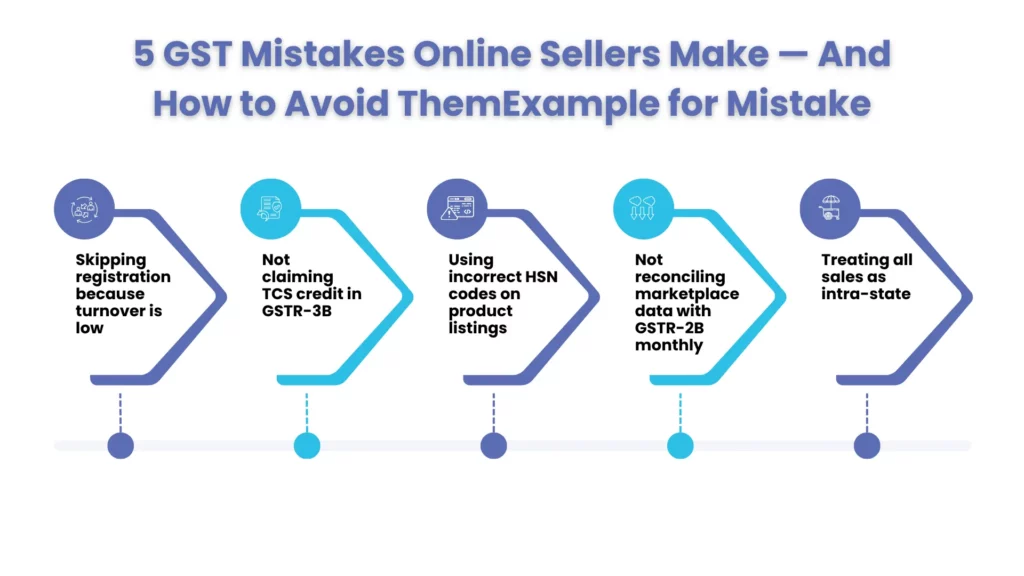
- Skipping registration because turnover is low – There is no turnover exemption for marketplace sellers. Registration is mandatory from your first sale. The penalty for non-registration is 10% of the tax due, with a minimum of ₹10,000. Don’t wait.
- Not claiming TCS credit in GSTR-3B – Every rupee deducted by your marketplace as TCS is sitting in your credit ledger. Not claiming it means paying more tax than you owe. This is money you’ve already paid — claim it every month.
- Using incorrect HSN codes on product listings – HSN codes determine your applicable GST rate. A wrong code means you’re either undercharging tax (creating a liability) or overcharging it (creating a compliance dispute). Verify your codes before listing.
- Not reconciling marketplace data with GSTR-2B monthly – If your reported sales don’t match what Amazon or Flipkart has filed, the portal flags it automatically. Small mismatches left unresolved compounds month to month into notices and credit holds.
- Treating all sales as intra-state – If you’re shipping pan-India, most of your sales are likely inter-state and attract IGST — not CGST/SGST. Misclassifying these attracts interest charges, even if your total tax paid is correct.
For Example,
Nita lists cotton bags under the wrong HSN code — 12% GST instead of the correct 5%. Over six months, she overcharges customers ₹14,000 and spends two weeks filing amendments and issuing credit notes. One HSN check before listing would have prevented all of it.
When GST Compliance Starts Requiring More Than a Spreadsheet
| Business Stage | Monthly Orders | Recommended Approach |
| Just starting | Under 100, 1 platform | Self-managed with basic accounting tool |
| Growing | 100–500, 1–2 platforms | Accounting software + periodic CA review |
| Scaling | 500+, 3+ platforms | Dedicated e-commerce accounting support |
| Multi-state / FBA | Any volume, multiple warehouses | Professional compliance — multiple GSTINs required |
Example:
Vikram’s clothing brand started with 80 Meesho orders a month — manageable on a spreadsheet. Eighteen months later, he was on Amazon, Flipkart, and his own website with 700+ monthly orders across two FBA warehouses. GST tasks went from 2 hours to 15+ hours a month. Errors started costing him ITC claims. The spreadsheet didn’t fail — the volume outgrew it.
Signs you’ve hit that point: selling on 3+ platforms, 200+ monthly invoices, FBA stock in multiple states, or regular GSTR-2B mismatches.
Stop Losing Money on Unclaimed TCS Credits.
Our team reconciles your Amazon, Flipkart & Meesho settlements and ensures every rupee of TCS and ITC is claimed monthly.
People Also Ask:
Do I need GST registration if my online sales are below ₹40 lakh?
Yes. The ₹40 lakh threshold does not apply to marketplace sellers. Under Section 24(ix) of the CGST Act, GST registration is mandatory from your very first sale on any platform like Amazon, Flipkart, or Meesho — regardless of turnover.
What is TCS and will it reduce my payout?
TCS (Tax Collected at Source) is 1% deducted by the marketplace from every settlement before paying you. It is not a permanent loss — you can claim it back as a credit when filing GSTR-3B every month. Missing this claim means paying more tax than you actually owe.
Do I need to file GST returns even if I had zero sales that month?
Yes. GSTR-1 and GSTR-3B must be filed every month even if your sales were nil. Skipping a return attracts late fees of ₹200 per day and can block your buyers from seeing invoices in their GSTR-2B.
When does IGST apply instead of CGST and SGST on my sales?
IGST applies when the buyer is in a different state from your registration state. CGST and SGST apply only for intra-state sales. If you ship pan-India, most of your orders attract IGST — misclassifying them attracts interest even if the total tax paid is correct.
Can I use the GST Composition Scheme as a marketplace seller?
No. Section 10(2)(d) of the CGST Act explicitly bars marketplace sellers from opting into the Composition Scheme. It is available only to D2C website-only sellers with turnover below ₹1.5 crore.
What ITC can I claim as an online seller?
You can claim ITC on stock and raw materials, packaging, courier and logistics, marketplace commission, and professional fees, as long as your supplier has filed their own GST return and the invoice appears in your GSTR-2B. ITC cannot be claimed on personal expenses, free samples, or returned products.
What is GST for online sellers in India?
GST for online sellers in India is a mandatory indirect tax framework that applies differently from offline businesses. Marketplace sellers on platforms like Amazon, Flipkart, and Meesho must register from their very first sale regardless of turnover, file monthly returns, collect the correct GST rate on every order, and reconcile TCS credits — all under the CGST Act, 2017.
The Bottom Line
GST for online sellers comes down to four things: register before your first sale, understand how TCS affects your payouts, file your returns on time, and claim every rupee of ITC you’re owed. Get these right consistently and e-commerce GST compliance stops being a burden.
GST compliance doesn’t have to be the part of running your store that keeps you up at night. Start with one action today: confirm your GSTIN is active, verify your HSN codes, and check your last GSTR-1 matches your actual sales. Those three steps alone put you ahead of most first-time sellers.
For D2C and B2C brands that want to hand this off entirely — explore Corient’s e-commerce accounting and reconciliation services built for online sellers scaling across multiple platforms.
GST Sorted. Now Let’s Make Sure It Stays That Way.
Getting registered and filing on time is just the start. As order volumes grow, the real cost is the hours lost chasing TCS credits, fixing GSTR-2B mismatches, and reconciling platform settlements.
Corient handles all of it, so you can focus on selling, not spreadsheets.