


A GST compliance checklist is a carefully sequenced list of activities from returns to ITC reconciliation, e-invoicing, to year-end that finance teams, AP Specialists, and tax managers need to complete on a monthly, quarterly and annual basis to avoid penalties, interest and denied Input Tax Credit (ITC).
In FY 2026-27, Indian businesses have more compliance items than ever to keep track of. The e-invoicing limit has been lowered to ₹5 crore, the Invoice Management System (IMS) requires weekly compliance, with no ITC extensions. The consequences of omitting even a single task include 18% interest per year on unpaid tax or loss of ITC.
This GST compliance checklist covers every critical action your finance team must complete – such as GSTR-1 and GSTR-3B deadlines, or actions to reverse ITC under Rule 37, 37A, 42, and 43 – in light of the new rules for FY2026-27.
What Has Changed Under GST in FY 2026-27 That Finance Teams Must Know
Several changes in FY 2026-27 directly impact GST compliance checklist and need to be part of a GST compliance checklist.
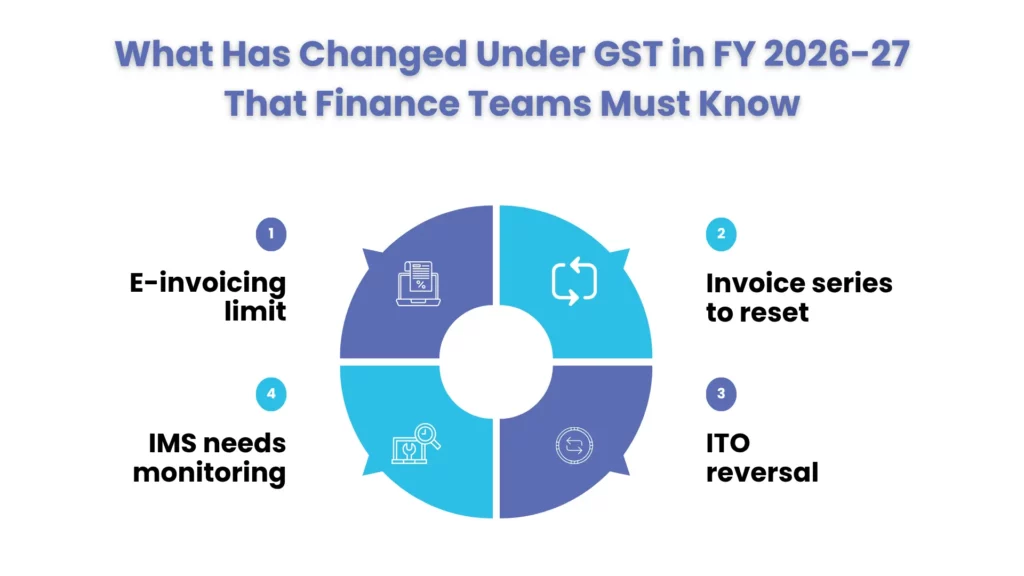
- E-invoicing limit lowered to ₹5 crore: Companies with annual turnover over ₹5 crore, the following GST compliance checklist step apply for e-invoices for all B2B (business-to-business), B2G (business-to-government) and export supply. An IRN is essential for an invoice to be valid and for buyer ITC.
- Invoice series to reset from 1 April 2026: Invoice numbers must be reset annually. ERP systems must be reset: If businesses don’t reset their ERP systems, duplicate invoice numbers result in IRP rejection and buyer ITC blockage.
- IMS needs monitoring: Invoice Management System (IMS) must be monitored with acceptance, rejection or deferment of inward invoices. Untaken actions impact ITC: Weekly monitoring is required.
- ITO reversal on composition scheme: Opting for composition scheme requires ITC-03 filing and reversal of applicable ITC by 30 May 2026. Failure is subject to 18% annual interest.
GST Return Filing Checklist – Monthly, Quarterly, and Annual
The GST return filing due dates are crucial to the GST compliance checklist calendar. Return filing is subject to 18% p.a. interest and late fees per day.
Monthly return filers (turnover more than ₹5 crore):
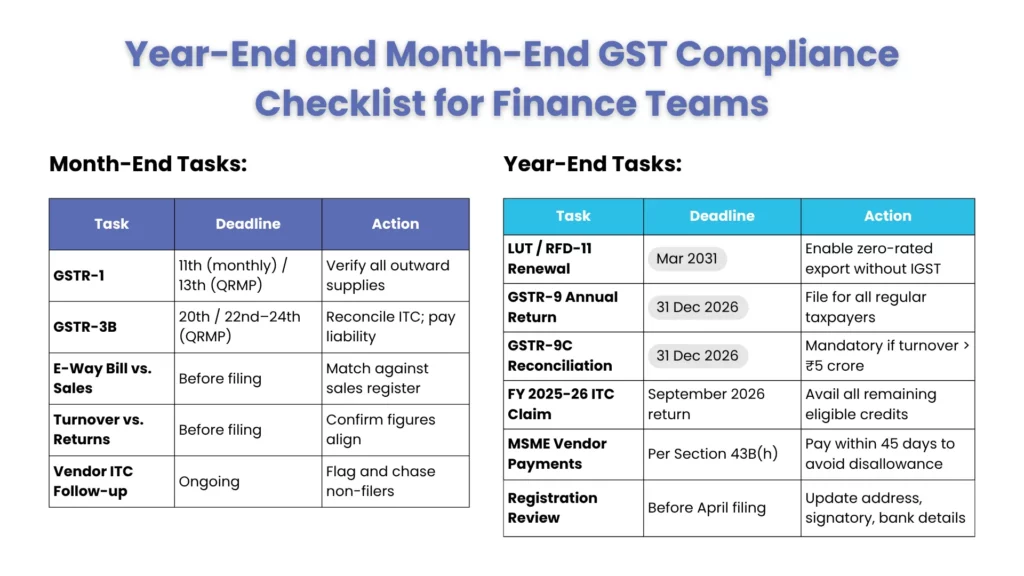
- GSTR-1: Up to the 11th day of the subsequent month
- GSTR-3B: Up to the 20th day of the subsequent month
QRMP (turnover upto ₹5 crore):
- GSTR-1: Up to the 13th day of the subsequent month
- GSTR-3B: Up to the 22nd (Category-I) or 24th (Category-II) day of the subsequent month.
Annual returns:
- GSTR-9: By or before 31 December 2016 (Regular Taxpayer, Turnover > ₹2 Crore)
- GSTR-9C: Along with GSTR-9 (Taxpayer, Turnover > ₹5 Crore)
When filing your returns, compare your outward supplies with your sales register, GSTIN of the recipient, and ensure that the GSTR-1 and GSTR-3B match your account books.
Input Tax Credit (ITC) Reconciliation Checklist
ITC issues have been a major GST compliance checklist issue in India. Here are some GST compliance checklist things that need to be done when closing books each month:
- GSTR-3B ITC reconciliation against GSTR-2B: GSTR-2B comes out each month on the 14th and gives you the rightful ITC. Anything not in GSTR-2B is likely to attract an audit.
- Purchase ledgers reconciliation against GSTR-2B: You should find cases of supplier non-filing, date mismatches, and any GSTIN mismatches.
- 17(5) Disallowed ITC: If you have bought items such as motor vehicles, food or beverages, club membership, or items meant for personal use, then they can’t qualify for the ITC. Ensure that it is done before filing.
- Rule 42/43 Mixed Supply: Proportionate reversal on certain ineligible transactions based on the ratio of exempted turnover to total.
- Rule 37 Unpaid Invoice: If invoices are outstanding for more than 180 days, then disallow ITC. Once paid, you can claim it back.
- ITC FY 2025-26 Claim Before 30 September 2026: Any ITC claims post-filing of GSTR-3B in September 2026 will be automatically forfeited, with no exception or extension of period possible.
- Rule 37A Reversal of ITC on Vendor Non-filing: In case the supplier fails to file his/her GSTR-3B in FY 2025-26 prior to 30
E-Invoicing Compliance Checklist for Large Indian Enterprises
For businesses with turnover above ₹5 crore, e-invoicing is mandatory for all B2B and B2C transactions. An invoice without a valid IRN is not a legal document and destroys the buyer’s ITC claim.
Key steps in the e-invoicing compliance checklist:
- Raise every eligible invoice through an IRP-integrated ERP or the government IRP portal
- Validate all GSTINs before generating invoices an invalid GSTIN causes IRP rejection
- Include all mandatory fields: HSN/SAC code, invoice date, taxable value, and applicable GST amounts
- For businesses with turnover above ₹10 crore, generate the IRN within 30 days of the invoice date
- Reconcile all IRN-generated invoices against GSTR-1 auto-population before the filing due date
- Retain the signed JSON, IRN, and QR code for every invoice for a minimum of 6 years
Year-End and Month-End GST Compliance Checklist for Finance Teams
The GST compliance checklist India finance departments rely on covers both month-end and year-end tasks to eliminate last-minute rushes and penalty exposure.
GST Penalty and Interest Reference:
| Default Type | Rate |
| Interest — unpaid tax liability | 18% per annum (Section 50(1) CGST Act) |
| Interest — wrongly availed ITC | 24% per annum (Section 50(3) CGST Act) |
| Late fee — GSTR-1/3B with liability | ₹50 per day (₹25 CGST + ₹25 SGST) |
| Late fee — GSTR-1/3B nil return | ₹20 per day (₹10 CGST + ₹10 SGST) |
| Maximum late fee cap | ₹10,000 per return |
Tools and Systems That Help Finance Teams Stay GST-Compliant
- Tally Prime: Invoicing, e-way bills, and GST return preparation
- Vyapar Tax One: Automated reconciliation with artificial intelligence for ITC using Tally accounting software
- Clear Tax GST: Filing of bulk returns, automatic GSTR-2B match, and reminder on deadlines
- GST Portal : Official site for downloading GSTR-2B and ledger statements
Choose software that offers real-time matching of GSTR-2B, automatic flagging of ITC reversals, support for e-invoicing API, and multiple GSTIN dashboard features.
Get a Free GST Compliance Audit.
Identify gaps in your returns, ITC, and e-invoicing before they cost you.
People Also Ask:
Explain GST compliance process?
GST compliance involves filing of Monthly/ Quarterly Returns like GSTR-1, GSTR-2B and GSTR-3B and Annual Return i.e., GSTR-9 in case of turnover exceeding ₹2 crores. Total 37 Returns could be filed per year as per regulations.
What would be e-invoice limit as per rule of 2016?
Starting April 1, 2026, anyone with an annual turnover of ₹5 crore or more (since the 2017-18 financial year) must issue an electronic invoice for B2B transactions, B2G transactions, and exports, along with an IRN (Invoice Reference Number).
What are important rules of GST for 2026?
Some Important GST Rules from April 1, 2026 are – Mandatory Multi-factor Authentication (MFA) to login on GST Portal, strict scrutiny for input tax credits (ITC), automatic interest computation under GSTR-3B Form, changes in E-Way Bill Rules and reduced Threshold for e-Invoicing to ₹5 crore.
What is GSTR-9 and its due date?
GSTR-9 is the annual GST return summarizing a taxpayer’s outward and inward supplies for the year. It must be filed by 31st December of the following financial year, unless the government extends the deadline.
Explain GST compliance process?
GST compliance means filing key returns GSTR-1, GSTR-2B, and GSTR-3B every month or quarter, plus GSTR-9 annually if your turnover crosses ₹2 crore. How many returns you file in a year depends on your business size and filing scheme.
The Bottom Line
For FY 2026-27, GST compliance checklist calls for a much stricter and proactive method that ranges from e-invoicing, ITC deadlines, to annual filing. Having a meticulously maintained checklist, which you review monthly and update anytime there are changes in regulations, will give you the best chance of avoiding penalties and audits.
At Corient Business Solutions, we assist companies in implementing this very method for GST compliance. We can help you plug those holes in your present system today.