



Running finance in a large Indian energy enterprise within the energy sector involves more than just one challenge; there are multiple challenges occurring simultaneously.
A plant expansion in one state. A renewable project awaiting financial closure in another. A compliance deadline today and an ERP migration that is live but unreliable. For CFOs and Finance Directors in India’s power, oil and gas, and renewables sector, this is not a crisis, it is the baseline.
The answer is not to work harder within a broken system. It is to build a smarter one.
The Hidden Cost of Fragmented Financial Operations
Most finance leaders recognise the obvious costs of fragmentation: delayed reporting, manual reconciliation errors, missed deadlines. What is less visible is the strategic cost.
When Plant-Level Data Does Not Reach Group Finance
When data from distributed plants does not consolidate cleanly, treasury decisions get made on estimated positions. Board reporting relies on partially verified figures. The CFO spends time chasing numbers instead of interpreting them.
At enterprise scale, this is not inefficient. It is a structural risk.
The Danger of Managing Compliance on Spreadsheets
India’s energy sector carries layered regulatory obligations — GST across multiple states, TDS, CERC or PNGRB filings, Ind AS requirements, and growing ESG disclosure mandates. Tracking these across spreadsheets with no single owner or audit trail leaves the organisation one personnel change away from a serious compliance gap.
Cash Flow Management — A Structural Problem, Not Just a Treasury One
In India’s energy sector, cash flow pressure is rarely caused by poor treasury management alone. It is usually built into the business model itself.
The DISCOM Receivables Challenge
When state distribution companies stretch payment cycles beyond 90 days, the consequences travel through the entire organisation. Procurement slips. Debt servicing tightens. Capital project sequencing becomes harder to manage. Monitoring daily cash positions without modelling these structural delays means the finance team is always reacting, never anticipating.
Building a Single Cash View Across States and Projects
For enterprises operating across multiple states with varied PPA terms and tariff structures, consolidated treasury visibility is essential. The most effective cash flow models integrate plant-wise actuals, fuel cost projections, receivable ageing, and group-level liquidity positions into one dynamic view — updated continuously, not compiled monthly.
According to PFC’s annual reporting on DISCOM payment delays and their impact on working capital, receivable cycles in several states continue to exceed 90 days — making structural cash forecasting a non-negotiable discipline.
ERP for Energy Enterprises — Why a Generic System Is a Liability
An ERP platform is only as useful as how accurately it reflects the business it serves. For large energy enterprises, generic configurations almost always fall short.
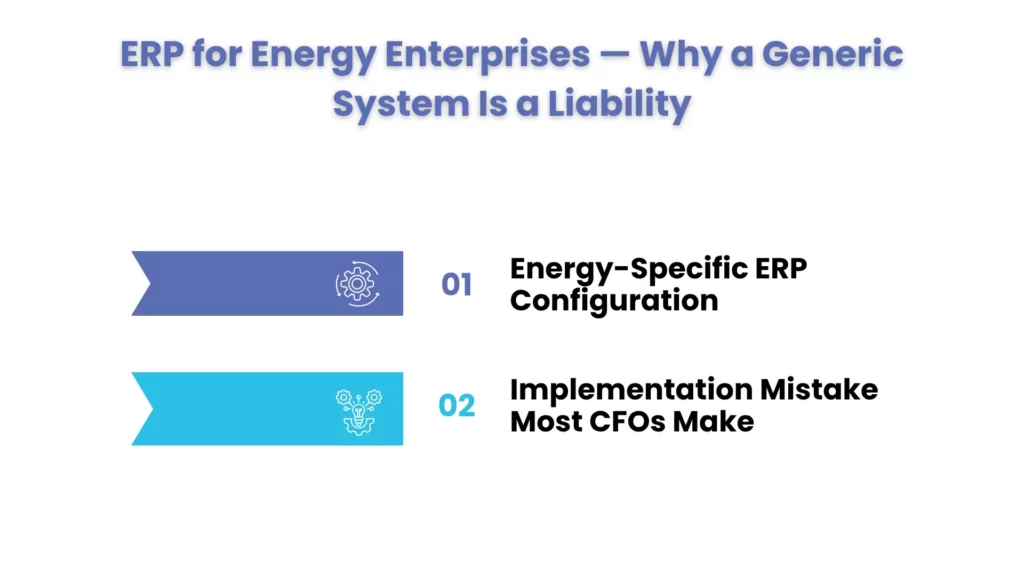
What Energy-Specific ERP Configuration Actually Requires
The gaps tend to appear in the areas that matter most — Ind AS-compliant asset accounting, project-wise capital expenditure tracking, multi-state GST reconciliation, and CERC or PNGRB regulatory reporting. These are not edge cases. They are core finance operations, and they cannot be patched onto a generic template after go-live.
The Implementation Mistake Most CFOs Make
Treating ERP as an IT project is the single most common reason implementations underdeliver. Configuration decisions made in the early stages define the system’s usefulness for years. Finance leaders who stay engaged through process mapping, UAT, and post-go-live refinement consistently get better outcomes than those who hand the project to a technology team and wait for results.
Finance leaders who stay engaged through process mapping, UAT, and post-go-live refinement consistently get better outcomes in Corient Business Solution.
Compliance Is an Operating Model, Not a Filing Calendar
As regulatory scrutiny increases and ESG reporting requirements grow, compliance is becoming a board-level concern — not just a finance team responsibility.
Building an Integrated Compliance Operating Model
Every obligation needs a named owner, a documented process, and a verifiable evidence trail. When this is embedded into ERP workflows rather than managed separately, compliance shifts from something the organisation periodically catches up on to something it continuously maintains.
The ESG Layer Is Already Here
For listed energy companies, BRSR reporting is mandatory. For others, investor expectations are moving faster than regulatory timelines. Finance teams that integrate ESG data collection into existing financial workflows now — rather than building a parallel structure later — will be significantly better positioned as requirements expand.
SEBI, the authoritative regulatory source for BRSR and ESG disclosure requirements in India) Placement suggestion: — “SEBI’s BRSR reporting framework for listed companies is already mandatory for the top 1,000 listed entities — and the scope is expanding. Finance teams that prepare now avoid a costly catch-up later.
Real-Time Reporting — From Numbers Factory to Decision Partner
The monthly MIS pack was designed for a world where decisions were made monthly. That world no longer exists.
What Real-Time Financial Reporting Looks Like in Practice
It means live executive dashboards, automated variance alerts, and KPI feeds that do not require a finance team member to compile them manually. It means the CFO walking into a board meeting with current figures — not approximations based on data that is two weeks old.
The Shift From Scorekeeper to Strategic Advisor
When the manual compilation layer is removed, the finance function gains something more valuable than speed. It gains the capacity to explain what the numbers mean — to advise on project economics, capital allocation, and fuel strategy — rather than simply produce the report.
That shift is where financial transformation delivers its real return.
Get a Free Finance Assessment.
We’ll identify the gaps, you decide what to fix.
People Also Ask:
What makes financial management in India’s energy sector uniquely challenging?
Multiple regulatory frameworks, delayed DISCOM payments, multi-state GST obligations, and large capital projects all run simultaneously. Generic financial tools were not built for this level of complexity.
How do delayed DISCOM payments affect a power company’s finances?
They tighten working capital, delay procurement, and pressure debt servicing — all at the same time. The fix is structural cash forecasting, not just faster collections.
What should a CFO look for when evaluating an ERP for an energy enterprise?
Look for energy-specific configuration — Ind AS asset accounting, multi-state GST, project cost tracking, and CERC/PNGRB reporting. If the system needs heavy customisation for these basics, it is not the right fit.
How do energy companies move from reactive to proactive compliance?
Assign every regulatory obligation a named owner, a clear process, and an audit trail — then embed it into your ERP. Compliance becomes continuous, not a last-minute scramble.
What does real-time financial reporting look like in practice?
Live dashboards, automated alerts, and current KPIs — without manual data pulls. The CFO walks into every meeting with accurate numbers, not last week’s estimates.
When is the right time to start an ERP transformation?
Before the pain becomes acute. Enterprise ERP implementations typically take 12 to 24 months from design to stable operation. Organisations that begin when existing systems are already under serious strain tend to make poorer configuration decisions under pressure. The better trigger is forward-looking: if your business is growing, regulatory demands are increasing, and your current systems require rising manual intervention for basic outputs, the window for a considered transformation is now.
Conclusion: Building the Financial Operating Model Your Business Has Outgrown
Cash flow, ERP, compliance, and reporting are not separate problems. They are connected symptoms of one central question: does your finance function have the infrastructure to match the complexity of the business it serves?
The organisations that answer yes have built a financial operating model where the components work together. ERP feeds the compliance calendar. Cash forecasting draws on real-time plant data. The CFO has the visibility to lead commercially, not just report periodically.
Building that model requires sequencing and sustained leadership attention. But continuing to stretch legacy processes across a business that has outgrown them carries its own cost — one that tends to stay invisible until it becomes undeniable.
Is your finance function managing your complexity — or is your complexity managing your finance function?