



Accounting firms for restaurants in India are bookkeeping and compliance firms that reconcile daily POS, cash, card and Swiggy/Zomato payouts, track food cost by dish, produce per-outlet P&L reports, and file GST, TDS and payroll returns. A firm that only files returns on time does not deliver restaurant accounting as defined here. Corient Business Solutions, Lekhakar and Nexora Bizz are three firms in this guide built around food businesses; shortlist any firm that handles aggregator reconciliation as a standard service, not as an add-on.
Why the difference costs money: a worked example
Take a delivery order with a ₹1,000 menu value. The figures below are an illustration with assumed numbers, not client data. The 20% commission is an assumption; actual rates differ by platform and contract.
| Line item | Basis | Amount (₹) |
|---|---|---|
| Menu sale | Order value | 1,000 |
| Platform commission | 20% (assumed) | −200 |
| GST on commission | 18% of ₹200 | −36 |
| TDS on e-commerce payment | 0.1% of ₹1,000 | −1 |
| Payout received | 763 |
A restaurant that books ₹763 as “sales” understates revenue by ₹237 on this single order. Across 1,500 delivery orders a month, that gap is ₹3,55,500 of revenue and commission that never appears in the P&L. The 18% GST on commission is a second leak: restaurants taxed at 5% generally cannot claim input tax credit, so that ₹36 is a real cost that belongs in your margin calculation.
Quick comparison: the 10 firms at a glance
| Firm | Best for | Core service | Restaurant-specific? |
|---|---|---|---|
| Corient Business Solutions | Cafés, QSRs, cloud kitchens, multi-outlet groups | Bookkeeping, aggregator reconciliation, payroll, taxation, consolidated reporting | Yes, as part of a wider SME back-office offering |
| Lekhakar | Cafés and QSRs | POS reconciliation, inventory, payroll, vendor payments | Yes |
| Nexora Bizz | Cloud kitchens, multi-location chains | AI-based reporting, aggregator reconciliation | Yes |
| Patron Accounting | Single outlets adding services as they grow | CA- and CS-led accounting, MIS, payroll, audit | General, with restaurant clients |
| Aviaan Accounting | Groups expanding to new cities | Bookkeeping, payroll, virtual CFO | General, with hospitality experience |
| RegisterKaro | New restaurants | Registration, compliance, books | General |
| AccounTX | Single-location restaurants | Tax filing, monthly closures | General |
| Munimigiri | Budget-focused dhabas, cafés, QSRs | Remote Tally bookkeeping | General, food businesses included |
| Greenbucks Accounting | Owner-operated restaurants | Fixed-fee monthly accounting, payroll | General |
| CONFiANCE | Owners who want one named contact | Advisory-led accounting and compliance | General |
Only the first three describe restaurants as their core offering. The remaining seven are general SME firms that serve restaurants; ask each for restaurant client references.
10 Accounting Firms for Restaurants: A Detailed Overview
1. Corient Business Solutions
Best for: cafés, QSRs, cloud kitchens and multi-outlet restaurant groups. Corient Business Solutions provides accounting and bookkeeping services for restaurants in India, including day-to-day bookkeeping, payroll, taxation, compliance, and management reporting. Its restaurant accounting services also cover areas such as sales reconciliation, inventory and food-cost tracking, and financial reporting for businesses operating across multiple outlets. This can be relevant for restaurant owners looking to centralise accounting and reporting across locations.
2. Patron Accounting
Best for: single outlets adding services as they grow. A CA- and CS-led firm with offices in Pune, Gurgaon and Mumbai, working across Tally, Zoho, Xero and Razorpay. Monthly accounting, MIS reporting and year-end finalisation are billed separately, so you add services as the business grows.
3. Aviaan Accounting
Best for: restaurant groups expanding to new cities. Aviaan provides bookkeeping, payroll, compliance and virtual CFO support across India, with dedicated account managers and cloud-based workflows. Its hospitality experience is international, so ask for Indian F&B references.
4. RegisterKaro
Best for: new restaurants that need registration and accounting together. A Bengaluru-based legal-tech platform that combines incorporation, compliance and small-business accounting from day one.
5. AccounTX
Best for: single-location restaurants. It bundles tax filing and monthly closures into one retainer, which suits restaurants that need consistent compliance more than deep reporting.
6. Munimigiri
Best for: budget-conscious dhabas, cafés and QSRs. Remote bookkeeping built around Tally for small traders and food businesses.
7. Greenbucks Accounting
Best for: owner-operated restaurants. Accounting and payroll with fixed monthly fees and straightforward reporting.
8. CONFiANCE
Best for: owners who want one named contact. Accounting, compliance and advisory for SMEs, built around one person handling your account each month.
9. Lekhakar
Best for: cafés and QSRs. Built for cafés and QSRs, it lists POS reconciliation, inventory tracking, payroll and vendor payments as standard services.
10. Nexora Bizz
Best for: cloud kitchens and multi-location chains. Nexora Bizz offers AI-based accounting and analytics for food service operators, covering real-time reporting, aggregator reconciliation and multi-location consolidation.
What the books of an Indian restaurant must include
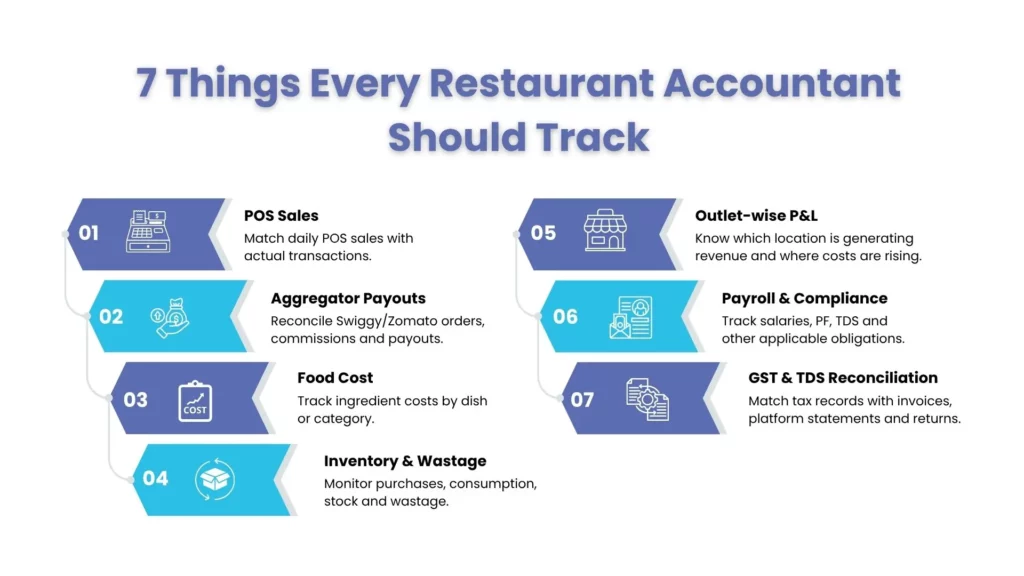
| Requirement | What it means in practice |
|---|---|
| Daily sales reconciliation | Match POS totals to the cash drawer, card settlements and delivery-app statements |
| Food cost by dish or category | Track food cost % per dish, not as one lump expense |
| Aggregator reconciliation | Match each payout to the platform’s settlement statement, commission invoices and TDS entries in Form 26AS/AIS |
| Multi-outlet consolidation | Per-outlet and combined P&L, with a shared chart of accounts |
| Payroll | PF filed through EPFO, plus service charge and tip handling on pay slips |
| Inventory and wastage | Log stock received, used and written off every week |
Cloud kitchens face a narrower version of this problem. Nearly all revenue comes through aggregators, so payout cycles, packaging cost as a COGS line, and per-brand cost allocation carry most of the accounting work.
GST and TDS rules for restaurants in India, 2026
GST compliance for restaurants in India rests on six rules, and each one changes how you record sales and platform payouts.
- Standard rate: Standalone restaurants, including dine-in, takeaway and delivery, charge 5% GST without input tax credit (ITC).
- Delivery apps: Under Section 9(5) of the CGST Act, the platform pays the 5% GST on restaurant services supplied through it, so it does not appear in your GSTR-3B liability for those orders.
- Platform fees: Commission, listing and technology fees generally attract 18% GST.
- Composition scheme: Restaurants with annual turnover up to ₹1.5 crore (₹75 lakh in special category states) can pay a flat 5% and file quarterly. They cannot claim ITC or serve alcohol.
- TDS on platform payouts: Aggregators deduct 0.1% on the gross amount. This was Section 194-O and, from 1 April 2026, sits under Section 393(1), Table Sl. No. 8(v), of the Income-tax Act, 2025. The rate was 1% until 30 September 2024.
- Hotel restaurants: Sources differ on how the 22 September 2025 changes treat restaurants in hotels with room tariff above ₹7,500. One summary cites Notification 10/2025-Central Tax (Rate) for a uniform 5% without ITC. Confirm against the notification with your CA.
In-house vs outsourced accounting
| Situation | Better fit |
|---|---|
| Multi-outlet chain with high transaction volume | In-house controller, supported by an external CA for filings |
| Single outlet or early-stage restaurant | Outsourced |
| Owner who wants CA-level review without a full-time salary | Outsourced |
| Expansion into new states | Outsourced, for cross-state compliance |
| Cloud kitchen needing aggregator reconciliation | Outsourced to a firm that lists it as standard |
How to choose the right firm for your restaurant
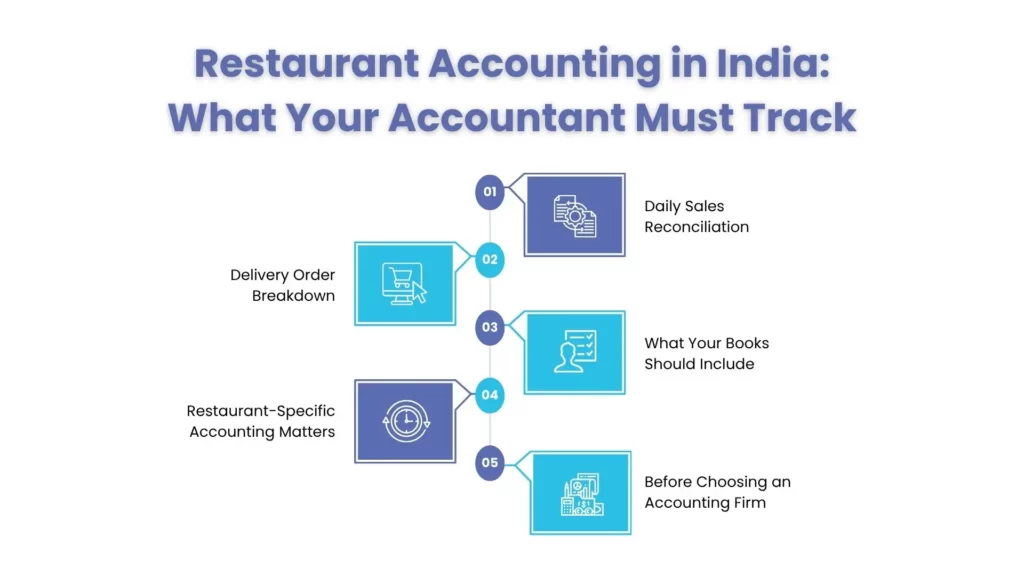
A restaurant accountant should answer all five of these questions with specifics before you sign:
- Can I speak to two restaurant clients? A firm with real restaurant clients will give references.
- Is aggregator reconciliation in the base fee? If it costs extra, price it in.
- Does it work on my POS and accounting software? Check Petpooja, Posist, Restroworks, Zoho Books or Tally Prime against your stack.
- Will I get a written scope and fee structure? Get it before onboarding.
- Who handles my account? Ask for a named person or team.
Red flags: booking aggregator payouts as revenue; no separate ledger for commission; no monthly food cost report; a fee quoted without asking your outlet count.
Book a consultation with Corient’s team to see what a POS-to-payout reconciliation shows about your margins.
People Also Ask:
Does a restaurant in India need a CA, or is a bookkeeper enough?
A bookkeeper can record daily entries. Tax filing and year-end finalisation need CA oversight, so most firms bundle both.
Can restaurants claim ITC on GST?
Standalone restaurants at 5% cannot claim input tax credit. Confirm your premises category with your CA before assuming otherwise.
What is TDS under Section 194-O?
It is 0.1% deducted by e-commerce platforms on gross payouts. From 1 April 2026 it falls under Section 393 of the Income-tax Act, 2025. The deducted amount shows in Form 26AS/AIS.
How do I reconcile Zomato and Swiggy payouts?
Match each payout to the platform’s settlement statement, the commission invoice and your POS sales for the same orders. Then check the TDS entry in Form 26AS/AIS.
What is the best accounting software for restaurants in India?
Tally Prime and Zoho Books are common choices. Pair either with a POS that exports daily sales to your books.
How often should restaurant accounts be reviewed?
Reconcile sales and aggregator payouts daily or weekly, and review full financial statements monthly.
Conclusion
Match the firm to your stage. A single café needs POS reconciliation and monthly closing. A five-outlet chain needs consolidated P&L and a shared chart of accounts. Insist on restaurant-specific experience at either size. For groups that want bookkeeping, payroll and compliance under one dedicated team, Corient Business Solutions covers cafés, QSRs, cloud kitchens and multi-outlet groups under that model.