


The best restaurant accounting software in India pairs GST-native cloud accounting (TallyPrime, Zoho Books, or Busy) with a restaurant POS and inventory system (Petpooja or RestroERP). Small operators often start with Vyapar or Khatabook; larger multi-outlet chains add Marg ERP or MarginEdge for cost control. All options below are evaluated specifically for Indian GST compliance, not global fit.
Running a restaurant in India means managing GST at two different rates, reconciling aggregator payouts, and tracking food cost, spreadsheets stop working fast. Under GST rules administered by the Central Board of Indirect Taxes and Customs (CBIC), standalone restaurants pay 5% GST without input tax credit (ITC), while restaurant services inside hotels with room tariffs above ₹7,500 a night attract 18% GST with ITC. See the current CBIC notification
A restaurant must register for GST once turnover crosses ₹20 lakh (₹10 lakh in special category states), and can opt into the composition scheme up to ₹1.5 crore turnover (₹75 lakh in special category states). Full thresholds on the GST Portal
This guide ranks the 10 accounting tools genuinely suited to the Indian restaurant market, built for Indian GST natively, or with strong, proven India integrations.
Key Features to Look for in Restaurant Accounting Software
Look for GST-compliant invoicing, POS integration, inventory/recipe tracking, multi-outlet reporting, and aggregator reconciliation, anything less leaves gaps at tax-filing time.
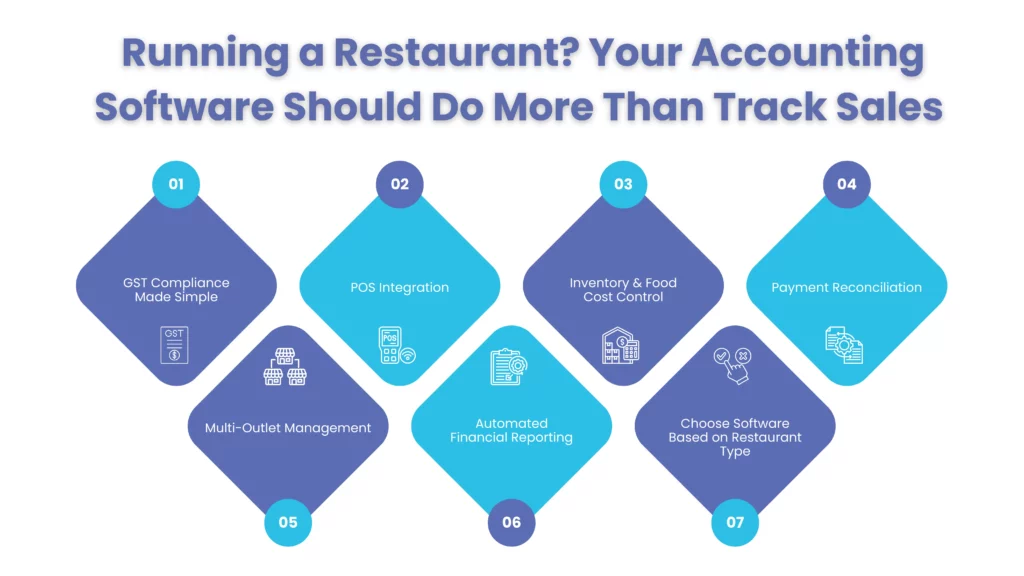
- GST-compliant invoicing: The 5% and 18% restaurant slabs, composition scheme configuration, and HSN 9963 tagging.
- POS integration: A live feed from Petpooja, RestroERP, or a similar POS into the ledger.
- Inventory and recipe control: Raw material tracking, wastage reports, and food cost per dish.
- Multi-outlet support: Consolidated, outlet-wise reporting from one cloud dashboard.
- Aggregator reconciliation: Matching UPI, card, wallet, and Swiggy/Zomato settlements — and knowing which portion of that revenue the aggregator has already paid GST on (see Section 9(5) below).
- Role-based access and audit trails: Essential once a group has multiple managers and auditors.
The Top 10 Restaurant Accounting Software in India
1. TallyPrime
Best for: Established Indian restaurants already filing GST on Tally.
Native Indian GST modules, POS connectors, and the largest installed base among Indian accountants, the default choice when your CA already works in Tally.
2. Zoho Books
Best for: Cloud-first operators who want GST natively built in.
An Indian cloud platform with native composition scheme support and direct GST-portal-aligned return filing.
3. Busy Accounting Software
Best for: Small-to-mid chains wanting Tally-level GST depth at a lower cost.
A long-standing Indian desktop-and-cloud hybrid strong on GST billing, inventory, and multi-branch consolidation, with lighter POS tooling than Petpooja or RestroERP.
4. Marg ERP
Best for: Inventory-heavy, multi-outlet operators.
An Indian ERP with strong barcode-driven inventory and billing, adopted by food businesses that need tight stock control alongside GST filing.
5. Vyapar
Best for: Single-outlet restaurants and cafés graduating from a basic ledger app.
A mobile-first Indian GST billing and inventory app, a step up from Khatabook, a step below TallyPrime or Zoho Books.
6. Petpooja
Best for: High-volume billing and menu management.
One of India’s leading restaurant POS systems, commonly integrated with Tally, Zoho Books, or Busy for downstream accounting.
7. RestroERP
Best for: Operationally focused restaurants needing POS + inventory + finance in one place.
Usually paired with TallyPrime or Zoho Books; strong on restaurant-specific stock items.
8. Khatabook
Best for: Micro and small operators just starting out.
A free, mobile-first ledger, good until GST complexity (multi-rate, multi-outlet) outgrows it.
9. QuickBooks Online
Best for: Cloud-native operators wanting a broad app ecosystem alongside Indian GST add-ons.
Strong third-party integrations; GST handled via India-specific add-ons rather than natively.
10. MarginEdge
Best for: Food cost and invoice automation layered on top of an existing ledger.
Doesn’t replace TallyPrime or Zoho Books, plugs into them for deep food-cost analytics.
Quick Comparison Table
| Software | Best For | GST Support | POS Integration | Inventory Management | Multi-Outlet Support |
| TallyPrime | Established Indian restaurants | Native Indian GST | Custom/connector-based | Strong stock modules | Possible with configuration |
| Zoho Books | Cloud GST-compliant accounting | Native, GST-portal aligned | Integrates with multiple POS | Via Zoho ecosystem | Good |
| Busy Accounting Software | Small-mid chains, lower-cost Tally alternative | Native Indian GST | Limited direct POS | Strong stock/barcode modules | Good with configuration |
| Marg ERP | Inventory-heavy multi-outlet operators | Native Indian GST | Limited direct POS | Very strong (barcode-driven) | Good |
| Vyapar | Single-outlet, graduating from a ledger app | Native Indian GST, basic | Basic or none | Simple inventory | Limited |
| Petpooja | High-volume POS and menu management | GST-ready billing | Core POS system | Basic; menu-focused | Strong |
| RestroERP | Operationally focused restaurants | POS GST configuration | Built-in POS | Strong for restaurant items | Good |
| Khatabook | Micro/small restaurant business | Limited GST features | Basic or none | Simple ledger, no full ERP | Limited |
| QuickBooks Online | Small-mid, cloud-first, India GST add-ons | Via local add-ons | Strong app ecosystem | Basic via add-ons | Good via classes/locations |
| MarginEdge | Food cost & invoice automation | Indirect via GL | Connects to many POS | Deep food cost analytics | Good |
Still weighing TallyPrime vs Zoho Books vs Busy vs the rest?
Tell us your outlet count and turnover, and we’ll help you identify which software actually fits your restaurant — free, with no obligation.
Best Restaurant Accounting Software by Restaurant Type
- Standalone and fine-dine: Zoho Books or TallyPrime with Petpooja/RestroERP.
- QSRs and cafés: Zoho Books or Busy with Petpooja for fast billing.
- Cloud kitchens: QuickBooks Online with MarginEdge for aggregator reconciliation.
- Multi-store outlets or franchises: TallyPrime or Marg ERP with per-store GST accounting.
- Food stalls and new restaurants: Khatabook or Vyapar as a free/low-cost start.
Benefits of Using Restaurant Accounting Software
- Precise GST classification: Correct 5%/18% treatment per CBIC/GST Council rules.
- Better cash flow visibility: Real-time sales and food-cost tracking.
- Audit-ready records: Clean financials for audits and loans.
- Time savings: Automated postings free up accountants for outlet-level analysis
GST Compliance Requirements for Restaurant Accounting Software
Software must correctly apply the 5%/18% split, enforce turnover-based registration, support composition scheme filing, and produce accurate GSTR-1/GSTR-3B invoice data.
- Rate application: 5% without ITC for standalone restaurants; 18% with ITC for “specified premises” hotels (room tariff ₹7,500+/night), per CBIC.
- Registration threshold: Mandatory above ₹20 lakh turnover (₹10 lakh in special category states), per the GST Portal.
- Composition scheme: Turnover up to ₹1.5 crore (₹75 lakh in special category states) qualifies for a flat 5% rate, quarterly CMP-08, and annual GSTR-4.
- Invoice-level reporting: Accurate outward-supply data in GSTR-1 and GSTR-3B, reconciled monthly.
How Aggregators Change the GST Picture (Section 9(5))
Under Section 9(5) of the CGST Act, Swiggy and Zomato are treated as the “deemed supplier” on many orders, meaning the platform, not the restaurant, collects and remits that 5% GST directly to the government.
This changes two things for your accounting:
- Your own GST liability calculation must exclude the aggregator-collected portion, or you overstate, and effectively double-pay, GST.
- Reconciliation isn’t just matching bank deposits to POS bills; it means checking that the aggregator’s GSTR-2B entry correctly reflects what they collected on your behalf, monthly.
Software that only reconciles settlements without accounting for Section 9(5) will misstate GST liability, a common blind spot even in well-run multi-outlet operations.
E-Invoicing and QR Code Requirements for Larger Chains
Once aggregate turnover crosses the government-notified e-invoicing threshold, B2B invoices must carry an IRP-issued QR code and IRN to be valid for ITC.
This mainly affects multi-outlet groups doing B2B catering or corporate billing, most single-outlet, B2C restaurants won’t hit the threshold. Confirm current applicability on the GST e-invoice portal, since the threshold has been lowered progressively.
How to Choose the Right Accounting Software
The best accounting software for a restaurant in India is one that combines GST-compliant invoicing, real-time inventory and food cost tracking, POS and delivery app integration, and financial reporting, all in a single, easy-to-use platform. For most restaurants, this means looking beyond generic accounting tools and choosing software built specifically for food service businesses.
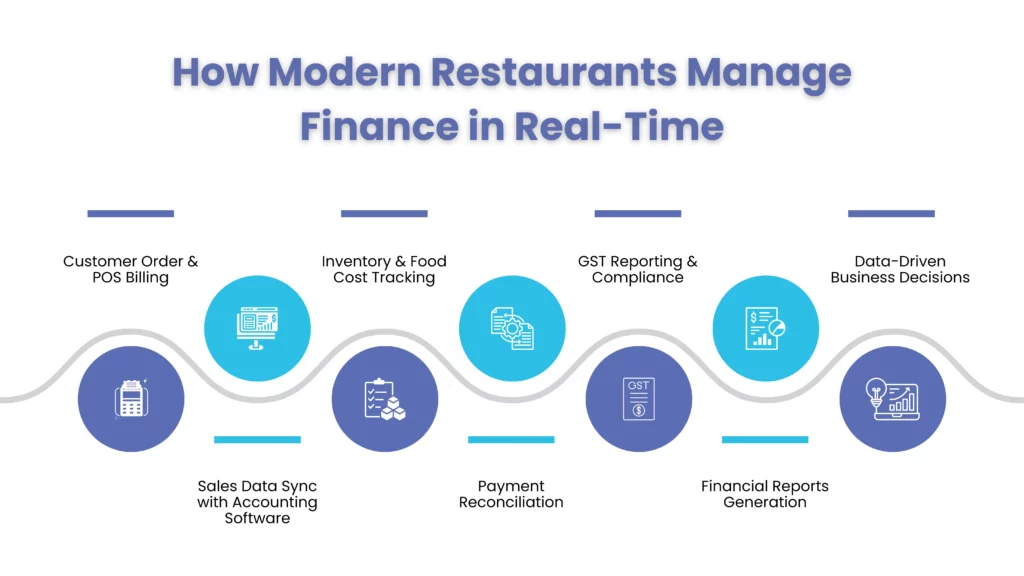
Below is a breakdown of the key factors to evaluate before choosing one.
Does it offer restaurant-specific features?
Generic accounting software isn’t built for how restaurants actually operate. Look for tools that include:
- Inventory tracking
- Purchase and vendor management
- Recipe costing
- Sales tracking
- Expense monitoring
These features address the day-to-day realities of running a kitchen, not just basic bookkeeping.
Does it integrate with your POS and delivery platforms?
Restaurant accounting software should automatically sync with your POS system and delivery apps like Zomato and Swiggy. This integration eliminates manual data entry, reduces errors, and ensures every order and rupee of revenue is tracked in real time.
Is it GST-compliant?
GST compliance is non-negotiable for restaurants in India. The right software should generate GST-ready invoices, tax reports, and compliance records automatically — reducing the risk of errors during filing season.
Does it help control food costs and wastage?
Food cost and wastage directly impact restaurant profitability. Effective software tracks stock levels, monitors supplier expenses, and flags wastage trends early, helping you catch cost leaks before they affect margins.
Can it scale with your business?
If you plan to open new outlets or expect transaction volumes to grow, choose software designed to scale. It should support multiple locations and higher order volumes without requiring a platform switch later.
Does it provide actionable financial insights?
Look for built-in reporting on profit & loss, cash flow, and sales analytics. These insights help restaurant owners make data-driven decisions instead of relying on guesswork.
Is it easy for your team to use?
Software is only useful if your staff can operate it without extensive training. Prioritize a simple interface backed by responsive customer support.
Common Mistakes to Avoid
- Underestimating multi-outlet complexity: Setups that can’t consolidate across branches.
- Treating POS as full accounting: POS reports alone rarely satisfy GST needs.
- Delaying an upgrade: Staying on Khatabook or Vyapar after crossing GST thresholds.
- Misreporting aggregator revenue: Not accounting for Section 9(5) GST already collected by Swiggy/Zomato.
When Should Restaurants Hire Professional Accounting Support?
Once turnover approaches GST or composition thresholds, or the business runs multiple outlets, professional support becomes worth the cost, for outlet-wise profitability, cash-flow forecasting, and staying ahead of GST rule changes. A specialised restaurant accountant can help streamline bookkeeping, financial reporting, and restaurant-specific accounting processes.
How Corient Helps
- Software selection: Advising whether Zoho Books, TallyPrime, Busy, Marg, or Vyapar fits your profile, then integrating Petpooja or RestroERP.
- GST configuration and filing: Mapping rates, composition eligibility, Section 9(5) exposure, and HSN/SAC codes; preparing GSTR-1 and GSTR-3B.
- Ongoing bookkeeping and MIS: Sales posting, reconciliation, outlet-wise P&L dashboards.
- Scalable processes: Standardised chart of accounts for multi-outlet networks.
Need Help Choosing the Right Software?
Corient helps restaurants choose the right accounting setup, streamline bookkeeping, and improve financial visibility.
People Also Ask:
What is the best accounting software for restaurants in India?
It depends on size. Smaller operations do well with Zoho Books or TallyPrime plus a POS like Petpooja or RestroERP. Larger chains typically use Marg ERP or Busy for tighter inventory and multi-outlet control.
What software do restaurants use to bill?
Petpooja and RestroERP are the top POS choices for restaurant billing, usually integrated with Zoho Books, TallyPrime, or Busy so billing and accounting sync automatically.
What is the best way to account for a restaurant?
Most mid-size and large Indian restaurants use accrual-based accounting, which gives a more accurate financial picture than cash-based accounting. Good software applies this by default.
Which software do the majority of restaurants use in India?
TallyPrime and Zoho Books are the most widely used, typically paired with Petpooja. Busy, Marg ERP, and Vyapar are common among smaller operators graduating from a basic ledger app.
What does restaurant accounting software cost in India?
Free/low-cost apps like Khatabook and Vyapar start near zero; mid-range cloud tools like Zoho Books and QuickBooks Online run in the low thousands of rupees per month; TallyPrime and Busy are sold as one-time or annual licences. (Verify exact current pricing with each vendor before publishing.)
Does GST on aggregator orders (Swiggy/Zomato) need to be filed by the restaurant?
Not entirely. Under Section 9(5) of the CGST Act, aggregators act as the deemed supplier for many orders and remit GST directly. Restaurants still need to reconcile this against their own records monthly.
Conclusion: Getting Restaurant Accounting Right in India
Spreadsheets can carry a single-outlet café for a while. They can’t carry a business managing two GST rates, three aggregator payouts, and a Section 9(5) reconciliation every month, and trying to make them stretch your team’s time in exactly the wrong direction, away from running the restaurant and into fixing avoidable errors.
The right stack isn’t complicated once you match it to your stage:
- Starting out or single-outlet → Khatabook or Vyapar, paired with Petpooja for billing.
- Established and GST-ready → TallyPrime or Zoho Books, the two most trusted names in Indian restaurant accounting.
- Scaling across outlets → Busy or Marg ERP for inventory depth, MarginEdge layered on top for food-cost control.
What matters more than the brand name is whether the software actually handles the things that trip up Indian restaurants specifically, the 5%/18% GST split, composition scheme eligibility, and the Section 9(5) aggregator rule that quietly causes over-reporting in kitchens that look otherwise well-run.
If you’ve read this far, you’ve probably already spotted a gap in your own setup. That’s normal, most restaurant groups we work with had one too, and it usually costs more to leave unfixed than to fix.
Not sure where your restaurant’s accounting stands right now?
Get a free 20-minute review of your GST setup and software fit, no cost, no obligation. Fill out the form today – completely free, with no obligation.