



Running a restaurant is hard enough without wondering whether your books are telling you the truth. Food costs move daily, labor is your biggest variable expense, cash and card tips need to be tracked separately, and a busy Saturday night can generate more transactions than most small businesses see in a week. Generic bookkeeping advice doesn’t account for any of that, which is exactly why so many restaurant owners feel like their numbers never quite add up.
According to Toast’s restaurant industry benchmarks, the average restaurant profit margin sits at just 3–5%, which is exactly why even small bookkeeping errors can tip a restaurant from profitable to underwater.
This guide breaks down what restaurant bookkeeping actually involves, the numbers that matter most, and how to build a system that gives you a clear, accurate picture of where your restaurant stands, every single week, not just at tax time.
What Makes Restaurant Bookkeeping Different
Bookkeeping for a restaurant isn’t just “accounting, but for food.” A handful of factors make it its own discipline:
- High transaction volume: Hundreds of small sales a day, often across multiple payment types, tip structures, and discount codes.
- Perishable inventory: Food spoils, portions vary, and waste has to be tracked or it quietly eats into margin.
- Complex labor costs: Tipped vs. non-tipped wages, overtime, shift differentials, and multi-state tax rules if you operate more than one location.
- Multiple revenue streams: Dine-in, takeout, delivery apps, catering, and gift cards each need to be recorded and reconciled differently.
- Thin margins: Restaurants typically run on 3–9% net margins, so small errors in cost tracking can mean the difference between a profitable month and a loss.
Because of this, restaurant bookkeeping needs daily attention, not a once-a-month catch-up session.
Daily, Weekly, and Monthly Bookkeeping Tasks
A restaurant’s books stay accurate when the work is broken into a rhythm, rather than tackled all at once.
Daily
- Reconcile POS sales against the till and card processor deposits
- Record cash tips separately from credit card tips
- Log daily food and beverage sales by category (helps with menu engineering later)
- Track any voids, comps, or discounts with a reason code
Weekly
- Reconcile vendor invoices against deliveries received
- Review labor cost as a percentage of sales
- Update inventory counts for high-cost items (proteins, alcohol, seafood)
- Process payroll and confirm tip reporting is accurate for tax purposes
Monthly
- Close the books and generate a profit and loss statement (P&L)
- Reconcile all bank and merchant accounts
- Review prime cost (more on this below)
- Compare actual performance against budget
- File and remit sales tax
Skipping any of these layers is usually where restaurants lose visibility, by the time an owner notices a problem in the monthly P&L, it’s often been building for weeks.
The Numbers Every Restaurant Owner Should Track
Prime Cost
Prime cost, the combined total of cost of goods sold (COGS) and labor costs, is the single most important metric in restaurant bookkeeping. Most healthy full-service restaurants aim to keep prime cost between 55–60% of revenue; quick-service concepts often target slightly lower. If prime cost creeps up, it’s usually the first sign of a pricing, waste, or scheduling problem.
Cost of Goods Sold (COGS)
COGS reflects what you spent on food and beverage to generate your sales. Calculating it accurately requires tracking beginning inventory, purchases, and ending inventory for each period, not just what you spent at the vendor level.
Labor Cost Percentage
Labor cost as a percentage of sales tells you whether your staffing model matches your sales volume. This needs to include wages, employer payroll taxes, and benefits, not just hourly pay.
Tip Reporting and Allocation
Tip income has specific reporting requirements, and mismanaging it is one of the most common restaurant bookkeeping mistakes. Cash tips, credit card tips, and tip pooling arrangements all need to be tracked and reported correctly to stay compliant and to keep payroll tax calculations accurate.
Sales Tax
Sales tax rates and rules vary not just by state but sometimes by city or county, and some jurisdictions tax prepared food differently from grocery items. Restaurants with delivery or catering operations across multiple jurisdictions need especially careful tracking here.
Common Restaurant Bookkeeping Mistakes
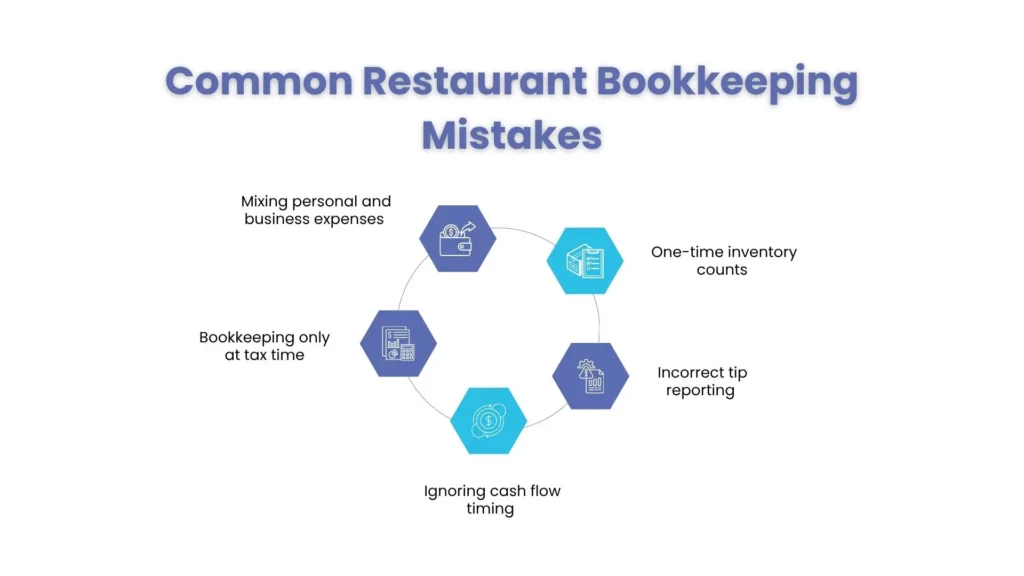
- Mixing personal and business expenses: This is one of the fastest ways to lose track of true profitability and complicate tax filing.
- Not reconciling POS data daily: Small discrepancies compound quickly across hundreds of daily transactions.
- Treating inventory as a one-time count: Inventory needs to be tracked continuously, especially for high-cost or high-waste items.
- Recording tips incorrectly: Underreporting or misclassifying tips creates compliance risk and skews labor cost reporting.
- Ignoring cash flow timing: A restaurant can be profitable on paper and still run short on cash if vendor payment timing isn’t managed alongside receivables.
- Doing books only at tax time: Annual clean-up doesn’t give an owner the real-time visibility needed to make menu, staffing, or pricing decisions.
Restaurant Bookkeeping vs. Restaurant Accounting
These terms get used interchangeably, but they serve different purposes.
- Bookkeeping is the day-to-day recording of financial transactions, sales, purchases, payroll, and reconciliations. It’s the foundation: accurate, timely, and detailed.
- Accounting takes that data and turns it into strategy, analyzing prime cost trends, preparing tax filings, forecasting cash flow, and advising on pricing or expansion decisions.
A restaurant needs both, but they don’t have to come from the same place. Many owners handle bookkeeping in-house or through a bookkeeping service, then bring in a CPA or accountant periodically for tax strategy and higher-level financial planning.
Bookkeeping Methods: Cash vs. Accrual
Most small, independent restaurants use cash-basis accounting, recording revenue and expenses when money actually changes hands. It’s simpler and gives an immediate read on cash position.
Larger restaurants, multi-location groups, or those seeking financing typically use accrual-basis accounting, which records revenue and expenses when they’re earned or incurred, regardless of when cash moves. This gives a more accurate long-term picture of profitability and is often required by lenders or investors.
The right method depends on your restaurant’s size, complexity, and growth plans, and it’s worth confirming with a bookkeeper or accountant rather than defaulting to whatever your POS system happens to export.
Software and Systems Restaurants Rely On
A restaurant’s bookkeeping is only as good as the systems feeding it. Most setups run on restaurant accounting software that handles POS integration, inventory, and payroll in one place, cutting down manual entry errors and keeping records audit-ready.
- POS integration that syncs sales, tips, and payment data directly into your bookkeeping software, cutting down manual entry errors
- Accounting software (such as QuickBooks or Xero) configured with a restaurant-specific chart of accounts
- Inventory management tools that track usage against purchases in real time
- Payroll software built to handle tipped wage calculations and multi-jurisdiction tax rules
The goal isn’t to have the most tools, it’s to have systems that talk to each other, so data doesn’t have to be re-entered by hand at every step.
In-House vs. Outsourced Restaurant Bookkeeping
Some restaurants keep restaurant accounting in-house, often with a manager or owner handling it alongside other duties. Others bring in a dedicated restaurant accountant who understands prime cost, GST compliance for restaurants, and multi-location consolidation, without the overhead of a full-time hire.
Outsourced bookkeeping services bring dedicated expertise in restaurant-specific accounting: prime cost tracking, tip compliance, multi-location consolidation, and POS reconciliation, without the overhead of a full-time hire. For growing restaurant groups especially, this often means more accurate, more timely books at a lower cost than an in-house finance team.
How to Choose the Right Restaurant Bookkeeping Service
Not every bookkeeping service understands the restaurant industry’s specific rhythms, so it’s worth evaluating a few things before committing to one.
- Industry-specific experience: Ask directly whether they’ve worked with restaurants before, and whether their restaurant accountant understands prime cost, tip reporting, GST compliance for restaurants, and food cost tracking, not just generic small business bookkeeping.
- POS and software compatibility: Confirm they can integrate with your existing POS system and accounting software, rather than asking you to switch platforms or manually export reports.
- Reporting frequency and clarity: Look for weekly or daily reconciliation, not just a monthly report delivered after the fact. Ask to see a sample P&L and balance sheet so you know what you’ll actually be receiving.
- Tip and payroll compliance knowledge: This is a common area of error, make sure whoever handles your books understands tip allocation, tip credit rules, and multi-state payroll if you operate in more than one location.
- Scalability: If you’re planning to open additional locations, choose a service that can consolidate reporting across locations rather than treating each one as a separate client.
- Transparent pricing and communication: You should know what’s included, how quickly questions get answered, and who you’re actually working with, not just a support ticket queue.
People Also Ask:
How much does restaurant bookkeeping usually cost?
Honestly, it depends a lot on how big and busy the restaurant is. If you’re doing it in-house, the cost is really just someone’s time, a manager or owner squeezing it in between everything else. Outsourced bookkeeping services usually charge a monthly fee that scales with your revenue and how many locations you’re running, plus how detailed you want the reporting to be.
How often should a restaurant actually reconcile its books?
Daily, ideally – at least for POS sales against what actually hit the bank. Weekly works for vendor invoices and labor costs. Then once a month, you close everything out and look at the full P&L. The longer you wait between checks, the harder it gets to spot where something went wrong.
What’s the real difference between a bookkeeper and an accountant here?
Think of the bookkeeper as the person keeping score every day, recording sales, payroll, vendor bills, making sure everything reconciles. The accountant is the one who steps back and tells you what the score means: tax strategy, whether you can afford to open a second location, that kind of thing. Most restaurants end up needing both at some point.
How should tips actually be recorded?
Separately, cash tips and credit card tips shouldn’t get lumped together, and if you’re pooling tips among staff, that needs to be documented too. This isn’t a place to estimate. Tip records feed directly into payroll tax calculations, and getting it wrong is one of the more common ways restaurants run into compliance trouble.
Can any of this be automated?
Some of it, yes – POS systems can feed sales data straight into your accounting software, payroll tools can handle a lot of the tip and wage math, and inventory apps can track usage in real time. But automation only gets you so far. Someone still needs to actually look at the numbers, catch what doesn’t add up, and make sure the reports match what’s really happening on the floor.
Running your restaurant’s numbers shouldn’t feel like guesswork. If your bookkeeping isn’t keeping pace with your kitchen, it’s time for a system that does accurate, on time, every month.
Conclusion
At the end of the day, restaurant bookkeeping comes down to one question: do you actually know how your restaurant is doing right now, or are you finding out weeks later when it’s too late to fix anything?
That’s really what separates restaurants that stay profitable from ones that get surprised by a bad month. It’s not about buying more software or building fancier spreadsheets, it’s about staying close to the handful of numbers that matter, like prime cost and labor percentage, and not letting reconciliation slide until it becomes a monthly scramble.
Some owners are comfortable managing this themselves, and others do better handing it off to someone who lives in restaurant numbers every day. Either way, the restaurants that make good decisions are the ones working off real, current numbers, not last quarter’s guesswork.