




Accounting for startups is the process of recording, organising and reporting every rupee that moves through your company, so you can track burn, stay compliant with GST, TDS and ROC deadlines, and hand investors clean books during due diligence. In India, it starts the day you incorporate, not the day you raise.
Most founders learn this the expensive way. You spend eighteen months building a product, then a term sheet arrives, the investor’s diligence team asks for three years of reconciled financials, and you discover your bookkeeping is a WhatsApp folder of bill photos and a Google Sheet nobody updated after March.
This guide covers what accounting for startups actually looks like in India, the entity you pick, the books the law requires you to keep, the compliance calendar you cannot miss, what it costs, and the mistakes that cost founders real money.
What is startup accounting, and how is it different in India?
Startup accounting is the day-to-day discipline of capturing transactions, categorising them correctly, reconciling them against bank statements, and producing three statements: profit and loss, balance sheet, and cash flow.
That much is universal. What makes accounting for startups in India distinct is the compliance layer sitting on top:
You file more often:
A US startup files quarterly. An Indian private limited company with GST registration touches a filing portal almost every month — GSTR-1, GSTR-3B, TDS challans, and then annual ROC and income tax returns.
Statutory audit is not optional:
Every private limited company in India must have its accounts audited by a Chartered Accountant, regardless of turnover or revenue. Zero-revenue pre-seed startups included.
Your software must have an audit trail. Since FY 2023–24, companies using accounting software must use a version with an edit-log (audit trail) feature that cannot be disabled. If yours doesn’t, your auditor is required to qualify the audit report.
The tax law itself just changed:
The Income-tax Act, 2025 came into force on 1 April 2026, replacing the 1961 Act. It renumbers nearly every section and replaces “Assessment Year” and “Previous Year” with a single “Tax Year”. Rates are largely unchanged, but every section number your old CA quoted you is now different.
Paying vendors late has a tax cost. If you buy from a micro or small enterprise and don’t pay within 45 days (15 days without a written agreement), that expense gets disallowed — which increases your taxable income.
None of this is hard. It is just relentless, and it does not pause because you’re mid-launch.
Get the entity structure right before you do anything else
Your entity decides your entire startup accounting and compliance burden. Changing it later is possible but painful, and investors will make you convert to a Private Limited Company anyway.
| Entity | Statutory audit | Best for | Funding-ready? |
|---|---|---|---|
| Sole proprietorship | No | Solo consultants, testing an idea | No |
| Partnership firm | Only if tax audit applies | Two founders, low capital, services | No |
| LLP | Only if turnover > ₹40 lakh or contribution > ₹25 lakh | Bootstrapped agencies, profit-sharing teams | Rarely |
| One Person Company | Yes | Single founder wanting limited liability | No |
| Private Limited Company | Yes, always | Anything VC-backed or ESOP-issuing | Yes |
If you intend to raise institutional capital, issue ESOPs, or take on a co-founder with vesting, incorporate as a Private Limited Company from day one. The extra ₹15,000–₹25,000 a year in compliance cost is cheaper than a mid-diligence conversion.
One more step worth doing early: apply for DPIIT recognition on the Startup India portal. It’s free, takes days, and unlocks benefits including the Section 80-IAC tax holiday route and relaxed loss carry-forward rules when your shareholding changes after a funding round.
Set up books the Companies Act actually accepts
Section 128 of the Companies Act, 2013 requires every company to keep books of account on an accrual basis, using the double-entry system, at its registered office — and to preserve them for eight financial years.
In practice, “books” means:
- Bank and cash records, reconciled monthly against statements
- Sales register with GST-compliant tax invoices
- Purchase register with vendor invoices and GSTINs captured
- Fixed asset register with depreciation schedules
- Payroll records including PF, ESI, professional tax and TDS on salary
- Statutory registers – members, directors, charges, share transfers
Two rules that save you months of pain later:
- Open a current account in the company’s name and never mix it with personal spending. Founder UPI payments for AWS bills are the single most common reason startup books take weeks to clean up.
- Capture the GSTIN on every purchase invoice. No GSTIN, no input tax credit. That’s real cash lost on every cloud bill, laptop and co-working invoice.
Cash vs accrual — and why Indian companies don’t really get a choice
Cash accounting records money when it hits or leaves your bank. Accrual accounting records revenue when it’s earned and expenses when they’re incurred, regardless of payment timing.
For an Indian private limited company, accrual is mandatory. Section 128 says so. You may find it useful to view a cash-basis report internally to see true runway, but your statutory books are accrual.
This matters more than founders expect. If you invoice a client ₹8 lakh in March with 60-day payment terms, accrual books show ₹8 lakh of March revenue and a receivable. Your bank shows nothing until May. A founder reading only the P&L thinks the company had a great quarter. The cash flow statement is the one telling the truth.
Most early-stage Indian companies report under Accounting Standards (AS) notified under the Companies (Accounting Standards) Rules. Ind AS becomes mandatory at higher net worth thresholds or on listing – worth knowing exists, not worth worrying about pre-Series B.
Build a chart of accounts that matches how you actually spend
A chart of accounts is the backbone of startups accounting – the master list of buckets every transaction falls into. Start narrow. Twenty-five well-chosen heads beat two hundred you’ll never use.
For an Indian SaaS or D2C startup, a workable starting structure:
- Revenue: subscription revenue, one-time/setup revenue, other income
- Cost of revenue: cloud and hosting, payment gateway charges, third-party APIs, customer support
- People: salaries, contractor payments, PF/ESI employer contribution, recruitment
- Growth: performance marketing, content, events, sales commissions
- Operations: rent/co-working, software subscriptions, professional fees, travel
- Statutory: GST payable, TDS payable, advance tax, ROC filing fees
- Balance sheet: share capital, securities premium, CCPS/CCD if you’ve raised, fixed assets, GST input credit
Keep GST input credit as its own ledger. At scale it’s a meaningful working-capital asset, and treating it as a random expense line hides money you’re owed.
Know your compliance calendar
This is the part that catches founders. Here is the recurring rhythm for a GST-registered private limited company.
| Deadline | Compliance / Filing | Applicable To |
|---|---|---|
| 7th of every month (30 April for March deductions) | TDS Payment | Businesses deducting TDS |
| 11th of every month | GSTR-1 (Outward Supply Details) | Monthly GST Filers |
| 20th of every month | GSTR-3B (Summary Return & Tax Payment) | Monthly GST Filers |
| 15 June, 15 September, 15 December & 15 March | Advance Tax Instalments | Companies with taxable profits |
| Quarterly (31 July, 31 October, 31 January & 31 May) | TDS Returns (Forms 24Q & 26Q) | Businesses deducting TDS |
| 30 April & 31 October | MSME-1 (Half-Yearly Return for Outstanding MSME Payments) | Companies with pending MSME vendor payments |
| 30 May | LLP Form 11 (Annual Return) | LLPs |
| 30 June | DPT-3 (Return of Deposits) | Companies |
| 30 September | Annual General Meeting (AGM), Adoption of Audited Financial Statements & DIR-3 KYC for Directors | Companies |
| Within 30 days of AGM | AOC-4 (Filing of Financial Statements with ROC) | Companies |
| Within 60 days of AGM | MGT-7 / MGT-7A (Annual Return Filing with ROC) | Companies |
| 31 October | Income Tax Return Filing (Audit Cases) | Companies requiring tax audit |
| 30 October | LLP Form 8 (Statement of Accounts & Solvency) | LLPs |
Two turnover triggers to watch as you grow:
- GST registration becomes mandatory above ₹40 lakh turnover for goods and ₹20 lakh for services in most states (₹20 lakh / ₹10 lakh in special category states). Register earlier voluntarily if your customers are businesses who want input credit.
- E-invoicing kicks in above ₹5 crore aggregate turnover. Miss it and your invoice has no IRN – which means it’s invalid under GST law and your customer can’t claim credit on it.
Also note the September 2025 GST rate rationalisation: the old 12% and 28% slabs were removed, leaving 0%, 5%, 18% and a 40% slab for luxury and sin goods. If your product catalogue or invoice templates still carry old rates, fix them.
Track the four numbers that matter more than profit
Your P&L will show a loss for years. That’s normal. These are the numbers that actually tell you how the business is doing.
- Net burn: cash out minus cash in, per month. Not your expense line; actual cash movement.
- Runway: closing bank balance ÷ average net burn over the last three months. ₹2.4 crore in the bank against ₹20 lakh monthly burn is 12 months. Recalculate it every month, and start fundraising conversations at 9 months, not 3.
- CAC and payback: total sales and marketing spend ÷ new customers acquired. Then: how many months of gross margin does it take to earn that back? Under 12 months is healthy for Indian B2B SaaS; under 6 for D2C.
- MRR and net revenue retention: for subscription businesses, MRR is contracted monthly revenue, and NRR tells you whether your existing customers grow or shrink. Indian investors ask for both, in a monthly cohort view, at Series A.
Build these as a one-page dashboard your accounting software feeds automatically. If pulling them takes more than ten minutes, your chart of accounts is wrong.
Pick software built for Indian compliance
Most accounting software for startups is built for US or UK tax rules. Global tools often don’t handle GST return formats, e-invoicing IRN generation, TDS ledgers or e-way bills. Note that QuickBooks withdrew from the India market in 2023, so older blog recommendations you’ll find online are out of date.
| Tool | Strongest for | Rough cost |
|---|---|---|
| Zoho Books | Startups wanting GST filing, e-invoicing and bank feeds in one cloud tool | Free tier under ₹25 lakh turnover; paid plans from ~₹900/month |
| TallyPrime | Companies whose CA works in Tally; strong statutory reporting and audit trail | ~₹18,000 one-time licence + AMC |
| Vyapar / Refrens | Very early stage, invoicing-first, solo founders | ₹0–₹5,000/year |
| Busy | Inventory-heavy trading and D2C businesses | ~₹10,000+ per licence |
| Zoho Payroll / RazorpayX Payroll | Automating salary, PF, ESI, PT and TDS on salary | ~₹50–₹100 per employee/month |
Whatever you choose, verify the audit trail feature is on and cannot be turned off. That’s a statutory requirement now, not a preference.
Tax benefits Indian startups routinely leave on the table
- Section 80-IAC tax holiday: A DPIIT-recognised Private Limited Company or LLP incorporated between 1 April 2016 and 31 March 2030, with turnover under ₹100 crore, can claim a 100% deduction on profits for any three consecutive years out of its first ten. Two things founders get wrong: DPIIT recognition alone doesn’t grant it — you need a separate Inter-Ministerial Board certificate – and MAT at 15% of book profits still applies during the holiday years. Choose your three years deliberately; burning them on loss-making years wastes the benefit entirely.
- Angel tax is gone: Section 56(2)(viib) was abolished with effect from 1 April 2025. Valuation-premium tax exposure on new rounds is no longer a concern, though pre-April-2025 rounds can still attract legacy assessments.
- ESOP perquisite tax deferral. Eligible DPIIT-recognised startups can defer the perquisite tax employees owe at exercise, to the earliest of 48 months, the employee leaving, or the sale of shares, a genuine hiring advantage when you’re competing on equity.
- Loss carry-forward survives funding rounds: The relaxed rule for eligible startups allows accumulated losses to be carried forward despite shareholding changes, provided the original shareholders continue to hold shares. Clean, contemporaneous books are what let you prove it.
Six mistakes that cost Indian founders real money
- Mixing personal and business spending. Every founder-card AWS payment becomes a director’s loan question during diligence.
- Ignoring input tax credit hygiene. Unclaimed GST credit on cloud, hardware and agency invoices is pure cash leakage.
- Deducting TDS but not depositing it. Interest, penalty, and disallowance of the underlying expense. Painful and entirely avoidable.
- Treating the statutory audit as a March activity. Reconcile monthly, or you’ll spend six weeks reconstructing a year.
- Paying MSME vendors on 90-day terms. Beyond 45 days, the deduction gets disallowed and your tax bill goes up.
- No cap table hygiene. SAFEs, CCPS, ESOP pool changes and share transfers must appear in your statutory registers and financials. Diligence finds every gap.
When should you hire real accounting help?
- Pre-seed to seed: outsource startups accounting to a CA firm handling bookkeeping, GST, TDS, ROC and audit.
- Post-seed with a team: add payroll automation and a part-time finance manager for vendor payments and reconciliation.
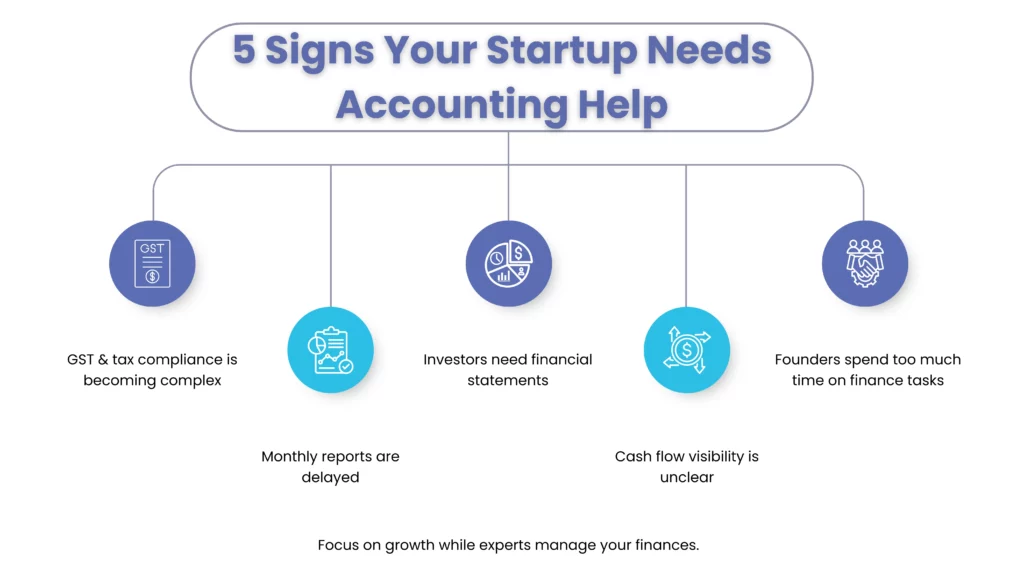
- Series A onwards: a full-time finance lead or virtual CFO. Signals you’ve crossed the line, monthly close taking more than 10 days, you can’t answer “what’s our burn?” without opening four files, investors asking for cohort-level unit economics, or you’re preparing for a formal audit or ESOP valuation.
Your books shouldn’t be the reason a term sheet stalls.
Corient handles bookkeeping, GST, TDS, ROC and statutory audit for 200+ Indian startups, from pre-seed to Series B. Fixed monthly pricing, no surprises at year-end.
People Also Ask:
Is accounting mandatory for a startup with no revenue?
Yes. Every private limited company must maintain books, file an annual income tax return, complete a statutory audit, and file ROC returns even with zero revenue or transactions.
Do I need GST registration from day one?
Not necessarily. Registration becomes mandatory above ₹40 lakh turnover for goods and ₹20 lakh for services in most states. Many B2B startups register voluntarily earlier so their customers can claim input tax credit.
What are the tax exemptions available for startups in India?
Under Section 80-IAC of the Income-tax Act, turnkey of startups under DPIIT recognition can avail 100% deduction for three consecutive years during the initial period of 10 years from incorporation with a limit of turnover of ₹100 crore and is required to obtain a certificate from Inter-Ministerial Board.
Can I do my own startup accounting and bookkeeping?
Yes, for the first few months. Recording transactions and reconciling bank statements in Zoho Books or Tally is manageable. Statutory audit, ROC filings and tax returns must involve a qualified professional.
Should startups hire an Accountant for their bookkeeping?
Yes, for most companies at the early and growth stage. Outsourcing provides bookkeeping, statutory filings, and CFO-level advice without the expense of a full finance team allowing founders to concentrate on the product and
What changed with the Income-tax Act, 2025?
It replaced the Income-tax Act, 1961 from 1 April 2026, consolidating over 800 sections into 536 across 23 chapters and introducing the single “Tax Year” concept. Rates and slabs are broadly unchanged; section numbers are not.
How long must startups keep accounting records in India?
At least eight financial years, per Section 128 of the Companies Act, 2013 — and longer if any assessment or proceeding is pending.
Conclusion
Startups accounting in India isn’t complicated, but it is unforgiving of neglect. Incorporate correctly, open a clean current account, pick software with a working audit trail, close your books monthly, and put every deadline in the table above into a shared calendar with an owner’s name against it.
Do that, and when the term sheet arrives, diligence takes two weeks instead of two months. That difference has killed deals.
Note: This guide is general information, current as of July 2026, and not a substitute for professional advice. Tax and compliance rules change frequently, confirm your specific position with a practising Chartered Accountant or Company Secretary.