



The Indian food service sector is going through rapid change, with the organized segment of the industry projected to keep gaining share through 2026-2027. According to the National Restaurant Association of India’s Food Services Report, the sector is worth roughly Rs 5.69 lakh crore, contributes 1.9% to GDP, and employs over 8.5 million people directly, figures that are only climbing as restaurants, QSR chains, and cloud kitchens expand into Tier 2 and Tier 3 cities.
As this growth accelerates, restaurant accounting has become the critical dividing line between outlets that scale profitably and ones that quietly bleed cash. Whether you run a single premium fine-dining property or a multi-location QSR chain, staying on top of your daily financial health is non-negotiable.
This guide covers exactly what mid-to-large-scale restaurant owners in India need to know about restaurant accounting, GST compliance, and system selection for 2026-2027
What Is Restaurant Accounting?
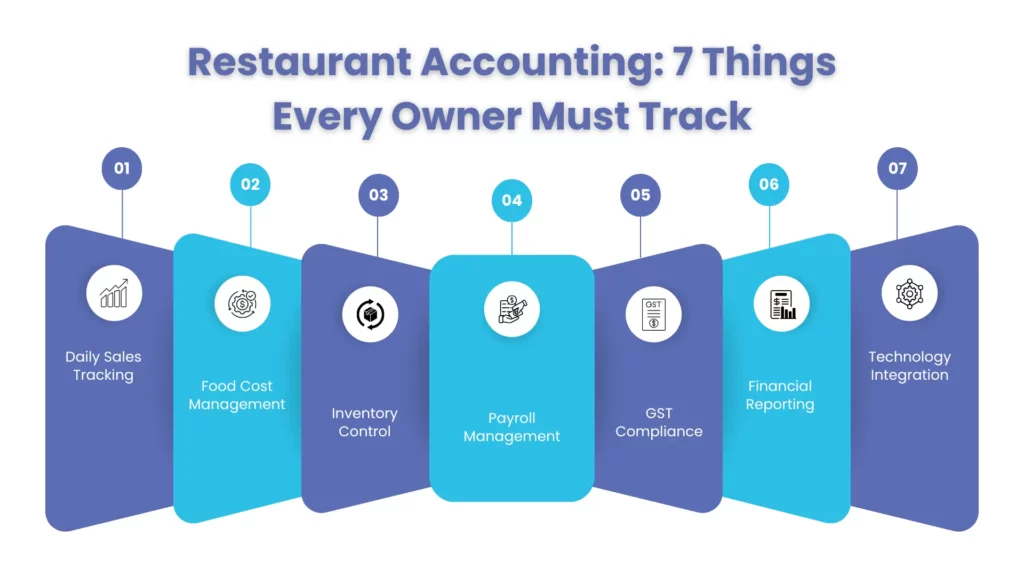
Restaurant accounting is simply the process of recording, organising, and understanding all the money coming into and going out of a food business. It is different from accounting for a service business because restaurants deal with daily challenges like food stock that can spoil, frequent cash and UPI payments, and changing staff costs due to different shifts, weekends, and busy seasons.
For a medium or large restaurant, accounting is not just about adding up daily sales. It includes tracking food costs, managing supplier payments and customer dues, checking the actual amount received from platforms like Zomato and Swiggy after their commissions, handling employee salaries, and following GST and income tax rules. If any of these areas are not managed properly, the business may not have a clear picture of its actual profits and financial health.
Why It’s Worth Getting Right
The Indian food services industry is highly competitive. As the prices of real estate in metropolitan cities are increasing along with the fast growth into smaller cities, there may be little room for profits.
There are several reasons why correct accounting for restaurants is crucial:
- Control of profitability: calculating prime cost COGS plus labor allows owners to maintain their spending within the standard threshold of 65% of total sales.
- Compliance with tax rules: India’s GST rules require restaurants to keep proper records of all invoices. Good accounting helps restaurants avoid mistakes, penalties, and compliance issues. Businesses can check the latest GST rates and updates on the official GST Portal.
- Smart menu optimization: Accurate monitoring of what dishes generate maximum margin and what ones are associated with the most food waste allows owners to adjust pricing and prevent losses.
The Basics Every Restaurant Owner Should Know
A few concepts do most of the heavy lifting here, and they’re worth understanding rather than leaving entirely to your accountant.
Prime cost:
It is the number that matters most cost of goods sold plus total labour cost, including statutory dues. Most operators aim to keep this under 65% of sales; go much above that and there’s little room left for rent, utilities, and profit.
Accrual vs. cash accounting:
Trips a lot of owners up, cash accounting only records money when it hits the bank, which hides a lot. Basic restaurants accounting for anything beyond a tiny outlet works better on the accrual method, recording revenue and expenses when the transaction happens rather than when cash actually moves.
Food cost percentage:
Ingredient cost divided by revenue those dishes brought in tells you fairly quickly if something’s off. A number creeping upward usually means wastage, over-portioning, or a supplier quietly raising prices.
Then there’s cash flow, which isn’t the same as profit, however many owners want it to be a great P&L on paper can still mean a cash crunch if payroll and supplier dues land the same week. Add the basics of staying registered your FSSAI license, GST registration, professional tax, and shop establishment paperwork and you’ve got the foundation any credible restaurants accounting system is built on.
How to Do Restaurant Accounting Step by Step
There’s no shortcut here, but there is a routine that works:
- Record sales daily, split by food, beverage, and aggregator payouts, checking the cashier summary against the register each day rather than at week’s end.
- Log expenses as they happen, sorted under food cost, liquor cost, payroll, rent, and utilities lump these together and food cost percentage stops meaning anything.
- Count inventory regularly weekly works for most kitchens so COGS is based on what’s actually on the shelf, not an estimate.
- Reconcile POS against the bank weekly, matching UPI, card, and corporate payouts to what the system billed.
- File GST on time through the GST Portal GSTR-1 and GSTR-3B, on whatever cycle your registration requires.
- Close the month properly with a P&L, balance sheet, and cash flow statement, instead of reconstructing it all at year-end.
Do this consistently and how to do restaurant accounting stops being a once-a-year panic and turns into routine housekeeping.
Choosing the Right Restaurant Accounting System
At some point spreadsheets can’t keep up, usually right around the second or third outlet. A proper restaurant accounting software setup earns its cost back quickly if it pulls sales straight from your POS without manual entry, reconciles aggregator commissions automatically instead of leaving that to a tired manager at midnight, generates GST-compliant invoices at the correct rate, and handles recipe-level costing so ingredient use ties directly to what’s sold.
| Feature to Look For | Why It Matters for Large Businesses | Recommended Tool/Platform |
| POS & Aggregator Integration | Automates Zomato/Swiggy reconciliation and cuts out manual sales entry errors | TallyPrime, Chefdesk |
| GST-Compliant Invoicing | Applies correct tax rates automatically and keeps pace with rule changes | Zoho Books, myBillBook |
| Kitchen Order Ticket (KOT) Linking | Ties prep time and cost directly to each order | Gofrugal, Focus e-RMS |
No tool is magic on its own; a restaurant accounting software is only as good as the discipline behind it, but a decent platform removes most of the manual error that creeps in when everything’s tracked by hand.
Common Mistakes That Quietly Hurt Restaurants
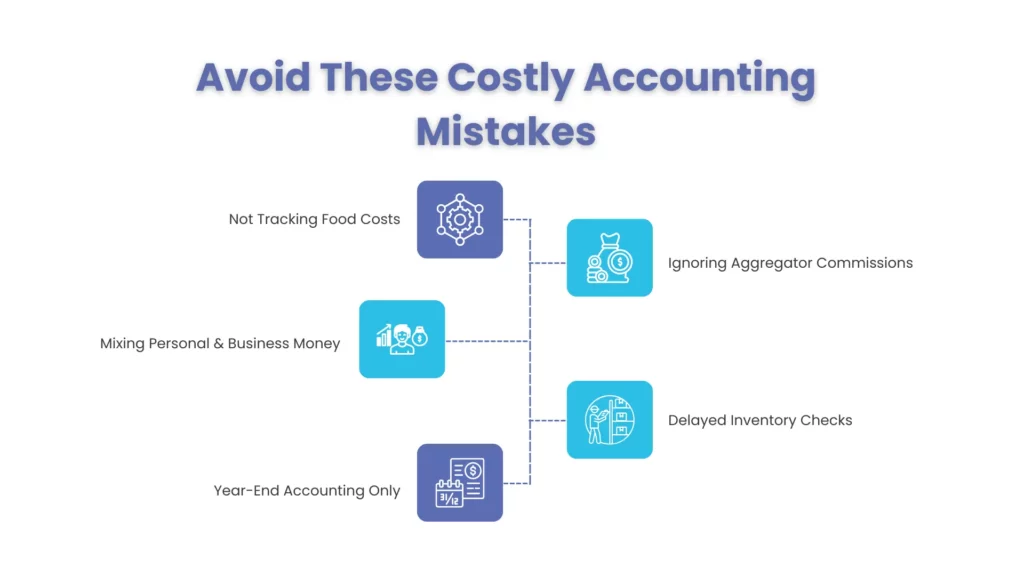
Some of these sound obvious, yet they’re everywhere. Over-ordering perishables while under-ordering fast movers is a classic: it ties up cash in stock that ends up in the bin, and a disciplined weekly count catches most of it.
Not reconciling aggregator commissions is another quiet killer. Zomato and Swiggy take a real cut, and if accounting for restaurant operations doesn’t track that precisely, you can run delivery orders at a loss without noticing. Mixing personal and business money is still shockingly common too; it muddies your real numbers and creates tax headaches later.
Then there’s tax record-keeping missed input tax credit, sloppy PF/ESI filings, the kind of thing that draws penalties fast. The Ministry of Corporate Affairs publishes updated compliance requirements regularly, worth checking rather than assuming last year’s rules apply. Underlying all of these: treating restaurant accounting as an annual task instead of a weekly habit.
When to Bring in Outside Help
- Your accounting software works fine, but your books still feel out of control
- You’ve added new outlets or a central kitchen, and dividing costs between them is a mess
- You’re not sure how to split shared expenses like rent, staff, or raw material costs across locations
- You’re raising outside funding, and investors want financials you don’t have ready
- GST filing has gotten more complex than a simple monthly return
- You’re spending nights reconciling numbers instead of running the kitchen
- Growth has outpaced what your current in-house team can realistically handle
Bringing in outside help isn’t a sign something’s broken, it’s what frees you up to focus on the restaurant, not the reconciliations.
Good Food Deserves Good Books. You didn’t get into the restaurant business to chase invoices at midnight. Let Corient handle the books.
Conclusion
Restaurant accounting was never really about ticking a compliance box. Done properly, it’s what tells you, honestly, whether the business is working and what keeps you out of trouble with GST, FSSAI, and income tax rules that keep shifting year to year. Whether you’re nailing down basic accounting for restaurants in one location or building a full restaurants accounting system across a chain, the habit is the same: reconcile often, file on time, and look at the numbers monthly instead of waiting for tax season.
If you’d rather hand this off to people who do it for a living, Corient Business Solutions works with large and mid-size Indian restaurant and hospitality businesses on accounting, payroll, and tax compliance. Reach out to Corient Business Solutions for a restaurant accounting system built around how your business actually runs in 2026-27.