


Accounting practices are the standardised methods used by organisations to record, classify, and report financial transactions. In India, they are governed by three key laws:
- Companies Act 2013 — financial reporting and book-keeping
- Income Tax Act 1961 — tax compliance and TDS
- CGST Act 2017 — GST compliance and reconciliation
The eight main types: financial, management, cost, tax, audit & assurance, forensic, government, and project accounting.
If you run a business in India, accounting isn’t just about keeping books — it’s about surviving scrutiny. Whether you’re filing GSTR-3B at midnight or navigating an Ind AS restatement, the quality of your accounting practices determines your compliance risk and your decision-making clarity.
India has over 4 lakh registered Chartered Accountants (ICAI) and 1.4 crore active GST registrations as of mid-2024 (GSTN). For this volume of financial activity, robust accounting practices aren’t optional — they’re the foundation of every audit-clean balance sheet and every on-time filing.
Industry Trends & Statistics in India’s Accounting Sector (Key Trends & Stats)
The digital revolution in the Indian accounting companies is fast gaining momentum owing to increasing regulations and technology uptake in the field. The adoption of the GST regime under the CGST Act, 2017 has changed the approach taken towards record keeping and it necessitates those invoices are now tracked in real-time and tax reconciliation is automatic.
Important Industry Figures:
- A significant number of SMEs in India have shifted towards cloud computing for their accounting purposes. Many accounting companies in India shifted toward cloud-based applications like Tally, Zoho Books, and SAP B1 have led in terms of market dominance in this regard.
- As per the NASSCOM Industry Report for the year 2023-24, the Indian BPM industry earned around USD 4 billion via the APO model.
- Convergence to Ind AS (Indian Accounting Standards) based on IFRS (International Financial Reporting Standards) has been achieved in listed and large unlisted companies totaling more than 5000.
- The financial accounting process is experiencing changes in the form of automated invoicing, AI expense classification, and real-time financial dashboarding.
- India had over 1.4 crore active GST registrations as of mid-2024 (GSTN), making GST-compliant accounting a non-negotiable requirement for the vast majority of businesses.
8 Types of Accounting Practices – With Features, Focus Areas & Enterprise Priority
| Types | of Key Attributes | Area of Emphasis |
| Financial Accounting | Balance sheet, Profit and Loss statement, cash flows | External reporting; Companies Act 2013, Ind AS, ICAI standards |
| Management Accounting | Budgeting, variance analysis, key performance indicators | Internal decisions; strategic planning and efficiency |
| Cost Accounting | Product costing, activity-based costing, cost volume profit | Optimizing costs for manufacturing or service activities |
| Tax Accounting | GST calculations, TDS calculations, IT returns, deferred taxes | Income Tax Act 1961 and GST law compliance |
| Audit and Assurance | Internal and statutory auditing procedures, verification | Verification and financial soundness |
| Forensic Accounting | Fraud identification, litigation assistance, dispute settlement | Disputes investigation and resolution |
| Government Accounting | Accounting on fund basis, budget tracking | Financial management of public funds |
| Project Accounting | Cost tracking of project, milestone billing, work-in-process | Financial management for project-oriented activities |
Indian GAAP vs Ind AS — Key Differences Every Business Must Know
One of the most common questions from Indian CFOs and finance managers is how Indian GAAP differs from Ind AS (Indian Accounting Standards aligned with IFRS). Here is a concise comparison:
| Parameter | Indian GAAP | Ind AS (IFRS-aligned) |
| Governing body | ICAI / MCA | MCA (notified under Companies Act 2013) |
| Applicability | Unlisted companies below threshold; SMEs | Listed companies + Net worth ≥ ₹250 crore |
| Revenue recognition | Based on completion of transaction | 5-step model (Ind AS 115, based on IFRS 15) |
| Financial instruments | Cost-based measurement | Fair value measurement (Ind AS 109) |
| Leases | Operating vs finance lease distinction | All leases on balance sheet (Ind AS 116) |
| Presentation format | Schedule VI / Revised Schedule III | Schedule III (Division II) |
| Consolidation | Required for subsidiaries | Required; stricter control definition (Ind AS 110) |
Note: Companies below the Ind AS threshold may voluntarily adopt it. Unlisted NBFCs with net worth ≥ ₹250 crore must also comply.
7 Key Features of Good Accounting Practices Under Indian Standards
The adoption of best accounting practices that contribute to financial reliability and regulatory compliance include:
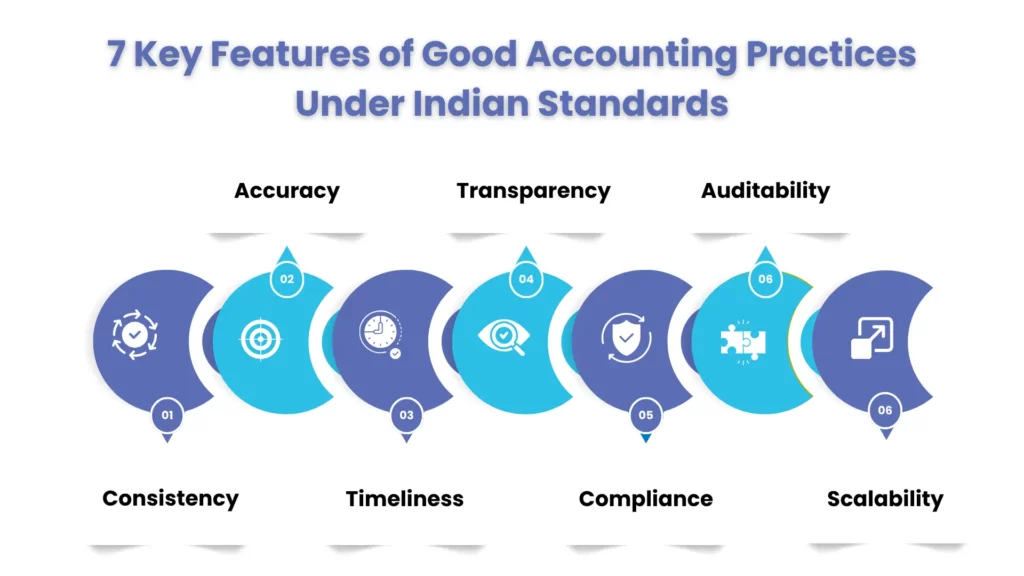
- Consistency
It becomes possible to compare reports and analyze trends through the use of a consistent approach to accounting. Transactions similar in nature should be consistently accounted for using Indian GAAP and Ind AS standards. - Accuracy
Accurate recording and documentation minimize errors and audit findings. Double entry book keeping systems and automated reconciliation utilities boost reliability. - Timeliness
Recording and reporting cycles are regular and aid to decision making. The statutory timelines for monthly closures, quarterly reviews and annual audits are adhered to. - Transparency
Good presentation and disclosure work towards the development of trust by the stakeholders. Transparency of financial statements is provided for by Schedule III of the Companies Act 2013. - Compliance
By following statutory requirements, such as Ind AS filing, TDS deposits and filing of GST, penalties and legal liability is avoided. - Auditability
Statutory audits are carried out smoothly with well documented and documented transaction trails. Proper maintenance of books of account is required as per provision of section 128 of Companies Act. - Scalability
New and growing companies need to flex within their accounting systems, but not change the fundamentals. Cloud ERP systems are scalable to growing businesses.
Accounting Software for Indian Businesses — Which One to Use?
The right software makes compliance easier. Here’s a practical side-by-side for Indian businesses:
| Software | Best For | GST Integration | Ind AS Support | Starting Cost |
| Tally Prime | Large Enterprise,SMEs, MSMEs | Built-in, strong | Partial | ~₹18,000/yr |
| Zoho Books | Startups, freelancers | Strong | Limited | Free – ₹2,999/mo |
| SAP Business One | Mid-market, enterprise | Strong | Full | ₹3–5L+ implementation |
| QuickBooks India | Small businesses | Good | Limited | ~₹12,000/yr |
Tally Prime leads for SMEs and Enterprise given its deep GST regime integration and India-wide support network. Enterprises with global consolidation requirements typically choose SAP.
E-Invoicing Under GST — What Every Indian Business Needs to Know
Since October 2022, e-invoicing is mandatory for businesses with annual aggregate turnover above ₹5 crore. (GSTN e-Invoice Portal)
How the process works:
- Generate the invoice in your accounting software
- Upload it to the Invoice Registration Portal (IRP)
- IRP validates and returns an IRN (Invoice Reference Number) + QR code
- Share the signed e-invoice with your buyer — GSTR-1 is auto-populated
Accounting impact: E-invoices auto-populate GSTR-1, significantly reducing manual reconciliation work and ITC mismatch errors. Non-compliance attracts a penalty of ₹10,000 per invoice under Rule 48(5) of CGST Rules.
Worked Example: Journal Entries for an Indian Manufacturing Company
| Account | Dr (₹) | Cr (₹) |
| Debtor / Trade Receivables A/c | 1,18,000 | |
| Sales A/c | 1,00,000 | |
| Output CGST A/c (9%) | 9,000 | |
| Output SGST A/c (9%) | 9,000 | |
| (Being goods sold with 18% GST — GSTR-1 filing obligation triggered) | ||
Note: The above applies to intra-state transactions. For inter-state transactions, IGST @18% replaces CGST + SGST — a common source of error for new GST registrants. Always check the buyer’s GSTIN state code before applying the tax split.
Example 2 — TDS deduction on professional fees of ₹50,000 (Section 194J, 10% TDS)
| Account | Dr (₹) | Cr (₹) |
| Professional Fees A/c | 50,000 | |
| TDS Payable A/c (194J) | 5,000 | |
| Vendor / Creditor A/c | 45,000 | |
| (Being TDS deducted at source; to be deposited by 7th of following month via Challan 281) | ||
Accounting Practices in the Indian Enterprise Context
Indian enterprises face unique accounting problems that arise because of their structure and the legal framework surrounding them. It is essential to understand these context-specific problems to ensure proper accounting:
Cash vs. Accrual Accounting
Section 128 of the Companies Act prescribes the use of accrual accounting for the majority of Indian companies. However, smaller enterprises with turnover under ₹2 crore may opt for presumptive taxation under Section 44AD, effectively using a simplified cash-equivalent method.
GST Accounting Requirements
GST businesses are required to have three separate registers of input tax credit, output tax liability and transactions made across states. It is essential to manage invoice-level data systematically as part of the process for monthly filing of GSTR-1 and GSTR-3B.
Compliance Penalties at glance
- Late GST filing → Penalty under Section 47, CGST Act
- TDS default → Interest under Section 201, Income Tax Act
- Books not maintained → Prosecution under Section 128 read with Section 147, Companies Act 2013
- E-invoice non-compliance → ₹10,000 per invoice under Rule 48(5), CGST Rules
6 Common Accounting Mistakes Made by Large-Cap Indian Companies (and How to Avoid Them)
Fair Value Errors — The Accounting Practice Most Large-Caps Get Wrong
Using internal estimates when market data exists violates Ind AS 113 accounting practices. Hire a SEBI-registered valuer, document the methodology, and file it every reporting period. Auditors are specifically checking this — a qualified opinion here is entirely avoidable.
The Lease Accounting Practice That Still Haunts Balance Sheets
Post Ind AS 116, any lease over 12 months must follow proper on-balance-sheet accounting practices — no exceptions. Aggressive short-term exemptions or ignored renewal options make your debt look lower than it is. Lenders and rating agencies will spot it before you do.
Related Party Accounting Practices Stuck in 2021
SEBI’s April 2022 overhaul changed the accounting practices around RPT approvals — new thresholds, stronger audit committee obligations, broader shareholder approval requirements. Many listed companies are still following outdated practices. Fix the workflow before a SEBI notice forces you to.
Deferred Tax — An Accounting Practice Built on Hope
Sound accounting practices require reasonable certainty of future taxable profit before recognising a DTA under Ind AS 12 — not optimism. Loss-making companies and those carrying large MAT credits are most exposed. When the write-down hits, it’s public and painful. Every DTA needs a board-approved forecast behind it.
Consolidation Accounting Practices
That Compound Quietly Intra-group transactions not eliminated, NCI miscalculated, inconsistent accounting practices applied across subsidiaries — none of these feel urgent until they cause a restatement. A Group Reporting Manual with standardised practices and a proper consolidation tool catches most errors before they snowball.
Audit Trail — The Accounting Practice Compliance Gap Your ERP Is Hiding
Since April 2023, maintaining a tamper-proof transaction log is a mandatory accounting practice under MCA rules. Many SAP and Oracle ERP configurations have super-user settings that technically break this requirement. Statutory auditors must now report gaps under CARO 2020. Run an IT configuration audit well before year-end — not after the auditor finds it first.
Trusted by 500+ Indian businesses for GST, Ind AS, and ROC compliance.
Get a free consultation and see how we can clean up your accounting practices in 30 days.
People Also Ask:
What do you mean by accounting practices? Discuss their importance in India.
Accounting practice refers to the process of systematically preparing and presenting the accounts in an orderly fashion. It enables Indian companies to adhere to the Companies Act, GST law, and Income Tax Act requirements. It promotes transparency, aids in auditing, and offers reliable data for making decisions.
Explain the differences between bookkeeping and accounting.
Bookkeeping records daily transactions — receipts, bills, bank entries. Accounting uses that recorded data to classify, interpret, and report financial information for decision-making. Sound accounting always starts with accurate bookkeeping.
List the five fundamental accounting concepts.
The five major accounting concepts include the Business Entity Concept, Going Concern Concept, Revenue Recognition Concept, Consistency Concept, and Matching Concept.
How do I stay GST-compliant in my accounting practice?
Reconcile ITC with GSTR-2B every month, file GSTR-1 and GSTR-3B on time, use e-invoice-compatible software if your turnover exceeds ₹5 crore, and ensure your ERP maintains a tamper-proof audit trail.
How do modern accounting practices differ from traditional accounting practices?
Modern accounting practices include cloud-based accounting, automated systems via bank feed accounts, GST integration, and AI technology. Traditional accounting systems involved manually recorded ledgers and regular reconciliations.
Which accounting software is best for large enterprises in India?
For large enterprises, SAP S/4HANA leads for multi-entity consolidation, Ind AS compliance, and GST portal integration. Oracle NetSuite suits businesses with international subsidiaries needing IFRS/Ind AS dual reporting. Microsoft Dynamics 365 Finance is a strong option for organisations already in the Microsoft ecosystem. The right choice depends on your subsidiary structure, implementation budget, and whether global consolidation or India-specific compliance depth is the higher priority.
Conclusion
Accounting practices are the foundation of financial integrity and regulatory compliance for Indian companies. Whether you’re navigating Ind AS for the first time, setting up a GST reconciliation workflow, or ensuring your ERP meets MCA audit trail rules, getting your accounting structure right from the outset saves significant cost and risk downstream. For complex compliance needs, work with an ICAI-registered Chartered Accountant who understands your sector and scale.
Need expert help? Corient Business Solutions offers end-to-end accounting support through ICAI-registered Chartered Accountants — covering Ind AS, GST, MCA audit trail, and Income Tax compliance, so your books stay accurate, timely, and audit-ready.