


Bookkeeping for startups in India is the daily recording, categorising and reconciling of every business transaction using double-entry, accrual-based accounting software with an audit trail, as the Companies Act, 2013 requires for companies. It keeps your cash runway visible, GST and TDS filings accurate, and your books ready for investor due diligence.
Imagine a B2B SaaS or D2C business grows from ₹2 crore to ₹18 crore in revenue in FY 26-27.Now, let’s assume a B2B SaaS or D2C business grows from ₹2 crore to ₹18 crore in revenue during FY 26-27. Bookings are promising but enterprise customers pay late, the cloud bill does up, tax deductions are lost. Without a bookkeeping system, the founder spots the cash shortage only when payroll is due.
According to the Ministry of Commerce and Industry, DPIIT had recognised 2,50,046 startups by October 2026, and over 55,200 were recognised in FY 2025-26 alone. All of them need reliable books.
This guide to Bookkeeping for Startups will focus on what metrics to monitor, what you can do to safeguard your cash flow, and how to stay compliant on GST, TDS and audit trail, what bookkeeping costs and which software to use, as well as when outsourcing is worth considering for the growth of startups and the accounting firms that support them.
What is Bookkeeping for Startups
Bookkeeping for start-ups is a daily process of recording, categorising and reconciling all transactions that a growing business undertakes. A high-growth business requires records that are tailored for high transaction volumes, investor due diligence, and good corporate governance, unlike a typical small business that only needs to keep records for annual tax calculations.
Section 128 of the Companies Act, 2013, requires the companies to keep books of account in the double entry system on an accrual basis. Rule 3(1) of the Companies (Accounts) Rules, 2014 applies this to every company using accounting software for financial years starting on or after 1 April 2023. The software must record an audit trail of each transaction, keep an edit log of changes with dates, and ensure the audit trail cannot be disabled. Statutory auditors must report on this under Rule 11(g) of the Companies (Audit and Auditors) Rules, 2014.
Two further rules matter if you use cloud software. Rule 3(5) requires daily backups of electronic books on servers located in India, and Rule 3(6) requires companies whose books sit on a third-party server to intimate the service provider details annually with their financial statements (summary of the rules). LLPs and proprietorships are outside Rule 3(1), but GST law still requires an edit/delete log for electronic records.
Bookkeeping for Startups: What Should Founders Track From Day One?
Keeping ledgers clean through Bookkeeping for Startups from incorporation saves costly clean-up prior to due diligence or audit. Monitor these 6 things since you lay your first rupee as capital:
- Equity and convertible instruments: Keep a note of all seed cheques, SAFE notes, Compulsorily Convertible Preference Share (CCPS) and ESOP grants in Share Capital, and keep the cap table matched to the ledger.
- Customer receipts and deferred revenue: Cash collected in advance but revenue not earned, especially annual subscriptions. Most startups follow Indian GAAP (Accounting Standards), so recognise revenue as the service is delivered. Ind AS applies only to listed and larger unlisted companies; confirm with your CA.
- Track direct costs separately: logistics and gateway fees separate from general overheads to ensure gross margin is correct.
- Payroll and Statutory Deductions: Monitor salaries, contractor payments, Provident Fund, ESI, Professional Tax and TDS each pay cycle.
- Spending for founders: Get a digital receipt and provide a business justification for the expense.
- Fixed assets: Maintain an asset register including dates of purchase, depreciation and and capitalise eligible software development costs.
How Can Startups Use Bookkeeping to Manage Cash Flow?
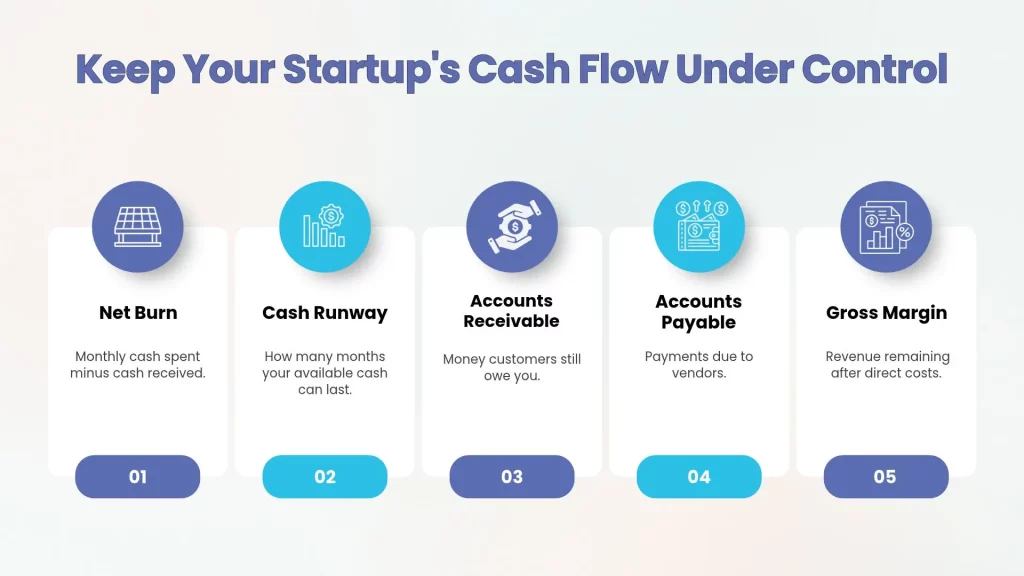
Not all profit on an income statement translates to cash in the bank. Good bookkeeping for startups transforms past transactions into a real-time glimpse of cash flow.
1. Record net burn and runway weekly
Reconcile bank accounts at least once a week instead of quarterly. Gross burn is all cash you spend in a month. Net burn is cash spent minus cash received in that month. Runway in months = unrestricted cash ÷ net burn
Example: Example: you hold ₹24 lakh, spend ₹8 lakh a month and collect ₹2 lakh a month. Net burn is ₹6 lakh, so runway is 24 ÷ 6 = 4 months. It’s best to begin fundraising or cost-cutting long before the runway is that short.
2. Follow strict receivables ageing policy.
Group overdue invoices into 30-, 60- and 90-day buckets as part of a disciplined order-to-cash process, send structured reminders, and consider invoice discounting through RBI-regulated TReDS platforms where eligible.
Late payment is a national problem. Micro and small enterprises had filed 2,56,892 delayed-payment applications worth ₹55,244 crore on the MSME Samadhaan portal, per figures the government gave Parliament. If your startup sells to large buyers, the same payment-delay risk applies to your receivables.
3. Ring-fence statutory and tax liabilities
One of the most common cash traps is paying expenses that are tax and/or TDS collected for everyday business activities. Startups with well-structured bookkeeping have these dues in a separate reserve account, and funds are set aside for statutory payments before discretionary funds are used.
4. Time payables around receipts (and the MSME payment rule)
Do not pay vendors on an earlier than due date, a disciplined account payable process preserves working capital without late fees. One exception: under Section 43B(h) of the Income Tax Act, amounts owed to registered micro and small enterprise suppliers are deductible only when actually paid, and payment must be made within 15 days (no written agreement) or 45 days (with agreement) to claim the deduction in the year of accrual. Tag MSME vendors in your books and pay them inside that window. Confirm current limits with your CA.
7 Bookkeeping Practices That Help Startups Scale in India
As transactions grow from hundreds to thousands a month, ad-hoc accounting breaks down. These seven practices keep bookkeeping for startups scalable:
| Practice | What to do | Why it helps |
| 1. Ring-fence business banking | Use dedicated current accounts and company cards | Faster reconciliations and clean governance |
| 2. Standardise the chart of accounts | Set categories by department: R&D, sales, G&A, direct costs | Instant view of CAC, gross margin and departmental burn |
| 3. Use audit-trail software | Choose cloud tools with a permanent edit log and India-hosted backups | Supports audit reporting under the Companies (Audit and Auditors) Rules |
| 4. Automate bank and gateway feeds | Connect Razorpay, Stripe, PayU and bank accounts to the ledger | Fewer entry errors and automatic fee matching |
| 5. Close books by the 10th | Follow a monthly checklist for accruals, prepaid items and reconciliations | Timely MIS packs for founders and investors |
| 6. Digitise documents | Attach invoices, purchase orders and contracts to entries | Audit-ready files and eight-year retention |
| 7. Reconcile multi-entity ledgers | Track branches, warehouses and subsidiaries separately | Smoother consolidation when you expand |
Which Accounting Software Should an Indian Startup Use?
Popular options for Bookkeeping for Startups include Tally, Zoho Books and QuickBooks, with ERP modules for businesses that manage inventory across warehouses. Whatever you choose, check these before buying:
- The edit log cannot be switched off (get this confirmed in writing from the vendor).
- Backups are held on servers in India, or the vendor supports the Rule 3(5) and 3(6) requirements.
- It supports GST returns and e-invoicing, TDS, and bank and payment-gateway feeds.
- It offers role-based access and approval workflows before you reach Series A.
How Much Does Bookkeeping Cost for an Indian Startup?
The cost of Bookkeeping for Startups depends on four things: monthly transaction volume, number of entities and bank accounts, whether GST/TDS compliance and MIS reporting are included, and whether you use freelancers, an in-house hire or an outsourced finance and accounting team.
Which Financial Reports Should Startups Review Every Month?
Data from bookkeeping for startups creates value only when someone reviews it. Generate these five reports within ten days of month-end:
- Profit and loss, budget versus actual: Highlights cost overruns immediately.
- Balance sheet: Shows assets, liabilities, deferred revenue and equity.
- Cash flow statement: Reconciles profit with real cash movement across operating, investing and financing activities.
- Receivables and payables ageing: Shows trapped working capital and vendor bills due over the next 30 to 90 days.
- Unit economics and runway dashboard: Tracks MRR or GMV, gross margin, net burn and months of runway.
Monthly Close Checklist (Close by the 10th)
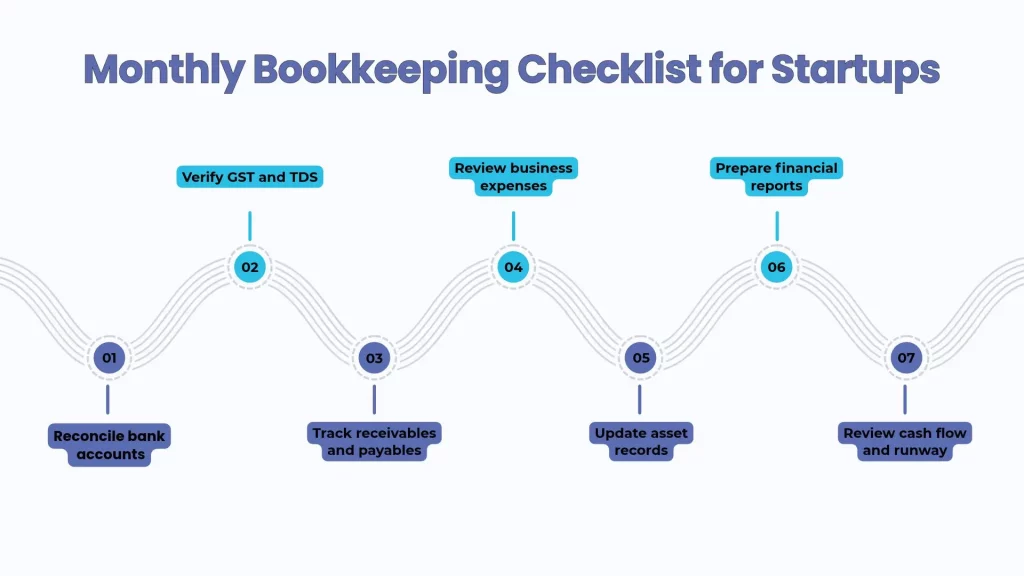
- Reconcile all bank accounts and payment-gateway settlements.
- Post accruals, prepaid expenses and deferred revenue.
- Reconcile GSTR-2B with the purchase register and review GST liability.
- Reconcile TDS deducted and deposited; check against Form 26AS/AIS.
- Review receivables and payables ageing; flag MSME vendors nearing the payment window.
- Update the fixed-asset register and depreciation.
- Match the cap table to share capital and ESOP records.
- Produce the five reports above and circulate the MIS pack.
Common Bookkeeping Mistakes That Can Affect Startup Growth
Even well-funded startups stumble over preventable errors. Accounting firms onboarding startups often find these five:
- Treating cash collected as revenue earned: Booking an annual subscription as immediate income inflates growth and distorts unit economics.
- Skipping accrual accounting: Recording expenses only when cash leaves hides unpaid bills and creates false profit spikes.
- Ignoring audit-trail requirements: Spreadsheets and legacy software without an edit log can lead to audit qualifications.
- Expensing capital items: Writing off long-term software development or hardware in one month understates profit.
- Skipping TDS reconciliation: Books that do not match your TDS credit statements can mean disallowed expenses, interest and delayed refunds.
When Should a Startup Upgrade Its Bookkeeping System?
Basic tools work at the pre-seed stage, but outgrowing them causes drag. Upgrade your bookkeeping for startups setup when:
- Manual entry across marketplaces, gateways and billing platforms becomes error-prone and month-end close drags past two weeks
- You open a foreign subsidiary or add several entities or currencies
- Inventory across multiple warehouses needs an integrated ERP module
- Series A or later fundraising approaches and investors expect approval workflows, role-based access and real-time MIS
Outsourced Bookkeeping for Startups: When Is the Right Time to Outsource?
Building an in-house team with a controller, tax specialist and bookkeepers is expensive and slow. That is why outsourced bookkeeping for startups has become a popular model for growing companies and accounting firms that need delivery capacity.
Consider outsourcing when:
- Founders spend their nights on receipts and reconciliations rather than product, sales and fundraising
- Specialist chartered accountancy skills are required for compliance work like Ind AS, Audits, TDS and Board Reporting (and Ind AS, if it applies to you).
- Seasonal hiring or an influx of new employees after funding puts your in-house team under pressure.
- You have several start-up clients and require white-label delivery capacity from your accounting firm.
How CorientBS Supports Bookkeeping and Financial Management for Startups
Corient Business Solutions (CorientBS) supports startups, mid-market businesses and accounting firms throughout India, UK and the US providing accounting startups services and more. It has a team of more than 600 accountants and finance experts located in Mumbai and Coventry, who are equipped with both accounting automation and knowledge of Indian regulations.
- Consistent team learns chart of accounts and workflows in dedicated startup accounting pods.
- Automated reconciliation and error checks the tool process invoices, match bank, and check for anomalies in the ledger.
- Daily records become cash flow forecasts and unit economics dashboards; investor-ready MIS and virtual CFO support.
- Data Security: records secure according to ISO 27001 and GDPR compliant controls.
People Also Ask:
Can outsource bookkeeping be a good fit for a small startup?
Yes. For startup teams in the seed stage, outsourced bookkeeping provides access to seasoned accounting experts, tools and compliance monitoring that an in-house finance team would not afford otherwise. Around 45% of the recognised startups are based in Tier-II and Tier-III cities where they may not be able to access specialist talent with ease.
How frequently should startups maintain their bookkeeping documents?
Balance bank accounts, payment gateway settlements & expense categories every day or at least on a weekly basis. Finally, close the books in an official way by the 10th of every month, thus, burn and runway won’t be a surprise.
What should be in the startup’s records if they want to apply for financing?
Create and submit audited/reconciled financial statements, monthly MIS reports, a cap table which is matched to the ledger, bank statements, key customer and vendor contracts, and proof of all statutory filings.
Should Indian startups be required to implement audit trail software?
For companies, yes. The accounting software must provide an audit trail of all edits, which cannot be turned off, in accordance with Rule 3(1) of the Companies (Accounts) Rules.
What is the duration for which Indian startups will have to maintain their books of accounts?
Under section 128 of the 2013 Companies Act companies are required to keep certain books of account and supporting vouchers for a minimum of 8 years.
What is the purpose of double entry bookkeeping in avoiding cash shortage?
Double entry bookkeeping systems for startups record both cash and liabilities like unpaid vendor bills, deferred revenue and statutory dues, providing a sound working capital position rather than an inaccurate balance in the bank.
Conclusion
Bookkeeping for Startups helps you save money runway, adhere to the rules of audit-trail in MCA and helps you gain investor confidence. If founders document transactions from the get-go, they generally don’t get unpleasant shocks after starting a business.
For startups, these are key habits that comprise reliable bookkeeping reconciling weekly, closing books on the 10th and reviewing the five most important reports monthly. Collect receivables quickly and maintain tax money as a separate account.
Address common pitfalls, upgrade your system when month-end is dragging and outsource when your founder time is becoming the limiting factor.
Corient Business Solutions provides bookkeeping and financial management support tailored to the needs of startups and accounting firms seeking orderly books, timely reports and enhanced financial capabilities.