




The best accounting firms for startups in India in 2026 are Corient Business Solutions, RegisterKaro, Startupfino, Jordensky, AnBac Advisors, Futurex Solutions, StartUp Accounting, Nangia Andersen, Grant Thornton Bharat and Aone Outsourcing Solutions. Choose by stage: pre-seed founders need GST, TDS and ROC compliance; funded startups also need fundraising, ESOP and virtual CFO support.
What separates a startup specialist from a general CA is hands-on experience with ESOP structuring, investor-ready books and fundraising instruments such as CCPS and SAFE-style convertible notes. The choice directly affects your fundraising readiness, your compliance record and the hours you spend on admin instead of product.
A Real-World Example: How One Missed Rule Costs a Startup
Take a two-founder D2C skincare brand in Pune. The founders incorporate a private limited company in April, launch on a marketplace in June and ship orders to customers in other states. They assume GST can wait until turnover reaches ₹40 lakh. It cannot: inter-state supply of goods triggers compulsory GST registration from the first rupee under Section 24, regardless of turnover.
Later that year, they hold their AGM on 30 September but file AOC-4 and MGT-7 90 days late. Each form attracts an additional fee of ₹100 per day with no upper cap, so the delay costs ₹18,000 (90 days × ₹100 × 2 forms) before any statutory penalty. A generalist bookkeeper may miss both issues. A startup-specialist CA builds them into the compliance calendar from day one.
This guide compares all 10 accounting firms for startups, then covers the 2026 regulatory changes, realistic costs, a full compliance checklist and how to choose the right partner.
What Changed for Startup Accounting in India in 2026
Several rules that older guides still quote are now out of date. India had over 2.25 lakh DPIIT-recognised startups as of early 2026, and each of them is affected by the changes below.
| Area | Previous rule | Current rule (September 2026) |
|---|---|---|
| DPIIT turnover limit | ₹100 crore | ₹200 crore for regular startups (G.S.R. 108(E), 4 February 2026) |
| Deep Tech startups | No separate category | Recognition up to 20 years; turnover ceiling ₹300 crore |
| Eligible entities | Pvt Ltd, LLP, registered partnership | Cooperative and multi-state cooperative societies added |
| Angel tax | DPIIT startups claimed exemption | Abolished from 1 April 2025; no longer a DPIIT benefit |
| Income tax law | Income-tax Act, 1961 | Income-tax Act, 2025 in force from 1 April 2026; “tax year” replaces previous year and assessment year |
| Startup tax holiday | Section 80-IAC | Benefit carried forward; reported as Section 140 of the 2025 Act. IMB certificate still required |
Why Startups Need a Startup-Specialist CA
A CA whose client base is retail shops and manufacturing units may not work with cap tables, convertible notes or DPIIT recognition every week. Startups accounting sits at the intersection of company law, FEMA, GST and income tax, which is why it differs from ordinary small-business bookkeeping.
A reliable startup CA brings:
- DPIIT and Startup India registration support, including eligibility checks against the 2026 limits: entity under 10 years old (20 for Deep Tech), turnover under ₹200 crore (₹300 crore for Deep Tech) and an approved entity type.
- Investor-ready financial statements that hold up during due diligence.
- Familiarity with fundraising instruments: SAFE-style notes, CCPS, CCDs and ESOP pools.
- IMB certification support for the startup tax holiday. DPIIT recognition alone does not unlock it.
- Faster turnaround on filings, with same-week answers on GST notices and investor queries.
How We Selected These Firms
We assessed each firm against five criteria:
- Published startup services: DPIIT registration, fundraising documentation or ESOP support.
- Compliance coverage: GST, TDS, ROC and income tax available in one engagement.
- Advisory depth: virtual CFO, tax advisory or cross-border capability.
- Stage fit: a clear match to pre-seed, seed, growth or scale-up needs.
- Scope transparency: service scope described publicly.
Pricing changes frequently, so request a written quote from each shortlisted firm.
The 10 Best Accounting Firms for Startups in India
The shortlist runs from boutique startup-specialist CAs to large professional networks. Use the comparison table first, then read the profiles of the firms that match your stage.
Quick Comparison: Best Accounting Firms for Startups in India
| Firm | Best Suited For | Core Strength |
|---|---|---|
| Corient Business Solutions | SMEs scaling past early stage | Process-driven accounting & back office |
| RegisterKaro | New incorporations & DPIIT registration | Registration-to-compliance bundling |
| Startupfino | Single legal + finance partner | Startup lifecycle coverage |
| Jordensky | Early to growth-stage startups | Virtual CFO & bookkeeping accuracy |
| AnBac Advisors | Growing startups needing advisory | Tax & regulatory advisory |
| Futurex Solutions | Founders outsourcing finance ops | Back-office & payroll outsourcing |
| StartUp Accounting | Pre-seed and seed founders | Startup-specific fixed packages |
| Nangia Andersen | Startups with cross-border needs | International tax & regulatory depth |
| Grant Thornton Bharat | Well-funded, scaling startups | Enterprise CFO advisory |
| Aone Outsourcing Solutions | Cost-conscious transactional needs | Bookkeeping & outsourcing |
1. Corient Business Solutions – Best for Process-Driven Accounting as You Scale
Corient works with SMEs and accountancy practices on accounting, compliance and back-office support, with process-driven, technology-led delivery. It suits founders who want one provider from early bookkeeping through post-funding reporting.
2. RegisterKaro – Best for Incorporation and DPIIT Registration
RegisterKaro is widely used for company incorporation and DPIIT registration, with accounting and compliance offered alongside. It suits first-time founders who want registration and ongoing filings from one provider.
3. Startupfino – Best Single Partner for Legal and Finance
Startupfino is built around the startup lifecycle: incorporation, fundraising documentation, compliance and accounting. It suits founders who want one point of contact across legal and financial filings.
4. Jordensky – Best for Virtual CFO at Early and Growth Stage
Jordensky focuses on CA and virtual CFO services for early-stage and growth-stage startups, a solid fit for founders who want bookkeeping accuracy paired with compliance calendars tailored to Indian filing deadlines.
5. AnBac Advisors – Best for Tax and Regulatory Advisory
AnBac Advisors offers accounting, tax and regulatory advisory, bundling routine compliance with advisory support as a company matures. It suits founders who expect to scale quickly and need advice beyond filings.
6. Futurex Solutions – Best for Outsourced Bookkeeping and Payroll
Futurex Solutions provides accounting and back-office outsourcing. It suits startups that want to hand off bookkeeping and payroll without building an in-house finance team.
7. StartUp Accounting – Best Fixed Packages for Pre-Seed and Seed
StartUp Accounting is built specifically around startup bookkeeping, GST and ROC compliance, with packages structured for pre-seed and seed-stage founders who need a predictable monthly cost.
8. Nangia Andersen – Best for Cross-Border Tax
Nangia Andersen is the accredited tax consulting and advisory member firm of Andersen Global in India, offering tax, regulatory and cross-border advisory from offices across major cities. It suits startups with foreign investors, a foreign holding company or overseas subsidiaries.
9. Grant Thornton Bharat – Best for Well-Funded Scale-Ups
Grant Thornton Bharat is one of India’s larger professional services networks, with offerings for tech-driven companies and a CFO advisory practice covering business process outsourcing, financial reporting and global mobility. It suits well-funded startups that need enterprise-grade reporting.
10. Aone Outsourcing Solutions – Best Budget Option for Transactional Accounting
Aone Outsourcing Solutions offers accounting, bookkeeping and back-office outsourcing. It is a lower-cost route for founders who mainly need transactional accounting handled reliably.
Compliance Checklist Every Startup CA Should Handle (2026)
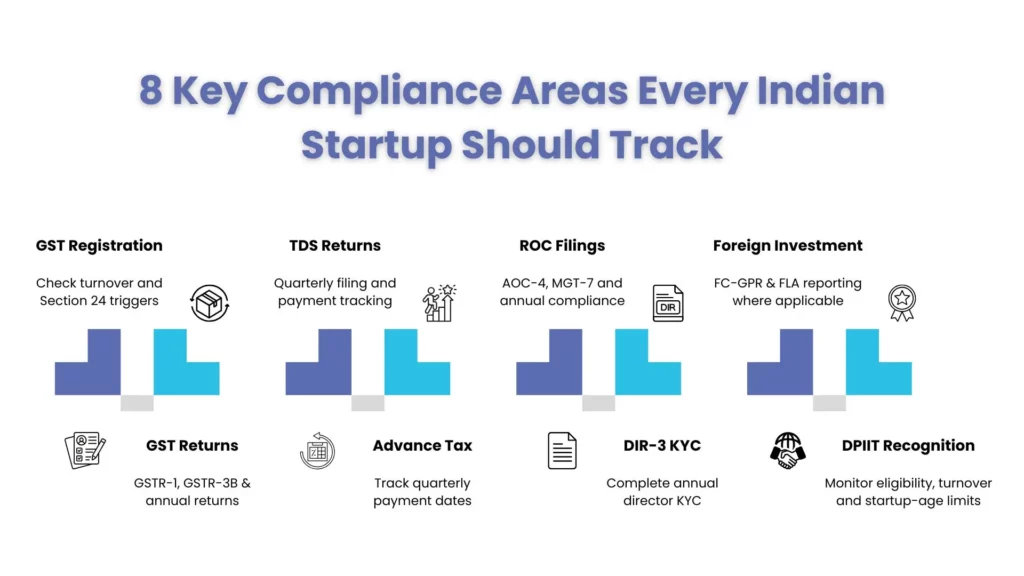
A reliable startup CA manages every item below proactively, without waiting for you to ask.
| Compliance | Deadline or trigger | Risk if missed |
|---|---|---|
| INC-20A (commencement of business) | Within 180 days of incorporation | Company cannot legally commence business; strike-off risk |
| GST registration | Turnover above ₹40 lakh (goods) or ₹20 lakh (services) in most states; lower limits in some special-category states; from the first sale for Section 24 cases | Tax, interest and penalties; loss of input tax credit |
| GST returns | GSTR-1 and GSTR-3B monthly or quarterly; GSTR-9 annually by 31 December | Late fees and interest |
| TDS returns | Quarterly, on salaries, professional fees and specified vendor payments | Interest, late fees, disallowed expenses |
| Advance tax | 15 June, 15 September, 15 December, 15 March | Interest on shortfall |
| DIR-3 KYC | 30 September each year | ₹5,000 fee and DIN deactivation |
| AOC-4 and MGT-7 | 30 and 60 days from the AGM | ₹100 per day per form, no cap; director disqualification after three consecutive years of non-filing |
| LLP Form 11 and Form 8 | 30 May and 30 October | Daily additional fees |
| FC-GPR (foreign investment) | Within 30 days of share allotment | Late submission fee; FEMA compounding |
| FLA return | 15 July each year, if foreign investment is held | RBI reporting default |
| Income tax | Company ITR; startup tax holiday tracking under the 2025 Act | Lost deductions, interest |
| DPIIT recognition | Track age and turnover limits and fund-use restrictions | Loss of startup benefits |
Missing any of these is a common reason founders switch accounting firms mid-year.
Fundraising, ESOP and Tax Holiday: Where Specialists Earn Their Fee
Fundraising compliance
- Allotment window: under the Companies Act, shares must be allotted within 60 days of receiving application money, or the funds must be refunded.
- Foreign investment: FC-GPR must be filed on the RBI FIRMS portal within 30 days of allotment, irrespective of when funds arrived.
- Valuation: shares issued to foreign investors need a valuation report confirming the price meets FEMA pricing norms.
ESOP tax deferral
ESOPs are taxed as a salary perquisite when employees exercise their options. Employees of eligible startups can defer that tax until the earliest of sale, exit or the end of the statutory window. The Income-tax Act, 2025 retains this structure with renumbered provisions. Eligibility requires the IMB certificate, not only DPIIT recognition.
The startup tax holiday
Eligible startups can claim a 100% deduction on profits for any three consecutive years within the first ten years. The gap is large: about 3,700 startups have received IMB approval, against more than two lakh DPIIT-recognised startups. Ask any shortlisted firm how many IMB applications it has filed.
CA vs Bookkeeper vs Virtual CFO: What Stage Needs What
| Role | What they handle | Stage |
|---|---|---|
| Bookkeeper | Day-to-day transaction recording and reconciliation | Pre-revenue or very early stage |
| CA (compliance-focused) | Statutory filings: GST, TDS, ROC, income tax | From incorporation onwards |
| Virtual CFO | Cash-flow forecasting, fundraising strategy, board reporting | Preparing to raise, or post-funding |
When Do You Need a Virtual CFO?
A virtual CFO works part-time or on retainer, without the cost of a full-time hire. Add one when:
- You are preparing for a funding round and investors expect a clean data room.
- Your burn rate needs active management, not just monthly reporting.
- You run multiple revenue streams or more than one entity.
- Your board asks questions your bookkeeper cannot answer confidently.
Until one of these triggers applies, a compliance-focused CA handling GST, TDS and ROC filings is usually enough.
How to Choose the Right CA for Your Startup
Before you sign an engagement letter, put every shortlisted startup accountant through these five checks:
- Check startup-specific experience: ask for examples of DPIIT registrations, IMB applications or funding rounds the firm has handled.
- Confirm turnaround times: startups often need same-week responses on GST notices or investor queries.
- Get advisory pricing in writing: so advisory costs do not creep beyond the retainer.
- Look for sector familiarity: SaaS, D2C and deep tech have distinct GST, revenue recognition and R&D documentation needs.
- Test responsiveness before signing: a firm slow to reply during sales is unlikely to be faster as a client.
Red flags to avoid
- No named CA or ICAI membership number on the engagement letter.
- Per-filing fees hidden outside the monthly retainer.
- Claims that DPIIT recognition alone secures the tax holiday.
- No compliance calendar shared within the first month.
How Corient Helps Startups in India With Accounting & CA Services
Corient works with founders who want compliance handled reliably, not a black-box outsourcing arrangement. Its finance and accounting services cover structured GST, TDS and ROC processes, purchase-to-pay workflows from vendor invoice to approved payment, and accounting support that scales with transaction volume, headcount or a funding round.
For startups not ready for a full-time CFO, Corient bridges the gap without the overhead of an in-house finance team.
Book a free 30-minute compliance health check with Corient’s CA team. We will review your GST, ROC and DPIIT status and share a written 12-month compliance calendar.
People Also Ask:
How much does a CA charge for a startup in India?
A private limited startup typically pays ₹40,000 to ₹1,50,000 a year for core compliance, or ₹5,000 to ₹15,000 a month for outsourced accounting. Virtual CFO work is billed separately.
Are startup-specialist CAs more expensive than a general CA?
Not necessarily. Pricing depends on scope and transaction volume. Advisory-heavy engagements cost more than compliance-only packages.
Is DPIIT recognition compulsory for every startup?
No. DPIIT recognition is optional, but it is a prerequisite for the startup tax holiday and allows self-certification under specified labour and environmental laws. Apply on the Startup India portal.
Does DPIIT recognition automatically give the tax holiday?
No. You need a separate certificate from the Inter-Ministerial Board, and partnership firms are not eligible for the deduction.
Is angel tax still applicable to startups?
No. Angel tax was abolished from 1 April 2025 for all investors, so it no longer affects fundraising valuations.
When should a startup hire a virtual CFO instead of a CA?
Once the business is preparing for a funding round, managing multiple revenue streams, or needs active cash-flow and forecasting support beyond routine compliance.
What happens if a startup misses ROC filing deadlines?
Each late AOC-4 or MGT-7 attracts ₹100 per day with no cap. If filings are missed for three consecutive financial years, every director is disqualified for five years under Section 164(2).
Do startups need to register for GST from day one?
Only in specific cases. Registration becomes mandatory once turnover crosses ₹40 lakh for goods or ₹20 lakh for services in most states. However, inter-state supply of goods and other Section 24 cases require registration from the first sale. Voluntary early registration helps with input tax credit and B2B credibility.
Conclusion: Choosing the Right CA Partner for Your Startup
The right accounting firm for your startup keeps filings on time, books investor-ready and your tax holiday eligibility intact under the 2026 rules. Choose based on what your business needs over the next 12 months: basic GST, TDS and ROC compliance, fundraising support or cross-border advice.
Corient Business Solutions works with founders who want compliance handled reliably, with accounting that scales as filings, fundraising and finance needs grow.