




Amazon seller accounting is the practice of recording and reconciling every gross sale, marketplace fee, GST entry, TCS and TDS deduction, refund and settlement payout flowing through an Amazon Seller Central account, so your books reflect what Amazon actually pays you, not what your sales dashboard reports.
Those two numbers are almost never the same.
Your dashboard says ₹1,02,000 for the cycle. Your bank shows ₹75,900. The missing ₹26,100 didn’t vanish, it was netted off as referral fees, FBA charges, ad spend, TCS, TDS and refunds before the payout ever left Amazon. Scale that to ₹80 lakh a year and roughly ₹20 lakh moves through your business as line items most sellers never record.
That gap is why Amazon seller accounting exists as a discipline separate from ordinary retail bookkeeping. In India, three deductions are baked into every payout:
| Deduction | Current rate | Statutory basis | Effective from |
| GST TCS (intra-state) | 0.25% CGST + 0.25% SGST | Section 52, CGST Act — Notification 15/2024-Central Tax | 10 July 2024 |
| GST TCS (inter-state) | 0.5% IGST | Section 52, CGST Act — IGST Notification 01/2024 | 10 July 2024 |
| Income-tax TDS | 0.1% of gross sales (5% without PAN) | Section 194-O, Income-tax Act 1961 → Section 393(1), Income-tax Act 2025 | 1 October 2024 |
TCS is charged on the net taxable value of supplies, sales less returns, not gross. And the ₹5 lakh annual threshold under Section 194-O applies only to resident individuals and HUFs. If you sell through a Private Limited company, LLP or partnership firm, TDS applies from the first rupee.
Most sellers have never checked which of these three they’re actually recovering. If you’re not sure, that’s the first thing worth looking at, our team runs a free 15-minute reconciliation review that tells you where your TCS and TDS credits currently stand.
What changed for FY 2026-27
- GST 2.0 — rate slabs restructured to 5% / 18% / 40% from 22 September 2025
- GSTR-3B hard-locking — outward liability non-editable since the July 2025 tax period
- IMS mandatory — Invoice Management System became a compulsory monthly step from 1 April 2026
- Income-tax Act, 2025 — replaced the 1961 Act from 1 April 2026; “Assessment Year” is now “Tax Year”
What Is Amazon Seller Accounting?
Amazon seller accounting means tracking every financial event inside Seller Central and recording it correctly in your ledger, gross order value, referral and closing fees, FBA fulfilment and storage charges, advertising spend, GST output liability, TCS and TDS credits, returns and refunds, and finally the net bank settlement.
The distinction from ordinary retail bookkeeping is simple. A shop deposits what it collects. An Amazon seller receives a net figure with fees and taxes already stripped out.
Book only the bank credit as sales and three things break at once: your P&L understates revenue, your GST liability is computed on the wrong base, and your income-tax computation inherits the same wrong number.
Because Amazon accounting involves settlement reconciliation, inventory tracking, marketplace fees and tax compliance, many growing sellers prefer working with specialised e-commerce accounting experts instead of relying on standard bookkeeping.
For Example:
a seller books ₹75,900 as “total sales” when gross sales were ₹1,02,000. GSTR-1 goes out understated. Amazon separately files GSTR-8 with the correct figure. The mismatch is sitting on the department’s system before the seller notices anything is wrong.
Why Doesn’t Your Amazon Payout Match Your Sales?
The fee stack is bigger than you think
Most sellers price cost-plus and assume a margin. Then the full stack lands: referral, closing, weight handling, FBA fulfilment, storage, long-term storage, and advertising.
For Example: A Jaipur home-décor seller running ₹18 lakh a month across three FBA warehouses had priced at 40% margin. After referral (₹150), FBA fee (₹120), ads (₹80) and storage (₹20) on a ₹1,000 SKU, plus a 12% return rate, real contribution was 22%. Two SKUs were negative. None of it was visible until fees were booked as separate expense heads instead of being netted against sales.
Proper accounting typically reveals a true margin 8–15 percentage points below the assumed figure.
Settlement timing has nothing to do with order timing
Amazon pays on a rolling cycle, disconnected from when orders were placed, and a portion of your balance sits as reserved or in deferred transactions — visible in Seller Central, not yet in your bank.
During the Great Indian Festival or Prime Day, volume spikes in one week and the return wave arrives 30 days later, often in the next GST period. Without disciplined cut-off procedure, revenue and returns land in the wrong months.
The department sees Amazon’s numbers before yours
Amazon files GSTR-8 monthly, by the 10th. That data flows into the portal against your GSTIN. Your GSTR-1 and GSTR-3B are matched against it. Mismatches between marketplace-reported and seller-filed figures remain one of the most common triggers for notices to e-commerce sellers.
How Do Amazon Settlements Actually Work?
Amazon aggregates activity over a settlement period and pays one net figure.
Net Settlement = (Gross Sales + Shipping) − (Referral Fee + Closing Fee + Weight Handling + FBA Fees + Storage + Ads + TCS + TDS + Refunds)
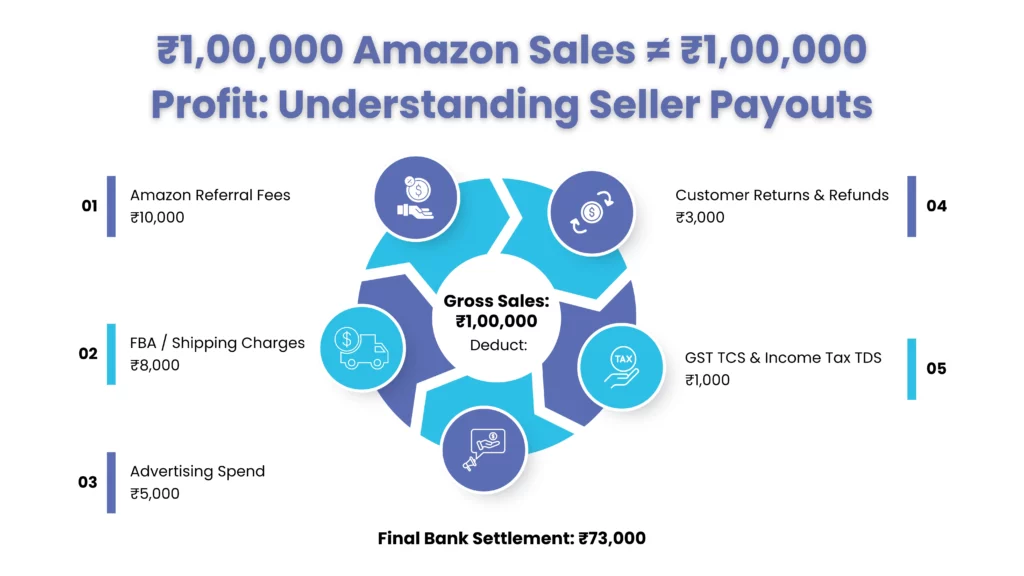
A 26% gap. Reconciliation therefore has to happen at transaction level using Amazon’s downloadable reports, never at bank-statement level.
Why Amazon’s own reports disagree with each other
The answer isn’t “one of them is wrong.”
- MTR (Merchant Tax Report) — built on invoice and shipment dates. Your source for GSTR-1.
- Payments Report — built on settlement dates. Your source for bank reconciliation.
- Date Range Report — can run on either basis, which is why it produces a third number.
All three download from Amazon Seller Central under Reports. Same period, three totals: a cut-off difference, not an error. Sellers who don’t know this spend hours hunting a discrepancy that was never a discrepancy.
Amazon Bookkeeping Workflow: 8 Steps
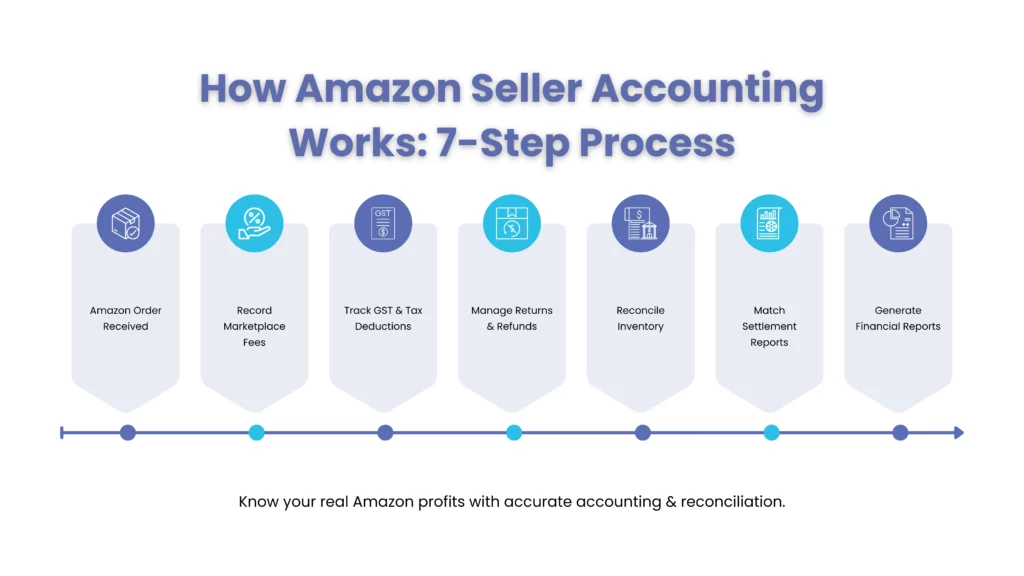
- Record gross sales: Pull the MTR and book gross order value (excluding GST) for the period the order was invoiced or shipped — not when Amazon settles.
- Record marketplace fees separately: Referral, closing, fixed, shipping and FBA fulfilment fees each get their own expense head. Net them against sales and you lose the ability to see which fee is eating your margin.
- Record GST: Output liability from the MTR. Claim ITC on inventory purchases and on Amazon’s fee invoices, which carry 18% GST.
- Record TCS and TDS: GST TCS as a receivable pending credit in the Electronic Cash Ledger; Section 194-O TDS as advance tax credit against your PAN.
- Record returns and refunds: As sales returns, reducing revenue and output GST. Booking them as an expense overstates both.
- Record inventory movement: Stock sent to FBA, sold, returned (sellable vs unfulfillable), and units lost or disposed by Amazon.
- Match bank deposits: Every credit reconciled line-by-line against its settlement report.
- Close and review monthly: Gross and net margin, ad spend as % of revenue, return rate and reconcile filings against Amazon’s GSTR-8 data before the next cycle opens.
A chart of accounts that actually works
The single biggest structural improvement most Amazon sellers can make is splitting their ledger properly:
- Revenue: Product Sales, Shipping Recovery
- Contra-revenue: Sales Returns, Cancellations
- Fees (separate heads): Referral, Closing, Weight Handling, FBA Fulfilment, Storage, Long-Term Storage, Removal, Advertising
- Statutory: Output CGST/SGST/IGST, Input Tax Credit, TCS Receivable, TDS Receivable
- Control: Marketplace Clearing Account
That last one is the practitioner’s tool. Route gross sales in and every deduction out through a clearing account. When a cycle is correctly reconciled, the clearing account nets to zero. A non-zero balance tells you something is missing before anyone files anything.
Amazon Settlement Reconciliation, Explained
Reconciliation verifies that Amazon’s bank deposit exactly equals gross sales minus fees, TCS, TDS and refunds for that period. Build it in three layers:
- Transaction level — every order matched to its fee deductions
- Settlement level — every payout matched to the bank credit
- GST level — TCS and TDS matched against the Electronic Cash Ledger and Form 26AS
Skip a layer and discrepancies accumulate silently across the year, becoming almost untraceable by the time of annual filing.
Common variance causes: refunds processed in a later cycle than the sale; promotional rebates and coupon adjustments; FBA reimbursements credited without an order reference; fee corrections Amazon posts retrospectively.
Reconcile every cycle. Tracing a ₹4,000 variance across one week is a ten-minute job; across a year it can take a full day.
Managing FBA Inventory Accounting
Your stock physically sits inside Amazon’s network, not your warehouse. Track five states: in-transit to Amazon, available at FBA, reserved for pending orders, returned (sellable vs unfulfillable), and lost or disposed by Amazon.
Pull the FBA Inventory Reconciliation Report monthly and tie it to your ledger. A gap between “units Amazon holds” and “units you shipped” affects both valuation and, for multi-state sellers, stock transfer compliance.
Reimbursements are money most sellers leave behind. Units lost or damaged inside Amazon’s network are often reimbursable, but claim windows are limited. Identify eligible units from the Inventory Ledger Report, file within the window, and book the reimbursement as other income — not sales revenue. It isn’t a supply, and treating it as sales inflates both turnover and your GST base.
Inter-state stock transfers to another state’s fulfilment centre are deemed supplies under Schedule I, requiring a delivery challan, e-way bill compliance and correct valuation, not an internal note in a spreadsheet.
GST Compliance for Amazon Sellers in India
Do you actually need GST registration?
The old answer was “yes, always, no threshold.” That stopped being universally true on 1 October 2023.
Under Notification 34/2023-Central Tax, issued under Section 23(2), a person supplying goods through an e-commerce operator is exempt from mandatory registration if all of these hold:
- supplies are made in only one State or UT
- no inter-state supply is made
- aggregate turnover stays below the Section 22(1) threshold (₹40 lakh for goods, ₹20 lakh for services; lower in special category states)
- a validated PAN is declared on the portal and an Enrolment Number obtained before any supply
Two catches. The exemption covers goods only, not services. And the moment you ship inter-state, most FBA sellers, by design, full GSTIN registration is mandatory again.
Note too that sellers supplying through an ECO liable to collect TCS cannot opt for the composition scheme.
Claiming your TCS credit, the step everyone misses
Amazon collects TCS at 0.5% and files GSTR-8 by the 10th of the following month. That amount does not land in your Electronic Cash Ledger automatically.
You have to accept it. On the GST portal, go to “TDS and TCS Credit Received,” review the entries against your records, and accept. Only then does the credit become usable against output liability.
We routinely see sellers with lakhs of rupees sitting unaccepted across many months, money that was always theirs, simply never claimed.
GSTR-3B hard-locking and IMS: the new reality
This is the most significant change to the reconciliation workflow in years, and most guidance on Amazon accounting hasn’t caught up.
Following the GSTN Advisory dated 7 June 2025, outward liability fields in GSTR-3B (Tables 3.1 and 3.2) have been non-editable since the July 2025 tax period. They auto-populate from GSTR-1 and GSTR-1A. There is no manual adjustment at filing.
The practical consequence: if you booked net settlements instead of gross sales, that error flows into GSTR-1, then into GSTR-3B, and locks. The only correction route is GSTR-1A, filed once per tax period, before GSTR-3B. Miss it and the month is closed.
On the purchase side, the Invoice Management System (IMS) became a mandatory step from 1 April 2026, with hard blocks on ITC for invoices not reflected in GSTR-2B.
Amazon’s fee invoices now arrive in your IMS dashboard, and here is the trap:
Inaction is deemed acceptance. An invoice you neither accept nor reject flows automatically into your GSTR-2B.
Log in to the GST portal, review Amazon’s fee invoices against your records, and act explicitly. ITC hard-locking on Table 4 has been signalled for around July 2026 — at which point an unreviewed invoice becomes a locked-in error.
The reframe worth internalising, transaction-level reconciliation used to be good practice. The portal now enforces it.
Filing on net settlements instead of gross sales? Under hard-locking, that error can only be corrected through GSTR-1A – once, before GSTR-3B goes out. After that the period is closed.
We review your last three cycles against Amazon’s GSTR-8 data and flag what’s still correctable.
GST 2.0: what the September 2025 rate change meant
The 56th GST Council meeting on 3 September 2025 restructured slabs into 5% / 18% / 40%, effective 22 September 2025, abolishing the 12% and 28% brackets.
For Amazon sellers this meant HSN remapping across the catalogue, repricing, and MRP re-stickering on stock already inside fulfilment centres. One point worth stating clearly: a rate reduction alone does not require ITC reversal, that applies only where a supply became exempt.
Your monthly compliance calendar
| Return | Frequency | Due | Source data |
| GSTR-1 | Monthly / Quarterly | 11th | MTR |
| GSTR-1A | As needed, once per period | Before GSTR-3B | Corrections to GSTR-1 |
| GSTR-3B | Monthly | 20th | Auto-populated; ITC from GSTR-2B |
| IMS action | Monthly | Before 14th | Supplier + Amazon fee invoices |
| TCS credit acceptance | Monthly | After 10th | Amazon’s GSTR-8 |
Income Tax: Section 194-O for Amazon Sellers
Amazon deducts TDS at 0.1% of gross sales value under Section 194-O, credited against your PAN. Without a valid PAN or Aadhaar, the rate rises to 5%.
The ₹5 lakh annual threshold is often misquoted as universal. It isn’t, it applies only to resident individuals and HUFs. Companies, LLPs and partnership firms face deduction from the first rupee, with no threshold.
Verify the credit in Form 26AS and cross-check against AIS on the Income Tax e-filing portal, then claim it as advance tax when filing. A seller doing ₹40 lakh through Amazon should see roughly ₹20,000 as GST TCS and ₹4,000 as income-tax TDS across the year, both fully recoverable, but only if reconciled.
One transition note: the Income-tax Act, 1961 was repealed with effect from 1 April 2026 and replaced by the Income-tax Act, 2025, with new Income-tax Rules, 2026.
Section 194-O carries forward as Section 393(1) at the same 0.1% rate. Substantively nothing changed; structurally, almost every section was renumbered and “Assessment Year” has become “Tax Year.”
7 Amazon Accounting Mistakes That Cost Real Money
Recording the settlement as sales: The most common and most expensive error. Understates revenue, misstates GST liability, and post hard-locking, locks that error into a return you can no longer edit.
- Netting fees against sales: Hides which fee category is destroying your margin.
- Poor FBA inventory tracking: Wrong valuation, and for multi-state sellers, incorrect stock transfer reporting.
- Treating returns as an expense: Overstates both revenue and output GST.
- Reconciling only at year-end: Dozens of unreconciled cycles isn’t a bookkeeping task, it’s a forensic one.
- Ignoring ITC on Amazon’s fee invoices: 18% GST on every commission invoice — now dependent on acting in IMS.
- Mixing personal and business expenses: Complicates the audit trail and invites scrutiny you don’t need.
Recognise three or more of these in your own books? That’s usually a structural problem with how the ledger was set up, not a discipline problem, and it’s fixable in a single clean-up cycle. Talk to our e-commerce accounting team
Best Accounting Software for Amazon Sellers in India
One clarification first, because it appears in a lot of outdated advice: QuickBooks is no longer available in India. Intuit stopped new sign-ups in 2022 and withdrew the product entirely in 2023.
| Software | GST readiness | Multi-GSTIN | Best fit |
| TallyPrime | Strong | Yes | Most Indian sellers; CA familiarity |
| Zoho Books | Strong | Yes | Cloud-first, connector ecosystem |
| Busy | Strong | Yes | Inventory-heavy sellers |
| ERPNext | Good | Yes | High volume, open source, needs setup |
Pair your ledger with a reconciliation layer, an Amazon connector or a structured template ingesting MTR, Payments and Inventory reports. Choose based on order volume, number of GSTINs, and whether you need real-time SKU profitability or just month-end compliance.
When Should You Outsource Amazon Accounting?
Four honest trigger points:
- monthly order volume moves into the hundreds or thousands
- you register for GST in more than one state for FBA
- your team can’t close books within the first two weeks of the following month
- you’ve missed a GSTR-1A correction window, or found unaccepted TCS credit
If two or more apply, the cost of getting it wrong has already overtaken the cost of getting help.
| What you need | Where we help |
| Monthly books built on settlement data | Amazon & e-commerce bookkeeping |
| GSTR-1, GSTR-1A, GSTR-3B and GSTR-8 matching | GST return filing & reconciliation |
| Section 194-O TDS credit reconciliation | Direct tax compliance |
| SKU-level margin and MIS reporting | MIS & management reporting |
People Also Ask:
What is Amazon Seller Accounting?
Amazon Seller Accounting is the practice of recording and reconciling every sale, fee, GST entry, TCS/TDS deduction, refund, and bank settlement generated through an Amazon Seller Central account, so that a seller’s books accurately reflect gross sales, true margins, and GST/income tax liability rather than just the net bank deposit.
Do Amazon sellers need GST registration even with low turnover?
Not always, since 1 October 2023. Under Notification 34/2023-Central Tax, a seller supplying goods in a single state, making no inter-state supply, and staying below the ₹40 lakh threshold can use an Enrolment Number instead of a GSTIN. Any inter-state supply, or supply of services, brings mandatory registration back.
Does the ₹5 lakh TDS threshold apply to my company?
No — it applies only to resident individuals and HUFs. Private Limited companies, LLPs and partnership firms face 194-O deduction from the first rupee.
What is IMS and why does it matter for Amazon sellers?
The Invoice Management System is where every supplier invoice, including Amazon’s fee invoices, lands for you to accept, reject or keep pending. Your action determines what enters GSTR-2B and therefore what ITC you can claim. From 1 April 2026 it’s a compulsory monthly step.
Why doesn’t my Amazon settlement match my sales report?
Because MTR, the Payments report and the Date Range report use different date logic — invoice date, settlement date, or either. It’s a cut-off difference, not an error. Use MTR for GSTR-1 and the Payments report for bank reconciliation.
Do I need GST registration in every state where Amazon stores my stock?
Where you make taxable supplies from that state, yes. Under FBA, Amazon typically ships from the fulfillment centre, which is what drives the analysis. Each additional GSTIN adds monthly returns and reconciliation, so weigh it against volume.
When should an Amazon seller outsource accounting instead of managing it in-house?
Outsourcing typically makes sense once monthly order volumes scale into the hundreds or thousands, once a seller registers for GST in multiple states for FBA fulfilment, or once the internal team can’t consistently close monthly books and GST filings within the first couple of weeks of the following month.
Conclusion
Amazon seller accounting isn’t bookkeeping hygiene, it’s the difference between knowing your real margin and guessing at it. Between marketplace fees, Section 52 TCS, Section 194-O TDS, returns and FBA inventory movement, one broken link in the reconciliation chain distorts your GST filings, your tax computation and your pricing decisions simultaneously.
And with GSTR-3B outward liability locked and IMS now mandatory, the window to fix a mistake has narrowed from a year to a single tax period.
If your bookkeeping isn’t keeping pace with your settlement complexity, review it before the next filing deadline rather than after it.
Get your Amazon books audit-ready for FY 2026-27
Corient Business Solutions works with Indian e-commerce accounting and Amazon sellers on settlement reconciliation, GST compliance, TCS and TDS recovery, FBA inventory valuation and MIS reporting, built around marketplace data, not generic retail templates.
On a free 15-minute call we’ll look at one recent settlement cycle with you and tell you plainly what’s reconciling and what isn’t. No obligation either way. Book your reconciliation review
This guide is general information, not advice on any specific set of facts. Applicability depends on your entity type, turnover, states of operation and product categories.