


The Accounts Payable Specialist is a finance professionals who is responsible for the entire vendor payment process of a business organization, from invoice checking, TDS deductions to GSTR-2B reconciliation, and audit documentation.
The Accounts Payable specialist job involves strict compliance requirements under GST Act, Income-tax Act, and MSMED Act, 2006. Failure to comply strictly with the requirements of these acts can be detrimental to your business operations as you will fail to claim your input tax credits, make TDS deductions, and pay the MSME.
Indian companies normally begin with a single individual taking care of vendor payments amid other duties until their volume of invoices increases. An Accounts Payable Specialist will save you all this trouble.
What Does an Accounts Payable Specialist Actually Do?
All the stages of paying the vendors, starting with the receiving of an invoice to the final payment, reconciliation, and supporting audit are managed by an Accounts Payable Specialist. This in India encompasses compliance obligations which have direct financial implications in the event of being handled improperly.
| Task / Responsibility | Description |
| Invoice Review & Verification | Validate accuracy, GSTIN authenticity, and documentation before any payment is approved |
| 2-Way / 3-Way PO Matching | Match invoices against purchase orders and goods receipt notes to confirm delivery |
| Data Entry & GL Coding | Record all transactions in ERP systems — Tally Prime, SAP, Zoho Books, Busy Accounting — with correct coding |
| Approval Routing & Tracking | Route invoices through internal approval chains and follow up on pending authorizations |
| Payment Processing | Execute vendor payments via NEFT, RTGS, cheque, or UPI within agreed credit terms |
| GST & TDS Compliance | Deduct TDS under Sections 194C, 194J, and 194H; reconcile GSTR-2B for ITC claims; validate IRN for e-invoices |
| MSME Payment Tracking | Monitor vendor payment timelines to comply with the 45-day rule under the MSMED Act, 2006 |
| Account Reconciliation | Reconcile the AP sub-ledger against the general ledger and resolve ageing discrepancies |
| Month-End Close Support | Prepare AP ageing reports, audit documentation, and financial summaries for senior finance leadership |
Input tax credit may be blocked due to a missed TDS deduction, invalid IRN, or GSTR-2B mismatch and lead to a penalty notice or to audit exposure effects that compound silently and increase with the volume of invoices.
The Role of an AP Specialist in the Procure-to-Pay Process
Where AP Sits in the P2P Process
The P2P process (Procure-to-Pay) is a cycle of identifying a business need up to paying the vendor. AP is the last and the most compliance sensitive phase as any decision made will safeguard or expose the business.
At this level, a competent Accounts Payable Specialist will make sure that:
- The release of payment is done after every invoice is checked against an authorized purchase order and goods receipt note.
- TDS is charged at the appropriate rate, and paid at the right time and correctly documented in Form 26Q.
- The input tax credit on GST is only taken on invoices that are certified in GSTR-2B which the business would not experience an ITC reversal in the assessment.
- e-Invoices are verified in the Invoice Registration Portal with a valid IRN which is available to those businesses with a turnover of more than 5 crores per year.
- Under the MSMED Act payments to the MSME vendors are discharged within 45 days to prevent compound interest and Section 43B(h), which was inserted by the Finance Act 2023, disallowance of payments to income tax. Under this section, the value that is due to MSME vendors, which were outstanding beyond the agreed credit period or 45 days in which there was no agreement is not eligible as a deduction in the year of accrual but it can only be eligible as a deduction in the year of actual payment. It is more of an effect of direct income tax, rather than an interest payment.
- General ledger is at all time accurate and audit ready.
In the absence of an AP Specialist at this level, businesses experience duplicate payments, defaulting on ITC, compliance defaults, and loss of vendors all which increase directly with the volume of transactions.
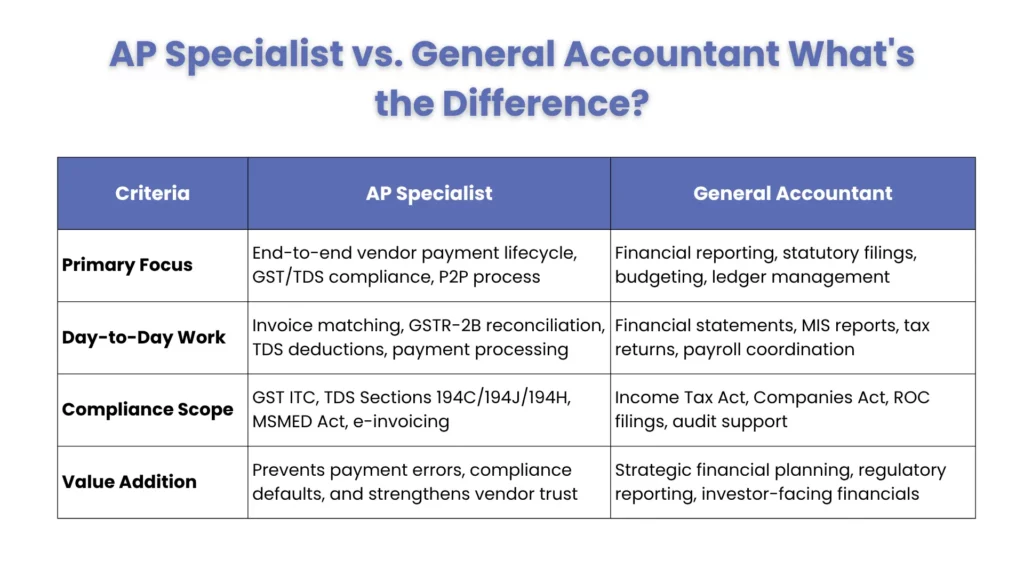
AP Specialist vs. General Accountant What’s the Difference?
Both roles are valuable, but they serve distinct functions. An AP Specialist provides the depth that high-volume, compliance-heavy vendor operations require.
Key Skills Every Accounts Payable Specialist Should Have
An effective Accounts Payable Specialist combines technical accuracy with regulatory knowledge. They work confidently across ERP platforms like Tally Prime, SAP, and Zoho Books, and apply GST and TDS rules correctly on every transaction. Strong attention to detail in 3-way matching, GSTR-2B reconciliation, and vendor communication prevents costly errors before they reach the ledger. In short, this role demands both process discipline and compliance awareness, not just data entry.
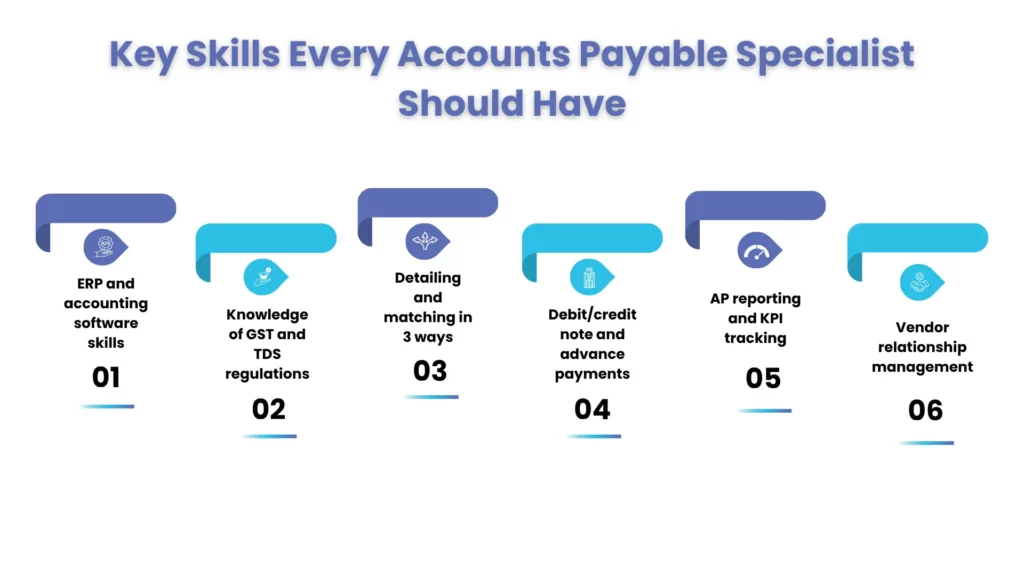
- ERP and accounting software skills: Practical experience with Tally Prime, SAP, Oracle or Zoho Books is required. Knowledge of AP automation tools – such as OCR-based invoice capture, RPA workflows – is a more and more sought-after differentiator as Indian businesses automate high-volume payable processes.
- Knowledge of GST and TDS regulations: This cannot be compromised in India. GSTR-2B reconciliation skills, applicability of TDS in various sections, applicability of IRN, March deposit deadline exception, MSME payment rules, and tax implication of Section 43B(h) are some of the competencies that distinguish a qualified AP Specialist and a general finance executive.
- Detailing and matching in 3 ways: A mismatched GSTIN, incorrect TDS rate or unmatched GRN can prevent ITC claims to be processed, lead to compliance notices, or create supplier issues. Vouching invoices with POs and goods receipt notes – and raising an exception to a position of audit finding – is an essential discipline.
- Debit/credit note and advance payments: Handling debit and credit notes issued by suppliers, reconciliation of advances with final invoices and keeping a record of open balances are some of the day-to-day activities that most businesses do not take seriously until they realize their mistakes in the ledger book.
- AP reporting and KPI tracking: AP Specialists create ageing reports and monitor such metrics as Days Payable Outstanding (DPO), time to process an invoice, and first-pass match rate – transforming a transactional position into a strategic contribution to working capital decision-making.
- Vendor relationship management: Both process expertise and interpersonal ability are needed to engage in proactive communication about payment schedules and professional dispute resolution, particularly when dealing with MSME vendors at the risk of which a delay has a statutory interest and income tax penalty.
How to Evaluate If Your Business Needs an AP Specialist Now
When it comes to investing in specific AP skills, it is nearly always sooner than most Indian businesses have struck. The following are the indications that your existing setup is no longer satisfactory:
- Processing 50 or more vendor invoices per month through spreadsheets or informal approvals
- Late or duplicate payments occurring in the last two quarters
- GST input tax credit being missed or flagged due to GSTR-2B mismatches
- TDS deductions applied inconsistently or deposited after the statutory due date
- MSME vendor payments not tracked against the 45-day compliance timeline, creating Section 43B(h) tax exposure
- Month-end close regularly delayed due to unreconciled AP balances
- A vendor complaint or GST/TDS notice escalating to senior leadership
The average AP Specialist would have a cost of ₹3.5L to 10L annually, according to the experience and location in India – where Mumbai and Bengaluru are on the higher side. Compared to exposure of missed ITC, TDS defaults, Section 43B(h) disallowances and duplicate payments, the cost of not hiring is outweighing the investment in salaries by most businesses.
Get a Dedicated AP Specialist, Without the Hiring Cost.
GSTR-2B, TDS, MSME tracking — handled by Corient’s AP team, every month.
People Also Ask:
What are the key skills for an accounts payable specialist?
An Accounts Payable Specialist should have strong data entry skills, be proficient in Excel, understand accounting principles and AP processes, be familiar with purchase order workflows, and work independently with initiative.
What are the duties and responsibilities of an accounts payable specialist?
An Accounts Payable Specialist prepares, maintains, and reconciles AP documents, including invoices, statements, check requests, and expense reimbursements, ensuring accuracy and timely processing.
When should a business hire an AP Specialist?
A business should hire an AP Specialist when invoice volumes are high, late or duplicate payments occur, or month-end reconciliations become difficult to manage efficiently.
What are the key responsibilities of AP?
An Accounts Payable (AP) professional is responsible for processing invoices, executing payments, managing vendor records, and ensuring all outgoing financial transactions are accurate and compliant.
How can Corient Business Solution help with accounts Payable?
Corient Business Solution provides experienced AP Specialists to handle invoice verification, payment processing, reconciliations, and audit support, delivering the efficiency of a dedicated AP team without the expense of hiring in-house.
The Bottom Line:
Accounts Payable Specialist is not an administrative job but rather is a financial control job. Managing the P2P cycle, and enforcing 3-way matching to processing GST reconciliation: this role safeguards cash flow, regulatory position, and vendor relations directly.
With the expansion of Indian businesses and increased complexity to compliance, there is a risk of not utilizing specific accounting support at all.
Get started with Corient Business Solution.
Corient Business Solution works with Indian businesses that are scaling faster than their AP function can keep up. GSTR-2B reconciliation, TDS deadlines, MSME payment windows, Section 43B(h) compliance these aren’t one-time tasks. They run every month, in parallel, with real financial consequences if missed. We help you stay on top of all of it, without building a full in-house team.