



Running a hospitality business has never been simple. But for the finance professionals behind the scenes, the CFOs, financial controllers, and finance teams & managers keeping the numbers honest, the last few years have brought a level of complexity that feels qualitatively different from what came before.
It is not just one thing. It rarely is. It is the combination: rising operational costs hitting at the same moment as tightening regulatory requirements, seasonal demand swings becoming harder to predict, and a labour market where skilled finance professionals are genuinely difficult to retain. That convergence is what makes hospitality finance challenges particularly draining to manage.
If your team is feeling stretched, you are not alone. And more importantly, the situation is not without solutions.
The pressures finance teams in hospitality are quietly carrying
In conversations with finance leaders across hotels, restaurant groups, and serviced apartment operators, the same themes come up again and again. They tend not to arrive as single isolated problems. They arrive together, layered on top of each other, reducing the bandwidth available for anything strategic.
Balancing cost control with guest experience
Ownership wants costs reduced; operations need investment in quality and staff. Finance sits in the middle, asked to satisfy both simultaneously. The leaders who manage this well stop treating cost management as a blunt instrument, they focus on where spend is not generating return, and protect the investment that is.
Supporting growth while maintaining financial control
Expansion into new properties introduces new entities, new reporting requirements, and often new regulatory environments. Without scalable finance management in hospitality, growth can quietly erode the financial discipline that made it possible in the first place.
Meeting audit, regulatory, and compliance obligations
From VAT and payroll to sector-specific licensing and detailed audit trails, compliance demands have grown substantially. GST filing requirements for hospitality businesses in India alone, covering multiple rate slabs, monthly returns, and ITC reconciliation, can consume significant finance team bandwidth Managed reactively, scrambled for at year-end, they consume disproportionate time and create risk. The businesses that handle this well build compliance into their operating rhythm rather than treating it as a periodic emergency.
Seasonal cash flow management
Demand peaks and troughs are a known reality in hospitality, but the financial implications remain one of the most persistent challenges. It is not just about forecasting revenue, it is about timing supplier payments, managing payroll in off-peak periods, and maintaining the liquidity needed to prepare for the next busy season.
Revenue leakage and operational spend
In multi-outlet operations, small inefficiencies compound quickly. A margin variance here, an unexplained cost variance there, none catastrophic in isolation, but together they quietly erode profitability. Effective financial oversight for hotels means building the visibility to catch these leakages before they become embedded.
Effective finance and accounting oversight for hotels means building the visibility to catch these leakages before they become embedded.
Technology that adds complexity instead of reducing it
The promise of hospitality technology is efficiency. The reality, for many finance teams, is a fragmented ecosystem of PMS, POS, procurement, and payroll tools that do not communicate well. Finance ends up manually reconciling data across systems, time-consuming, error-prone, and the opposite of what technology should deliver. Structured back-office processing support can remove that burden from your core finance team entirely.
Retaining skilled finance professionals
Hospitality faces a specific retention challenge: the perception that finance roles here are more demanding and less rewarding than comparable positions elsewhere. Keeping good people requires not just competitive pay, but an environment where finance professionals are doing meaningful work, not endlessly firefighting manual processes. It is also worth noting that EPFO compliance obligations for hospitality employers add to payroll complexity, particularly for businesses with large seasonal workforces.
Using real-time data for better decisions.
Strategic financial leadership depends on timely, accurate information. When reporting is slow or fragmented across properties, the ability to make confident decisions, on pricing, capital allocation, and cost management in hospitality, is significantly reduced. Leaders with reliable real-time data consistently report a clearer sense of control.
What happens when these pressures are left unaddressed
Each of the challenges above is manageable in isolation. The problem is that they rarely arrive alone. When finance teams are simultaneously managing compliance demands, manual reconciliations, retention concerns, and cash flow pressure, the cumulative effect is predictable: strategic work gets pushed aside in favor of operational firefighting.
The consequence is a finance function that is technically functioning, the reports get produced, the audits get passed, the payroll goes out, but that is not contributing the forward-looking insight the business needs. Leadership makes decisions with less financial context than they should have.
Opportunities to improve margins or redirect spend go unidentified. And the finance team itself becomes exhausted and difficult to retain.
This is the pattern that often sits beneath the surface when a hospitality business is not growing as efficiently as it could be.
A different approach to hospitality finance management
The finance teams that move past this pattern tend to make a deliberate shift: from reactive management to proactive financial oversight. That shift does not happen all at once, but it tends to follow a recognisable set of moves.
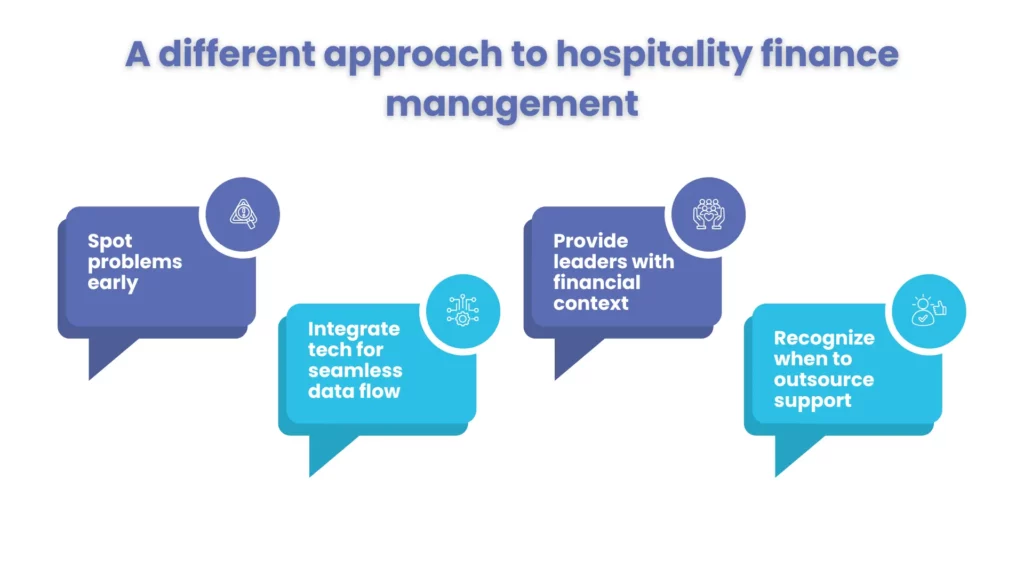
Build systems that surface problems early
Rather than discovering variances at month-end, leading finance teams invest in reporting structures that flag anomalies in real time. This turns financial oversight from a retrospective exercise into a genuinely forward-looking function.
Integrate technology so data flows, not just accumulates.
The goal is not to have more software — it is to have software that works together. When PMS, payroll, and procurement systems share data reliably, finance stops being a manual assembly operation and starts being a source of genuine insight.
Give leadership the financial context they need to decide well.
Reporting should not just summarise the past, it should inform the future. Finance teams that deliver forward-looking analysis, not just historical summaries, become genuinely valuable to senior leadership rather than being seen purely as a compliance function.
Know when internal capacity needs external support.
For many hospitality businesses, particularly those growing, restructuring, or navigating regulatory change — the volume and complexity of finance work outgrows what an internal team can absorb alone. Recognising that moment, and acting on it, is itself a mark of strong financial leadership.
At Corient Business Solutions, we work alongside hospitality finance teams to identify where processes can be streamlined and where financial oversight can be strengthened, so that your team can spend more time on the work that actually moves the business forward. If the challenges above sound familiar, we would welcome a conversation about how your team is approaching them.
People Also Ask:
What are the biggest finance challenges faced by hospitality businesses in India?
GST reconciliation, seasonal cash flow gaps, cost control pressure, and fragmented reporting across properties are the most common pain points. Retaining skilled finance staff adds another layer of difficulty for most operators.
How can a hospitality business improve its financial oversight without hiring more staff?
Integrate your PMS, payroll, and procurement systems so data flows automatically instead of being manually compiled. Delegating transactional work — AP/AR, GST reconciliation, MIS reporting — to a specialist team frees your internal staff for strategic decisions.
What is revenue leakage in hospitality and how do you prevent it?
Revenue leakage is unrecovered income or hidden cost overruns — unbilled upgrades, vendor overbilling, missed GST input credits. Prevent it with real-time reporting, regular reconciliation, and clear spend controls across all departments.
How does seasonal demand affect cash flow management in hotels?
Peak seasons bring revenue but front-loaded costs; off-peak months bring fixed overheads with lower income. A rolling 13-week cash flow forecast, strategic supplier payment timing, and a seasonal liquidity buffer keep you protected through both cycles.
What GST compliance obligations apply specifically to hospitality businesses in India?
Hotels must manage multiple GST rates — typically 12% or 18% for rooms, 5% or 18% for F&B — along with monthly GSTR-1 and GSTR-3B filings and accurate ITC reconciliation. Multi-state operators also need to handle place-of-supply rules carefully.
When should a hospitality business bring in specialist finance support?
When your finance team spends more time on reconciliations and invoice processing than on analysis, it is a clear signal. Expanding into new properties, year-end compliance backlogs, or difficulty retaining finance staff are all good moments to bring in specialist support and refocus your internal team on decisions that matter.
The bottom line
Hospitality finance challenges are real, they are widespread, and they are not a reflection of a team’s capability. They are a reflection of a sector that asks an enormous amount of its finance professionals. The businesses that manage these pressures most effectively are not necessarily the ones with the largest finance teams, they are the ones that have built the right processes, the right visibility, and the right support structures to keep pace with a complex operating environment.
Understanding where your team is spending its time and energy is the first step toward improving it. The second step is being willing to have an honest conversation about what would need to change.
That conversation is always worth having.