


Your dashboard says ₹40 lakh in sales this month. Your CA says the business is profitable. Then the bank balance doesn’t match either number, and nobody can explain the gap. If that sounds familiar, the problem isn’t your business, it’s your e-commerce accounting system.
The Economic Survey 2025–26, tabled in Parliament by the Ministry of Finance, names e-commerce among India’s fastest-growing digital services segments real, government-acknowledged growth. But scale is exposing a quiet problem: most e-commerce founders running multi-crore operations are still on a general accountant, a spreadsheet, and a “sort it at year-end” habit. Every unreconciled fee, unmatched return, and misallocated fulfillment cost is margin that exists on paper but is never recovered; nobody notices until the books are cleaned up.
This blog covers where founders leak margin, why generic types of accounting systems fail at marketplace scale, and what a proper e-commerce accounting system looks like for 2026–27 backed by official GST provisions and RBI references, with industry estimates marked as such.
| Margin Leak | Typical Range (estimate) | Root Cause |
| Payment & platform fees | 3–8% of revenue | No fee-level reconciliation |
| Returns & refunds | 5–15% of orders | Not reversed in COGS/revenue |
| Fulfillment across channels | 2–6% of revenue | Blended, not channel-wise costing |
| GST/TCS mismatches | Working capital blocked 30–60 days | Manual GSTR-8 vs GSTR-3B reconciliation |
The Hidden Costs Your E-commerce Accounting System Isn’t Tracking
Payment Fees and What Breaks Past ₹50L a Month
Every marketplace settlement nets off commission, fixed fee, collection fee, GST on fees, shipping, and TCS before the money hits your bank. RBI’s Master Direction on Payment Aggregators, 2025 requires aggregators to disclose the merchant discount rate, set-up fees, and maintenance charges upfront but few founders check settlement reports against that disclosed fee sheet.
Under Section 52 of the CGST Act, operators must deduct TCS on the net taxable value of supplies (post-returns) and deposit it by the 10th of the following month via GSTR-8. The rate reduced from 1% to 0.5% on 10 July 2024, via CBIC Notification yet founders still book TCS as an expense instead of a receivable. Past ₹50L in monthly sales, GST registration is compulsory in every state you operate from with no threshold exemption under Section 24 of the CGST Act and volume outgrows manual reconciliation fast. Without real ecommerce accounting and proper e commerce accounting, most founders never audit the fees buried in their net settlement.
Returns and Refunds, the Margin Killer Your Spreadsheets Miss
Fashion and apparel returns in Indian e-commerce are widely cited at 15–40%, “low-return” categories at 5–10%. A spreadsheet logs a sale but rarely reverses the COGS, restocking cost, and GST credit note together. This is where basic ecommerce accounting breaks down, showing up as a revenue dip weeks later with no linked cost reversal, so margin stays wrong until quarter-end cleanup.
True Fulfillment Costs Across Multiple Channels
A ₹500 order shipped via Amazon FBA, your D2C site, or a quick-commerce dark store doesn’t cost the same to fulfill. Most founders apply one blended cost anyway. Proper multi-channel accounting attributes pick-pack, last-mile, and reverse-logistics cost per channel and per SKU the only way to know if a listing is genuinely profitable or subsidized.
Why Basic Accounting Systems Fail at E-commerce Scale
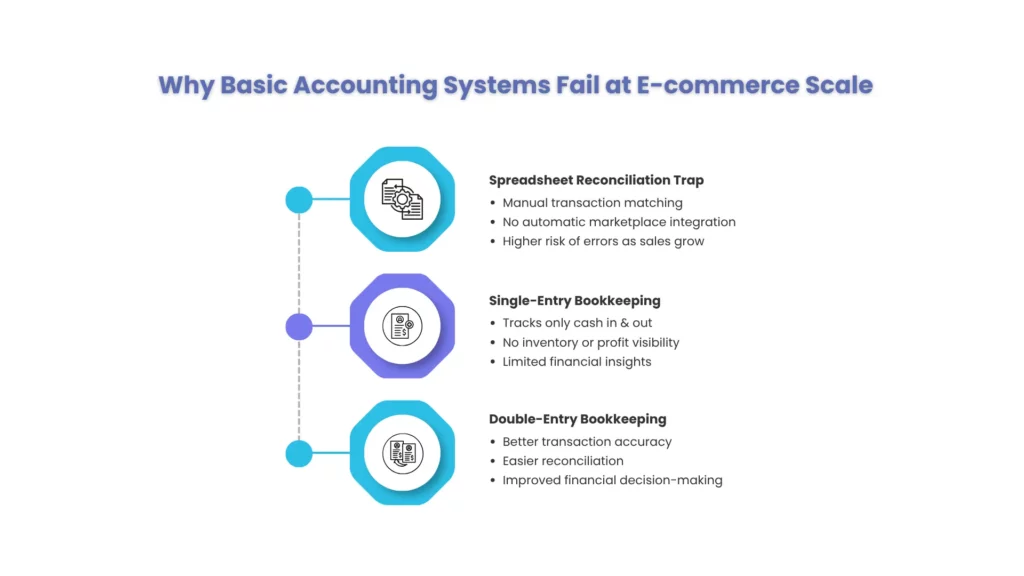
The Spreadsheet Reconciliation Trap
Spreadsheets can’t natively pull marketplace settlement reports, gateway statements, and bank credits into one ledger. Founders manually match hundreds of line items monthly, and errors compound as volume grows the biggest reason online store financial management collapses when a business scales, since a spreadsheet was never built as a real accounting information system.
Single-Entry Bookkeeping vs. Proper E-commerce Accounting
Single-Entry Bookkeeping:
Single-entry bookkeeping only tracks cash inflows and outflows. It does not provide visibility into inventory value, accrued liabilities, TCS receivables, or channel-wise contribution margins. This makes it difficult to measure true profitability and maintain complete financial records.
Proper E-commerce Accounting (Double Entry):
Proper e-commerce accounting uses double-entry bookkeeping principles to accurately record marketplace settlements, returns, tax adjustments, and inventory movements. It supports compliance requirements, including stock records, invoice tracking, and audit trails, while providing reliable insights into business performance.
Common E-commerce Accounting System Challenges, and How to Fix Them
| Challenge | Problem | Fix |
| Multi-Channel Revenue Reconciliation Errors | Marketplace sales rarely match bank credits due to different settlement cycles and fee deductions. | Automate settlement tracking, match orders with payments, and flag discrepancies early. |
| Inventory Valuation and COGS Mismatches | Marketplace stock may be overstated, causing incorrect inventory values and profit margins. | Sync inventory systems and record COGS accurately when sales are confirmed. |
| GST and Tax Compliance Across Marketplaces | GSTR-8, GSTR-1, and GSTR-3B mismatches can delay refunds and block working capital. | Reconcile GST reports and sales records monthly to avoid compliance issues. |
What a Proper E-commerce Accounting System Looks Like
- Automated Multi-Channel Accounting and Reconciliation: Instead of manual imports, transactions from every marketplace, gateway, and bank account flow automatically into one ledger, with fee-level and TCS-level breakdowns preserving the foundation of genuine multi-channel accounting.
- SKU-Level Profit Margin Tracking (Contribution Margin): Real profit margin tracking happens at SKU level: revenue minus COGS, commission, gateway fees, fulfillment cost, and attributed ad spend how founders drop underperforming SKUs and back real winners instead of guessing from gross sales.
- Real-Time Cash Flow vs. Accrual Visibility: Founders need both: accrual for true profitability, cash-basis for runway planning. A modern e-commerce accounting system shows both side-by-side instead of one misleading number.
Benefits of a Professional E-commerce Accounting System
| Benefit | How It Helps |
| Recover Lost Margins | Tracks fees, returns, TCS credits, and fulfillment costs to identify revenue gaps and improve SKU profitability. |
| Faster Month-End Close | Automates reconciliation, reduces manual errors, and speeds up financial closing from days to hours. |
| Investor and Lender-Ready Reports | Provides accurate SKU-level and channel-wise financial data to support funding and loan decisions. |
Still Managing Marketplace Settlements Manually? Manual reconciliation becomes expensive as your business scales. Get automated settlement tracking, GST reconciliation, and financial reporting built for modern e-commerce businesses.
People Also Ask:
What is the difference between a general accountant and an e-commerce accountant?
A general accountant records sales and expenses at a high level. One running a proper e-commerce accounting system reconciles marketplace settlements, tracks TCS under Section 52, and reports SKU-level margins none of which standard bookkeeping covers.
How do I calculate my true profit margin on Amazon FBA using an accounting system?
Take SKU-level revenue and subtract COGS, referral and FBA fees, settlement charges, GST/TCS adjustments, and attributed ad spend. A proper e-commerce accounting system automates this instead of a manual spreadsheet pull.
Should I use cash basis or accrual accounting for my e-commerce business?
Most growing businesses need accrual accounting for accurate profitability reporting, especially for investors and lenders, while tracking cash flow separately for runway. A good accounting information system gives you both without extra manual work.
How do I handle GST reconciliation across multiple marketplaces?
Cross-check each marketplace’s GSTR-8 against your own GSTR-1 and GSTR-3B monthly, not annually, and reconcile TCS credited to your electronic cash ledger via the Returns Dashboard on the GST Portal. Make it a standing process, not a year-end scramble.
When should I upgrade from a basic accounting system to a dedicated e-commerce solution?
The moment you sell on more than one channel, cross ₹50L in monthly sales, or your bank balance disagrees with your reported profit, those are the clearest signs your setup has outgrown basic types of accounting systems and needs a dedicated e-commerce accounting system.
Can a proper e-commerce accounting system help during fundraising or loan applications?
Yes, investors and lenders now routinely ask for channel-wise and SKU-level financials. A properly maintained online store financial management process produces these on demand and speeds up due diligence.
Which tools and platforms are best for ecommerce accounting and financial data analysis?
The best tools depend on your business size and needs. QuickBooks Online and Xero are top choices for core bookkeeping and financial reporting. A2X is popular for automatically reconciling Shopify, Amazon, or Etsy sales into your accounting software. For deeper financial visualization and reporting, tools like Power BI or Looker Studio can turn your accounting data into easy-to-read dashboards. Larger businesses often add NetSuite or QuickBooks Enterprise for more advanced, multi-channel financial management. Most ecommerce sellers start with QuickBooks or Xero plus A2X, then layer in visualization tools as their reporting needs grow.
Conclusion
E-commerce founders don’t lose margin because their business model is broken; they lose it because the e-commerce accounting system underneath was never built for marketplace fees, GST TCS, and SKU-level costing. The Economic Survey 2025–26 confirms e-commerce is among India’s fastest-scaling digital segments; the founders who win will be the ones who know their true numbers behind that growth.
If you’re scaling past, still reconciling settlements in a spreadsheet, it’s time to fix the foundation. Corient Business Solutions helps Indian e-commerce founders and mid-to-large businesses build proper e-commerce accounting, GST/TCS reconciliation, and SKU-level margin tracking that holds up to investor and lender scrutiny, backed by real online store financial management practices.