


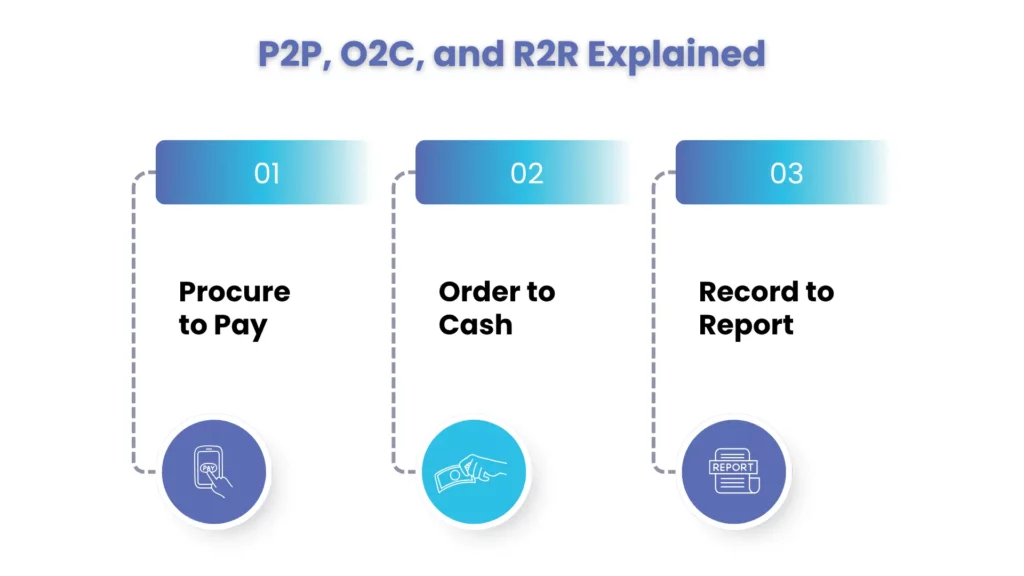
- P2P (Procure-to-Pay) handles how you buy from vendors and pay them.
- R2R (Record-to-Report) handles how you record those transactions and report your numbers.
- O2C (Order-to-Cash) handles how you fulfil customer orders and collect payment.
These three cycles sit in different departments, procurement, finance, and sales but they all draw from the same ledger. If one cycle leaks data, the others end up cleaning it up at month-end. Get the handoffs between Procure-to-Pay, Record-to-Report, and Order-to-Cash right, and your team spends far less time reconciling spreadsheets and far more time using the numbers.
The sections below walk through what the P2P process, R2R process, and O2C process each cover, where Indian businesses tend to lose time, and how the three connect into a single flow from spend to cash.
A quick comparison
| Process | Department | Purpose | Key Activities | Outcome When It Runs Well |
| P2P (Procure-to-Pay) | Procurement & Accounts Payable | Manage vendor spending and payments | Indent → Purchase Order → GRN → Invoice → Payment | Controlled spend, clean GST input credit |
| R2R (Record-to-Report) | Finance & Accounting | Record, reconcile, and report financial results | Journal entries → Reconciliation → MIS & statutory reporting | Faster book closure, audit-ready records |
| O2C (Order-to-Cash) | Sales & Finance | Convert customer orders into invoiced revenue and collected cash | Order → Credit check → Delivery → Invoice → Collection | Shorter DSO, healthier cash flow |
In one line: P2P controls how money leaves your business, R2R tells you where it went, and O2C brings money back in.
Procure-to-Pay (P2P): the spend side of the ledger
P2P is the workflow that turns a business need into a paid vendor invoice. In an Indian context, the Procure-to-Pay process means an indent or purchase requisition, an approval chain, a purchase order, a Goods Receipt Note (GRN), a tax invoice that matches what was actually delivered, and finally a payment that respects TDS deductions and your vendor’s MSME status.
The real value of P2P isn’t paperwork, it’s whether spend stays controlled. A well-run P2P process gives you three things that matter every quarter:
- Visibility — you know what’s being bought, by whom, and against which budget before the invoice lands on the AP desk.
- Control — approvals, budgets, preferred vendors, and contracted rates are applied at the moment of commitment, not after the fact.
- Compliance — vendor PAN and GSTIN are captured upfront, HSN/SAC codes are correct, and your input tax credit isn’t stuck in mismatched 2B reconciliations.
P2P also touches one of India’s most under-managed obligations: the MSMED Act’s 45-day payment rule. If a registered Micro or Small enterprise raises an invoice, you’re legally bound to pay within 45 days (or the contractually agreed period, capped at 45). Miss that, and the interest exposure is real, and now disclosable in your financial statements. A P2P system that flags MSME vendors at the PO stage saves your finance team from awkward year-end disclosures.
When P2P is weak, spend management becomes reactive. Invoices arrive without context, budgets are reconciled after they’ve already been blown, and GST credit gets held up because the supplier didn’t file GSTR-1 on time. When P2P runs well, fewer exceptions reach the books, and the data flowing into R2R is already clean.
Order-to-Cash (O2C): the revenue engine
The O2C process covers everything from the moment a customer places a confirmed order to the moment their payment hits the bank. Order-to-Cash includes credit checks, order management, fulfilment, e-invoicing on the GSTN portal, collections, and revenue recognition.
For Indian businesses especially those crossing the ₹5 crore e-invoicing threshold or exporting to overseas customers, O2C is where compliance and cash flow meet. Every B2B invoice over the threshold needs an Invoice Reference Number (IRN) from the Invoice Registration Portal before it can be issued. Miss that, and your customer can’t claim input credit, which becomes your collections problem fast.
O2C is also where Days Sales Outstanding (DSO) lives or dies. A well-structured O2C process keeps sales orders, delivery proof, and invoices aligned so customers can’t park disputes against missing paperwork. When data from Order-to-Cash flows cleanly into R2R, finance gets a reliable view of expected cash inflow and can plan working capital around it instead of guessing.
Record-to-Report (R2R): the financial control center
The R2R process is how daily transactions become trustworthy financial statements. Record-to-Report covers journal entries, sub-ledger reconciliations, bank reconciliations, fixed asset accounting, tax provisioning, MIS preparation, and statutory reporting under the Companies Act and applicable Ind AS standards.
R2R is where the consequences of weak P2P and O2C show up. A wrongly coded purchase invoice means a wrong expense line. A missing GRN means an open Goods Received Not Invoiced (GRNI) balance that auditors will flag. An unconfirmed customer payment sits in a suspense account until someone untangles it.
When the R2R process runs smoothly, finance closes books faster, spots variances earlier, and produces numbers that hold up under statutory audit, internal financial control (IFC) testing, and tax assessment. When it doesn’t, the close drags into the third week of the month and management reporting loses credibility.
Where the three cycles actually connect
The handoffs between Procure-to-Pay, Order-to-Cash, and Record-to-Report are simple in theory and messy in practice.
A purchase approved in P2P becomes a payable that R2R has to record correctly. A customer invoice generated in O2C affects revenue recognition, GST liability, and cash flow forecasting, all R2R territory. If any of those data points are wrong at source, R2R inherits the problem during close.
The breakdown usually happens at the transaction level. A PO is raised without a budget code, so the expense lands in a generic ledger. A delivery happens in March but the invoice is dated April, so revenue gets recognised in the wrong period. A vendor’s GSTIN is captured incorrectly, so ITC is denied months later when GSTR-2B doesn’t match. None of these are system failures, they’re process gaps between cycles that get patched manually, under pressure, right before the books close.
The companies that pull ahead treat P2P, R2R, and O2C as one connected financial flow rather than three separate departments. P2P sets the conditions for how money leaves, O2C defines how money comes in, and R2R confirms both sides match reality. When the inputs are structured and consistent, finance stops fixing data and starts using it.
For Example:
Imagine a large FMCG enterprise like a multi-brand consumer goods company with 20 factories, 5,000 vendors, and customers across 50 countries. When the company raises purchase orders for ₹500 crore worth of raw materials, palm oil, packaging, chemicals, receives them at its plants, matches each invoice against the PO and goods receipt, deducts TDS, and pays 5,000 suppliers (including flagged MSMEs within 45 days), that’s P2P (Procure-to-Pay) running at scale. When the same company ships finished goods to distributors and modern-trade retailers, generates thousands of e-invoices a day with IRNs from the GSTN portal, manages credit limits, and collects ₹2,000 crore in monthly receivables, that’s O2C (Order-to-Cash) powering the revenue engine. At month-end, the corporate finance team consolidates ledgers from all 20 plants, reconciles intercompany balances, matches GSTR-2B with the books, posts accruals, and closes the books in 5 working days to publish quarterly results to the stock exchange, that’s R2R (Record-to-Report) turning millions of transactions into audited financial statements. Same three cycles as the neighborhood bakery, buy, sell, report, only now they involve crores of rupees, thousands of people, SAP S/4HANA, a Global Business Services center, and SEBI-mandated disclosure timelines.
Stay on top of your financial cycles
Get the latest best practices, expert insights, and compliance updates on P2P, R2R, and O2C — GST-ready and built for Indian businesses — delivered straight to your inbox.
People Also Ask:
What is Procure to Pay (P2P)?
Procure to Pay is the end-to-end process of buying goods or services and paying your vendor. It starts from raising an indent or purchase requisition, goes through PO creation, Goods Receipt Note (GRN), invoice matching, and ends with payment with TDS deductions and MSME payment timelines factored in.
Is the P2P process only relevant for large companies?
No. Even a 50-person startup running on Tally or Zoho Books benefits from a defined Procure-to-Pay flow. The size of the controls scales with the business, but the principles, approval before purchase, invoice matched to PO, payment within terms, apply at any scale.
What is Order to Cash (O2C)?
Order to Cash is the mirror image of P2P, but on the revenue side. It covers everything from receiving a customer order to raising a GST-compliant e-invoice (with IRN from the IRP portal) and collecting the payment. A smooth O2C process shortens your DSO, keeps your cash flow healthy, and ensures your revenue recognition is audit-ready.
How does Record to Report (R2R) differ from P2P?
P2P is about managing what you spend and paying vendors on time. R2R picks up from there, it takes all those transactions (from P2P, O2C, and elsewhere) and converts them into accurate financial statements, GST reconciliations, MIS reports, and statutory filings under the Companies Act and Ind AS. Simply put: P2P executes transactions, R2R records and reports them.
How does GST compliance fit into these cycles?
GST touches both P2P (input credit on purchases) and O2C (output liability on sales). R2R is where the two are reconciled into your monthly GSTR-3B filing. Errors in any of the three cycles will show up in your GST reconciliation.
Where should an Indian business start if all three cycles feel broken?
Start with P2P. It produces the cleanest, fastest wins, vendor compliance, MSME payment tracking, and accurate input credit. The improvements feed directly into Record-to-Report within one or two close cycles.
Conclusion:
P2P, R2R, and O2C aren’t competing processes. They’re three views of the same financial reality. Treat Procure-to-Pay, Order-to-Cash, and Record-to-Report as a connected system, with shared data, clean handoffs, and consistent coding, and your finance team stops reconciling history and starts shaping what comes next.
Whether you’re a growing startup or an established enterprise, getting these three cycles to work as one is what separates a reactive finance team from a strategic one. At Corient, we help Indian businesses build that connected system, GST-compliant, Ind AS-ready, and built to close faster and report with confidence.