


What is AP Automation?
AP automation (accounts payable automation) is the use of software to digitize the invoice-to-payment process. For Indian enterprises, it captures invoices, runs GST, IRN, RCM, and TDS compliance checks, matches invoices to purchase orders, routes approvals, and executes payments turning a manual, error-prone workflow into a scalable, audit-ready one.
Compliance is now central to the accounts payable (AP) function, not just an operational task. GST reconciliation, e-invoicing IRN verification, RCM identification, TDS deduction, and payment mandates are embedded in every AP cycle. For large enterprises processing tens of thousands of invoices across multiple GST registrations, even a small mistake can trigger serious consequences like ITC disallowance, TDS shortfalls, or complaints. Relying on manual AP teams alone makes it nearly impossible to stay on top of compliance at this scale.
In this guide the best finance teams tackle this by combining automation with human judgment. Automation takes care of routine tasks like capturing invoices, validating GST, and executing payments, while AP professionals focus on exceptions, disputes, and interpreting complex regulations. Together, they make the process smoother, more accurate, and far less stressful.
How AP Automation Works: Step-by-Step
Modern account payable automation follows a structured workflow that replaces manual data entry and email-based approvals with system-driven processing:
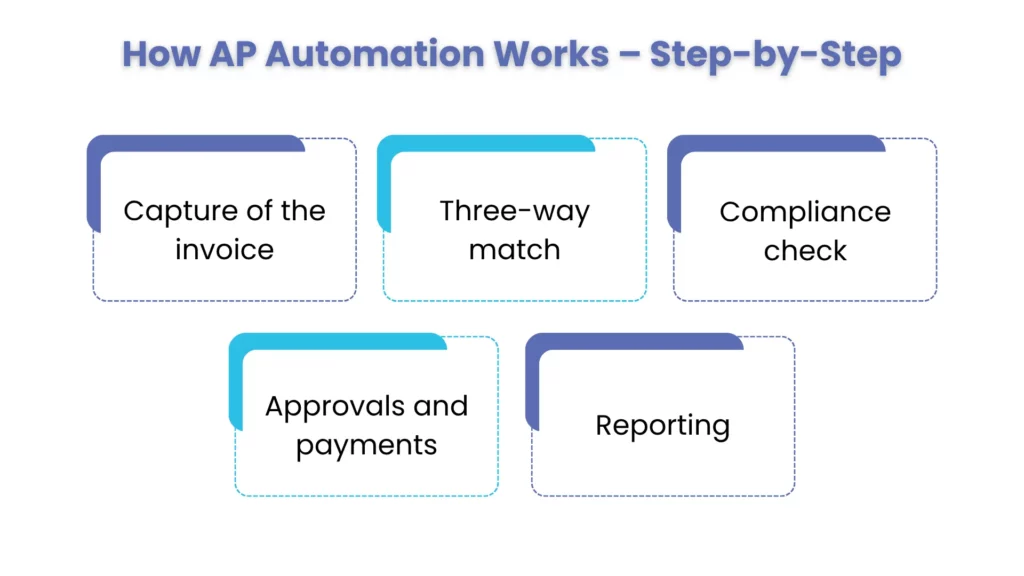
Capture of the invoice:
All invoices received by email, EDI, supplier portals and scanned invoices are processed using OCR for extraction of GSTIN number of vendor, invoice number, HSN/SAC codes, line items, taxes, and payment terms.
Three-way match:
The invoice is matched against the purchase order and goods received note. Invoices that match successfully get further process; others get reviewed manually.
Compliance check:
Checks whether GSTIN and IRN are validated for the suppliers that send compliant e-invoices. Identifies any transaction which needs to be RCM, creates self-invoice, deducts TDS under Sections 194C, 194I, 194J, and 194Q (applicable where buyer turnover exceeds ₹10 crore) and reconciles GSTR-2B before approving any invoice.
Approvals and payments:
After checking for compliance, invoice is approved and paid using NEFT, RTGS, IMPS, or UPI. Payments to MSME vendors are tracked to ensure compliance with the 45-day rule under Section 15 of the MSMED Act, 2006, with penalties for delays applicable under Section 16.
Reporting:
Finance leadership gets real-time dashboards covering outstanding liabilities, payment ageing, and cash flow projections updated continuously, not at month-end
Why GST Compliance Is Now a System Problem, Not a People Problem
India’s GST regime demands invoice-level accuracy at scale. GSTR-2B reconciliation, comparing supplier-declared invoices against your purchase register, occurs monthly. For a large enterprise, this involves thousands of line items every cycle.
AP automation platforms integrated with the GSTN portal validate GSTIN status, verify IRN authenticity, flag RCM-applicable transactions, and reconcile GSTR-2B discrepancies before they become disallowances. According to CBIC guidelines, all B2B invoices from vendors with turnover above ₹5 crore must carry a valid IRN. Automation ensures only compliant invoices enter the payables cycle, blocking fraudulent or duplicate invoices at source. Use our GST compliance checklist to track every monthly obligation your finance team must meet alongside AP automation.
E-Invoicing Mandates: What Indian Enterprises Must Know
India’s e-invoicing threshold has dropped steadily, from ₹500 crore in October 2020 to ₹100 crore in January 2021, ₹50 crore in April 2021, ₹20 crore in April 2022, ₹10 crore in October 2022, and ₹5 crore in August 2023. Large enterprises are already fully covered. The direction of travel is clear: the threshold will continue to fall.
Every B2B invoice from a covered vendor must carry a valid IRN generated on the Invoice Registration Portal (IRP). AP automation enforces this automatically, rejecting non-compliant invoices before they reach the approval queue.
Key Challenges in AP Automation and How to Overcome Them
| Challenge | Recommended Approach |
|---|---|
| Integration issues with existing ERP/accounting systems | Select AP automation tools with pre-built connectors and conduct thorough testing before full implementation. |
| Inaccurate data capture or duplicate entries | Utilize AI-powered OCR with validation checks to improve accuracy and minimize manual corrections. |
| Employee resistance to new workflows | Offer training sessions, involve teams early in decision-making, and emphasize time-saving benefits. |
| Security, compliance, and audit risks | Implement role-based access controls, encrypt sensitive data, and perform regular compliance audits. |
| Overreliance on automation without human oversight | Maintain periodic human review for high-value transactions or exceptions. |
| Leveraging AP automation services | Partner with specialized AP service providers for end-to-end processing while ensuring compliance and scalability. |
AP Automation’s Role in the Procure-to-Pay Cycle
AP automation sits at the tail end of the procure-to-pay (P2P) cycle the end-to-end process from purchase requisition to vendor payment. When connected to procurement systems, data flows without manual re-entry at each stage:
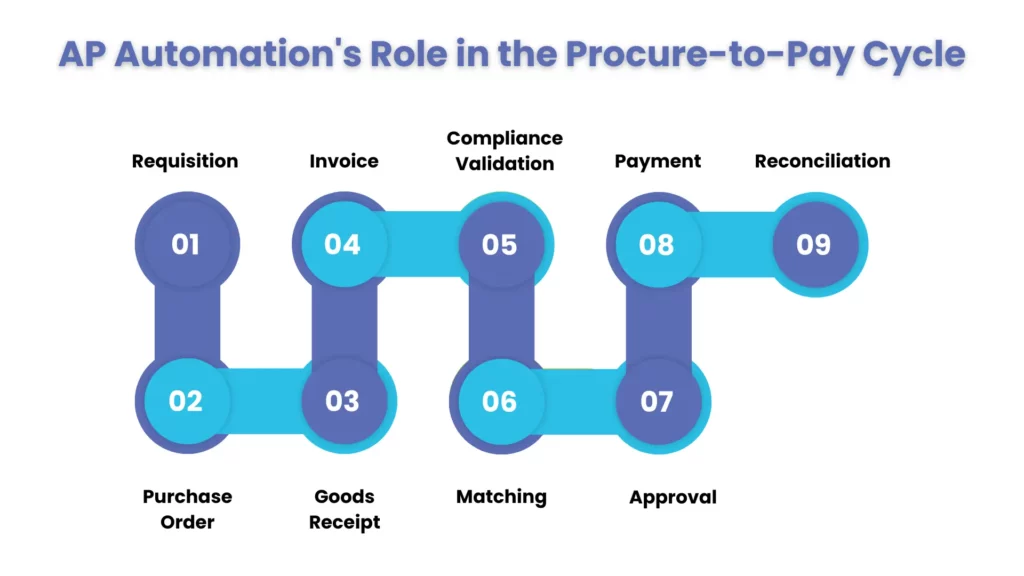
Connected P2P gives CFOs a single view of committed, approved, and paid spend enabling accurate cash flow forecasting, better working capital management, and stronger payment terms negotiation with key vendors.
AP software for Large Businesses
AP automation software for large enterprises is built to handle high invoice volumes across multiple entities, GST registrations, and approval layers, with India-specific compliance at is core. Unlike SME-focused tools, enterprise-grade software scales reliably when processing tens of thousands of invoices monthly and managing complex approval workflows. When evaluating AP software, large finance teams should look for:
- Multi-entity, multi-GSTIN architecture with inter-company flows and consolidated reporting.
- High-volume processing without performance drops.
- Native ERP integration for SAP, Oracle, or other systems.
- Built-in India compliance for GSTIN validation, IRN verification, RCM, TDS, GSTR-2B reconciliation, and MSME payment tracking
- Configurable approval workflows reflecting delegation of authority matrices.
- Enterprise-grade security and controls with maker checker and audit trails.
- Banking integration for NEFT, RTGS, IMPS, and UPI.
- India-hosted data storage with DPDP Act-compliant data handling
AI and intelligent document processing (IDP): Leading AP platforms now use machine learning for invoice classification, anomaly detection (flagging unusual amounts, new vendors, or duplicate invoice numbers), and straight-through processing rate optimisation. When evaluating vendors, ask specifically about IDP capabilities — OCR alone is a 2018-era solution.
4 Outcomes Finance Leaders Can Expect
Companies that have both automated their AP processes and used structured, manual review of the processes report:
60–80% reduction in cost per invoice:
Manual processing in Indian enterprises typically costs ₹200–350 per invoice. With straight-through automation, this drops to ₹30–70. (Industry benchmark range; verify against your own baseline before projecting savings.)
Processing cycle time reduced to 1-3 days:
Clean invoices can be done in same day or next day as compared to 10–15 days in the manual process.
ITC leakage prevention: As any ineligible claim is caught at the stage of processing before it is challenged by the GSTN during the assessment stage, GSTN automated validation, IRN verification, RCM identification and GSTR-2B reconciliation safeguards against disallowances during assessment.
Audit-ready records:
Each invoice, approval and payment include a timestamped audit trail to minimize GST audit preparation from weeks to hours.
ROI frame:
If your enterprise processes 5,000 invoices/month and reduces cost per invoice by ₹200, the monthly saving is ₹10 lakh. Implementation costs for an enterprise AP platform in India typically range from ₹15–40 lakh (one-time setup) with annual licensing of ₹8–20 lakh depending on volume and entities. Most enterprises recover implementation costs within 6–12 months. For more on building a finance function that delivers this ROI, see our guide on whether your finance and accounting process is actually working.
Before You Implement
Before selecting accounts payable automation solutions software, large enterprise finance leaders should pressure-test:
- ERP compatibility: Native integration is non-negotiable. Middleware adds latency, cost, and failure points.
- India-specific compliance: GST validation, IRN verification, RCM self-invoice generation, TDS handling, and payment tracking must be built-in.
- Banking integration: NEFT, RTGS, IMPS, and UPI for your primary banking relationships.
- Exception workflow design: RCM transactions, credit notes, and disputed invoices are where most implementations succeed or fail.
- Human-in-the-loop design: AP professionals must be able to review, override, and annotate flagged transactions.
Still managing 10,000+ invoices manually every month?
Corient’s AP specialists help Indian enterprises automate invoice processing with GST, IRN, RCM, and TDS compliance built in, not bolted on. Get a free assessment of your current workflow and a realistic implementation roadmap.
People Also Ask:
What is AP automation and how does it work?
AP automation uses OCR, AI, and workflow software to capture, validate, approve, and schedule payments against invoices automatically. In India, this includes GSTIN validation, IRN verification, RCM self-invoice generation, TDS deduction, and GSTR-2B reconciliation — replacing manual data entry with compliant, system-driven processing.
Does AP automation replace the accounts payable team?
No. Automation handles high-volume, routine tasks. AP professionals remain essential for exception management, vendor escalations, regulatory interpretation, and payment decisions.
How does AP automation address GST compliance for Indian businesses?
Modern Accounts Payable Automation Systems for India ensure that vendors’ GSTIN is validated, IRN number is checked in case of e-Invoicing-compliant vendors, and the details in the invoices are matched against the GSTR-2B avoiding ITC leakage and compliance penalties
What is the difference between AP automation and a standard ERP AP module?
Your ERP’s AP module does deal with record keeping, yet it needs to incorporate large amounts of manual effort, fails to provide smart invoice extraction, AI-enabled matching, or sophisticated exception handling. An AP solution geared toward automation will build on top of or integrate with your ERP to deliver straight-through processing.
How long does AP automation implementation take for a large Indian enterprise?
Typically, 3–6 months, covering vendor master data cleansing, ERP integration, parallel processing, and team training.
What should large enterprises prioritise when evaluating AP automation vendors?
Multi-entity and multi-GSTIN support, native ERP integration, built-in India compliance (GST, e-invoicing, TDS, MSME payment tracking), robust exception handling, AI-powered IDP capabilities, and DPDP Act-compliant data handling. Our procure-to-pay services team can help you evaluate and implement the right platform for your entity structure.
Conclusion
AP automation is a finance strategy, not just a technology decision, huge enterprises in India with thousands of invoices, multiple GST registrations, RCM obligations and TDS compliance requirements, and payment mandates require accounts payable automation solutions custom built for India instead of simply tweaked versions from a global framework. With effective automation, the exception, dispute, and judgment work are left for experienced AP staff, with repeatable and compliance-based tasks being automated. This balance provides for efficiency and accuracy in operations and adherence to regulatory requirements.
Businesses with automation and human management have a clear advantage over non-automated businesses. At Corient Business Solutions we assist the organizations to design and implement a system to optimize the AP function while taking into account the regulatory requirements and operational realities. It’s not about adoption anymore, it’s about a smarter, compliant and scalable AP process.